
Probing 2D Metals: Unlocking Electronic Secrets with Raman Spectroscopy
Researchers reveal how breaking inversion symmetry in 2D metals enables electronic Raman scattering, a powerful, non-destructive tool for characterizing...
Research conducted by: Human Sciences Research Council
The scientific community acknowledges the rigorous efforts of the Human Sciences Research Council in pioneering this study. Their dedication to advancing the intersection of materials science and environmental chemistry has provided a critical framework for understanding how nanocomposite electrodes can be leveraged to detect hazardous pollutants with unprecedented precision. Through their meticulous synthesis of graphene-polyaniline composites, they have opened new pathways for real time chemical sensing.
The detection of polycyclic aromatic hydrocarbons in environmental samples remains one of the most pressing challenges in analytical chemistry today. Among these compounds, anthracene stands out as a significant pollutant due to its stability and potential toxicity. Traditionally, the identification of such molecules has relied upon cumbersome methods like high performance liquid chromatography or gas chromatography mass spectrometry. While these techniques offer high sensitivity, they often require extensive sample preparation and expensive instrumentation that precludes their use in field settings. The emergence of electrochemical sensors provides a compelling alternative by offering rapid response times, low cost, and the potential for miniaturization.
The core of this technological leap lies in the modification of electrode surfaces to enhance electron transfer kinetics. A standard glassy carbon electrode often lacks the necessary catalytic activity to oxidize anthracene efficiently at reasonable potentials. To overcome this limitation, researchers have turned to graphene and conductive polymers. Graphene, a two dimensional allotrope of carbon, provides an extraordinary surface area and exceptional electrical conductivity. However, when used in isolation, graphene sheets tend to aggregate due to strong van der Waals forces, which reduces the effective active surface area. By integrating polyaniline into the graphene matrix, a synergistic effect is achieved where the polymer prevents graphene agglomeration while graphene enhances the overall conductivity of the polyaniline.
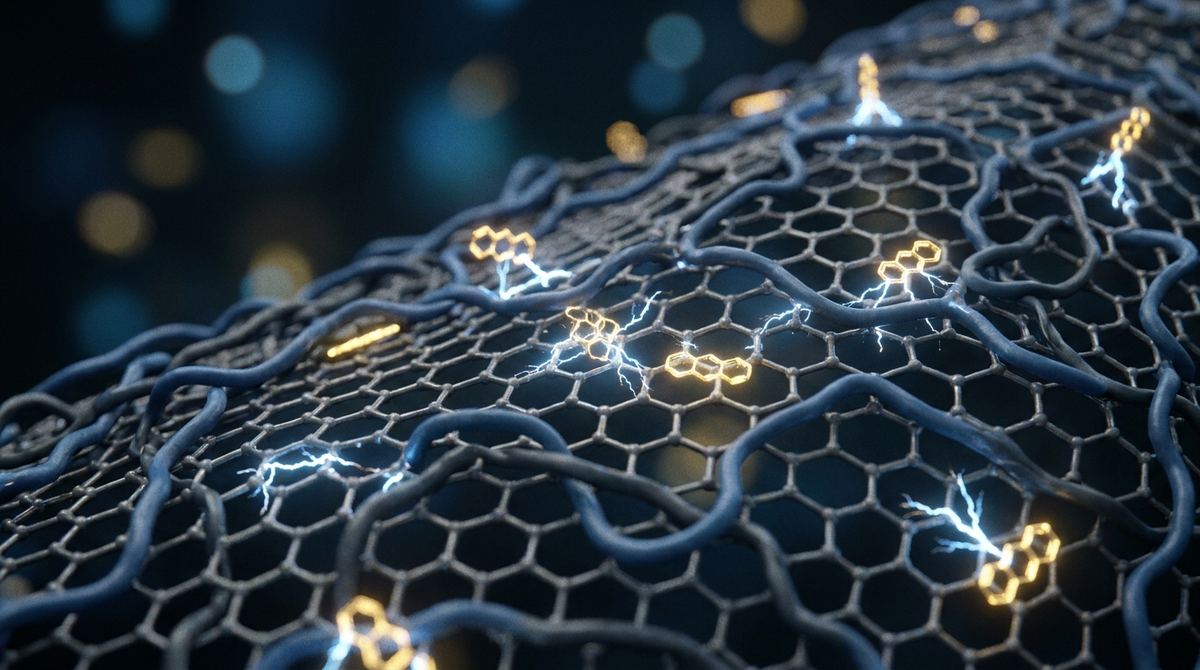
The construction of the graphenated-polyaniline or GR-PANI nanocomposite requires a precise understanding of the interaction between the carbon lattice and the polymer chains. Polyaniline is one of the most studied conducting polymers because of its environmental stability and the ability to tune its conductivity through doping. In this specific sensor architecture, the graphene acts as a structural template upon which the polyaniline is deposited. This arrangement ensures that the conductive pathways are maintained throughout the composite film, facilitating the rapid movement of electrons from the analyte to the electrode substrate.
The synthesis typically involves the polymerization of aniline monomers in the presence of graphene oxide or reduced graphene oxide. As the polyaniline forms, it wraps around the graphene sheets, creating a porous three dimensional network. This porosity is vital because it allows anthracene molecules to penetrate deeper into the electrode material, increasing the number of available active sites for oxidation. The resulting GR-PANI film exhibits superior electrochemical properties compared to either component alone. While pure polyaniline may suffer from limited stability in certain pH ranges, the presence of graphene provides a stabilizing effect that extends the operational window of the sensor.
From a structural perspective, the hybridization of these two materials alters the electronic density of states at the surface. The pi pi stacking interactions between the aromatic rings of polyaniline and the hexagonal lattice of graphene create an electronically conductive highway. This is particularly important for anthracene detection, as anthracene itself consists of three fused benzene rings. The structural similarity between the analyte and the sensor material promotes a high affinity, effectively pre concentrating the anthracene at the electrode interface before the oxidation process begins.
The sensing principle of this device is based on the direct electro-oxidation of anthracene. In an electrochemical cell, when a sufficient positive potential is applied to the GR-PANI modified glassy carbon electrode, electrons are stripped from the anthracene molecule. This process typically occurs in several stages, involving the formation of radical cations and subsequently more complex oxidized species. The efficiency of this process depends heavily on the overpotential required to initiate the reaction. A lower overpotential indicates a more efficient catalyst, reducing the likelihood of interference from other electroactive species present in an environmental sample.
On a bare glassy carbon electrode, the oxidation of anthracene is often sluggish and requires high potentials, which can lead to electrode fouling or the decomposition of the electrolyte. However, the GR-PANI composite lowers this activation energy significantly. The polyaniline component acts as a mediator, facilitating the transfer of electrons through its conjugated backbone, while the graphene provides the necessary surface area to accommodate a large number of anthracene molecules simultaneously. This results in a sharp and well defined oxidation peak when observed via voltammetry.
The kinetics of this reaction are generally governed by the diffusion of anthracene from the bulk solution to the electrode surface. Because anthracene is hydrophobic, its interaction with the hydrophobic regions of the graphene-polyaniline matrix is favorable. This adsorption step precedes the electron transfer, meaning the sensor operates through a combination of adsorptive and diffusive mechanisms. The resulting current signal is directly proportional to the concentration of anthracene in the sample, allowing for precise quantification.
To understand why the GR-PANI composite outperforms individual components, one must examine the synergy between the carbonaceous scaffold and the conductive polymer. Pure graphene, while highly conductive, lacks specific functional groups that can interact strongly with certain organic pollutants. On the other hand, polyaniline possesses amine and imine groups that can engage in hydrogen bonding and electrostatic interactions. When these two are combined, the resulting nanocomposite exhibits a dual functionality: the high electronic mobility of graphene and the chemical versatility of polyaniline.
One of the primary advantages is the prevention of pi stacking between graphene layers. In pristine graphene films, the sheets often collapse into graphite like structures, which hides much of the surface area. Polyaniline acts as a spacer, keeping the graphene sheets apart and maintaining a high effective surface area for the analyte to bind. This increase in active sites leads to a significant boost in the peak current observed during voltammetric scans, effectively lowering the limit of detection.
Furthermore, the polyaniline provides an additional layer of catalytic activity. The nitrogen atoms within the polymer chain can coordinate with the aromatic structure of anthracene, orienting the molecule in a way that favors electron transfer. This molecular orientation is critical because it ensures that the most electroactive part of the anthracene molecule is in direct contact with the conductive surface. The combined effect of increased surface area and improved catalytic kinetics results in a sensor that is not only more sensitive but also more selective than traditional carbon based electrodes.
The evaluation of the GR-PANI sensor typically employs cyclic voltammetry to characterize the electrochemical behavior. In a typical scan, the potential is swept linearly from a starting value to a peak value and then reversed. The resulting voltammogram shows a current peak at a specific potential corresponding to the oxidation of anthracene. The height of this peak is the primary analytical signal used for quantification. By measuring the peak current across a range of known anthracene concentrations, a calibration curve can be constructed.
Another powerful technique utilized in this research is differential pulse voltammetry. This method reduces the background charging current, which often masks the faradaic current associated with the analyte oxidation. By applying pulses of potential rather than a linear sweep, the sensor can detect much lower concentrations of anthracene. The signal transduction process converts a chemical concentration into an electrical current, providing a direct readout that can be processed by simple electronic circuitry.
The stability of the signal is also a key consideration. Because the GR-PANI film is chemically anchored to the glassy carbon electrode, it resists leaching and degradation during repeated use. The reproducibility of the peak potential indicates that the chemical environment at the electrode surface remains constant, ensuring that measurements taken over time are consistent. This robustness is essential for any sensor intended for practical application in environmental monitoring where samples may vary in complexity.
While voltammetry is excellent for characterization, amperometry is often preferred for real time sensing. In an amperometric setup, the potential is held constant at a value slightly above the oxidation peak of anthracene. The resulting steady state current is monitored over time. When anthracene is introduced into the system, the current increases proportionally to its concentration. This method allows for continuous monitoring and provides a faster response time than scanning voltammetry.
The analytical performance of the GR-PANI modified electrode is characterized by high sensitivity and a low limit of detection. Sensitivity is defined as the slope of the calibration curve, representing the change in current per unit change in concentration. Due to the synergistic effects mentioned previously, the GR-PANI sensor exhibits a steep slope, meaning it can detect even minute fluctuations in anthracene levels. The limit of detection is further pushed down by the high signal to noise ratio afforded by the graphene component.
Linearity is another critical metric. The sensor demonstrates a linear response over several orders of magnitude, which means it can be used for both trace analysis and the quantification of highly contaminated samples without requiring extensive dilution. This wide dynamic range is a direct result of the high density of active sites provided by the 3D nanocomposite structure. Additionally, the response time is nearly instantaneous, as the thin film allows for rapid diffusion of the analyte to the electrode surface.
When compared to traditional methods like HPLC or GC-MS, the GR-PANI electrochemical sensor offers several distinct advantages. The most prominent is the speed of analysis. While chromatography requires hours of sample extraction and instrument run time, the electrochemical sensor provides results in seconds. This makes it an ideal candidate for on site screening where immediate decisions regarding environmental safety must be made.
Cost effectiveness is another major factor. The materials used to construct the GR-PANI electrode are relatively inexpensive, and the instrumentation required for voltammetry is a fraction of the cost of a mass spectrometer. Moreover, the sensor requires minimal sample preparation. In many cases, the analyte can be measured directly in an aqueous solution with only minor adjustments to pH or supporting electrolyte concentration.
However, it is important to note that while electrochemical sensors excel in speed and cost, they may lack the absolute structural confirmation provided by mass spectrometry. A mass spectrometer can identify every single component in a complex mixture, whereas an electrochemical sensor identifies species based on their oxidation potentials. Despite this, for the specific monitoring of anthracene, the high selectivity of the GR-PANI composite makes it a viable and superior tool for routine surveillance and early warning systems.
What is the primary role of graphene in the GR-PANI composite?
Graphene serves as a conductive scaffold that increases the overall surface area of the electrode and enhances electrical conductivity. It also prevents the polyaniline chains from agglomerating, ensuring that more active sites are available for the oxidation of anthracene.
How does this sensor differ from a standard carbon electrode?
A standard glassy carbon electrode has limited catalytic activity and a smaller active surface area, which leads to slower electron transfer and higher detection limits. The GR-PANI modification lowers the overpotential required for oxidation and significantly boosts the signal strength.
Can this sensor be used to detect other polycyclic aromatic hydrocarbons?
Yes, many PAHs exhibit similar electro-oxidation behavior. While this study focuses on anthracene, the general principle of using conductive polymer graphene composites can be applied to other similar molecules, although the specific oxidation potentials will vary between different compounds.
Is the GR-PANI sensor stable over long periods of time?
The combination of graphene and polyaniline provides significant structural stability. The graphene lattice helps anchor the polymer, reducing degradation and ensuring that the electrode maintains its sensitivity across multiple measurement cycles.
What are the practical applications of this research in the real world?
This technology can be integrated into portable handheld devices for environmental agencies to monitor water and soil contamination in real time. It can also be used in industrial waste streams to ensure that anthracene levels remain below regulatory limits before discharge into the environment.
The development of the graphenated-polyaniline nanocomposite electrode represents a significant advancement in the field of electrochemical sensing. By leveraging the unique properties of both graphene and polyaniline, researchers have created a tool capable of detecting anthracene with high sensitivity, speed, and reliability. The synergistic interaction between these materials not only enhances the electronic transport but also optimizes the chemical affinity for the target analyte.
As we move toward a future where real time environmental monitoring becomes standard, such sensors will play a pivotal role. The ability to transition from laboratory based chromatography to field based electrochemical detection allows for more frequent and comprehensive sampling of our ecosystems. This not only aids in the identification of pollution sources but also enables quicker response times in remediation efforts. Ultimately, the integration of nanomaterials into sensor design provides a blueprint for tackling a wide array of chemical pollutants, ensuring a cleaner and safer environment through the power of materials science.
Serious about B2B integration? Test our premium Pulsed Electrical Resistive Carbon Heating turbostratic graphene in your lab. 100g sample packs available now.
Explore More
Researchers reveal how breaking inversion symmetry in 2D metals enables electronic Raman scattering, a powerful, non-destructive tool for characterizing...

Researchers use AI to accelerate the discovery of new materials, identifying a graphene-boron nitride composite for interstellar spacecraft shielding.

In BN-encapsulated graphene, the ultimate limit on electron speed is not graphene itself, but remote phonon scattering from the insulating layers that...