
Probing 2D Metals: Unlocking Electronic Secrets with Raman Spectroscopy
Researchers reveal how breaking inversion symmetry in 2D metals enables electronic Raman scattering, a powerful, non-destructive tool for characterizing...
Introduction
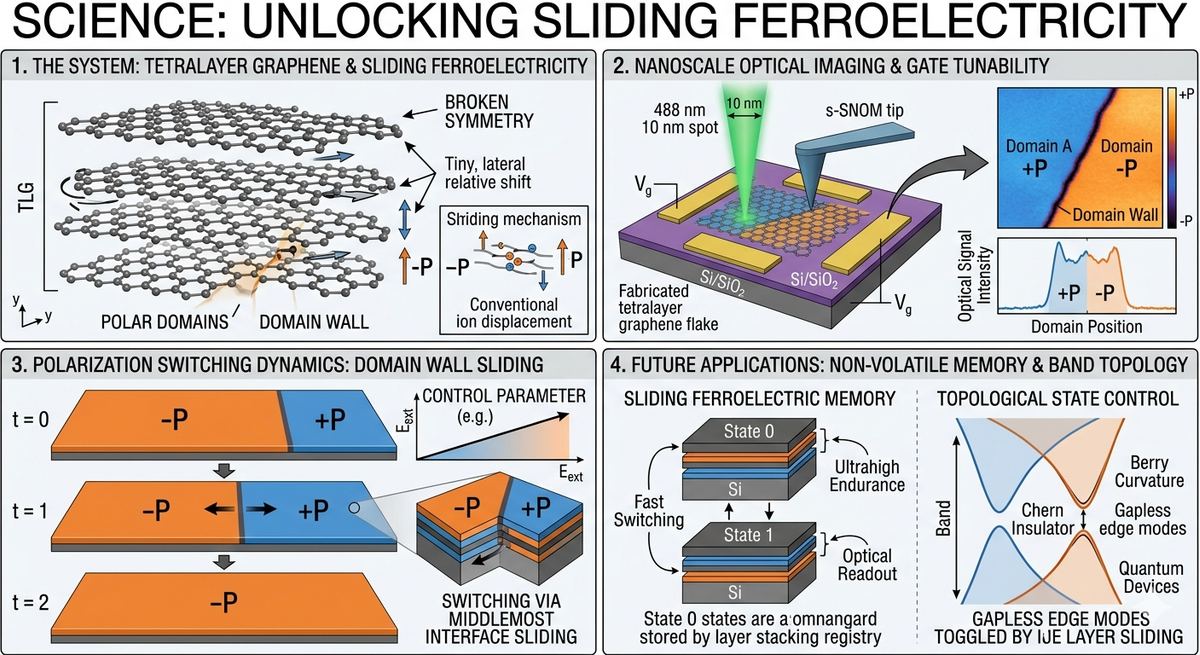
The landscape of condensed matter physics has been fundamentally altered by the rise of two dimensional materials. While graphene is often celebrated for its exceptional conductivity and mechanical strength, recent research has pivoted toward more complex arrangements of these carbon sheets. One of the most intriguing phenomena emerging from this exploration is sliding ferroelectricity. Unlike traditional ferroelectric materials, where polarization arises from the displacement of ions within a crystal lattice, sliding ferroelectricity occurs due to the relative shift between atomic layers. This discovery represents a paradigm shift in how scientists approach memory storage and electronic switching at the atomic scale. The most recent breakthrough involves the direct imaging of electric polarization switching in multilayer graphene, specifically focusing on the dynamics of domain walls.
Research conducted by: Zhou Zhou, Xiyao Peng, Jianfeng Bi, Jing He, Fei Xue, Jie Jiang, Huizhen Wu, Zhiwen Shi, Haoliang Qian, Toshikaze Kariyado, Sihan Zhao. This work represents a monumental achievement in the field of nanotechnology and materials science, providing the first direct visual evidence of polarization switching through domain wall sliding in multilayer graphene. By combining advanced optical imaging with theoretical modeling, these researchers have clarified the mechanism behind electric polarization in tetralayer graphene, offering a blueprint for future devices that rely on the precise manipulation of electronic states in 2D systems.
To understand why this discovery is significant, one must first examine the structural nuances of multilayer graphene. In simple bilayer or trilayer graphene, certain symmetries often prevent the existence of a spontaneous electric polarization. However, tetralayer graphene occupies a unique position as the thinnest natural graphene polytype that exhibits broken inversion and mirror symmetries. Symmetry is the cornerstone of ferroelectricity; for a material to be ferroelectric, it must lack a center of inversion, allowing for a preferred direction of electric dipoles.
In tetralayer graphene, the stacking order of the carbon sheets creates a non centrosymmetric environment. The researchers identified that this specific configuration allows for the emergence of polar domains. These domains are regions within the material where the electric polarization is uniform. When two adjacent domains possess opposite polarization directions, they are separated by a boundary known as a domain wall. The stability and movement of these walls are what define the ferroelectric behavior of the system. By isolating tetralayer graphene, the team could study the most fundamental unit of this phenomenon without the interference found in thicker bulk materials.
Conventional ferroelectrics, such as barium titanate, rely on a structural phase transition where a central ion shifts position relative to the surrounding oxygen octahedra. This movement creates a permanent dipole moment that can be flipped by an external electric field. In contrast, sliding ferroelectricity is a purely interfacial phenomenon driven by the sliding of one layer relative to another. In multilayer graphene, the polarization is not derived from internal atomic displacement but from the electronic redistribution that occurs when layers slide into specific registry patterns.
This mechanism is fundamentally more flexible than conventional ferroelectricity because it does not depend on the inherent chemistry of a complex oxide but rather on the geometry and stacking of carbon atoms. The energy barrier for switching in sliding ferroelectrics is governed by the van der Waals interaction between the sheets. Because these interactions are relatively weak compared to covalent or ionic bonds, the polarization can be manipulated with high precision. The researchers observed that this sliding process occurs at specific interfaces within the tetralayer stack, providing a mechanism for switching that is distinct from any previously documented behavior in carbon based materials.
One of the primary challenges in studying 2D ferroelectricity is the difficulty of detecting polarization directly. Because the layers are so thin, conventional probes often disrupt the state they are trying to measure. To overcome this, the research team employed a gate tunable nanoscale optical imaging technique. This method allows for the detection of electronic states with high spatial resolution without requiring invasive contact that would alter the domain structure.
By applying a gate voltage, the researchers could modulate the carrier density and the internal electric field of the graphene sample. The optical readout works by detecting changes in how light interacts with the polar domains. Since domains with opposite polarization respond differently to the applied fields, they produce distinct optical signatures. This enabled the team to map out the distribution of polar domains across the tetralayer graphene surface for the first time. The ability to visualize these domains in real time is crucial because it transforms a theoretical prediction into an observable physical reality, allowing the scientists to track exactly how the polarization flips when external stimuli are applied.
The core discovery of this research is the direct observation of domain wall sliding. The team discovered that the switching of electric polarization does not happen simultaneously across the entire crystal. Instead, it occurs through the movement of a domain wall. When an external global electric field or a local mechanical force is applied, the boundary between two opposite polar domains begins to shift.
Through combined experimental observation and theoretical calculations, the researchers determined that the switching is primarily driven by single domain wall sliding at the middlemost interface of the tetralayer stack. This means that while the outer layers may remain relatively stationary, the central interfaces slide relative to one another to invert the polarization. This specific localization of movement reduces the energy required for switching and explains why the process is so efficient. The researchers demonstrated that they could control this sliding using both electrical means and mechanical forces, suggesting that tetralayer graphene can act as a transducer converting mechanical stress into electronic signals or vice versa.
Beyond the immediate application of ferroelectric switching, this research has deep implications for our understanding of quantum materials. Multilayer graphene is renowned for its engineerable strong electron correlation and non trivial band topology. The ability to switch polarization via sliding directly affects the electronic structure of the material. Specifically, the change in stacking order during a slide can trigger transitions between different topological phases.
When the layers slide, the symmetry of the system changes, which in turn alters the Berry curvature and the topological invariants of the electron bands. This suggests that sliding ferroelectricity could be used as a switch to toggle the material between a topological insulator state and a metallic or superconducting state. The interplay between the polar order and the electronic correlations means that by controlling the domain walls, one can effectively tune the quantum properties of the graphene on the fly. This opens up a new field of research where topology is not just a static property of a material but a dynamic variable controlled by sliding layers.
The observation of polarization switching in tetralayer graphene paves the way for a new generation of non volatile memory devices. Traditional Flash memory relies on trapping charges, which can lead to wear and tear over time. A sliding ferroelectric memory would instead store information based on the stacking registry of the graphene layers. Since this is a structural state, it could potentially offer much higher endurance and faster switching speeds.
Furthermore, the discovery of an optical readout method for 2D polarization provides a tool for creating ultra sensitive sensors. If light can be used to detect the movement of a single domain wall at a middlemost interface, then such devices could be used to detect minute changes in electric fields or mechanical vibrations at the nanoscale. The integration of these materials into current semiconductor workflows would allow for logic gates that are significantly smaller and more energy efficient than current silicon based transistors, as the switching is driven by sliding rather than the movement of massive amounts of charge.
FAQ
What exactly is sliding ferroelectricity?
Sliding ferroelectricity is a form of electric polarization that arises from the relative lateral displacement or sliding of two dimensional layers. Unlike conventional ferroelectrics where ions shift within a unit cell, here the entire layer shifts relative to its neighbor, changing the electronic distribution and creating a dipole moment.
Why is tetralayer graphene specifically used for this research?
Tetralayer graphene is the thinnest natural polytype of graphene that breaks both inversion and mirror symmetries. This lack of symmetry is a prerequisite for ferroelectricity, making it the ideal minimal system to study these effects without the complexity of bulk materials.
How was the polarization switching observed if it happens at an atomic scale?
The researchers used a gate tunable nanoscale optical imaging technique. By applying external voltages and observing the resulting optical signatures, they could distinguish between domains of opposite polarization and track the movement of the boundaries separating them.
Where does the sliding actually occur in the tetralayer stack?
Experimental data and theoretical models indicate that the polarization switching is caused by a single domain wall sliding specifically at the middlemost interface of the four layer stack, rather than across all layers simultaneously.
What are the practical applications of this discovery?
Potential applications include ultra dense non volatile memory storage, topological switches for quantum computing, and highly sensitive nanoscale sensors that can detect mechanical or electrical stimuli through optical readouts.
Conclusion
The direct imaging of electric polarization switching in multilayer graphene marks a pivotal moment in 2D materials research. By demonstrating that domain wall sliding at the middlemost interface of tetralayer graphene governs the inversion of polar domains, Zhou Zhou and their colleagues have provided an empirical foundation for sliding ferroelectricity. This work not only clarifies the fundamental physics of symmetry breaking and electron correlation in carbon systems but also introduces a sophisticated optical readout method that can be applied to other 2D materials. As we move toward an era of post silicon electronics, the ability to manipulate the topological and polar states of graphene through layer sliding offers a promising path toward devices that are faster, smaller, and fundamentally more efficient. The synergy between mechanical movement and electronic state control suggests that the future of nanoelectronics may lie not in the flow of current, but in the precise sliding of atoms.
Serious about B2B integration? Test our premium Pulsed Electrical Resistive Carbon Heating turbostratic graphene in your lab. 100g sample packs available now.
Explore More
Researchers reveal how breaking inversion symmetry in 2D metals enables electronic Raman scattering, a powerful, non-destructive tool for characterizing...

Researchers use AI to accelerate the discovery of new materials, identifying a graphene-boron nitride composite for interstellar spacecraft shielding.

In BN-encapsulated graphene, the ultimate limit on electron speed is not graphene itself, but remote phonon scattering from the insulating layers that...