
Probing 2D Metals: Unlocking Electronic Secrets with Raman Spectroscopy
Researchers reveal how breaking inversion symmetry in 2D metals enables electronic Raman scattering, a powerful, non-destructive tool for characterizing...
Research conducted by: Antimo Marrazzo, Maria Peressi, Samuel Cajahuaringa, Davide Bidoggia
This groundbreaking investigation into the aerodynamic properties of two-dimensional materials was spearheaded by an elite team of computational physicists and materials scientists. Their rigorous molecular dynamics simulations have unveiled critical insights into how surface structure and chemistry at the atomic level dictate macroscopic aerodynamic drag in rarefied environments. By systematically analyzing the complex interplay between atmospheric nitrogen molecules and graphene-coated surfaces, the researchers have provided the aerospace community with a highly actionable framework for designing next-generation satellite coatings. Their work bridges the gap between fundamental condensed matter physics and applied aerospace engineering, offering a tantalizing glimpse into a future where orbital drag can be actively mitigated through nanoscale surface engineering.
The quest to conquer the final frontier has always been fundamentally linked to our mastery of materials science. As humanity expands its footprint in Low Earth Orbit and Very Low Earth Orbit, aerospace engineers face a formidable invisible enemy known as rarefied-air drag. Unlike the thick, predictable atmosphere experienced by commercial airliners, the extreme upper reaches of the atmosphere present a highly complex fluid dynamics environment. Here, the air is so thin that traditional aerodynamic models completely break down. Satellites and spacecraft traversing these altitudes are constantly bombarded by solitary gas molecules, primarily nitrogen, which sap their kinetic energy and cause inevitable orbital decay. Overcoming this drag requires either carrying heavy reserves of chemical propellants to periodically boost the spacecraft back into its operational orbit or designing entirely new physical exteriors that can slip through the sparse atmosphere with unprecedented efficiency. It is within this high-stakes engineering paradigm that graphene emerges as a revolutionary solution, promising to redefine the aerodynamic limits of orbital vehicles.
To truly appreciate the magnitude of this scientific breakthrough, one must first understand the bizarre physical realities of rarefied atmospheres. In standard atmospheric conditions at sea level, air behaves as a continuous fluid. The molecules are densely packed and collide with each other constantly, allowing engineers to use continuum fluid dynamics and the Navier-Stokes equations to model airflow over an airplane wing or a sports car. However, at the altitudes characteristic of Very Low Earth Orbit, which typically range from two hundred to four hundred kilometers above the surface of the Earth, the atmosphere is incredibly sparse. The distance a gas molecule travels before colliding with another molecule, known as the mean free path, becomes exceptionally long, sometimes stretching for hundreds of meters.
Because the mean free path of the gas molecules is significantly larger than the physical dimensions of the spacecraft itself, continuum fluid dynamics ceases to be applicable. This regime is known as free-molecular flow. In this state, aerodynamic drag is no longer a product of fluid viscosity and flow separation, but rather the cumulative result of individual, discrete collisions between high-velocity gas molecules and the exposed outer surfaces of the spacecraft. When an atmospheric nitrogen molecule strikes the hull of a satellite moving at orbital velocities of approximately eight kilometers per second, the outcome of that single collision dictates the amount of momentum transferred from the spacecraft to the gas. If the molecule sticks to the surface briefly and then leaves in a random direction, it steals a significant amount of the vehicle's forward momentum. Therefore, the ultimate goal in designing aerodynamic surfaces for Very Low Earth Orbit is to control and optimize this exact microscopic interaction, forcing the gas molecules to bounce off the hull in a highly predictable, mirror-like fashion that preserves the momentum of the spacecraft.
The researchers utilized advanced molecular dynamics simulations to peer into this invisible world of high-speed atomic collisions. Molecular dynamics is a sophisticated computational technique that calculates the physical movements of atoms and molecules over time. By applying the laws of classical mechanics and utilizing highly accurate empirical potentials to describe the forces between atoms, the scientists were able to create a virtual wind tunnel at the nanoscale. They constructed highly detailed digital models of an alpha-alumina surface, specifically the zero-zero-zero-one crystal facet, which is a common and highly durable material utilized in aerospace applications. They then modeled this same alumina surface coated with a single, perfect layer of graphene, and finally, they modeled a bulk graphite surface to serve as a benchmark for carbon-based materials.
Into this simulated environment, the researchers fired diatomic nitrogen molecules at velocities corresponding to those experienced by satellites in orbit. The computational intensity required for these simulations is staggering, as the system must calculate the position, velocity, and forces acting upon thousands of individual atoms in femtosecond time steps. The researchers monitored the rotational, vibrational, and translational energy states of the nitrogen molecules before, during, and after their collision with the target surfaces. By running millions of simulated collisions across various impact angles and thermal conditions, they were able to extract statistically robust data regarding how the chemical composition and atomic topography of the surface govern the exchange of kinetic energy and momentum. This methodology allowed them to isolate the exact mechanisms by which a layer of carbon only one atom thick can fundamentally alter the aerodynamic profile of a massive structural component.
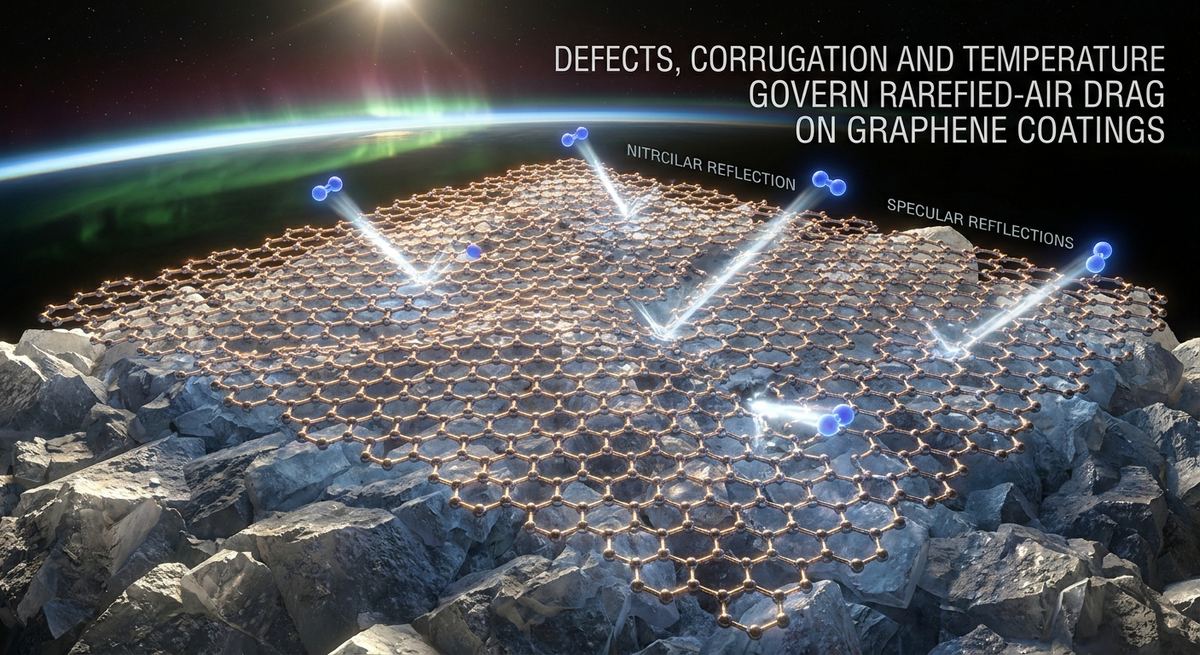
The central metric utilized by aerodynamicists to quantify this gas-surface momentum exchange in free-molecular flow is the Tangential Momentum Accommodation Coefficient. This coefficient is a dimensionless number ranging from zero to one that describes the nature of the molecular reflection off a surface. A coefficient of one represents completely diffuse reflection. In a diffuse reflection, the incoming gas molecule impacts the surface, becomes temporarily trapped in the microscopic atomic valleys of the material, reaches thermal equilibrium with the surface, and is eventually emitted back into space in a completely random direction. Because the molecule loses all memory of its initial incoming trajectory, it extracts the maximum possible forward momentum from the spacecraft, resulting in maximum aerodynamic drag.
Conversely, a Tangential Momentum Accommodation Coefficient of zero represents perfectly specular reflection. In a purely specular reflection, the gas molecule strikes the surface and bounces off at the exact same angle it arrived, much like a billiard ball striking the cushion of a pool table or a beam of light reflecting off a flawless mirror. Because the tangential velocity of the molecule relative to the surface is perfectly conserved, there is absolutely no transfer of forward momentum, and therefore, zero aerodynamic drag is generated along the axis of travel. While a coefficient of pure zero is practically impossible to achieve in reality due to the inherent thermal vibrations of all atomic lattices, minimizing this coefficient is the holy grail of orbital aerodynamics. The researchers focused their entire computational effort on determining exactly how much a graphene coating could push the reflection profile of nitrogen molecules away from the diffuse end of the spectrum and closer toward the ideal specular extreme.
The results of the molecular dynamics simulations revealed a stark contrast between the bare alumina surface and the graphene-coated surface. Bare alpha-alumina possesses a relatively complex and rough atomic landscape, characterized by exposed oxygen and aluminum atoms that create deep potential energy wells. When high-speed nitrogen molecules impact this surface, they are strongly attracted to these localized chemical binding sites. The molecules become briefly ensnared, tumbling and exchanging energy with the crystalline lattice before escaping. This interaction leads to a high degree of diffuse scattering and, consequently, a high Tangential Momentum Accommodation Coefficient. In practical terms, an uncoated alumina satellite experiences severe aerodynamic drag in the upper atmosphere.
However, when the researchers computationally draped a single layer of graphene over the alumina substrate, the aerodynamic dynamics shifted dramatically. Graphene is composed of carbon atoms arranged in a perfectly flat, tightly bound hexagonal honeycomb lattice. The carbon-carbon bonds in graphene are incredibly strong, and the surface presents a remarkably smooth and uniform potential energy landscape to the incoming nitrogen molecules. The graphene layer essentially acts as an atomic shield, masking the deep energy wells and chemical irregularities of the underlying alumina. When nitrogen molecules strike the graphene coating, they encounter a stiff, unyielding, and incredibly smooth barrier. Unable to penetrate or strongly bind to the carbon lattice, the molecules are forced to bounce off in a highly specular manner. The simulations demonstrated that the graphene coating markedly reduced the Tangential Momentum Accommodation Coefficient compared to bare alumina, proving that this two-dimensional wonder material functions as an exceptionally effective aerodynamic lubricant for spacecraft.
One of the most fascinating and counterintuitive discoveries to emerge from this research concerns the relationship between surface temperature and aerodynamic drag. Satellites orbiting the Earth are subjected to extreme thermal cycling. When exposed to direct sunlight, their outer surfaces can reach scorching temperatures, and when passing through the shadow of the Earth, they plunge into freezing cold. Furthermore, the constant bombardment of atmospheric gases at orbital velocities generates significant frictional heating. Therefore, any viable aerodynamic coating must maintain its performance across a wide and elevated temperature range. The researchers tested the graphene-coated alumina system at various temperatures, scaling the simulations all the way up to nine hundred Kelvin.
In many conventional materials, increasing the temperature increases the thermal vibrations of the surface atoms, a phenomenon known as phonon excitation. These violent atomic vibrations typically create a dynamically rougher surface, which one might expect to increase diffuse scattering and drag. However, the molecular dynamics simulations revealed that the drag-reducing performance of the graphene coating actually strengthens as the temperature increases up to nine hundred Kelvin. At these elevated temperatures, the thermal kinetic energy of the surface atoms and the incoming nitrogen molecules alters the interaction dynamics. The high thermal energy reduces the likelihood of the nitrogen molecules becoming temporarily trapped in shallow potential wells on the surface. Instead of lingering and losing their tangential momentum, the hot, highly energetic molecules strike the vibrating graphene lattice and are rapidly ejected. The stiffness of the graphene sheet ensures that even at high temperatures, the structural integrity of the honeycomb lattice remains intact, providing a consistently smooth macroscopic barrier that enhances specular reflection and lowers the Tangential Momentum Accommodation Coefficient even further.
While the theoretical performance of perfect, pristine graphene is astounding, the researchers understood that real-world manufacturing processes are never flawless. When graphene is synthesized and transferred onto a structural substrate like alumina in an industrial setting, it inevitably acquires structural defects. These defects can take the form of missing carbon atoms, known as vacancies, or topological anomalies where the carbon rings form pentagons and heptagons instead of perfect hexagons. These imperfections disrupt the pristine atomic smoothness of the material. Furthermore, defects can cause the graphene sheet to chemically bind with the underlying alumina substrate at localized points. This pinning effect pulls the flexible graphene sheet downward, creating microscopic wrinkles and bumps across the surface, a phenomenon referred to as defect-induced corrugation.
The researchers systematically introduced varying densities of these structural defects into their molecular dynamics simulations to observe the degradation of aerodynamic performance. As expected, the presence of defects and the resulting surface corrugation increased the Tangential Momentum Accommodation Coefficient. The microscopic bumps and atomic irregularities act as scattering centers. When a high-speed nitrogen molecule hits one of these corrugated ridges or falls into a vacancy, it is deflected in a random direction, increasing diffuse reflection and adding to the overall drag. Additionally, the defects alter the local electronic structure of the graphene, creating reactive zones that can briefly trap the nitrogen molecules. However, the critical finding of the study was one of resilience. The simulations proved that while defects do negatively impact performance, the graphene coating retains a significant portion of its aerodynamic superiority over bare alumina even at experimentally relevant defect densities. This means that aerospace manufacturers do not need to achieve impossible, atomically perfect graphene sheets to reap the benefits; even standard, industrially produced graphene coatings will drastically reduce orbital drag.
The implications of this research for the future of aerospace engineering cannot be overstated. The commercial space industry is currently undergoing a massive paradigm shift toward utilizing Very Low Earth Orbit. Operating satellites at altitudes below three hundred kilometers offers tremendous advantages, including exponentially better resolution for Earth observation cameras, lower latency for global telecommunications networks, and a naturally self-cleaning orbital environment where dead satellites quickly burn up in the atmosphere rather than contributing to dangerous space debris. However, the insurmountable barrier to widespread adoption of Very Low Earth Orbit has always been the immense cost of counteracting atmospheric drag.
By proving that a coating just one atom thick can fundamentally alter the gas-surface momentum exchange and significantly lower the Tangential Momentum Accommodation Coefficient, these researchers have provided the key to unlocking the lowest reaches of space. Spacecraft coated with graphene will experience a fraction of the drag encountered by traditional satellites. This reduction in drag translates directly into extended mission lifespans, as satellites will require vastly less onboard propellant to maintain their altitude. Alternatively, engineers could choose to maintain current mission lifespans but drastically reduce the size and weight of the satellites by eliminating heavy propulsion systems entirely, leading to cheaper launch costs and the ability to deploy massive constellations of miniaturized satellites. The integration of graphene coatings represents a fundamental leap forward in orbital vehicle design, transitioning the industry from relying solely on brute-force chemical propulsion to embracing elegant, nanoscale aerodynamic engineering.
Question: What is rarefied-air drag and why is it important for satellites?
Answer: Rarefied-air drag is the aerodynamic resistance experienced by objects moving through the extremely thin upper atmosphere of the Earth. Unlike aerodynamic drag at sea level, which involves continuous fluid flow, rarefied drag is caused by individual gas molecules colliding with the spacecraft. It is critically important because it slowly robs satellites of their forward momentum, causing their orbits to decay. If this drag is not counteracted by onboard thrusters, the satellite will eventually fall back to Earth and burn up in the lower atmosphere, prematurely ending its mission and costing operators millions of dollars.
Question: How does graphene reduce aerodynamic drag in space?
Answer: Graphene reduces aerodynamic drag by changing the way atmospheric gas molecules bounce off the surface of a spacecraft. Traditional aerospace materials have rough atomic surfaces that cause gas molecules to scatter in random directions upon impact, which transfers maximum momentum and creates high drag. Graphene, being a perfectly flat and tightly bound lattice of carbon atoms, provides an incredibly smooth atomic shield. When gas molecules hit the graphene, they bounce off cleanly at the same angle they arrived, a process called specular reflection. This clean bounce preserves the momentum of the spacecraft and significantly reduces aerodynamic drag.
Question: What is the Tangential Momentum Accommodation Coefficient?
Answer: The Tangential Momentum Accommodation Coefficient is a specific mathematical value used by physicists and engineers to measure how much momentum is transferred between a gas molecule and a solid surface during a collision. A high value near one means the molecule scattered randomly and transferred a lot of momentum, resulting in high drag. A low value near zero means the molecule bounced off cleanly like a mirror, transferring very little momentum and resulting in low drag. The primary goal of using graphene coatings is to lower this coefficient as much as possible.
Question: How do temperature changes affect the performance of graphene coatings?
Answer: Spacecraft experience extreme temperature fluctuations due to solar radiation and aerodynamic heating. Surprisingly, the research showed that the drag-reducing capabilities of graphene coatings actually improve as temperatures rise, up to nine hundred Kelvin. At higher temperatures, the increased thermal energy prevents the atmospheric gas molecules from sticking to the surface. Instead of lingering and causing drag, the hot gas molecules strike the vibrating graphene lattice and are immediately rejected, enhancing the clean, specular reflection required to maintain high aerodynamic efficiency.
Question: Do manufacturing defects ruin the aerodynamic benefits of graphene?
Answer: While perfect, defect-free graphene offers the best possible aerodynamic performance, manufacturing real-world graphene always introduces tiny structural flaws like missing carbon atoms. These defects cause the graphene to wrinkle and create microscopic bumps that increase drag compared to a perfect sheet. However, the study definitively showed that even with a realistic number of manufacturing defects, the graphene coating still performs vastly better than an uncoated surface. Therefore, the aerodynamic benefits of graphene are robust enough to be utilized using current industrial manufacturing capabilities.
The comprehensive molecular dynamics simulations conducted by this research team represent a watershed moment in our understanding of rarefied gas dynamics and nanomaterial applications. By proving that a single atomic layer of carbon can manipulate the Tangential Momentum Accommodation Coefficient of atmospheric nitrogen, they have elevated graphene from a mere electronic curiosity to a critical structural component for next-generation orbital vehicles. The revelation that this aerodynamic shielding effect not only withstands but actually strengthens at elevated temperatures up to nine hundred Kelvin ensures its viability in the harsh thermal environment of space. Furthermore, the demonstration that graphene retains its functional superiority despite realistic structural defects clears the path for immediate industrial scaling and application. As aerospace engineers look to exploit the immense benefits of Very Low Earth Orbit, mastering the atomic-level interactions between the atmosphere and the spacecraft hull will be the defining challenge. Thanks to this pioneering research, graphene coatings stand ready to slip through the upper atmosphere, drastically reducing drag, extending satellite lifespans, and ushering in a new era of sustainable and economically viable low-altitude space exploration.
Serious about B2B integration? Test our premium Pulsed Electrical Resistive Carbon Heating turbostratic graphene in your lab. 100g sample packs available now.
Explore More
Researchers reveal how breaking inversion symmetry in 2D metals enables electronic Raman scattering, a powerful, non-destructive tool for characterizing...

Researchers use AI to accelerate the discovery of new materials, identifying a graphene-boron nitride composite for interstellar spacecraft shielding.

In BN-encapsulated graphene, the ultimate limit on electron speed is not graphene itself, but remote phonon scattering from the insulating layers that...