
Probing 2D Metals: Unlocking Electronic Secrets with Raman Spectroscopy
Researchers reveal how breaking inversion symmetry in 2D metals enables electronic Raman scattering, a powerful, non-destructive tool for characterizing...
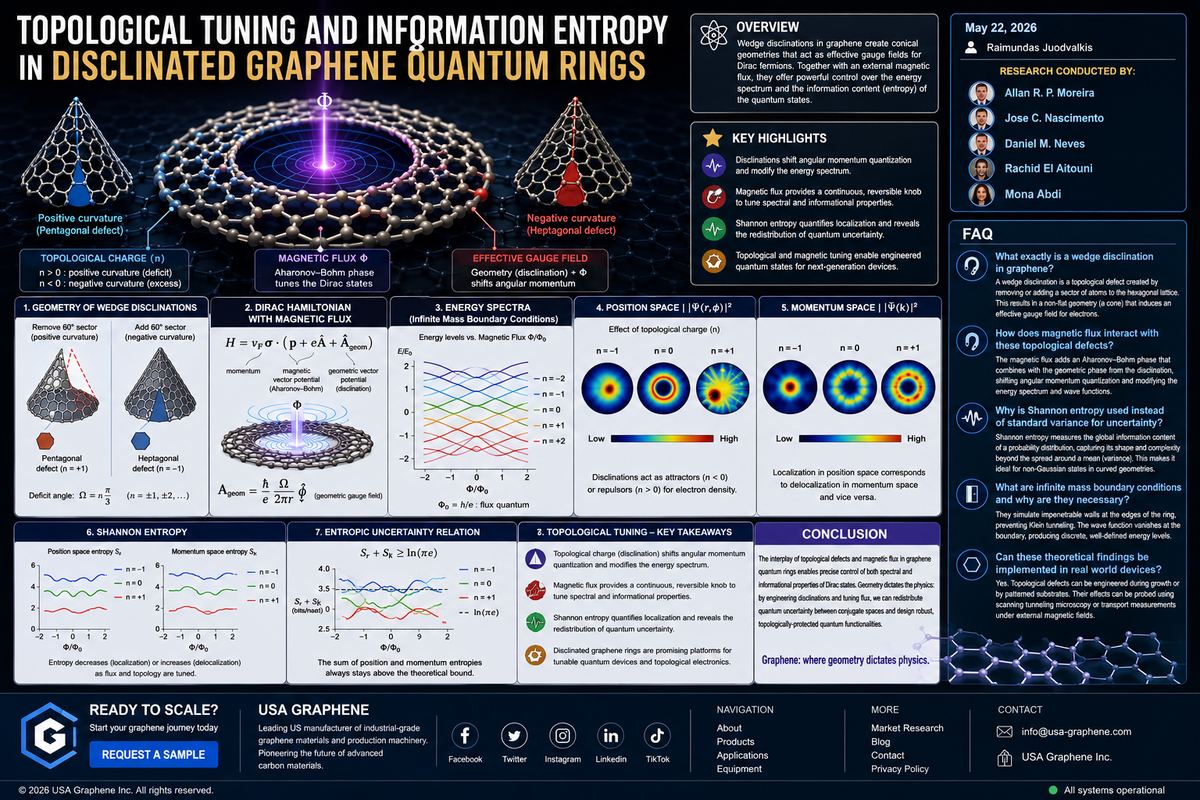
The pursuit of controlling electronic states at the nanometer scale has led researchers to explore the intersection of topology, geometry, and quantum mechanics. Graphene, a two dimensional honeycomb lattice of carbon atoms, serves as an ideal playground for these explorations due to its unique electronic properties. Specifically, electrons in graphene behave as massless Dirac fermions, governed by the Dirac equation rather than the traditional Schrodinger equation. When these electrons are confined within a quantum ring, their behavior is influenced by boundary conditions and external fields. However, the introduction of topological defects, such as wedge disclinations, adds a layer of complexity that allows for unprecedented control over the spectral and informational properties of the system. This article delves into the technical nuances of information theoretic analysis applied to Dirac states in these specialized graphene structures.
Research conducted by: Allan R. P. Moreira, Jose C. Nascimento, Daniel M. Neves, Rachid El Aitouni, Mona Abdi
The aforementioned researchers have provided a groundbreaking framework for understanding how the geometric curvature induced by topological defects interacts with external magnetic flux to redistribute quantum uncertainty. Their work bridges the gap between condensed matter physics and information theory, demonstrating that the spatial distribution of Dirac fermions is not merely a result of confinement but is deeply tied to the topological charge of the system. By employing a conical geometry model, they have unveiled the mechanisms through which disclinations act as tunable parameters for quantum state engineering in mesoscopic graphene systems.
To understand the behavior of electrons in a disclinated graphene ring, one must first conceptualize the nature of a wedge disclination. In a perfect hexagonal lattice, every carbon atom is bonded to three others, creating a flat plane. A wedge disclination occurs when a sector of this lattice is either removed or added before the edges are rejoined. For instance, removing a sixty degree slice and fusing the remaining edges creates a pentagonal defect, resulting in positive curvature. Conversely, adding a slice creates a heptagonal defect, leading to negative curvature.
Mathematically, these defects are modeled as conical singularities. The geometry is no longer Euclidean but follows a metric that describes a cone with a specific deficit angle. This change in geometry has profound implications for the Dirac Hamiltonian. In a flat sheet of graphene, the electrons move linearly; however, on a cone, they experience an effective gauge field. This geometric phase shift is akin to a magnetic flux even in the absence of a real external field. The topological charge, which characterizes the strength and sign of the disclination, modifies the angular momentum quantization of the Dirac fermions. Because the wave function must remain single valued as it wraps around the ring, the presence of the conical defect forces a shift in the allowed values of the angular momentum quantum number.
When an external magnetic flux is introduced through the center of the graphene quantum ring, it interacts with the existing topological gauge field. The total effective gauge contribution is the sum of the geometric effect from the disclination and the Aharonov Bohm effect from the magnetic flux. This interaction is captured within the Dirac Hamiltonian, which describes the energy of the fermions in terms of their momentum and spin.
In these systems, the spinor nature of the electrons becomes critical. The wave function consists of two components corresponding to the two sublattices of graphene. The curvature induces a spin connection, which ensures that the spinor is correctly transported across the curved surface. The researchers employ an analytical approach to solve this Hamiltonian, incorporating the magnetic flux as a continuous parameter. This allows them to observe how the energy spectrum shifts as the flux varies. One of the most striking findings is that the energy levels are not only dependent on the principal quantum number but are highly sensitive to the interplay between the topological charge and the magnetic flux. The flux can effectively cancel or amplify the geometric phase induced by the disclination, providing a mechanism for fine tuning the electronic properties of the ring without altering its physical structure.
Confining Dirac fermions within a finite region is notoriously difficult due to the Klein tunneling effect, where particles can penetrate potential barriers regardless of their height. To model a quantum ring with well defined edges, the researchers utilize infinite mass boundary conditions. This approach effectively creates a gap in the energy spectrum at the boundaries, ensuring that the wave functions vanish outside the ring's physical limits.
Under these conditions, the energy spectrum becomes discrete. The analytical expressions derived for these energy levels reveal a non trivial dependence on the radius of the ring and the deficit angle of the cone. As the topological charge increases, the gap between energy levels changes, reflecting the increased curvature of the system. Furthermore, the presence of magnetic flux induces a periodic modulation of these energy levels, a hallmark of Aharonov Bohm physics. The synthesis of infinite mass boundaries with conical geometry creates a highly constrained environment where the electron's energy is dictated by the global topology of the ring rather than local perturbations. This ensures that the resulting states are robust and determined primarily by the fundamental geometric parameters of the system.
While the energy spectrum provides a macroscopic view of the system, information theory allows for a deeper dive into the localization properties of the Dirac fermions. The researchers employ Shannon entropy to quantify the uncertainty associated with the position and momentum of the particles. In quantum mechanics, Shannon entropy is defined as the integral of the probability density multiplied by its own logarithm. A high entropy value indicates that the particle is spread out across the available space, while a low entropy value suggests strong localization.
In the position space of the graphene ring, the probability density is influenced heavily by the topological charge. The researchers found that wedge disclinations act as attractors or repulsors for the electron density. Depending on whether the curvature is positive or negative, the electrons may cluster in specific regions of the ring or distribute themselves more uniformly. This redistribution is not random but follows the symmetry imposed by the conical geometry. By calculating the Shannon entropy in position space, the study demonstrates that geometric defects can be used to control where an electron is most likely to be found. This has significant implications for the design of quantum dots and sensors, where precise localization of charge carriers is essential for operational efficiency.
To complete the information theoretic picture, it is necessary to examine the momentum space. The momentum distribution is obtained by taking the Fourier transform of the position space wave function. In a standard quantum system, there is an inherent trade off between position and momentum uncertainty, famously described by the Heisenberg uncertainty principle. However, Shannon entropy provides a more comprehensive measure through the Entropic Uncertainty Relation.
According to this relation, the sum of the entropies in position space and momentum space must remain above a certain minimum threshold. The research reveals that as magnetic flux or topological charge modifies the localization in position space, there is a corresponding and opposite change in momentum space. For example, when a disclination causes the electron density to become highly localized (lowering position entropy), the momentum distribution spreads out (increasing momentum entropy). This redistribution of uncertainty ensures that the entropic uncertainty relation is preserved even under extreme topological deformation.
This balance suggests that the information content of the Dirac state is conserved, but its distribution between conjugate spaces is tunable. By adjusting the magnetic flux or the nature of the disclination, one can effectively shift the informational weight from position to momentum or vice versa. This capability transforms the graphene quantum ring into a tunable informational filter, where the degree of uncertainty in the particle's state can be precisely engineered.
The synergy between topological defects and magnetic flux described in this research opens new avenues for mesoscopic device fabrication. Traditionally, electronic properties are tuned via chemical doping or external gating. However, this study suggests that geometric engineering is a viable and potentially more stable alternative. By intentionally introducing pentagonal or heptagonal defects during the growth of graphene rings, engineers can predetermine the energy spectrum and localization properties of the resulting device.
Moreover, the ability to use magnetic flux as a dynamic tuner means that these devices could function as highly sensitive switches or modulators. A small change in external flux could trigger a significant shift in the informational entropy of the system, altering how the device interacts with other quantum components. This is particularly relevant for the development of topological qubits in quantum computing, where robustness against local noise is required. Because the properties discussed here are derived from global topological features rather than local impurities, they are inherently more protected from decoherence.
What exactly is a wedge disclination in graphene?
A wedge disclination is a topological defect created by removing or adding a sector of atoms to the hexagonal lattice. This results in a non flat geometry, effectively turning the graphene sheet into a cone. These defects are characterized by their topological charge and induce an effective gauge field that influences electron movement.
How does magnetic flux interact with these topological defects?
The magnetic flux introduces an Aharonov Bohm phase that adds to the geometric phase created by the disclination. Together, they shift the angular momentum quantization of the Dirac fermions, which in turn modifies the energy spectrum and the spatial distribution of the electrons.
Why is Shannon entropy used instead of standard variance for uncertainty?
Shannon entropy provides a more global measure of information and uncertainty than standard variance. While variance measures the spread around a mean, Shannon entropy captures the overall shape and complexity of the probability distribution, making it better suited for studying non Gaussian states in curved geometries.
What are infinite mass boundary conditions and why are they necessary?
Infinite mass boundary conditions are mathematical constraints used to simulate hard walls at the edges of the ring. In graphene, this is necessary because Dirac fermions can typically tunnel through barriers. These conditions force the wave function to zero at the boundaries, creating discrete energy levels suitable for quantum rings.
Can these theoretical findings be implemented in real world devices?
Yes, while challenging, the creation of specific topological defects is possible through controlled chemical vapor deposition or by manipulating graphene growth on patterned substrates. Once created, the effects can be probed using scanning tunneling microscopy or transport measurements under external magnetic fields.
The research into Dirac states in disclinated graphene quantum rings reveals a profound connection between the physical shape of a material and the information it carries. By modeling these systems as conical geometries and applying an information theoretic lens, the authors have demonstrated that topological charges and magnetic fluxes are not merely perturbations but are fundamental tools for state manipulation. The discovery that uncertainty can be redistributed between position and momentum spaces through geometric tuning provides a new paradigm for quantum control.
As we move toward an era of topological electronics, the ability to engineer the spectral and informational properties of mesoscopic systems will be paramount. The findings presented here suggest that graphene is not just a conductor or a semiconductor but a flexible medium where geometry dictates physics. Through the careful orchestration of wedge disclinations and external fields, it is possible to create quantum devices with tailored localization and energy profiles, paving the way for more robust quantum sensors and computational elements.
Serious about B2B integration? Test our premium Pulsed Electrical Resistive Carbon Heating turbostratic graphene in your lab. 100g sample packs available now.
Explore More
Researchers reveal how breaking inversion symmetry in 2D metals enables electronic Raman scattering, a powerful, non-destructive tool for characterizing...

Researchers use AI to accelerate the discovery of new materials, identifying a graphene-boron nitride composite for interstellar spacecraft shielding.

In BN-encapsulated graphene, the ultimate limit on electron speed is not graphene itself, but remote phonon scattering from the insulating layers that...