
Stable Determinant Monte Carlo Simulations at Large Inverse Temperature $β$
Determinant Monte Carlo simulations are key to materials science but fail at low temperatures. New research offers a stable algorithm, enabling accurate...
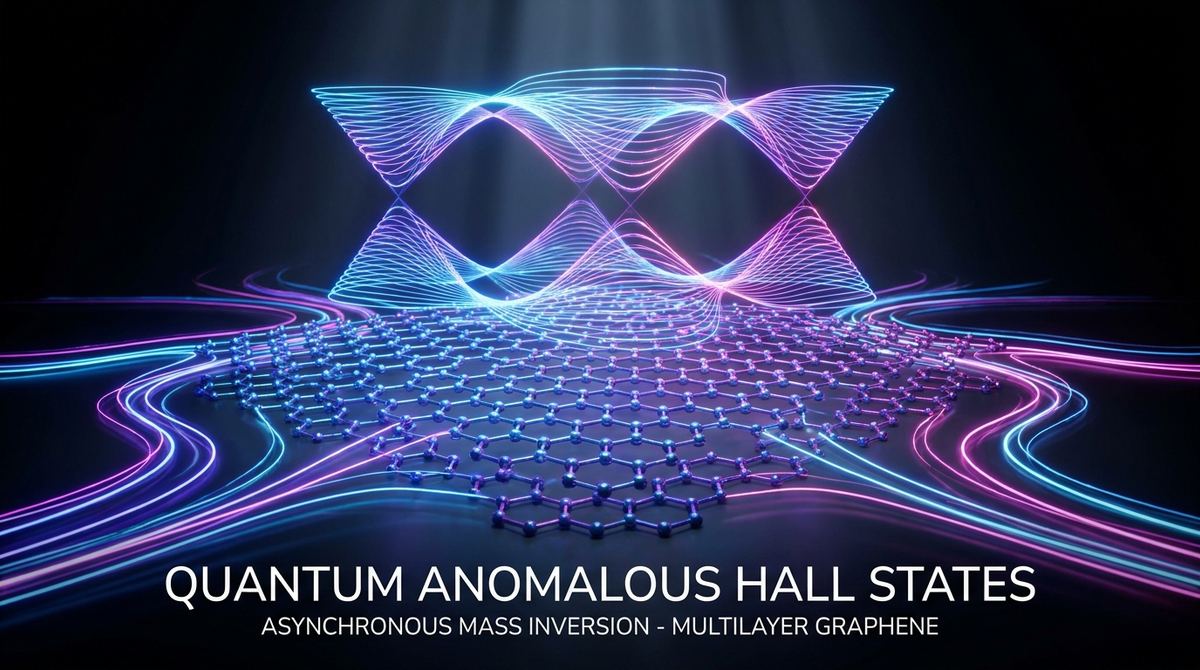
Research conducted by: Xilin Feng, Zi-Ting Sun, K. T. Law. This team of theoretical physicists has recently unveiled a profound mechanism that clarifies one of the most perplexing mysteries in the realm of two-dimensional materials. Their work, published with rigorous analytical and numerical models, provides a comprehensive framework for understanding how topological phases emerge in multilayer graphene systems. For years, condensed matter physicists have been fascinated by the exotic behaviors of electrons confined to two dimensions. Ever since the isolation of a single sheet of carbon atoms, the field has evolved rapidly, moving from single layers to twisted bilayers, and now to highly ordered crystalline multilayers. Among these, rhombohedral pentalayer graphene has emerged as a particularly rich playground for exploring electron correlation and topology. The recent experimental observation of quantum anomalous Hall states in this material sent shockwaves through the physics community. While the presence of these states was groundbreaking, the specific characteristics of the states, namely their Chern numbers, presented a formidable theoretical challenge.
To appreciate the magnitude of this discovery, one must understand the quantum anomalous Hall effect. It allows electrons to flow along the edges of a material without any energy loss or resistance, a phenomenon that could revolutionize electronics by eliminating waste heat entirely. Unlike the traditional quantum Hall effect, which requires massive, continuous external magnetic fields to force electrons into circular orbits, the anomalous version arises from the internal properties of the material. In systems like strongly correlated graphene, electron-electron interactions can spontaneously break time-reversal symmetry, creating a self-sustaining internal magnetization. The topological nature of these dissipationless states is mathematically characterized by an integer known as the Chern number. You can think of the Chern number as a topological invariant that dictates exactly how many one-way, dissipationless edge channels are available for electron transport.
In a rhombohedral pentalayer graphene system, which consists of five perfectly stacked layers of carbon atoms offset in a specific ABCAB pattern, theoretical models based on simple layer-counting naturally predicted a Chern number of minus five. This makes intuitive sense, as each layer is expected to contribute to the overall topological character of the band structure. However, experimentalists probing this material under specific gate voltages observed something highly unexpected. Alongside the predicted minus five state, they discovered a incredibly robust quantum anomalous Hall state with a Chern number of minus three. This minus three state completely defied simple layer-counting arguments. There was no obvious physical reason why a five-layer system would spontaneously reorganize its internal electronic structure to produce exactly three topological edge channels. The origin of this minus three state, and the physical mechanism driving the subsequent transition between the minus three and minus five states, became a central enigma in the study of strongly correlated two-dimensional materials.
To unravel this mystery, the researchers had to look deeply into the microscopic crystallographic details of the graphene lattice. Graphene is famous for its Dirac cones, which are the points in momentum space where the conduction and valence bands meet, giving electrons their unique massless behavior. In a simple, isolated single layer of graphene, these cones are perfectly symmetrical and circular in cross-section. But when you stack five layers in a rhombohedral sequence, where each layer is shifted slightly relative to the one below it, the interlayer interactions become incredibly complex. The electrons can hop not just between adjacent carbon atoms in the same horizontal plane, but also between atoms in different layers vertically and diagonally.
This complex array of hopping parameters introduces a phenomenon known in tight-binding models as trigonal warping. Trigonal warping distorts the idealized circular cross-section of the Dirac cones into a distinct triangular shape at lower energy scales. But the researchers demonstrated that trigonal warping does much more than just mildly distort the shape of the bands. At the absolute lowest energy scales relevant to the quantum anomalous Hall effect, trigonal warping actually tears the primary Dirac cone apart. Instead of a single, massive crossing point in momentum space, the band structure splits into a fascinating constellation. It forms one central touching point surrounded by three distinct satellite Dirac cones. This splitting is a purely geometric consequence of the rhombohedral stacking and the fundamental crystal symmetries of the carbon honeycomb lattice. Understanding this fragmented band structure was the first critical step in solving the Chern number puzzle, as it revealed that the topological properties of the material were not concentrated in a single point, but distributed across multiple, spatially separated points in momentum space.
With the band structure split into a central point and three satellite cones, the next piece of the puzzle involved the distribution of electrical charge across the five individual layers. In a pristine, isolated stack of pentalayer graphene in a vacuum, the layers are roughly equivalent in potential. However, in a real experimental setup, the graphene is encapsulated in dielectric materials like hexagonal boron nitride and subjected to external electric fields from dual-gate electrodes. Furthermore, strong electron-electron interactions within the material can lead to a spontaneous redistribution of charge, creating what is theoretically known as a staggered layer order. This means that the electrostatic potential alternates or varies in a complex, non-linear way from the top layer down to the bottom layer.
When scientists apply a perpendicular electric displacement field using the top and bottom gate electrodes, they explicitly break the inversion symmetry of the entire five-layer system. Breaking inversion symmetry is a strict prerequisite for opening a bandgap in graphene and giving the massless Dirac fermions a topological mass. In simpler topological materials, applying a displacement field opens a uniform gap across the entire momentum space simultaneously. However, the researchers showed that in rhombohedral pentalayer graphene, the coexistence of the naturally occurring staggered layer order and the externally applied displacement field produces a highly unusual and complex effect. It generates a mass term that is heavily dependent on momentum. Because the central touching point and the three satellite Dirac cones are located at drastically different positions in momentum space, they experience this mass term differently. The gap does not open uniformly; the landscape of the topological mass becomes a complex, undulating terrain where different valleys experience different effective potentials.
This momentum-dependent mass term sets the stage for the central breakthrough of the paper: the asynchronous mass inversion mechanism. In topological physics, a phase transition between different quantum anomalous Hall states occurs when the bandgap closes and reopens, a process technically known as mass inversion. During this inversion, the topological mass changes sign, and the Chern number of the system jumps to a new integer value. If the mass term in pentalayer graphene were uniform, the gap would close and reopen everywhere in momentum space simultaneously, jumping directly from a trivial insulating state to the final minus five state predicted by layer counting.
But because the mass term varies so drastically with momentum, the inversion does not happen all at once. As the experimentalists gradually increase the strength of the external displacement field by tuning the gate voltages, the topological mass at the three satellite cones decreases at a much faster rate than at the central point. At a critical threshold of the displacement field, the mass at the three satellite cones hits exactly zero and inverts. Because there are exactly three satellite cones, and each cone contributes one unit to the overall topological invariant upon inversion, this localized, partial mass inversion immediately drops the system into a quantum anomalous Hall state with a Chern number of minus three. The central cone remains un-inverted at this intermediate stage.
This brilliantly explains the mysterious minus three state observed in experiments. It is not an anomaly, but rather a stable intermediate topological phase born directly from the asynchronous nature of the bandgap closing. As the displacement field is increased even further past a second critical threshold, the mass at the central touching point finally reaches zero and inverts. This central inversion contributes the remaining topological charge necessary to drive the system from the minus three state into the minus five state. The entire transition sequence is smooth, predictable, and perfectly aligns with the most recent high-resolution experimental data.
The true power of a theoretical framework lies in its ability to explain more than just a single isolated anomaly. To prove the robustness and universality of the asynchronous mass inversion mechanism, the researchers applied their mathematical model to an entirely different multilayer graphene system: Bernal-stacked tetralayer graphene. Bernal stacking, which follows an alternating ABAB sequence rather than the stair-step ABCAB sequence of rhombohedral graphene, possesses fundamentally different crystalline symmetries. Recently, experimentalists probing this four-layer system discovered a quantum anomalous Hall state with a Chern number of six. Just as a minus three state in a five-layer system was confusing, a Chern number of six in a four-layer system seemed to violate every basic layer-counting intuition available to physicists.
However, when the researchers fed the specific hopping parameters and symmetries of Bernal-stacked tetralayer graphene into their framework, the mystery dissolved completely. The interplay of trigonal warping, which is also present in Bernal stacks although manifesting slightly differently, along with the specific staggered layer order of the tetralayer system and the applied displacement field, once again resulted in a heavily momentum-dependent mass term. The asynchronous mass inversion mechanism perfectly predicted the sequence of bandgap closings in this vastly different geometry. It demonstrated exactly how the various Dirac cones in the tetralayer band structure invert at different, specific displacement field strengths to yield a total accumulated Chern number of six. This generalization proves that asynchronous mass inversion is not just a highly specific quirk of pentalayer graphene, but a universal topological mechanism governing the behavior of strongly correlated stacked graphene systems.
The implications of this research extend far beyond merely solving a few specific experimental puzzles. By clearly identifying and mathematically defining the asynchronous mass inversion mechanism, the researchers have provided a detailed blueprint for engineering entirely new topological phases of matter. The quantum anomalous Hall effect is highly sought after for next-generation technology because it provides perfectly conducting, dissipationless channels that are topologically protected against scattering from material impurities and thermal fluctuations. The higher the Chern number, the more parallel dissipationless channels are available, which could lead to microscopic devices with vastly higher current-carrying capacities and significantly lower error rates in topological quantum computing applications.
Until now, discovering high-Chern number states in two-dimensional materials was largely a matter of experimental trial and error. With this new theoretical framework, materials scientists can intentionally design heterostructures to exhibit specific, desired Chern numbers. By carefully selecting the number of graphene layers, the exact crystallographic stacking sequence, and the precise strength of the applied displacement field, researchers can manipulate the trigonal warping and the staggered layer order to force asynchronous mass inversions exactly where and when they want them in momentum space. This unprecedented level of tunable topological engineering paves the way for a new era of low-power microelectronics and advanced quantum interconnects, bringing the theoretical promises of topological insulators much closer to practical, real-world application.
What is a quantum anomalous Hall state?
A quantum anomalous Hall state is a rare and highly prized phase of matter where a material conducts electricity along its edges with absolutely zero electrical resistance, and crucially, it does so without the need for an external magnetic field. In a traditional quantum Hall state, massive superconducting magnets are required to force electrons into circular orbits, creating these edge currents. The anomalous version achieves this exact same dissipationless edge transport through internal material properties, typically strong electron-electron interactions or internal magnetization combined with spin-orbit coupling. This results in topologically protected pathways for electrons, meaning they can flow without losing energy to heat, which is highly desirable for creating ultra-efficient electronic devices.
What does a Chern number represent in topological physics?
A Chern number is a mathematical integer used in topological physics to describe the global, overarching structure of a material's electronic bands. You can imagine it as a topological invariant that remains completely constant even if the material is stretched, compressed, or deformed, provided the fundamental bandgap does not close. In the specific context of the quantum anomalous Hall effect, the Chern number has a very direct and physical meaning. It corresponds exactly to the number of dissipationless, one-way channels available for electrons to travel along the outer edge of the material. A Chern number of minus three, for example, means there are exactly three distinct, protected edge channels carrying current in a specific direction.
How does trigonal warping affect the electrons in multilayer graphene?
Trigonal warping is a quantum mechanical phenomenon that arises from the complex hopping of electrons between different layers in a stacked graphene crystal. In an idealized single sheet of graphene, the energy landscape of electrons at low energies forms perfect, symmetrical cone-shaped structures called Dirac cones. However, when multiple layers are stacked, the vertical and diagonal electrical forces between the layers distort these perfect cones. Trigonal warping stretches and pulls the circular cross-section of the cones into a distinct triangular shape. At extremely low energies, this warping is so severe that it actually breaks a single Dirac cone apart into multiple distinct cones, creating a central point surrounded by three satellite cones, fundamentally altering the material's topological landscape.
What is the purpose of applying a displacement field in these experiments?
A displacement field is an external electric field applied perpendicularly across the layers of the graphene stack, typically achieved by placing incredibly thin gate electrodes above and below the material. The primary purpose of applying this field is to intentionally break the inversion symmetry of the crystal structure. In a perfectly symmetric graphene stack without an external field, the electrons do not have a preferred layer, and the material remains a gapless semimetal. By applying a displacement field, researchers create an electrical imbalance between the top and bottom layers. This imbalance forces a bandgap to open, giving the electrons a topological mass and allowing the material to transition into an insulating or quantum anomalous Hall state.
Why is the asynchronous mass inversion mechanism considered a significant discovery?
The asynchronous mass inversion mechanism is highly significant because it finally explains how a material can smoothly transition through intermediate topological phases that completely defy simple theoretical predictions based on layer counting. Previously, it was generally assumed that a displacement field would open or close a bandgap uniformly across all electrons in the material at the exact same time. This new mechanism reveals that because the electrons are distributed across different satellite cones in momentum space, the bandgap closes and reopens at completely different rates for different groups of electrons as the electric field increases. This localized, staggered inversion is exactly what creates unexpected states, like the minus three Chern state in a five-layer material, providing a powerful new way to understand and predict complex topological behavior.
The theoretical framework developed by Xilin Feng, Zi-Ting Sun, and K. T. Law marks a monumental step forward in our understanding of strongly correlated topological materials. By brilliantly illuminating the asynchronous mass inversion mechanism, they have decisively solved the pressing mystery of the mismatched Chern numbers in both rhombohedral pentalayer and Bernal-stacked tetralayer graphene. The elegant interplay between geometric trigonal warping, complex staggered layer order, and tunable external displacement fields demonstrates the astonishing complexity and adaptability of multilayer carbon systems. This work not only clarifies past experimental observations that baffled the community but also serves as a highly accurate predictive tool for future discoveries. As the global scientific community continues to push the boundaries of two-dimensional materials, the ability to engineer and precisely control high-Chern number states will be absolutely paramount. Ultimately, the profound insights provided by this asynchronous mass inversion model will heavily guide the development of next-generation topological electronics, bringing humanity much closer to a future defined by dissipationless quantum circuitry and unparalleled computational efficiency.
Serious about B2B integration? Test our premium Pulsed Electrical Resistive Carbon Heating turbostratic graphene in your lab. 100g sample packs available now.
Explore More
Determinant Monte Carlo simulations are key to materials science but fail at low temperatures. New research offers a stable algorithm, enabling accurate...

Researchers developed coupled dynamical Boltzmann transport equations that include long-range interactions, creating a more accurate model for electron...

Learn how to design and prototype graphene slit junctions for directional electron-beam formation and tunable spin filtering in nanoelectronic devices.