
Stable Determinant Monte Carlo Simulations at Large Inverse Temperature $β$
Determinant Monte Carlo simulations are key to materials science but fail at low temperatures. New research offers a stable algorithm, enabling accurate...
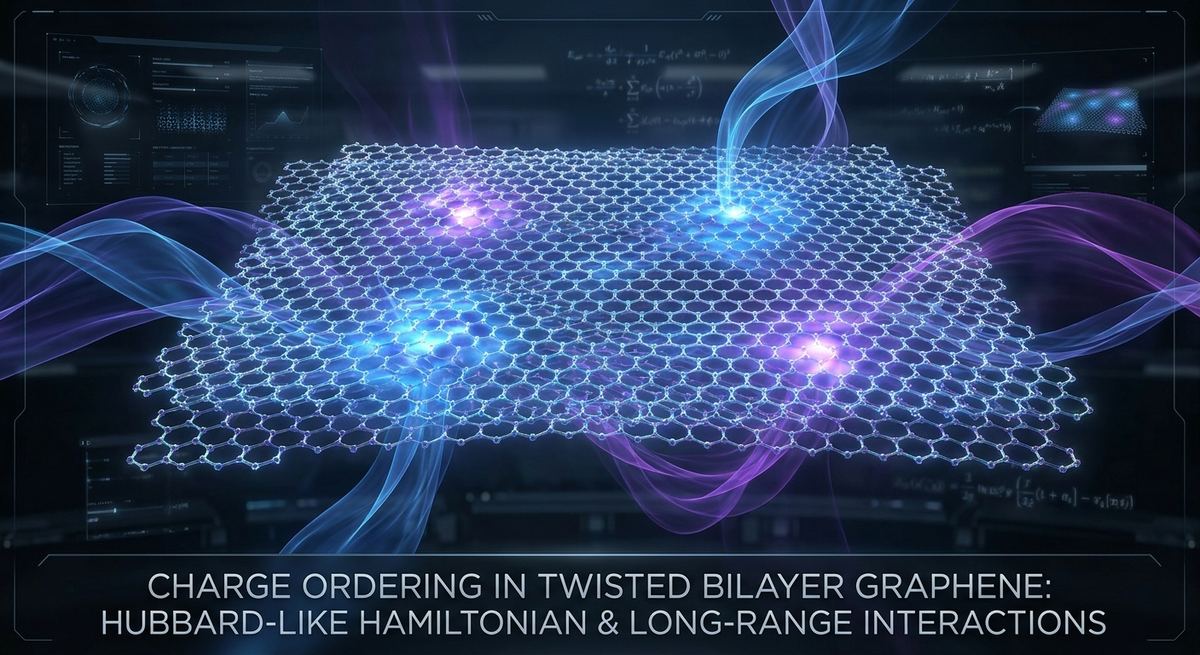
Research conducted by: A. Biborski. This seminal investigation, recently brought to light through the academic publishing avenues of the Jagiellonian University in 2026, serves as a cornerstone for modern condensed matter physics. The work painstakingly dissects the intricate mechanisms governing charge ordering within twisted bilayer graphene. By bridging the gap between theoretical modeling and observable physical phenomena, Biborski and the contributing research team have provided an unparalleled look into the behavior of strongly correlated electron systems. Their dedication to unraveling the complex interactions at the charge neutrality point has yielded insights that will fundamentally shape the future trajectory of quantum materials research, offering a robust framework for understanding how long-range interactions dictate the macroscopic properties of moiré superlattices.
Twisted bilayer graphene and other moiré systems, such as coupled layers of transition metal dichalcogenides, have captivated the global scientific community. These materials are not merely novelties; they represent highly tunable platforms for exploring exotic quantum phases. When two atomically thin layers of graphene are stacked and slightly rotated relative to one another, a vast periodic interference pattern known as a moiré superlattice emerges. This structural modification dramatically alters the electronic landscape of the material. At specific, highly calibrated twist angles, commonly referred to as magic angles, the kinetic energy of the electrons is severely quenched. Consequently, the behavior of the system is no longer dictated by the rapid, almost massless movement of charge carriers, but rather by the repulsive electrostatic interactions between them.
In this regime of quenched kinetic energy, twisted bilayer graphene transforms into a strongly correlated electron system. The electrons, forced to slow down and interact, begin to exhibit collective behaviors that give rise to insulating states, superconductivity, and unique forms of charge ordering. The recent study focuses intensely on the undoped case, corresponding to a filling factor of zero, which represents the charge neutrality point in the real physical system. Understanding the optimal charge distribution at this precise juncture is critical, as it serves as the foundational state from which all other exotic doped phases emerge. The methodology and findings detailed in this research provide a profound clarification of how the spatial extent of electron-electron interactions influences these foundational states.
To fully appreciate the gravity of this research, one must first understand the unique architecture of moiré systems. Graphene, in its isolated single-layer form, is a hexagonal lattice of carbon atoms where electrons behave as massless Dirac fermions. They travel through the lattice at incredible speeds, exhibiting highly efficient electrical conductivity. However, when a second layer of graphene is introduced and rotated by a minute angle, the resulting moiré superlattice creates a completely different environment. The periodic potential generated by the misaligned hexagonal grids essentially traps the electrons in specific regions of the superlattice, specifically the areas where the carbon atoms of both layers align perfectly, known as the AA stacking regions.
This trapping mechanism leads to the formation of flat energy bands in the electronic band structure of the material. In solid-state physics, the flatness of an energy band implies that the electrons have a very high effective mass and their kinetic energy is significantly reduced. When the kinetic energy becomes negligible compared to the Coulomb repulsion between the electrons, the system enters a strongly correlated regime. It is in this regime that the traditional independent-electron models fail, and more complex theoretical frameworks must be employed to accurately describe the physics at play.
Twisted bilayer graphene is often compared to coupled layers of transition metal dichalcogenides, another class of materials that exhibit similar moiré-induced flat bands. However, graphene remains the quintessential playground for physicists due to its relatively simple elemental composition and the unprecedented level of control researchers have over its twist angle and carrier concentration. The ability to dynamically tune the properties of twisted bilayer graphene simply by adjusting an external gate voltage makes it an ideal laboratory for testing complex theories of quantum mechanics and strongly correlated electron phenomena.
At the heart of the theoretical analysis presented in this study is the application of a Hubbard-like Hamiltonian. Originally formulated by John Hubbard in the 1960s, the Hubbard model is the simplest mathematical framework capable of capturing the transition between conducting and insulating states in interacting electron systems. It fundamentally balances two competing forces: the kinetic energy, which encourages electrons to hop from one lattice site to another, and the potential energy, which penalizes electrons for occupying the same lattice site due to electrostatic repulsion.
In the context of twisted bilayer graphene, a simple single-band Hubbard model is insufficient to capture the intricate topological and symmetry properties of the moiré superlattice. Therefore, the researchers utilized a highly sophisticated four-band lattice model. This extended model accounts for the multiple valleys and spin degrees of freedom inherent in graphene's electronic structure. By mapping the continuous moiré potential onto a discrete lattice model, the researchers were able to create a tractable mathematical representation of the system without losing the essential physics that govern its behavior.
The Hubbard-like Hamiltonian employed in this study goes beyond simple on-site repulsion. While traditional models often assume that electrons only interact when they sit on the exact same lattice site, the reality of twisted bilayer graphene is far more complex. The moiré unit cell is remarkably large, spanning hundreds of atomic distances. Consequently, the electrons localized in one region of the superlattice can strongly feel the electrostatic presence of electrons in neighboring regions. This realization necessitates the inclusion of extended interaction terms in the Hamiltonian, setting the stage for a comprehensive investigation into the effects of interaction range.
The central thesis of this groundbreaking research revolves around the impact of long-range density-density interactions. In quantum mechanics, the electron density describes the probability of finding an electron in a specific region of space. Density-density interactions refer to the Coulomb repulsive forces between these localized clouds of charge. In many conventional materials, the presence of conduction electrons creates a screening effect, which rapidly diminishes the strength of the Coulomb interaction over short distances. However, in the flat-band regime of twisted bilayer graphene at charge neutrality, this screening is significantly reduced.
Because the screening is weak and the moiré unit cell is massive, the electrostatic repulsion between electrons extends far beyond their immediate neighbors. The researchers hypothesized that the specific range of these density-density interactions would profoundly influence the resulting spatial arrangement of the electrons, a phenomenon known as charge ordering. If the interactions are artificially truncated or assumed to be purely short-range, the theoretical model might predict a completely different physical state than what actually occurs in the laboratory.
To rigorously test this hypothesis, the study systematically varied the range of the interaction terms included in the Hamiltonian. By extending the interactions from purely on-site to nearest-neighbor, next-nearest-neighbor, and even further across the moiré superlattice, the researchers were able to map out a comprehensive phase diagram of the system. This meticulous scaling of the interaction range proved to be the key to unlocking the true nature of the charge-ordered states at the zero-doping level, revealing that long-range electrostatic forces are not merely secondary corrections, but primary drivers of the material's macroscopic properties.
To solve the complex equations generated by the four-band Hubbard-like Hamiltonian, the researchers employed a dual-pronged computational approach, combining semi-classical simulated annealing optimization with unrestricted Hartree-Fock calculations. This combination of methodologies ensures both global optimization and quantum mechanical rigor. Simulated annealing is a probabilistic technique utilized to find the global minimum of a highly complex objective function. Inspired by the metallurgical process of heating and controlled cooling to reduce defects in crystals, this algorithm allows the computational model to explore a vast landscape of possible electron configurations.
In the context of this study, simulated annealing was used to randomly perturb the charge distribution across the simulated moiré lattice. By assigning an artificial temperature to the system and slowly cooling it down, the algorithm helps the system escape local energy minima and settle into the true lowest-energy state, which corresponds to the most stable physical configuration of electrons. This semi-classical approach is incredibly powerful for identifying macroscopic patterns of charge ordering that might be missed by more rigid, deterministic algorithms.
Once the simulated annealing process identified candidate charge distributions, the researchers utilized unrestricted Hartree-Fock calculations to refine their findings. The Hartree-Fock method is a foundational quantum mechanical approximation that treats each electron as moving in an average effective field generated by all the other electrons. The unrestricted variant of this method allows for symmetry breaking, meaning the electrons are not forced into predefined spin or spatial symmetries. This is absolutely essential for studying strongly correlated systems, where the electrons spontaneously organize into complex, asymmetrical patterns to minimize their mutual repulsion. The agreement between the semi-classical annealing and the quantum mechanical Hartree-Fock results provided a high degree of confidence in the study's conclusions.
The most revealing results of the study emerged from the process of energy scaling. As the researchers incrementally increased the range of the density-density interactions taken into account, they closely monitored the total energy of the various charge configurations. They discovered that the pattern of order is highly sensitive to the interaction range. A charge distribution that appears stable when only short-range interactions are considered might become highly unstable when long-range Coulomb forces are introduced into the simulation.
Through this rigorous scaling process, the researchers successfully narrowed down the vast array of possible configurations to two distinct patterns that represent the optimal charge distribution at a doping level of zero. At this charge neutrality point, the system is perfectly balanced, with neither an excess of electrons nor an excess of holes. The two identified patterns dictate exactly how the localized charges arrange themselves across the moiré superlattice to minimize the immense electrostatic pressure of the long-range interactions.
These optimal patterns are characterized by highly specific spatial symmetries that break the underlying symmetry of the moiré lattice. The emergence of these distinct patterns is a classic hallmark of a strongly correlated phase transition. By demonstrating that the selected charge ordering patterns survive the energy scaling process up to significant interaction ranges, the researchers have provided a highly predictive model for experimentalists. Future scanning tunneling microscopy experiments on undoped twisted bilayer graphene will now have a precise theoretical benchmark against which to compare their visual data, potentially confirming the exact geometry of the charge density waves predicted by this work.
The ramifications of this research extend far beyond the specific confines of twisted bilayer graphene. The demonstration that long-range density-density interactions fundamentally dictate the ground state of a moiré system offers a critical lesson for the broader study of strongly correlated electron systems. For decades, the condensed matter physics community has struggled to accurately model materials like high-temperature cuprate superconductors and heavy fermion compounds, where electron interactions defy simple theoretical descriptions.
By establishing a highly accurate, scaled Hamiltonian model for twisted bilayer graphene, this research provides a new mathematical blueprint. The methodologies developed here, particularly the integration of simulated annealing with unrestricted Hartree-Fock calculations over extended interaction ranges, can be adapted to study coupled layers of transition metal dichalcogenides and other emerging two-dimensional quantum materials. Understanding the exact nature of the insulating state at charge neutrality is the first, necessary step toward understanding how superconductivity emerges when these materials are subsequently doped with additional charge carriers.
Furthermore, the ability to control and predict charge ordering has significant implications for the development of next-generation quantum technologies. Materials that feature stable, predictable charge density waves can be utilized in novel nanoelectronic devices, advanced memory storage architectures, and potentially as components in topological quantum computers. The insights generated by Biborski and the broader research team ensure that theoretical physics keeps pace with experimental discoveries, guiding the rational design of future quantum materials based on the principles of moiré engineering.
Question One: What exactly is twisted bilayer graphene and why is it important? Answer: Twisted bilayer graphene consists of two individual sheets of atomically thin carbon, known as graphene, stacked on top of one another with a slight rotational misalignment. This slight twist creates a large-scale periodic structure called a moiré pattern. It is incredibly important because at specific magic angles, the physical properties of the material change drastically. The electrons slow down, their kinetic energy drops, and their interactions with one another become the dominant force, turning the material into a highly tunable platform for studying exotic quantum physics such as superconductivity and complex insulators.
Question Two: What is the significance of the charge neutrality point mentioned in the study? Answer: The charge neutrality point, which corresponds to a doping level of zero, is the state of the material where there are exactly enough electrons to fill the available low-energy states without any excess electrons or missing electrons. In twisted bilayer graphene, understanding the behavior of the material at this specific point is crucial because it acts as the baseline or parent state. The complex, strongly correlated phases that scientists are most interested in, such as the superconducting states, typically emerge when the material is slightly doped away from this neutral baseline.
Question Three: How does a Hubbard-like Hamiltonian help physicists understand these materials? Answer: A Hubbard-like Hamiltonian is a mathematical equation used in quantum physics to calculate the total energy of a system of interacting electrons. It simplifies complex atomic environments by focusing on two main factors: the energy it takes for an electron to jump from one position to another, and the energy cost of two electrons getting too close to each other due to their negative charges. By modifying this equation to include four distinct energy bands, researchers can accurately simulate the unique electronic environment created by the moiré pattern in twisted bilayer graphene.
Question Four: What is simulated annealing and why was it used in this specific research? Answer: Simulated annealing is a computational optimization technique inspired by the way metals are heated and slowly cooled to remove internal defects. In the context of this physics research, it is used as a computer algorithm to find the most stable arrangement of electrons in the material. By introducing random changes to the simulated electron positions and slowly decreasing an artificial temperature variable, the algorithm prevents the simulation from getting stuck in suboptimal configurations, ensuring the researchers find the true lowest-energy state of the charge ordering.
Question Five: Why do long-range density-density interactions change the outcome of the theoretical models? Answer: Density-density interactions refer to the repulsive electrical forces between localized areas of electron charge. In many traditional models, physicists only calculate these forces for electrons that are right next to each other to save computational time. However, in twisted bilayer graphene, the unit cells are so large and the screening effect is so weak that electrons feel each other's repulsive forces across significant distances. Including these long-range interactions changes the total energy calculations, forcing the theoretical models to predict entirely different, more accurate physical patterns of how the electrons arrange themselves.
The rigorous investigation into twisted bilayer graphene modeled by a Hubbard-like Hamiltonian represents a monumental achievement in theoretical condensed matter physics. By definitively proving that the range of density-density interactions dictates the resultant charge ordering in the undoped case, this research shifts the paradigm of how moiré systems are mathematically simulated. The identification of two optimal charge distribution patterns at the charge neutrality point provides a vital stepping stone for understanding the complex phase diagrams of strongly correlated materials.
As experimental techniques continue to advance, the theoretical frameworks established by this study will serve as an indispensable guide for researchers around the world. The successful synthesis of semi-classical simulated annealing and unrestricted Hartree-Fock calculations demonstrates the power of combining diverse computational methodologies to solve the deepest mysteries of quantum mechanics. Ultimately, this comprehensive study not only decodes the intricate behaviors of twisted bilayer graphene but also lights the way for the future discovery and application of novel two-dimensional quantum materials.
Serious about B2B integration? Test our premium Pulsed Electrical Resistive Carbon Heating turbostratic graphene in your lab. 100g sample packs available now.
Explore More
Determinant Monte Carlo simulations are key to materials science but fail at low temperatures. New research offers a stable algorithm, enabling accurate...

Researchers developed coupled dynamical Boltzmann transport equations that include long-range interactions, creating a more accurate model for electron...

Learn how to design and prototype graphene slit junctions for directional electron-beam formation and tunable spin filtering in nanoelectronic devices.