Unveiling Temporal Instability: A Deep Dive into the Graphene Spin (CP364) Computational Framework
Research conducted by: Claudio Pizzuti, Catherine Linda Pizzuti
The foundational work presented in the Graphene Spin CP364 dossier is the result of extensive methodological research and computational design led by these investigators. Their pioneering approach shifts the analytical paradigm away from traditional global degradation metrics, focusing instead on the hidden temporal anomalies that precede systemic failure. By conceptualizing a framework that is entirely domain-independent, their research provides a robust, reproducible pathway for scientists and engineers to identify dynamic regime transitions across a vast array of complex systems, from electrochemical batteries to large-scale electrical grids. Their dedication to open science and rigorous reproducibility sets a new standard for exploratory data analysis in the realm of complex system dynamics.
In the ever-evolving landscape of complex systems analysis, the ability to predict system failure or transition before it manifests macroscopically remains one of the most sought-after grails in computational science. Traditional methodologies have long relied on global metrics, monitoring overarching degradation, efficiency loss, or general performance decay. However, these traditional indicators often fail to capture the subtle, underlying shifts in system dynamics until the system has already entered a critical state. Enter Graphene Spin CP364, a methodological framework that reimagines how we analyze local temporal instability through structured time-series analysis. This comprehensive dossier presents a reproducible computational approach specifically designed to identify dynamic regime transitions, local instability patterns, and the progressive loss of temporal regularity that invariably precedes observable macroscopic changes.
The Core Philosophy of Graphene Spin CP364
The underlying hypothesis of the Graphene Spin CP364 framework is both elegant and profound. It posits that local temporal instability represents an informational dimension that is entirely distinct from traditional global metrics. While conventional monitoring systems might look at the overall state of a battery or an electrical grid at a specific moment in time, Graphene Spin focuses intensely on the evolution of the signal over time rather than the instantaneous state of the system. This shift in perspective is crucial for understanding heterogeneous systems approaching critical transitions.
In traditional diagnostic models, an engineer might look at a battery's total charge capacity to determine its health. If the capacity is stable, the system is deemed healthy. The Graphene Spin methodology argues that this instantaneous snapshot ignores the micro-fluctuations and temporal anomalies occurring beneath the surface. By treating temporal dynamics as an independent layer of information, the framework allows analysts to detect the microscopic shuddering of a system long before the macro-structure shows any signs of distress. This philosophy essentially treats time not just as a chronological axis, but as a dense fabric of informational variance where the earliest whispers of instability are recorded.
Furthermore, the methodology is intentionally designed to be domain-independent. It does not require explicit physical models, supervised labeling, or domain-specific assumptions to function effectively. This means that the mathematical and computational principles driving the framework can be applied equally to an aerospace battery system, a municipal power grid, or any multi-domain dynamic system where continuous signals can be tracked over time. By stripping away the need for domain-specific physical theories, the framework democratizes advanced temporal analysis, making it accessible and applicable to an incredibly diverse range of scientific and industrial applications.
The Three Principal Computational Modules
The computational pipeline of Graphene Spin CP364 is a marvel of structured data processing, built around three principal modules that work in tandem to dissect and analyze continuous signals. These modules transform raw, chaotic time-series data into coherent sequences of dynamic states. The first of these modules is GSD13, which is dedicated to Temporal Pattern Analysis. This module is the vanguard of the framework, utilizing advanced sliding-window analysis techniques to break down continuous signals into manageable, overlapping segments. By sliding a computational window across the time series, GSD13 can evaluate the local behavior of the signal without losing the context of its progression. It employs local derivative metrics to assess the rate of change within these specific windows, capturing the immediate volatility and temporal texture of the data at a highly granular level.
Following the initial pattern analysis, the data flows into the GSD14 module, which is tasked with Degradation Validation. While the framework emphasizes temporal instability over global degradation, it is still essential to contextualize the temporal findings against the overarching decay of the system. GSD14 analyzes the broader trends extracted from the time series to validate whether the local anomalies identified by GSD13 correlate with the long-term degradation trajectory of the system. This module ensures that the temporal instability being tracked is actually meaningful in the context of the system's lifespan, acting as a crucial bridge between micro-fluctuations and macro-decay.
Finally, the GSD15 module handles Instability Validation. This is where the framework aggregates the localized instability metrics and finalizes the regime classification. Through complex instability aggregation algorithms, GSD15 synthesizes the myriad data points generated by the sliding windows and local derivatives into a clear, understandable sequence of dynamic states. It is the responsibility of this module to definitively categorize the temporal segments into specific operational regimes, thereby transforming a continuous, potentially noisy signal into a structured narrative of system behavior over time. Together, these three modules create a robust, reproducible pipeline that can be deployed across wildly varying datasets with remarkable consistency.
Decoding the Dynamic Regimes
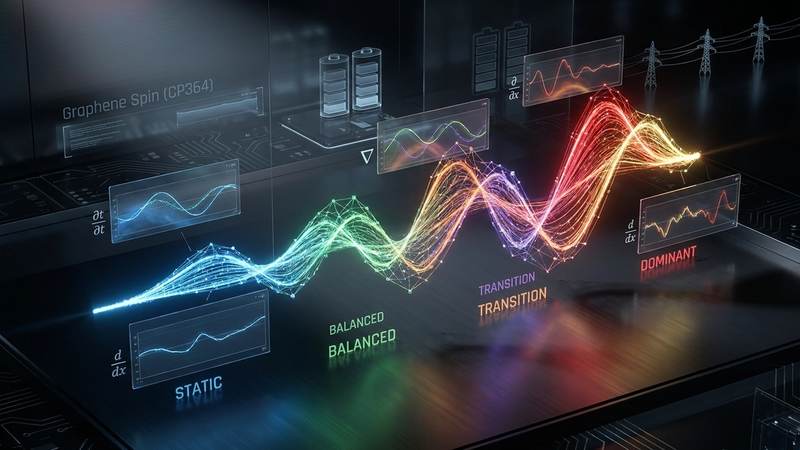
One of the most significant contributions of the Graphene Spin CP364 framework is its classification of temporal data into four distinct dynamic regimes. These regimes provide a universal language for describing the state of a system as it moves through time. The first regime is STATIC. In a STATIC regime, the system exhibits high temporal coherence and minimal variance. The signals are predictable, and the local derivatives remain close to zero. This is the hallmark of a healthy, perfectly stable system operating well within its optimal parameters, showing no signs of underlying distress.
The second regime is BALANCED. A BALANCED state indicates that while the system is largely stable, it is beginning to experience normal, manageable fluctuations. The sliding-window analysis might pick up minor variances and slight shifts in the local derivative metrics, but these are quickly compensated for by the system's internal balancing mechanisms. The temporal regularity is largely maintained, but the absolute rigidity of the STATIC state has been lost. It is an operational state where the system is working dynamically to maintain equilibrium.
The third regime, TRANSITION, is where the predictive power of the Graphene Spin framework truly shines. In the TRANSITION regime, the system begins to exhibit a progressive loss of temporal regularity. The local instability patterns become more pronounced, and the system struggles to return to a balanced baseline. The sliding windows reveal chaotic micro-fluctuations, and the local derivative metrics spike unpredictably. Importantly, during the TRANSITION phase, traditional global metrics like overall efficiency or total capacity might still appear perfectly normal. The instability is localized strictly within the temporal dynamics, serving as a hidden early warning system.
The final regime is DOMINANT. When a system enters the DOMINANT regime, the localized temporal instability has overwhelmed the system's balancing mechanisms. The continuous signal is characterized by extreme volatility, and the temporal structure is fundamentally broken. This regime invariably precedes or coincides with observable macroscopic changes, such as catastrophic failure, severe degradation, or a complete collapse of system efficiency. The dominant instability is no longer a hidden temporal anomaly but a driving force dictating the system's behavior.
Cross-Domain Applications and the NASA PCoE Dataset
To validate the efficacy and domain independence of the Graphene Spin CP364 framework, the researchers applied the methodology to highly heterogeneous domains, with a particular focus on electrochemical battery datasets provided by the NASA Prognostics Center of Excellence. The NASA PCoE datasets are renowned in the scientific community for their rigorous, high-fidelity tracking of lithium-ion battery degradation under various operational loads and environmental conditions. By applying the GSD13, GSD14, and GSD15 modules to this specific dataset, the researchers were able to test the framework against a well-documented, physically complex system.
The results were striking. Even without any explicit physical models of battery chemistry or supervised labeling of the data, the computational pipeline successfully identified the hidden temporal anomalies that preceded capacity fade in the batteries. The sliding-window analysis detected the precise moments when the electrochemical systems shifted from a BALANCED state into a TRANSITION state, long before the voltage or overall charge capacity curves showed any significant downward trends. This proved that the framework could extract deeply meaningful predictive data from complex systems using purely mathematical, model-free techniques.
Beyond electrochemical systems, the study also analyzed temporal signals from large-scale electrical systems and multi-domain dynamic systems. Despite the vastly different physical realities of an aerospace battery and a municipal electrical grid, the framework uncovered recurring temporal structures across all tested domains. The unsupervised nature of the methodology allowed it to adapt to the unique signal characteristics of each domain seamlessly. This cross-domain success underscores the fundamental assertion of the research: that local temporal coherence, and its progressive degradation, is a general structural property of complex systems approaching critical transitions, regardless of the specific physics governing those systems.
The Hidden Layer of Temporal Dynamics
Perhaps the most profound revelation detailed in the Graphene Spin CP364 dossier is the concept that temporal dynamics and global system state represent distinct but complementary informational layers. The research definitively shows that local instability can drastically increase even when traditional global indicators remain apparently stable. This finding challenges decades of standard engineering practices that rely solely on macroscopic metrics to determine system health. It suggests that our current monitoring paradigms are essentially blind to a massive layer of critical information.
Consider the structural integrity of a massive suspension bridge. Traditional metrics might measure the overall sag of the bridge or the total weight it can bear at any given moment. As long as the bridge does not sag beyond a certain point, it is deemed safe. However, the Graphene Spin methodology is akin to listening to the microscopic acoustic emissions of the steel cables over time. Long before the bridge sags, the cables will begin to emit anomalous temporal frequencies as micro-fractures form and propagate. By the time the overall sag is noticeable, the system is already in a state of catastrophic failure.
Similarly, in dynamic systems, the progressive sequence of BALANCED leading to TRANSITION and finally to DOMINANT instability evolves progressively rather than appearing instantaneously. This coherent sequence was observed consistently across both electrochemical and electrical systems during the study. Because this evolution happens in the temporal layer rather than the spatial or global layer, it remains entirely hidden from traditional diagnostic tools. Recognizing and tracking this hidden layer provides a massive leap forward in predictive maintenance, anomaly detection, and overall complex system management.
Open Science, Documentation, and Reproducibility
In an era where the reproducibility of computational research is frequently called into question, the release of the Graphene Spin CP364 dossier sets a gold standard for open science. The researchers have gone to extraordinary lengths to ensure that their methodology can be independently verified, tested, and expanded upon by the global scientific community. The release includes exhaustive, full dossier documentation that details every mathematical assumption, algorithmic choice, and computational step taken during the development of the framework.
Furthermore, the release package provides the actual computational scripts used to process the NASA PCoE datasets and the electrical system temporal signals. To facilitate immediate understanding and utilization, the researchers have included structured outputs, comprehensive CSV and JSON summaries, and detailed ranking tables. These resources allow independent analysts to review the exact regime classifications and instability aggregations generated by the GSD13, GSD14, and GSD15 modules.
To ensure the utmost integrity of the data and the computational pipeline, the release features MEMTRIN tracking structures and SHA256 integrity verification files. The inclusion of SHA256 hashes guarantees that the datasets and scripts remain unaltered from their original, published state, providing a cryptographically secure foundation for peer review. The extensive reproducibility notes explicitly guide independent researchers through the process of setting up the computational environment, running the sliding-window analyses, and verifying the emergence of the dynamic regimes. This commitment to transparency ensures that Graphene Spin CP364 is not just a theoretical concept, but a practical, verifiable tool for the scientific community.
Frequently Asked Questions
Question: What exactly is the Graphene Spin CP364 framework?
Answer: Graphene Spin CP364 is a methodological and computational framework designed for the exploratory analysis of temporal dynamics in complex systems. It utilizes structured time-series analysis, specifically sliding windows and local derivative metrics, to identify localized temporal instability and dynamic regime transitions. It is essentially a tool for detecting the hidden, microscopic warning signs of system failure before traditional, macroscopic metrics show any degradation.
Question: Does the framework require a deep understanding of the specific physical system being analyzed?
Answer: No, it does not. One of the primary strengths of the Graphene Spin methodology is that it is intentionally domain-independent. It does not require explicit physical models, supervised labeling, or domain-specific assumptions. The framework analyzes the mathematical evolution of a continuous signal over time, making it equally applicable to electrochemical batteries, electrical grids, or any other multi-domain dynamic system that produces time-series data.
Question: How do the four dynamic regimes help in predicting system failure?
Answer: The framework classifies data into four regimes: STATIC, BALANCED, TRANSITION, and DOMINANT. The research revealed a recurring, progressive sequence across heterogeneous domains where systems move from BALANCED to TRANSITION, and finally to DOMINANT. Because the TRANSITION phase represents a progressive loss of temporal regularity that occurs before global degradation is visible, tracking these regimes provides a powerful early warning system for predicting catastrophic macroscopic changes.
Question: What is the significance of the NASA PCoE dataset in this study?
Answer: The NASA Prognostics Center of Excellence battery datasets are highly respected, rigorous records of lithium-ion battery degradation. By applying the Graphene Spin framework to this dataset, the researchers were able to validate their methodology against a complex, real-world physical system. The successful identification of temporal instability preceding battery capacity fade proved that the model-free, unsupervised framework could extract highly accurate predictive insights from established, complex physical data.
Question: Is Graphene Spin an experimental material science technology?
Answer: No. The dossier explicitly states that Graphene Spin CP364 is presented as a computational and methodological framework for the exploratory analysis of temporal dynamics. It is not proposed as a validated physical theory, nor is it an experimental graphene material technology platform. The name refers to the computational methodology rather than the physical synthesis or application of graphene materials.
Conclusion
The Graphene Spin CP364 dossier represents a monumental shift in how we approach the analysis of complex systems. By proving that local temporal instability represents an informational dimension entirely distinct from traditional global metrics, the research opens up new frontiers in predictive maintenance and anomaly detection. The robust, domain-independent computational pipeline, driven by the GSD13, GSD14, and GSD15 modules, successfully transforms chaotic time-series data into actionable sequences of dynamic states. As systems across the globe become increasingly complex, the ability to detect the subtle transition from a balanced state to a dominant instability will become absolutely critical. Through its rigorous methodology and unwavering commitment to open science and reproducibility, Graphene Spin CP364 provides the scientific community with the exact tools needed to uncover the hidden temporal dynamics that govern the stability of the modern world.
Evaluate Our Quality
Serious about B2B integration? Test our premium Pulsed Electrical Resistive Carbon Heating turbostratic graphene in your lab. 100g sample packs available now.