
Stable Determinant Monte Carlo Simulations at Large Inverse Temperature $β$
Determinant Monte Carlo simulations are key to materials science but fail at low temperatures. New research offers a stable algorithm, enabling accurate...
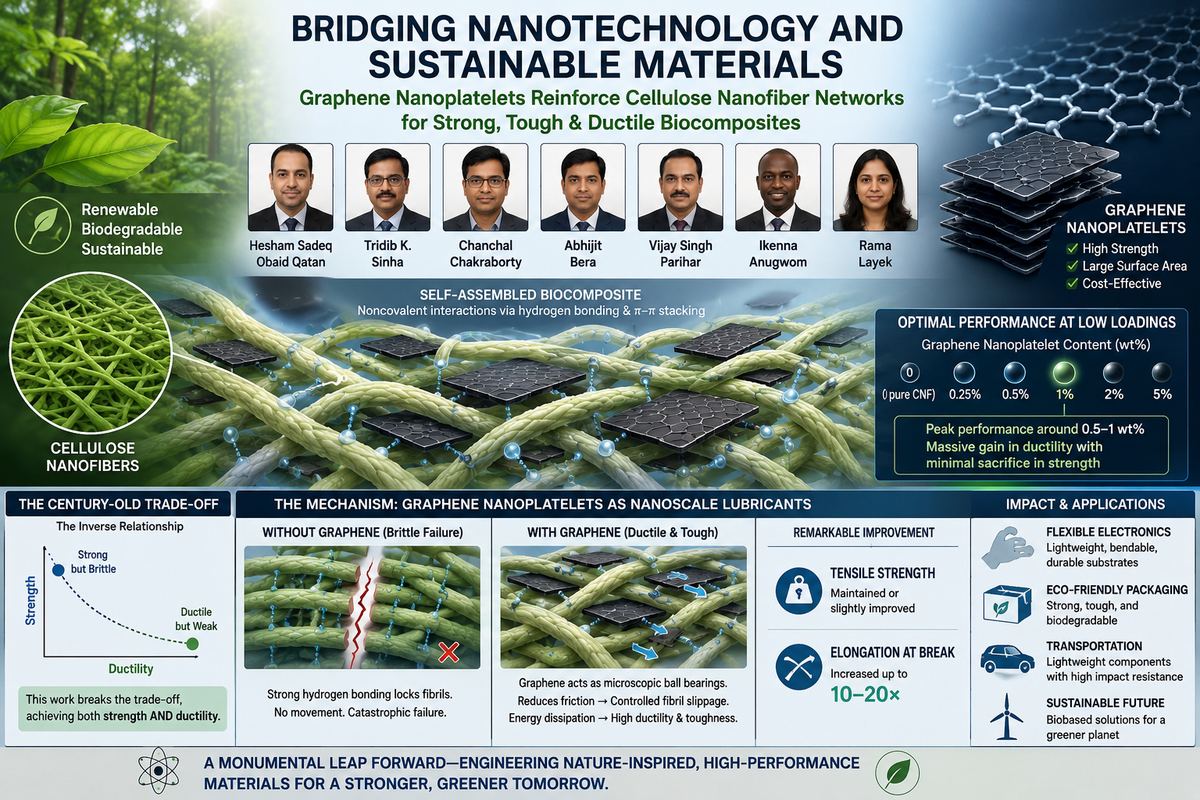
Research conducted by: Hesham Sadeq Obaid Qatan, Tridib K. Sinha, Chanchal Chakraborty, Abhijit Bera, Vijay Singh Parihar, Ikenna Anugwom, Rama Layek
This brilliant team of researchers has successfully bridged the gap between nanotechnology and sustainable materials, engineering a self-assembled biocomposite that defies the traditional boundaries of materials science. Their pioneering work on the integration of graphene nanoplatelets into cellulose nanofiber matrices has opened up an entirely new frontier in the development of materials that are simultaneously strong, tough, and ductile. By meticulously analyzing the structure-property relationships at the nanoscale, these scientists have provided a scalable, biologically based solution to one of the most enduring challenges in materials engineering: breaking the inverse relationship between material strength and ductility. Their research represents a monumental leap forward for industries ranging from flexible electronics to advanced eco-friendly packaging.
For decades, materials scientists have grappled with a fundamental trade-off. If you want a material to be exceptionally strong, you generally have to accept that it will be brittle, much like glass or advanced ceramics. Conversely, if you require a material to be highly ductile and flexible, you usually have to sacrifice ultimate tensile strength, as is the case with many synthetic polymers and rubbers. Nature, however, has long circumvented this limitation through the use of hierarchical, self-assembling architectures. Biological materials such as nacre, commonly known as mother-of-pearl, or the silk spun by spiders, exhibit remarkable combinations of strength and toughness. Inspired by these natural architectures, researchers have continuously sought to replicate this delicate balance in the laboratory. The recent breakthrough utilizing cellulose nanofibers and graphene nanoplatelets marks a highly significant milestone in this ongoing quest.
Cellulose is the most abundant biopolymer on the planet, serving as the primary structural component of plant cell walls. When broken down to its fundamental nanoscale constituents, we obtain cellulose nanofibers. These nanofibers possess extraordinary intrinsic mechanical properties, including high stiffness and impressive tensile strength, rivaling that of synthetic aramid fibers like Kevlar. Furthermore, because they are derived from renewable resources such as wood pulp or agricultural waste, cellulose nanofibers represent a highly sustainable, biodegradable alternative to petroleum-based polymers.
When processed into a film or nanopaper, cellulose nanofibers naturally self-assemble into a dense, tightly woven network. This self-assembly is driven by the rich chemistry of the cellulose molecule, which is decorated with numerous hydroxyl groups. These groups form a vast, interconnected network of hydrogen bonds between adjacent nanofibers. While this dense hydrogen bonding is responsible for the impressive stiffness and high ultimate tensile strength of pure cellulose nanopaper, it is also its greatest weakness. The rigid network locks the fibrils in place, preventing them from moving or sliding past one another when subjected to mechanical stress. As a result, when the material is stretched, it cannot dissipate the applied energy effectively. Instead of stretching, the rigid network undergoes catastrophic failure, snapping suddenly. This inherent brittleness has severely limited the widespread industrial application of pure cellulose nanofiber materials in scenarios where impact resistance and flexibility are paramount.
To overcome this limitation, researchers realized they needed to introduce a modifying agent into the cellulose matrix—a substance capable of disrupting the rigid hydrogen bond network just enough to allow for molecular movement without compromising the overall structural integrity of the material.
Enter graphene nanoplatelets. While pristine, single-layer graphene has garnered immense attention for its unparalleled electrical and mechanical properties, it remains expensive and difficult to produce at scale. Graphene nanoplatelets, on the other hand, consist of short stacks of graphene sheets. They retain many of the extraordinary properties of single-layer graphene, including high mechanical strength and an expansive, flat, aromatic surface area, but they are significantly more cost-effective and easier to disperse in aqueous solutions, making them ideal candidates for large-scale composite manufacturing.
In this groundbreaking study, the researchers hypothesized that introducing extremely low concentrations of graphene nanoplatelets into the cellulose nanofiber matrix could fundamentally alter its mechanical behavior. They experimented with remarkably small additions of graphene nanoplatelets, testing concentrations of 0.25, 0.5, 1, 2, and 5 percent by weight. The results were nothing short of spectacular. The researchers discovered that the graphene nanoplatelets act as an exceptionally efficient nanoscale lubricating agent.
By strategically positioning themselves between the cellulose fibrils, the incredibly smooth, flat surfaces of the graphene nanoplatelets function much like microscopic ball bearings. When mechanical stress is applied to the composite material, these ball bearings reduce the friction between adjacent cellulose fibers, allowing them to slide past one another smoothly rather than locking together and snapping under the strain. This phenomenon, known as controlled fibril slippage, is the mechanical secret behind the material's newfound ductility.
The profound transformation of the material's properties is not solely due to the physical presence of the graphene nanoplatelets; it is deeply rooted in the specific chemical interactions between the graphene and the cellulose. Traditional methods of creating strong composites often rely on covalent functionalization, where strong chemical bonds are permanently forged between the matrix and the filler. While this can increase strength, it frequently destroys the inherent structure of the nanomaterials and reduces their flexibility.
The researchers in this study opted for a more elegant, dynamic approach: noncovalent functionalization. Cellulose is a uniquely amphiphilic molecule. While it has a hydrophilic face dominated by the aforementioned hydroxyl groups, it also possesses a hydrophobic face characterized by the carbon-hydrogen backbone of the glucose rings. Graphene, being an entirely carbon-based, aromatic structure, features a dense cloud of pi-electrons hovering above and below its flat surface.
When the graphene nanoplatelets are dispersed within the cellulose matrix, a specific type of noncovalent interaction known as a carbon-hydrogen to pi interaction occurs. The hydrophobic carbon-hydrogen backbone of the cellulose is naturally drawn to the pi-electron clouds of the graphene nanoplatelets. This interaction allows the graphene to effectively bind to the cellulose without the need for destructive permanent chemical bonds.
Crucially, the presence of the graphene nanoplatelets partially blocks some of the rigid hydrogen bonds that would typically form between adjacent cellulose fibrils. However, this blocking is dynamic. As the material is stretched and the fibrils begin to slide past one another, lubricated by the graphene, the native hydrogen bonds are forced to rupture. This rupturing process absorbs a massive amount of energy. Because the graphene keeps the fibrils in close proximity and perfectly aligned, new hydrogen bonds can rapidly reform in new positions as the sliding continues. This continuous, dynamic cycle of rupture and reformation of hydrogen bonds alongside the stable carbon-hydrogen to pi interactions prevents catastrophic failure and allows the material to absorb an incredible amount of mechanical energy.
To prove that this complex nanoscale choreography was actually taking place, the researchers employed a comprehensive suite of advanced analytical techniques to establish a definitive structure-property relationship.
Field Emission Scanning Electron Microscopy was utilized to visually inspect the internal architecture of the composite nanopaper. The high-resolution imagery revealed the formation of a highly organized, layered fibrous network structure. The graphene nanoplatelets were seen to be uniformly dispersed and sandwiched between the layers of cellulose fibrils, creating a tightly packed, brick-and-mortar-like architecture highly reminiscent of natural nacre. This layered structure forces any microscopic cracks to travel a tortuous, winding path through the material, vastly increasing the energy required to tear the composite apart.
Raman spectroscopy, a technique that measures the vibrational modes of molecules, provided irrefutable evidence of the noncovalent functionalization. The researchers observed distinct shifts in the characteristic G and 2D bands of the graphene spectrum. These shifts indicate that the electron clouds of the graphene were actively interacting with the surrounding cellulose environment, confirming the presence of the dynamic carbon-hydrogen to pi interactions.
Fourier Transform Infrared Spectroscopy was used to probe the hydrogen bonding network. The results showed clear alterations in the vibrational frequencies associated with the hydroxyl groups of the cellulose. This shift in the infrared spectrum confirmed that the graphene nanoplatelets were indeed successfully intervening in the native hydrogen bonding network, partially blocking rigid bonds and introducing the flexibility required for the ball-bearing effect.
Finally, Wide-Angle X-ray Diffraction analysis yielded fascinating insights into the crystalline structure of the composite. Pure cellulose contains highly ordered crystalline regions that contribute to its stiffness. The X-ray diffraction patterns revealed that the introduction of the graphene nanoplatelets actually modified the crystal size of the cellulose and slightly reduced its overall crystallinity. Far from being a detriment, this reduction in perfect crystalline order was exactly what was needed. By slightly disrupting the rigid crystal packing, the graphene nanoplatelets introduced amorphous, flexible regions that allowed the macromolecular chains the freedom to move and stretch under stress.
The culmination of this intricate nanoscale engineering is a macroscopic material with mechanical properties that drastically outperform expectations. The tensile testing results of the biocomposite nanopaper were extraordinary, particularly at the incredibly low graphene nanoplatelet concentration of just 1 percent.
At this optimal concentration, the ultimate tensile strength of the biocomposite reached 158.3 megapascals, representing a 47 percent improvement over the pure cellulose nanopaper. Even more remarkably, the strain-to-failure, which measures how much the material can stretch before breaking, skyrocketed to 35 percent. This is a 191 percent improvement, showcasing massive ductility in a material that is traditionally quite brittle.
The most impressive metric, however, is toughness. Toughness is the total amount of energy a material can absorb before it fractures, calculated by measuring the entire area under the stress-strain curve. The toughness of the 1 percent graphene nanoplatelet composite reached a staggering 34.1 megajoules per cubic meter. This represents a 210 percent improvement over the pure cellulose material, effectively tripling its ability to absorb impact and mechanical energy.
The researchers noted that exceeding the 1 percent threshold began to yield diminishing returns. At concentrations of 2 percent and 5 percent, the graphene nanoplatelets likely began to agglomerate, clumping together rather than dispersing evenly as individual ball bearings. These clumps create weak points, or stress concentrators, within the matrix, which initiate premature cracking and reduce the overall mechanical performance. This highlights the incredible efficiency of the noncovalent functionalization approach; only a microscopic dusting of graphene is required to fundamentally rewrite the mechanical destiny of the cellulose.
The implications of this research extend far beyond the confines of the theoretical materials science laboratory. We are currently facing a global crisis regarding the accumulation of synthetic, non-biodegradable plastics in our oceans and landfills. Finding high-performance materials derived from renewable biological sources is of paramount importance for the future of sustainable manufacturing.
Because this novel biocomposite is composed primarily of cellulose, it remains highly sustainable and environmentally friendly. The manufacturing process utilizes water-based self-assembly, avoiding the need for harsh, toxic chemical solvents typically associated with advanced composite manufacturing.
The combination of high strength, extreme toughness, and impressive ductility makes this cellulose-graphene hybrid an ideal candidate for a wide array of future applications. In the realm of advanced packaging, it could replace traditional petroleum-based plastics, providing superior protection for goods while remaining entirely biodegradable. In the rapidly expanding field of flexible electronics, this tough nanopaper could serve as a sustainable, flexible substrate for wearable sensors, foldable displays, and bio-compatible medical devices. Furthermore, its high energy-absorption capabilities make it a promising material for lightweight structural components in the automotive and aerospace industries, where reducing weight without sacrificing safety is a constant engineering priority.
Question: What exactly is a cellulose nanofiber and where is it sourced from?
Answer: Cellulose is the main structural polymer found in the cell walls of plants and trees. When bulk plant material, such as wood pulp, is chemically or mechanically processed down to its smallest fundamental building blocks, it yields cellulose nanofibers. These are incredibly thin, long structures that possess extremely high intrinsic strength and stiffness, making them an excellent sustainable building block for advanced materials.
Question: How do graphene nanoplatelets differ from standard single-layer graphene?
Answer: Standard graphene is a single, one-atom-thick layer of carbon atoms arranged in a hexagonal lattice. While it has amazing properties, it is difficult and expensive to produce in large quantities. Graphene nanoplatelets consist of a few layers of these carbon sheets stacked together. They are much easier to manufacture at an industrial scale and are highly cost-effective, yet they still retain the flat, strong, and highly conductive characteristics that make graphene so useful in composites.
Question: What is meant by noncovalent functionalization in the context of this biocomposite?
Answer: Functionalization refers to the process of modifying a material so it interacts well with another material. Covalent functionalization involves creating permanent, strong chemical bonds, which can sometimes damage the structure of the nanomaterials. Noncovalent functionalization, as used in this study, relies on weaker, dynamic interactions, specifically the attraction between the carbon-hydrogen bonds of the cellulose and the electron clouds of the graphene. This allows the materials to bind together without damaging their native structures, enabling flexibility and movement.
Question: Why does reducing the crystallinity of the cellulose actually improve the composite material?
Answer: Crystallinity refers to how perfectly ordered and tightly packed the molecular chains are within a material. Highly crystalline materials are typically very stiff and strong, but they are also brittle and prone to snapping because the molecules cannot move. By introducing graphene nanoplatelets, the researchers slightly disrupted this perfect packing, reducing the crystallinity. This created flexible, amorphous zones that allow the material to stretch and bend under stress without breaking immediately.
Question: How does the ball-bearing effect function at the nanoscale level to increase toughness?
Answer: Under mechanical stress, the rigid network of pure cellulose tends to lock up and fracture. The flat, smooth graphene nanoplatelets situate themselves between the cellulose fibers. When pulling forces are applied, these graphene plates reduce the friction between the fibers, acting like microscopic ball bearings. This allows the cellulose fibers to slide past each other smoothly. As they slide, they absorb massive amounts of energy, which drastically increases the overall toughness and ductility of the composite.
The development of this noncovalently functionalized cellulose nanofiber and graphene nanoplatelet biocomposite represents a masterclass in nanoscale engineering. By understanding and manipulating the delicate interplay of hydrogen bonds and dynamic molecular interactions, researchers have effectively reprogrammed a brittle biopolymer into a highly ductile, super-tough material. Utilizing just a single percent of graphene to achieve a tripling of material toughness demonstrates the profound efficiency of this approach. As industries worldwide continue the urgent search for sustainable, high-performance alternatives to synthetic plastics, this bio-based, self-assembling nanocomposite stands out as a highly viable, scalable, and revolutionary solution. The future of materials science is not just about building stronger materials; it is about building smarter, tougher, and greener materials, and this research lights the path forward.
Serious about B2B integration? Test our premium Pulsed Electrical Resistive Carbon Heating turbostratic graphene in your lab. 100g sample packs available now.
Explore More
Determinant Monte Carlo simulations are key to materials science but fail at low temperatures. New research offers a stable algorithm, enabling accurate...

Researchers developed coupled dynamical Boltzmann transport equations that include long-range interactions, creating a more accurate model for electron...

Learn how to design and prototype graphene slit junctions for directional electron-beam formation and tunable spin filtering in nanoelectronic devices.