
Stable Determinant Monte Carlo Simulations at Large Inverse Temperature $β$
Determinant Monte Carlo simulations are key to materials science but fail at low temperatures. New research offers a stable algorithm, enabling accurate...
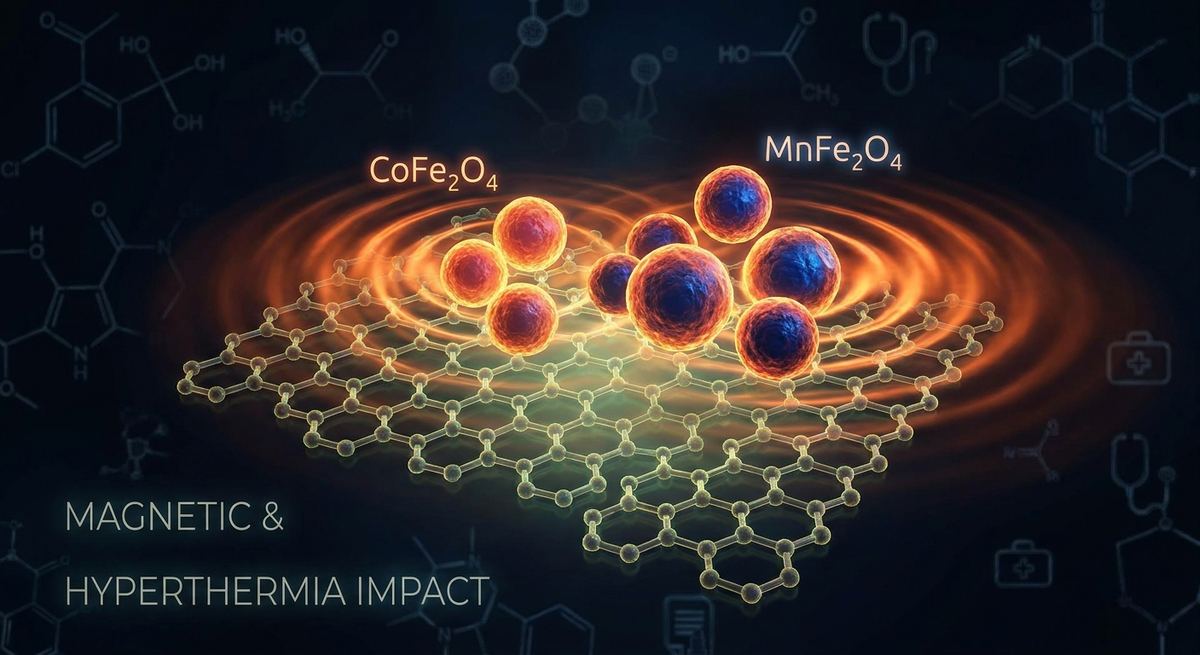
Research conducted by: Wegdan Ramadan, Aya Gasser, Abdallah Ramadan, Marcos García, Yohannes Getahun, Ahmed El‐Gendy. This dedicated team of scientists and engineers has systematically explored the intricate relationships between magnetic nanomaterials and graphene oxide, focusing on their combined potential in advanced medical therapeutics. Their exhaustive investigation into manganese and cobalt ferrites provides a foundational understanding of how structural modifications at the nanoscale can either amplify or dampen the heating efficiencies required for magnetic hyperthermia. Through their rigorous synthesis and characterization protocols, the researchers have illuminated the complex interplay between magnetic anisotropy, nanoparticle morphology, and the integration of carbon-based matrices, ultimately charting a clearer path toward optimized cancer treatments.
The quest for highly targeted, minimally invasive cancer therapies has driven materials scientists and medical researchers to explore the unique capabilities of nanotechnology. Among the most promising avenues is magnetic hyperthermia, a therapeutic technique that leverages alternating magnetic fields to generate localized heat within tumor tissues. By raising the temperature of cancer cells to a critical threshold, typically between forty-one and forty-six degrees Celsius, cellular apoptosis is induced without causing systemic damage to surrounding healthy tissue. The efficacy of this treatment relies entirely on the precise engineering of magnetic nanoparticles. Recent advancements have focused heavily on spinel ferrites due to their tunable magnetic properties and excellent chemical stability. To further enhance their biocompatibility and delivery mechanisms, researchers have begun interfacing these ferrites with two-dimensional carbon nanomaterials. The integration of graphene oxide into these magnetic systems presents a fascinating paradigm, offering significant biochemical advantages while simultaneously introducing profound physical challenges to the fundamental mechanisms of heat generation.
The application of magnetic nanoparticles in oncology represents a monumental shift from traditional, broad-spectrum treatments like chemotherapy and radiation. The core principle of magnetic hyperthermia hinges on the ability of specific nanoscale materials to convert electromagnetic energy into thermal energy. When these particles are injected directly into a tumor or guided there via functionalized surface targeting, they act as localized, microscopic heaters. An external alternating magnetic field, which passes harmlessly through human tissue, is then applied. The magnetic moments of the nanoparticles attempt to align with the rapidly oscillating field, and the energy dissipated during this continuous realignment process is released as heat.
Achieving the optimal temperature requires nanoparticles with exceptionally high heating efficiencies, quantified as the Specific Absorption Rate. The higher the Specific Absorption Rate, the less material is required to be injected into the patient, thereby minimizing potential toxicity and reducing the burden on the biological clearance systems of the body. Spinel ferrites, specifically manganese ferrite and cobalt ferrite, have emerged as prime candidates for this application. These materials possess an inverse spinel crystal structure, where variations in the distribution of metal cations across tetrahedral and octahedral sites allow for the fine-tuning of their magnetic behavior. However, the raw nanoparticles often suffer from agglomeration in biological fluids, limiting their clinical viability. This challenge necessitates the development of advanced nanocomposites that can maintain colloidal stability while preserving or enhancing magnetic performance.
To achieve the precise control over particle size, morphology, and crystallinity required for biomedical applications, the research team employed the hydrothermal synthesis method. This technique involves chemical reactions occurring in aqueous solutions at high temperatures and high vapor pressures, typically conducted within a specialized sealed vessel known as an autoclave. The hydrothermal method is highly favored in nanomaterial synthesis because it allows for the direct formation of highly crystalline phases without the need for subsequent high-temperature calcination, which often leads to severe particle aggregation and undesirable grain growth.
In this study, the researchers synthesized pure manganese ferrite, pure cobalt ferrite, and their respective graphene oxide composites. Manganese ferrite is widely recognized as a soft ferrite. Soft magnetic materials are characterized by low coercivity and high magnetic permeability, meaning their magnetic domains can be easily reoriented by an external field. Conversely, cobalt ferrite is a hard ferrite, characterized by high magnetic anisotropy and significant coercivity. The strong spin-orbit coupling provided by the cobalt ions creates a robust directional preference for the magnetic moments, making them much more resistant to realignment. By synthesizing both a soft and a hard ferrite under identical conditions, the researchers established a comprehensive comparative framework to evaluate how fundamental magnetic anisotropy influences hyperthermia performance, both in isolation and when hybridized with a graphene oxide matrix.
Understanding the physical and chemical reality of these synthesized nanoparticles requires a battery of sophisticated characterization techniques. X-ray diffraction was utilized to confirm the crystalline structure and phase purity of the ferrites. The diffraction patterns verified the successful formation of the face-centered cubic spinel structure for both manganese and cobalt ferrites. Furthermore, the application of the Scherrer equation to the diffraction peaks allowed the researchers to estimate the crystallite sizes, confirming that the synthesis successfully yielded materials firmly within the nanoscale regime.
Transmission electron microscopy provided direct visual confirmation of the nanoparticle morphology. The micrographs revealed the physical distribution of the nanoparticles and, crucially, how they interacted with the graphene oxide sheets in the composite samples. The images demonstrated that the ferrite nanoparticles were successfully anchored onto the expansive surface area of the two-dimensional graphene oxide layers. Raman spectroscopy and Fourier-transform infrared spectroscopy were subsequently employed to investigate the chemical bonding and molecular interactions. These vibrational spectroscopic techniques confirmed the presence of characteristic metal-oxygen bonds in the tetrahedral and octahedral sites of the spinel lattice, as well as the diverse oxygen-containing functional groups, such as hydroxyl, epoxy, and carboxyl groups, native to the graphene oxide sheets.
Vibrating sample magnetometry was critical for elucidating the magnetic properties of the samples. The magnetometry results painted a clear picture of the fundamental differences between the two ferrites. The manganese ferrite nanoparticles exhibited superparamagnetic behavior at room temperature, evidenced by the absence of a distinct hysteresis loop and near-zero coercivity. In a superparamagnetic state, thermal energy is sufficient to overcome the magnetic anisotropy barrier, allowing the magnetic moments to fluctuate randomly in the absence of an applied field. In stark contrast, the cobalt ferrite nanoparticles displayed distinct ferromagnetic properties with a wide hysteresis loop, reflecting their high magnetic anisotropy and hard magnetic nature.
The incorporation of graphene oxide into the ferrite systems was driven by the critical need to improve the biological interface of the nanoparticles. Graphene oxide is an intensely researched carbon allotrope characterized by a single layer of carbon atoms arranged in a hexagonal lattice, heavily decorated with oxygenated functional groups. These functional groups impart exceptional hydrophilicity, significantly enhancing the colloidal dispersion of the nanoparticles in aqueous environments. Moreover, the extensive surface area and abundant chemical docking sites provided by graphene oxide offer an ideal platform for bioconjugation. This allows for the attachment of targeting ligands, chemotherapeutic drugs, or specific antibodies, theoretically enabling a highly targeted, multifunctional delivery system for cancer therapy.
However, the experimental results revealed that these biochemical and structural advantages come at a significant physical cost. Across both the manganese and cobalt ferrite systems, the integration of graphene oxide consistently reduced the Specific Absorption Rate values. While the pure manganese ferrite achieved an impressive heating efficiency of one hundred and ten watts per gram, its graphene oxide composite saw a drastic reduction to sixty watts per gram. Similarly, the pure cobalt ferrite, which initially achieved seventy watts per gram, experienced a decrease to sixty watts per gram upon integration with the carbon matrix. This consistent dampening of heating efficiency highlights a fundamental trade-off in nanocomposite design, where modifications intended to improve biological utility inadvertently compromise the primary physical mechanism of the therapy.
To understand why the heating efficiency dropped, it is essential to unpack the fundamental mechanisms of heat generation in magnetic hyperthermia. When subjected to an alternating magnetic field, magnetic nanoparticles generate heat primarily through two distinct relaxation pathways: Néel relaxation and Brownian relaxation. Néel relaxation occurs when the magnetic dipole moment within the stationary crystal lattice physically flips to align with the oscillating external field. This internal friction generates thermal energy. Brownian relaxation, on the other hand, involves the physical, mechanical rotation of the entire nanoparticle within the surrounding fluid to achieve alignment. The frictional resistance between the rotating particle and the viscous fluid generates the heat.
The overall heating efficiency depends on whichever relaxation mechanism occurs faster, or in ideal cases, a synergistic combination of both. For the soft manganese ferrite, the relatively low magnetic anisotropy allows the internal magnetic moments to flip easily. Consequently, the effective relaxation time of manganese ferrite is perfectly matched to the frequency of the applied alternating magnetic field used in the hyperthermia experiments. It benefits from a powerful synergy of both Néel and Brownian relaxation mechanisms, culminating in the highly efficient Specific Absorption Rate of one hundred and ten watts per gram.
Conversely, the hard cobalt ferrite operates under entirely different constraints. Due to its exceptionally high magnetic anisotropy, the energy barrier required to flip the internal magnetic moments is massive. Under the experimental conditions, Néel relaxation is practically thermally inaccessible; the internal dipoles are essentially locked in place. Therefore, heat generation in the cobalt ferrite system relies predominantly, if not entirely, on the physical rotation of the particles via Brownian relaxation. Because it is restricted to only one mechanism, its heating efficiency is fundamentally capped at a lower threshold, resulting in a Specific Absorption Rate of only seventy watts per gram.
The pronounced reduction in heating efficiency observed in the graphene oxide composites can be attributed to complex physical phenomena operating at the interface between the magnetic nanoparticles and the carbon matrix. The first and most straightforward factor is magnetic phase dilution. Graphene oxide is fundamentally a nonmagnetic material. When it is hybridized with the ferrites, the overall mass of the composite increases without a proportional increase in magnetic material. Consequently, the saturation magnetization per gram of the composite is inherently lower than that of the pure ferrite, directly limiting the maximum potential for heat generation.
Beyond simple dilution, the physical interaction between the nanoparticles and the graphene oxide sheets introduces severe perturbations to the magnetic microstructure. The anchoring of the nanoparticles onto the rigid carbon lattice induces significant interfacial strain. This strain, combined with structural defects generated during the composite synthesis, leads to a phenomenon known as domain pinning. In domain pinning, the boundary walls between distinct magnetic domains within the nanoparticle become physically trapped or restricted by the structural defects at the interface. This restriction severely impedes the free rotation of the magnetic moments, dramatically hindering the Néel relaxation process.
This pinning effect perfectly explains the disproportionate drop in heating efficiency observed in the manganese ferrite composite. Because the pure manganese ferrite relied heavily on the highly efficient Néel relaxation to achieve its peak performance, the restriction of internal dipole movement caused by the graphene oxide interface crippled its primary heat-generating mechanism, slashing its efficiency nearly in half. In contrast, the pure cobalt ferrite was already restricted to Brownian relaxation due to its high intrinsic anisotropy. Therefore, the additional domain pinning introduced by the graphene oxide had a relatively minor impact, as the Néel relaxation was already inactive. This is why the cobalt ferrite composite experienced only a marginal decrease in efficiency, dropping from seventy to sixty watts per gram, proving to be relatively insensitive to the graphene oxide-induced magnetic modifications.
The findings of this comprehensive study present crucial guidelines for the future development of magnetic hyperthermia agents. For decades, the prevailing strategy in the field has been to maximize the saturation magnetization of the nanoparticles, operating under the assumption that a stronger magnetic response would uniformly yield higher heating efficiencies. However, this research decisively proves that maximizing magnetization is insufficient on its own. The true key to optimizing hyperthermia performance lies in the delicate tuning of the magnetic anisotropy constant.
Engineers and materials scientists must focus on precisely matching the effective relaxation timescale of the nanoparticles with the specific frequency and amplitude of the alternating magnetic field generated by clinical hyperthermia equipment. This requires meticulous control over particle size, as the volume of the magnetic core directly dictates the energy barrier for Néel relaxation. Furthermore, while the integration of materials like graphene oxide is undeniably necessary to achieve the colloidal stability, biocompatibility, and targeting capabilities required for in vivo applications, researchers must find innovative ways to mitigate the resulting interfacial strain and domain pinning. Future methodologies may involve introducing intermediate spacer layers or utilizing specialized functionalization techniques that preserve the magnetic freedom of the nanoparticle while still securing it to the delivery matrix.
Question: What is magnetic hyperthermia and how does it treat cancer?
Answer: Magnetic hyperthermia is an experimental cancer treatment that involves introducing magnetic nanoparticles into a tumor and then exposing the patient to an alternating magnetic field. The rapidly changing field causes the nanoparticles to generate heat through internal magnetic friction and physical rotation. This localized heat raises the temperature of the tumor cells to a level that causes cellular death, effectively destroying the cancer from the inside out while sparing surrounding healthy tissue.
Question: Why were manganese and cobalt ferrites chosen for this research?
Answer: Manganese and cobalt ferrites were selected because they represent opposite ends of the magnetic spectrum within the spinel ferrite family. Manganese ferrite is a soft magnetic material with low anisotropy, meaning its internal magnetic compass easily changes direction. Cobalt ferrite is a hard magnetic material with high anisotropy, meaning its magnetic direction is firmly locked. Comparing the two allows researchers to understand exactly how magnetic hardness affects heat generation during hyperthermia therapy.
Question: What role does graphene oxide play in these nanocomposites?
Answer: Graphene oxide is used as a supportive platform for the magnetic nanoparticles. Because raw nanoparticles tend to clump together in biological fluids, the highly functionalized, water-loving surface of graphene oxide helps keep them separated and stable. Additionally, the vast surface area of the graphene oxide sheets provides docking points where scientists can attach specific cancer-targeting drugs or antibodies, turning the magnetic heater into a highly precise delivery vehicle.
Question: What is the difference between Néel and Brownian relaxation?
Answer: Néel and Brownian relaxation are the two primary mechanisms by which magnetic nanoparticles generate heat. Néel relaxation occurs internally; the magnetic field of the particle flips back and forth within the stationary physical structure of the particle, generating heat through internal friction. Brownian relaxation occurs externally; the entire physical particle rotates back and forth within the surrounding fluid to align with the magnetic field, generating heat through mechanical fluid friction.
Question: Why did the addition of graphene oxide reduce the heating efficiency?
Answer: The addition of graphene oxide reduced the heating efficiency for two main reasons. First, graphene oxide is nonmagnetic, so adding it dilutes the overall magnetic strength of the composite material per gram. Second, binding the nanoparticles tightly to the rigid graphene oxide sheets creates physical stress and structural defects at the connection points. This stress effectively pins the internal magnetic structure of the nanoparticles, preventing the efficient internal flipping required for Néel relaxation.
The systematic investigation into manganese and cobalt ferrite graphene oxide composites reveals the profound complexities inherent in designing advanced nanomaterials for biomedical applications. While the transition from pure magnetic nanoparticles to complex hybrid composites is necessary to overcome the biological barriers of targeted drug delivery, this study demonstrates that such modifications inherently alter the fundamental physics of the system. The stark contrast between the highly efficient, dual-relaxation mechanism of the soft manganese ferrite and the highly restricted, mechanically dependent mechanism of the hard cobalt ferrite underscores the paramount importance of magnetic anisotropy in hyperthermia applications. Furthermore, the revelation that graphene oxide-induced domain pinning actively suppresses internal magnetic relaxation provides a critical warning for materials scientists. Moving forward, the successful realization of clinical magnetic hyperthermia will depend not merely on synthesizing the most magnetic materials possible, but on achieving a masterfully engineered equilibrium where structural stability, biochemical functionality, and unhindered magnetic relaxation coexist in perfect harmony.
Serious about B2B integration? Test our premium Pulsed Electrical Resistive Carbon Heating turbostratic graphene in your lab. 100g sample packs available now.
Explore More
Determinant Monte Carlo simulations are key to materials science but fail at low temperatures. New research offers a stable algorithm, enabling accurate...

Researchers developed coupled dynamical Boltzmann transport equations that include long-range interactions, creating a more accurate model for electron...

Learn how to design and prototype graphene slit junctions for directional electron-beam formation and tunable spin filtering in nanoelectronic devices.