
Self-Doping Crystals: A New Frontier in Flawless Electronics
Discover how preempted band-inversion transitions in graphene-based systems create a self-doped crystal, a revolutionary material for ultra-clean electronics.
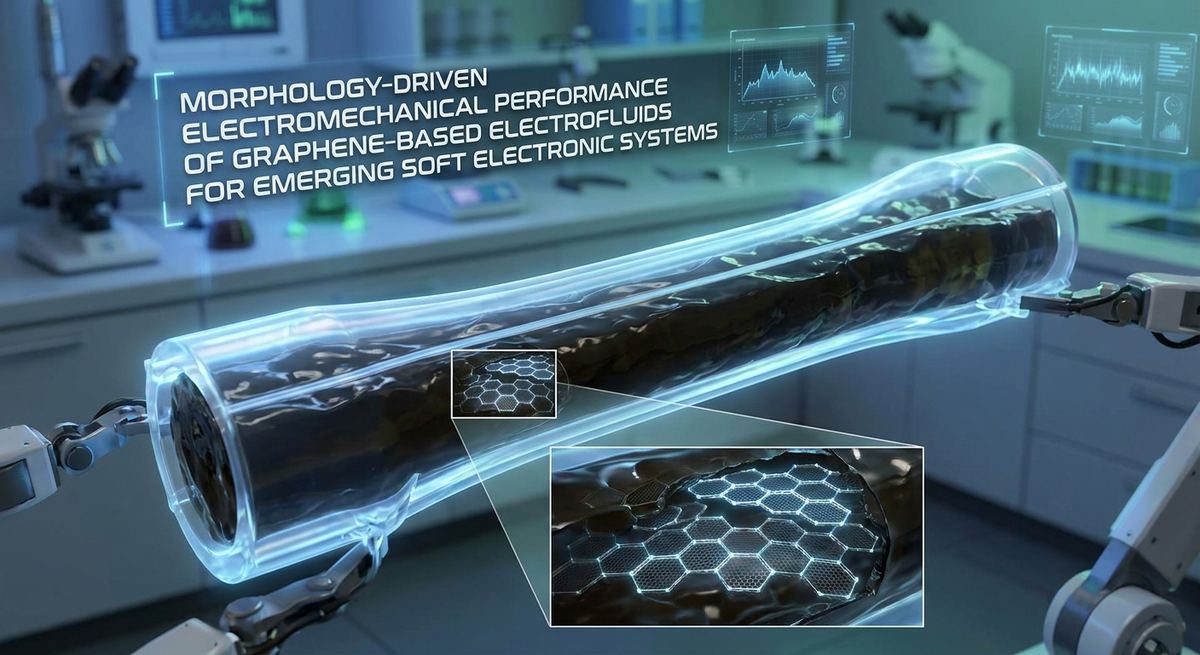
Research conducted by: Dominik S. Schmidt, Paolo Fortugno, Claudia-F. López-Cámara, Hartmut Wiggers, Lola González-García. This pioneering team has significantly advanced our understanding of soft electronic materials by systematically investigating how the physical shape and structure of two-dimensional carbon fillers dictate the overarching electromechanical behavior of glycerol-based suspensions. Their work bridges a critical gap between fundamental nanomaterial morphology and macroscopic device performance, laying a rigorous foundation for the next generation of stretchable devices.
The realm of electronics is undergoing a profound metamorphosis. For decades, the industry has been defined by rigid, planar silicon wafers and brittle metallic traces. However, the future demands flexibility. As we push toward bio-integrated wearables, artificial electronic skin, and soft robotics, the materials we use must seamlessly interface with the dynamic, curvilinear, and constantly moving surfaces of the human body and the natural world. This paradigm shift requires conductors that can stretch, bend, and twist without losing their electrical integrity. Among the most promising candidates for this new era are electrofluids, which are concentrated suspensions of electrically conductive particles dispersed within a liquid medium. When encapsulated in elastomeric channels, these fluids offer theoretically infinite bendability and extreme stretchability. Yet, engineering the perfect electrofluid is a complex balancing act of fluid dynamics, solid-state physics, and materials science. The recent research provides a masterclass in how to manipulate these fluids at the microscopic level to achieve highly specific macroscopic behaviors.
To understand the significance of this research, one must first appreciate the landscape of stretchable conductors. Traditional solid metal wires fail catastrophically under repeated high strain due to fatigue and fracturing. To circumvent this, engineers have explored liquid metals, such as gallium-indium alloys, which maintain conductivity regardless of deformation. However, liquid metals present significant drawbacks, including high mass density, high cost, potential toxicity, and complex surface oxidation behaviors that make them difficult to process and integrate into mass-market devices.
Electrofluids offer a highly customizable alternative. By suspending conductive nanomaterials in a viscous, non-volatile solvent, researchers can create a material that flows like a liquid but conducts electricity like a solid network. The carrier fluid provides the necessary mechanical compliance, while the dispersed particles form a percolating network of electrical pathways. In this study, glycerol was selected as the continuous phase. Glycerol is uniquely suited for this application due to its non-toxicity, low vapor pressure, and high dynamic viscosity. Its low volatility ensures that the electrofluid will not dry out over time when encapsulated in gas-permeable elastomers like silicone, while its high viscosity helps prevent the conductive particles from settling out of suspension, thereby maintaining a stable colloidal system.
The true innovation, however, lies not in the liquid, but in the solid fillers. The researchers hypothesized that the physical dimensions and mechanical properties of the conductive particles would profoundly influence the resulting fluid. They chose to investigate two-dimensional, graphene-like materials, which have already revolutionized solid-state electronics due to their exceptional electrical conductivity, mechanical strength, and high specific surface area. By comparing different forms of graphene, the team sought to uncover the fundamental structure-property relationships that govern electrofluid performance.
The central thesis of the study revolves around three distinct carbon-based filler materials: plasma synthesized few-layer graphene, chemically exfoliated multi-layer graphene, and bulk graphite. Each material represents a different point on the morphological spectrum, varying significantly in specific surface area, aspect ratio, and intrinsic stiffness.
Bulk graphite served as the baseline control material. Composed of massive, thick stacks of graphene sheets, graphite particles are highly rigid and possess a low aspect ratio, meaning their lateral dimensions are not vastly larger than their thickness. Because they are bulky and inflexible, they do not easily conform to one another or create expansive, overlapping networks within a fluid.
Multi-layer graphene, produced via chemical exfoliation, represents an intermediate morphology. The chemical exfoliation process involves inserting molecules between the layers of bulk graphite to force them apart, followed by chemical reduction to restore conductivity. This process yields flakes that are significantly thinner than bulk graphite, resulting in a higher aspect ratio and greater specific surface area. However, the chemical processing often leaves residual defects and functional groups, and the multi-layer nature means the flakes still retain a degree of mechanical rigidity.
Few-layer graphene, synthesized via microwave plasma processing, represents the extreme end of the morphological spectrum. In the plasma synthesis method, hydrocarbon precursors are atomized and reconstructed into pristine, highly crystalline carbon sheets in a bottom-up approach. The resulting flakes consist of only a few atomic layers, granting them an extraordinarily high aspect ratio and a massive specific surface area. Crucially, because they are so incredibly thin, these few-layer graphene sheets are highly flexible and exhibit significantly reduced intrinsic stiffness compared to their thicker counterparts. This extreme thinness and flexibility allow the sheets to crumple, fold, and conform to one another within the fluid matrix.
The most critical metric for any conductive composite is its percolation threshold. In the context of electrofluids, percolation refers to the exact concentration of filler material required to form a continuous, interconnected network spanning the entire volume of the fluid. Below this threshold, the particles are isolated, and the fluid remains an insulator. Above this threshold, electrons can travel from particle to particle, and the fluid becomes conductive.
The researchers discovered a profound correlation between the aspect ratio of the filler and the electrical percolation threshold. Bulk graphite, with its low aspect ratio, required a relatively high concentration to achieve conductivity, as the bulky particles had to be packed densely to ensure physical contact. Multi-layer graphene required significantly less material, thanks to its broader, flatter shape.
However, the few-layer graphene achieved truly remarkable results. The electrical percolation threshold for the plasma-synthesized few-layer graphene electrofluids was an astonishingly low 0.16 weight percent. This ultra-low threshold is entirely attributable to the material's immense aspect ratio and extreme flexibility. The long, ultra-thin sheets can span vast distances within the glycerol matrix, overlapping and establishing electrical contact with minimal material volume. This is a highly desirable trait for soft electronics, as lowering the filler concentration preserves the fluidic, compliant nature of the carrier liquid, ensuring the final composite remains as soft and deformable as possible.
Furthermore, the study investigated the mechanical percolation threshold, which is the concentration at which the particles form a structural network that fundamentally alters the fluid's rheological behavior, transitioning it from a simple viscous liquid to a complex viscoelastic material. Once again, the high aspect ratio of the few-layer graphene led to the lowest mechanical percolation threshold at 0.63 weight percent, demonstrating that the physical shape of the nanomaterial dictates both electrical and mechanical network formation.
To fully understand how these electrofluids would behave in real-world, dynamic applications, the researchers conducted extensive rheological amplitude sweeps. Rheology, the study of the flow and deformation of matter, is crucial for electrofluids because the suspended network of particles must withstand immense mechanical shear during stretching and bending.
During an amplitude sweep, the fluid is subjected to increasing levels of oscillatory strain, and the researchers measure the storage modulus and the loss modulus. The storage modulus represents the solid-like, elastic behavior of the fluid, indicating its ability to store deformation energy. The loss modulus represents the liquid-like, viscous behavior, indicating energy dissipated as heat through internal friction. The range of strain over which the storage modulus remains constant is known as the linear viscoelastic region.
The data revealed a stark contrast between the fluids. Electrofluids containing the rigid bulk graphite or the moderately stiff multi-layer graphene exhibited a narrow linear viscoelastic region. When subjected to strain, their inflexible particle networks quickly fractured and broke apart, causing the fluid to lose its solid-like structure and transition to a purely liquid state at very low deformation levels.
In contrast, the electrofluids containing the highly flexible few-layer graphene exhibited a vastly expanded linear viscoelastic region. Because the ultra-thin sheets possess reduced internal stiffness, they do not snap or fracture under strain. Instead, they store the elastic energy by bending, unwrinkling, and sliding over one another while maintaining their intricate, overlapping network. This unique capacity for storing elastic energy means that few-layer graphene electrofluids can endure significant mechanical disruption before their internal structure collapses, making them extraordinarily robust candidates for highly dynamic soft electronic environments.
The ultimate test of an electrofluid is how its electrical resistance changes when the material is physically stretched. This property is quantified by the Gauge Factor, which is the ratio of relative change in electrical resistance to the mechanical strain applied. In the world of soft electronics, engineers require materials with very specific Gauge Factors depending on the intended function of the component.
For soft electrical interconnects, which act as the wiring routing power and data between components, the ideal Gauge Factor is zero. The resistance must remain absolutely constant regardless of how much the wire is stretched, otherwise, the voltage delivered to the components will fluctuate, leading to system failure. The researchers discovered that the few-layer graphene electrofluids, when encapsulated in elastomeric channels, are almost completely insensitive to uniaxial tensile strain, exhibiting a Gauge Factor below one. Because the highly flexible, high-aspect-ratio sheets form such an expansive and overlapping network, applying strain simply causes the sheets to slide alongside each other. The vast contact area between the sheets ensures that electrical pathways remain intact even as the fluid channel is elongated, making few-layer graphene the perfect material for stable, stretchable wiring.
Conversely, for soft strain sensors, which are used to detect motion, breathing, or joint articulation, engineers require a material with a high Gauge Factor. The resistance must change significantly and predictably in response to strain. The study revealed that electrofluids utilizing the chemically exfoliated multi-layer graphene are exceptionally well-suited for this purpose. Because the multi-layer flakes are stiffer and have a lower aspect ratio than the few-layer sheets, their overlapping network is more tenuous. When the fluid channel is stretched, the stiffer flakes are pulled apart, progressively breaking the electrical pathways and causing a measurable, reliable increase in electrical resistance. This divergent behavior highlights the power of morphological control.
While the fundamental rheological and electrical properties of the fluids are fascinating, their practical utility depends entirely on successful integration into functional devices. The standard methodology involves injecting the electrofluids into microfluidic channels cast from highly stretchable silicone elastomers, such as polydimethylsiloxane.
This encapsulation process leverages the unique properties of both the fluid and the elastomer. The solid silicone provides the necessary structural integrity, protecting the fluid from environmental contamination and providing a restoring force that brings the channel back to its original shape after deformation. The electrofluid inside conforms instantly to any change in the channel's geometry.
The researchers demonstrated that the structural stability of the graphene network within the highly viscous glycerol prevents the phenomenon of phase separation under dynamic loading. In poorly designed suspensions, repeated stretching and relaxing can act like a pump, causing the carrier fluid to flow away from the conductive particles, resulting in dead zones of high resistance. However, the robust mechanical network formed by the high-aspect-ratio few-layer graphene effectively traps the glycerol molecules, ensuring the composite remains homogeneous even after thousands of stretching cycles. This synergistic relationship between the fluid mechanics of the glycerol and the solid-state physics of the graphene network is what transforms a simple suspension into a reliable, high-performance soft electronic component.
The implications of this research extend far beyond the laboratory. By establishing clear, quantitative relationships between the morphological properties of two-dimensional fillers and the macroscopic electromechanical performance of the resulting fluids, the research team has provided a comprehensive roadmap for the rational design of soft electronic materials.
Engineers are no longer forced to rely on trial-and-error formulations. If a robotics firm is developing an artificial skin that must detect the subtle strain of a robotic finger bending to grasp a delicate object, they now know to utilize multi-layer graphene electrofluids to maximize sensor sensitivity. If a medical device company is designing a smart compression garment that monitors cardiovascular health, they know to utilize plasma-synthesized few-layer graphene to create robust, strain-insensitive interconnects that can survive the rigorous stretching of daily wear.
As the fields of bio-integrated electronics and soft robotics continue to accelerate, the demand for materials that blur the line between living tissue and traditional machinery will only grow. The ability to fine-tune the electrical and mechanical properties of a fluid simply by selecting the appropriate nanoscale morphology of its constituent particles represents a massive leap forward. This study not only solves immediate engineering challenges but also opens the door to entirely new classes of liquid-state electronic devices that are as dynamic, resilient, and adaptable as the biological systems they are designed to emulate.
What are electrofluids?
Electrofluids are highly concentrated mixtures where electrically conductive particles, such as carbon or metal nanomaterials, are suspended within a liquid carrier medium. Unlike solid wires, these fluids can flow and deform naturally, making them incredibly useful as flexible conductors when injected into hollow, stretchable rubber or silicone channels for advanced electronic applications.
Why does the aspect ratio of graphene matter?
The aspect ratio is the relationship between the lateral width of a particle and its thickness. In conductive fluids, particles with a high aspect ratio, like ultra-thin sheets of graphene, can easily overlap and connect with each other across large distances. This allows the fluid to conduct electricity using far less material than would be required if the particles were thick, chunky, and had a low aspect ratio.
What is the difference between few-layer and multi-layer graphene in this context?
Few-layer graphene consists of only a handful of atomic carbon layers, making it incredibly thin, highly flexible, and capable of crumpling and sliding without breaking electrical contact. Multi-layer graphene is thicker and stiffer. In this research, the highly flexible few-layer graphene proved ideal for stable wiring, while the stiffer multi-layer graphene was better suited for creating sensors that react to stretching.
What is a percolation threshold?
The percolation threshold is the specific minimum concentration of conductive particles needed inside an insulating fluid to create a continuous, unbroken pathway for electricity to flow from one end to the other. Below this exact concentration, the particles are isolated and electricity cannot pass through the fluid.
How does this research benefit soft robotics?
Soft robots are built from flexible materials that mimic muscles and tissues, meaning rigid metal wires break easily when the robot moves. By understanding exactly how different shapes of microscopic graphene alter the properties of liquid conductors, engineers can now custom-design liquid wires and liquid sensors that stretch perfectly with the robot's body without losing power or data.
The meticulous investigation into the morphology-driven electromechanical performance of graphene-based electrofluids marks a pivotal moment in the evolution of soft electronics. By isolating variables such as aspect ratio, specific surface area, and intrinsic stiffness, the researchers have demystified the complex behaviors of conductive suspensions. The discovery that plasma-synthesized few-layer graphene can create strain-insensitive interconnects due to its remarkable flexibility and low percolation thresholds, while chemically exfoliated multi-layer graphene excels as a highly responsive strain gauge, provides a vital toolkit for material scientists. As we move closer to a future defined by seamless human-machine integration and ubiquitous flexible devices, the foundational structure-property relationships established in this study will undoubtedly serve as the bedrock upon which the next generation of resilient, liquid-state electronic systems will be built.
Serious about B2B integration? Test our premium Pulsed Electrical Resistive Carbon Heating turbostratic graphene in your lab. 100g sample packs available now.
Explore More
Discover how preempted band-inversion transitions in graphene-based systems create a self-doped crystal, a revolutionary material for ultra-clean electronics.

Discover how strain-induced curvature in monolayer graphene can engineer its electronic bandgap and thermal conductivity for next-generation flexible...

Learn to build a prototype graphene spintronic converter based on new research. This guide details how to use pressure to tune spin-to-charge conversion.