
Self-Doping Crystals: A New Frontier in Flawless Electronics
Discover how preempted band-inversion transitions in graphene-based systems create a self-doped crystal, a revolutionary material for ultra-clean electronics.
Research conducted by: Naser Ali, Ali Alsayegh, Ayas Alzanki, Mohammad Banyan, Mumayaz Alenezi, Ammar M. Bahman
This dedicated team of researchers has provided an invaluable contribution to the fields of thermodynamics, fluid mechanics, and nanotechnology. Their rigorous investigation into the thermal and pumping behaviors of graphene-water nanofluids establishes a critical foundation for next-generation thermal management systems. By meticulously mapping the complex interplay between nanoparticle concentration, surfactant levels, and operating temperatures, their work offers actionable insights that bridge the gap between theoretical nanomaterial science and practical industrial engineering. The scientific community and the industrial sector owe a great deal to their comprehensive analysis of heat transfer efficiency under varying flow conditions.
The surge in global energy demand necessitates profound efficiency improvements across all thermal systems. From immense power generation plants and chemical processing facilities to the delicate microprocessors inside modern electronics, the effective management of thermal energy is a universal bottleneck. Historically, engineers have relied on conventional working fluids such as water, ethylene glycol, and engine oils to transport heat away from critical components. However, the inherent thermal limitations of these macroscopic fluids have forced modern engineering to look toward the microscopic realm for solutions. Nanofluids have emerged as highly promising working fluids, fundamentally altering the landscape of thermal engineering by significantly improving thermal performance beyond the theoretical limits of traditional liquids.
Modern industrial and technological advancements are currently constrained by the limitations of conventional heat transfer fluids. As microprocessors become more densely packed with transistors and energy systems push for higher energy density, the amount of waste heat generated per square centimeter has skyrocketed. Traditional coolants inherently possess low thermal conductivities. Water, while abundant and relatively effective, reaches a thermodynamic ceiling that cannot be surpassed without fundamentally altering its physical properties.
This necessity has driven the development of nanofluids, which are engineered colloidal suspensions of nanometer-sized particles distributed uniformly throughout a base fluid. By seeding a base fluid with highly conductive solid particles, the overall thermal conductivity of the mixture is dramatically elevated. However, early attempts using metallic nanoparticles like copper or aluminum oxide presented severe challenges, including rapid sedimentation, pipe erosion, and unmanageable increases in fluid viscosity. The search for the ideal nanoparticle led researchers to carbon-based nanomaterials, specifically graphene, which boasts an unprecedented theoretical thermal conductivity.
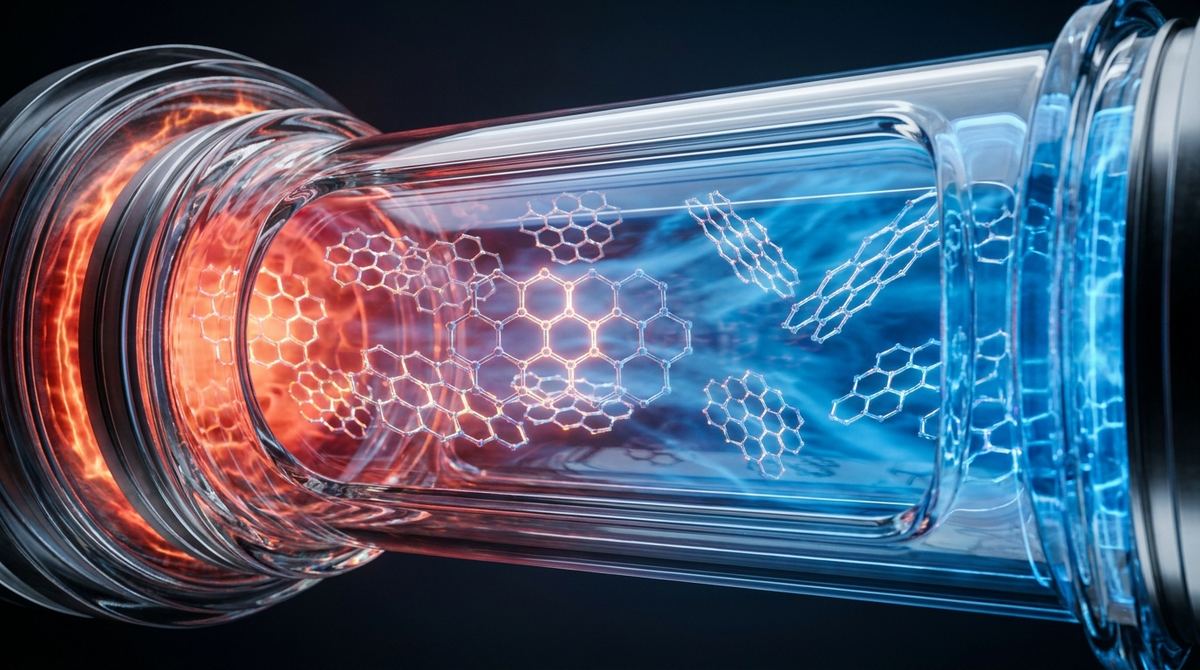
Graphene, a two-dimensional allotrope of carbon consisting of a single layer of atoms arranged in a hexagonal lattice, is renowned for its extraordinary thermal, electrical, and mechanical properties. For bulk thermal applications, researchers often utilize graphene nanoplatelets, which consist of short stacks of graphene sheets. These nanoplatelets retain much of the exceptional thermal conductivity of pristine single-layer graphene but are significantly more practical and cost-effective to produce at the industrial scales required for fluid engineering.
Creating a stable graphene-water nanofluid is a complex biochemical and mechanical challenge. Graphene is inherently hydrophobic, meaning it repels water. When introduced into an aqueous base fluid, graphene nanoplatelets are driven by strong van der Waals forces to agglomerate, clumping together into massive clusters that quickly precipitate out of the suspension. To counteract this, researchers must employ mechanical dispersion techniques, such as high-frequency ultrasonication, combined with chemical stabilization using surfactants.
In the evaluated research, sodium dodecyl sulphate was utilized as the primary surfactant. Sodium dodecyl sulphate is an anionic surfactant that coats the graphene nanoplatelets, lowering the surface tension of the water and imparting a negative electrostatic charge to the particles. This charge creates an electrostatic repulsion between the nanoplatelets, overcoming the van der Waals forces and maintaining a stable, homogeneous dispersion. However, the precise concentration of this surfactant is a delicate balancing act that deeply impacts the final thermodynamic properties of the fluid.
To accurately assess the viability of these advanced fluids, the research methodology encompassed a highly specific set of parameters designed to mimic real-world operating conditions. The experimental matrix involved graphene-water nanofluids formulated with graphene nanoplatelet volume fractions ranging from 0.01 to 0.10 percent. This specific range is critical because exceeding it often leads to exponential increases in viscosity, rendering the fluid too thick to pump efficiently.
The testing environment also varied the concentrations of the sodium dodecyl sulphate surfactant to observe its impact on thermal and rheological behaviors. Furthermore, the experiments were conducted across a wide temperature spectrum spanning from 10 to 70 degrees Celsius. This temperature range effectively captures the operating conditions of various thermal applications, from chilled water cooling systems in data centers operating at the lower end, to industrial heat exchangers and automotive radiators functioning near the higher end of the spectrum.
The researchers utilized advanced instrumentation to gather precise thermophysical data, measuring the dynamic viscosity, thermal conductivity, specific heat capacity, and density of the suspensions. These foundational properties are absolutely essential for calculating the complex dimensionless numbers and figures of merit required to evaluate the fluid under dynamic flow conditions.
Fluids in industrial applications rarely remain stagnant; they are constantly pumped through intricate networks of pipes and channels. The behavior of a fluid in motion is broadly categorized into two flow regimes: laminar and turbulent. Laminar flow is characterized by smooth, parallel layers of fluid sliding past one another with minimal mixing, typically occurring at lower velocities or in highly viscous fluids. Turbulent flow, conversely, features chaotic property changes, rapid variation of pressure, and high levels of fluid mixing, which is generally preferred for heat transfer because the chaotic motion continuously disrupts the thermal boundary layer at the pipe wall.
The effectiveness of a nanofluid must be evaluated distinctly within both regimes. For laminar flow applications, the researchers assessed the nanofluid effectiveness via the thermal conductivity-to-viscosity ratio. The criteria dictate that the ratio of the enhancement in thermal conductivity to the increase in viscosity must exceed 0.25. If the addition of nanoparticles thickens the fluid so much that it completely negates the benefit of the improved thermal conductivity, the fluid fails the laminar effectiveness test.
For turbulent performance, the evaluation shifts to the Mouromtseff number. The Mouromtseff number is a highly specific mathematical construct used to compare the heat transfer capabilities of different fluids under identical pumping power in turbulent internal forced convection. A Mouromtseff number greater than 1 indicates that the newly engineered nanofluid outperforms the baseline fluid. This dimensionless number incorporates the fluid density, thermal conductivity, dynamic viscosity, and specific heat capacity, providing a holistic view of the fluid under aggressive, chaotic flow conditions.
Beyond basic flow dynamics, the ultimate utility of a thermal fluid is judged by its figures of merit for both heat transfer and pumping power. The heat transfer figure of merit quantifies the actual gain in cooling or heating capacity provided by the nanofluid compared to pure water. It is a direct indicator of how much more efficiently a heat exchanger can operate, potentially allowing engineers to design smaller, lighter, and more cost-effective thermal management systems without sacrificing performance.
However, thermodynamics always demands a trade-off. This trade-off is captured by the pumping figure of merit. Adding solid graphene nanoplatelets to water invariably increases the dynamic viscosity of the liquid. A more viscous fluid creates greater frictional resistance against the walls of the piping system. Consequently, the mechanical pumps driving the fluid must consume more electrical energy to maintain the desired flow rate. The pumping figure of merit evaluates this energy penalty.
For a nanofluid to be considered commercially viable, the thermal enhancements must significantly outweigh the mechanical pumping penalties. If a facility saves a certain amount of energy due to improved heat transfer, but expends twice that amount of energy powering the fluid pumps, the systemic efficiency drops, rendering the nanofluid impractical. The delicate interplay between these two figures of merit forms the crux of the researchers analytical framework.
The rigorous analysis yielded highly nuanced and actionable results regarding the interplay of temperature, graphene concentration, and surfactant levels. The data revealed that higher graphene loadings, specifically at the maximum tested volume fraction of 0.10 percent, paired with lower surfactant levels, maximize the heat transfer performance. This peak performance is especially pronounced at elevated temperatures nearing 70 degrees Celsius.
The underlying physics of this result are fascinating. At higher temperatures, the base fluid naturally becomes less viscous. This thermal thinning effectively mitigates the viscosity penalty introduced by the solid graphene nanoplatelets. Furthermore, maintaining lower surfactant levels is crucial because excess sodium dodecyl sulphate can lead to the formation of foam and actually act as a thermal insulator around the nanoparticles, degrading the overall thermal conductivity of the suspension.
Conversely, the research identified the absolute worst-case scenario for fluid mechanics: the lowest pumping performance occurs at 10 degrees Celsius with 0.10 percent volume graphene and a higher surfactant concentration. At cold temperatures, water is naturally at its most viscous state before freezing. Piling the maximum load of nanoparticles into this thick fluid, and compounding it with high levels of chemical surfactant, creates a sluggish, highly resistive suspension. The pumping power required to move this cold, dense mixture skyrockets, resulting in a disastrous pumping figure of merit.
The findings from this comprehensive investigation reveal that both graphene concentration and operating temperature critically influence nanofluid effectiveness for enhanced thermal applications. This research provides a crucial roadmap for mechanical and chemical engineers seeking to implement next-generation cooling technologies.
In the realm of electric vehicles, where battery thermal management is a matter of both performance and safety, utilizing high-temperature optimized graphene nanofluids could allow for faster charging rates by rapidly dissipating the intense heat generated within the battery cells. In large-scale solar thermal power plants, where fluids must absorb immense amounts of solar radiation and transport it to turbines, the elevated thermal conductivity of these suspensions could drastically improve overall megawatt output.
Furthermore, the clear warnings regarding low-temperature viscosity penalties will save the heating, ventilation, and air conditioning industry immense amounts of time and resources. By understanding that high-concentration graphene fluids are detrimental in chilled water systems operating around 10 degrees Celsius, engineers can avoid costly retrofits and instead focus on alternative formulations or entirely different nanomaterials tailored for low-temperature rheology.
Q: What exactly is a nanofluid and why is it better than normal water?
A: A nanofluid is a specifically engineered fluid created by suspending microscopic, nanometer-sized particles within a traditional base fluid like water or ethylene glycol. Normal water has excellent specific heat capacity but very poor thermal conductivity, meaning it is slow to absorb and release heat. By adding highly conductive solid particles, the overall mixture conducts heat much faster, allowing thermal systems to operate at significantly higher efficiencies than they could with pure water alone.
Q: Why did the researchers choose graphene instead of metals like copper or aluminum?
A: Graphene was chosen because it possesses one of the highest known theoretical thermal conductivities of any material on Earth, far surpassing traditional metals. Additionally, graphene is a carbon-based material, making it significantly lighter than metals. This lower density helps prevent the nanoparticles from rapidly sinking to the bottom of the fluid system, ensuring a more stable, long-lasting suspension that requires less continuous mixing.
Q: What is the purpose of the sodium dodecyl sulphate in the fluid mixture?
A: Sodium dodecyl sulphate acts as a chemical surfactant. Because graphene naturally repels water, the particles want to clump together and separate from the fluid. The surfactant coats the graphene particles and gives them a negative electrical charge. Because like charges repel each other, the coated graphene particles push away from one another, remaining evenly distributed throughout the water and preventing clumping.
Q: How does temperature affect the performance of the graphene nanofluid?
A: Temperature is a critical variable because it directly impacts the thickness, or viscosity, of the fluid. At low temperatures, the fluid is thick, and the addition of graphene makes it even thicker, requiring massive amounts of pump energy to move. At high temperatures, the fluid naturally thins out. This thinning cancels out the thickness added by the graphene, allowing the system to benefit from the high heat transfer without suffering a severe penalty in pumping energy.
Q: What is the Mouromtseff number and why is it important in this study?
A: The Mouromtseff number is a specialized mathematical value used by engineers to determine if a new fluid is actually worth using in turbulent flow systems. It compares the heat transfer benefits against the energy required to pump the fluid. If the Mouromtseff number is greater than one, it means the thermal benefits outweigh the pumping costs, proving that the nanofluid is an objective upgrade over the standard base fluid.
The exploration of graphene-based nanofluids represents a pivotal frontier in the quest for optimal thermal management. As demonstrated by the extensive research, the integration of graphene nanoplatelets into water can yield remarkable enhancements in heat transfer, provided the variables of concentration, surfactant chemistry, and temperature are masterfully balanced. The revelation that higher graphene loadings combined with lower surfactant levels excel at elevated temperatures provides a clear directive for high-heat industrial applications. Simultaneously, the identification of severe pumping penalties at lower temperatures serves as a vital cautionary parameter for system designers. Ultimately, the transition from conventional coolants to advanced graphene nanofluids will not be a universal replacement, but rather a highly targeted engineering solution. As industries continue to push the boundaries of energy density and computational power, the precise, data-driven application of these remarkable suspensions will be paramount in keeping the technology of tomorrow cool, efficient, and operational.
Serious about B2B integration? Test our premium Pulsed Electrical Resistive Carbon Heating turbostratic graphene in your lab. 100g sample packs available now.
Explore More
Discover how preempted band-inversion transitions in graphene-based systems create a self-doped crystal, a revolutionary material for ultra-clean electronics.

Discover how strain-induced curvature in monolayer graphene can engineer its electronic bandgap and thermal conductivity for next-generation flexible...

Learn to build a prototype graphene spintronic converter based on new research. This guide details how to use pressure to tune spin-to-charge conversion.