
Remote Moiré Modulation in Twisted Trilayer Graphene for Future Electronics
Twisted trilayer graphene allows for remote electronic control of a decoupled layer, a breakthrough in moiré physics that could enable cleaner quantum devices.
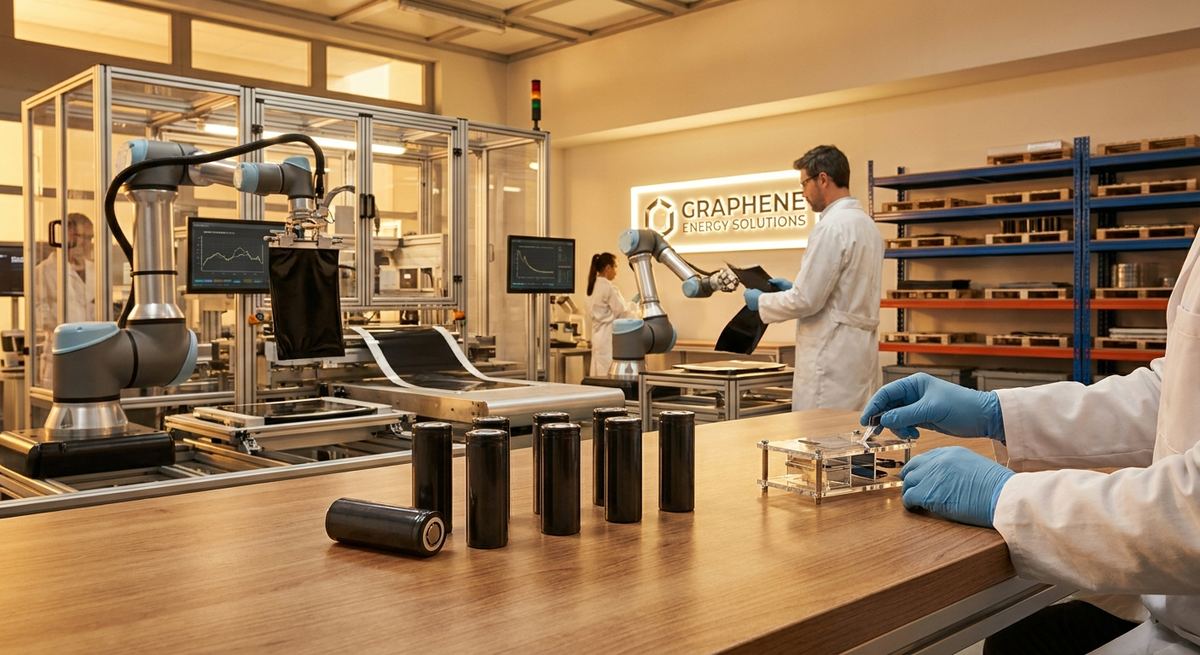
Energy storage is the ultimate bottleneck of modern technology. As the world rapidly electrifies, the demand for rapid-charging, long-lasting power sources is skyrocketing. Enter the graphene supercapacitor. For hardware entrepreneurs, engineers, and dedicated makers, this represents a massive, untapped frontier. You no longer need a billion-dollar gigafactory to produce cutting-edge energy storage. With off-the-shelf laboratory equipment and commercially available nanomaterials, you can manufacture high-performance graphene supercapacitors and sell them to a hungry market. This guide will walk you through exactly how to build a profitable graphene supercapacitor business from the ground up, covering everything from your initial lab setup to your final pricing strategy.
To sell this technology, you must fundamentally understand how it differs from the status quo. Batteries store energy chemically. When you charge a lithium-ion battery, a chemical reaction occurs that takes hours to complete. This chemical process generates heat, causes physical expansion, and inevitably degrades the internal components. Most batteries are dead after a few thousand charge cycles.
Supercapacitors, on the other hand, store energy electrostatically. Imagine rubbing a balloon on your hair to create static electricity; there is no chemical reaction, just a physical gathering of electrons on a surface. Because of this, supercapacitors can charge and discharge in a matter of seconds. They can also perform this rapid cycling millions of times without any degradation whatsoever.
However, traditional supercapacitors have a major flaw: low energy density. They cannot hold as much total power as a lithium-ion battery because their energy capacity is strictly limited by the physical surface area of their internal electrodes.
This is where graphene changes the entire paradigm. Graphene is a single layer of carbon atoms arranged in a hexagonal lattice. It is highly conductive and possesses a massive surface area. A single gram of graphene can cover an entire football field. By coating supercapacitor electrodes with graphene, you exponentially increase the surface area available for electrons to cling to. Graphene supercapacitors bridge the gap, offering the rapid charge times and infinite lifespan of a capacitor with an energy density that begins to rival traditional batteries.
The global market for supercapacitors is growing at a massive compound annual growth rate. While massive multinational corporations are focused on grid-scale storage and electric vehicle regenerative braking systems, there is a massive void in the middle and lower tiers of the market. Fast-charging energy storage is becoming an absolute necessity for consumer electronics, robotics, and remote sensors.
Standard capacitors simply do not hold enough charge for these modern applications, and lithium batteries wear out far too quickly in high-cycle environments. Small-scale manufacturers can thrive by targeting specialized applications where users need rapid bursts of power, extreme temperature tolerance, and zero maintenance. The maker movement, custom automotive communities, and the Internet of Things industry are desperate for reliable, high-capacity graphene supercapacitors. Furthermore, they are willing to pay a premium for specialized form factors that large corporate manufacturers completely ignore.
Setting up a micro-fabrication lab is more accessible today than at any point in history. You do not need a multi-million-dollar cleanroom. You can establish a highly functional pilot production line in a well-ventilated garage, basement, or leased commercial space for under $10,000. Here is your essential equipment list and estimated startup costs.
First, you need a ductless fume hood for handling solvents safely, which will cost around $800 on the used market. Next, a planetary centrifugal mixer is required to create a uniform, clump-free graphene slurry, costing roughly $1,500. To apply the slurry to your current collectors, you will need a motorized film applicator or a spin coater, which runs about $500.
A vacuum drying oven is absolutely essential for removing solvents from your coated electrodes without oxidizing the graphene, costing around $1,000. For assembly, you must have an argon-filled glovebox. Moisture is the enemy of supercapacitor electrolytes, and a basic acrylic glovebox with gas purging capabilities costs around $1,500. Finally, a coin cell crimper or pouch cell heat sealing machine will cost $800, and a basic multi-channel battery testing analyzer for quality control will run about $2,000.
For your initial raw materials, you will need Graphene Oxide powder ($100 per gram, though bulk pricing drops significantly), conductive carbon black ($30 per kilogram), PVDF binder ($50 per kilogram), NMP solvent ($40 per liter), and an organic electrolyte like TEABF4 in Acetonitrile ($150 per liter). Aluminum foil current collectors and cellulose separator paper will cost another $200. Your total initial capital expenditure will sit comfortably between $8,000 and $10,000.
Manufacturing graphene supercapacitors is a precise process of mixing, coating, drying, and sealing. Here is the practical recipe for producing your first batch.
Step One is creating the electrode slurry. In your planetary mixer, combine 80 percent reduced graphene oxide powder, 10 percent conductive carbon black, and 10 percent PVDF binder. Add the NMP solvent drop by drop until the mixture reaches the consistency of thick honey. The carbon black improves electrical conductivity between the graphene flakes, while the PVDF acts as a glue to hold the powder together.
Step Two is coating. Place a sheet of etched aluminum foil on your motorized film applicator. Pour a line of the slurry at the top of the foil and use a doctor blade set to a thickness of 100 micrometers to spread the slurry evenly across the foil.
Step Three is drying and calendering. Move the coated foil into your vacuum oven set to 120 degrees Celsius for twelve hours. This evaporates the toxic NMP solvent safely, leaving a solid, dry graphene film. Once dry, pass the foil through a rolling press, or calender, to compress the material. This increases the density of the electrode and ensures perfect electrical contact with the aluminum backing.
Step Four is cutting and assembly. Use a precision punch to cut the coated foil into circular discs for coin cells or rectangles for pouch cells. You will need two identical electrodes for each capacitor.
Step Five is the critical environment phase. Move your electrodes, your cellulose separator material, and your liquid electrolyte into the argon-filled glovebox. Inside the glovebox, sandwich a piece of the separator between the two graphene electrodes. Place this sandwich into your metal coin cell casing or aluminum laminated pouch. Inject a few drops of the TEABF4 electrolyte, ensuring the separator is fully saturated. Finally, use your crimper or heat sealer to hermetically seal the cell before removing it from the glovebox.
You cannot sell a product without verifying its specifications. Quality control is what separates a legitimate energy storage business from a weekend hobbyist. You must test for specific capacitance, equivalent series resistance, and cycle life.
You will use your multi-channel battery analyzer to perform Cyclic Voltammetry and Galvanostatic Charge-Discharge testing. Galvanostatic testing involves charging the supercapacitor at a constant current until it reaches its maximum voltage, typically 2.7 volts for organic electrolytes, and then discharging it at the same rate. By measuring the exact time it takes to discharge, you can calculate the true capacitance in Farads.
Equivalent series resistance, or ESR, is measured by observing the immediate voltage drop the exact millisecond the discharge cycle begins. A lower ESR means the capacitor can deliver power faster and with less waste heat. To test cycle life, you will program your analyzer to charge and discharge the cell continuously for 10,000 cycles. A high-quality graphene supercapacitor should retain at least 90 percent of its original capacitance after this burn-in test. Document these results meticulously. You will use these graphs in your marketing to prove the legitimacy of your product.
Competing with major manufacturers on standard, mass-market components is a race to the bottom. Your business model must focus on niche applications where buyers value extreme performance and custom configurations.
The custom car audio market is a highly lucrative target. High-end subwoofers draw massive surges of current that standard 12-volt car batteries simply cannot deliver quickly enough, resulting in headlight dimming and distorted bass. Large graphene supercapacitor banks, often called stiffening caps, provide instantaneous power to amplifiers. By wiring six 2.7-volt capacitors in series with a balancing board, you can create a 16.2-volt module perfect for the automotive market.
Another excellent niche is the maker electronics and robotics community. Hobbyists building Arduino or Raspberry Pi projects frequently need uninterruptible power supplies. A small graphene supercapacitor module can keep a single-board computer running for the crucial ten seconds it takes to safely save data and shut down during a power outage.
Furthermore, off-grid solar builders use supercapacitors to handle the heavy surge loads of starting well pumps, refrigerators, or power tools. This protects their expensive lithium battery banks from extreme strain. By designing supercapacitor modules specifically tailored with the correct voltage regulators and mounting brackets for these communities, you instantly differentiate your product from generic overseas imports.
Your packaging must reflect the premium, high-tech nature of graphene. Do not ship raw, unlabeled metal pouches or bare aluminum cylinders. For cylindrical or custom-bank capacitors, use thick, matte black PVC heat shrink tubing. Design a sleek, minimalist label using a vinyl cutter or order custom industrial decals. The label must clearly state the capacitance, maximum voltage, operating temperature range, and polarity. Do not underestimate visual appeal; engineers and makers love beautifully designed hardware.
For online sales, Tindie is the absolute best marketplace for maker-focused electronics. It caters specifically to hardware hackers who understand the value of a custom graphene supercapacitor UPS hat for a Raspberry Pi. Amazon is essential for broader reach, particularly for car audio capacitors and solar buffer modules.
Create a dedicated Shopify store to act as your brand headquarters. This site should feature your testing data, white papers, and detailed tutorials on how to integrate your supercapacitors into various projects. Content marketing is your best sales tool. Film YouTube videos demonstrating your supercapacitor starting a car without a battery, powering a heavy-lift drone, or surviving extreme freezing temperatures where normal batteries completely fail.
While direct-to-consumer sales on Amazon and Shopify provide immediate cash flow, business-to-business contracts are the key to long-term wealth and true scalability. Your ultimate goal is to become the OEM energy storage provider for boutique hardware companies.
Identify mid-sized manufacturers of drones, agricultural IoT sensors, and specialized medical devices. These companies often struggle with battery lifespan in harsh environments. A remote weather sensor in the desert might kill a lithium battery in a single year due to the extreme heat, but a graphene supercapacitor will last a decade without issue.
Reach out to the lead hardware engineers at these companies via LinkedIn or email. Do not send a generic sales pitch. Instead, offer a free, custom-tailored sample kit. Send them a beautifully packaged evaluation board featuring your graphene supercapacitors, complete with a data sheet detailing your cycle life tests and ESR ratings. Offer to customize the physical form factor to fit their specific enclosures. Securing just two or three B2B clients who order a thousand units a month will provide the stable, recurring revenue needed to expand your manufacturing line.
The profit margins in boutique nanomaterial energy storage are exceptionally high if you control the manufacturing process. Let us break down the unit economics of a standard 100-Farad, 2.7-volt graphene supercapacitor.
The raw materials, including the aluminum foil, graphene oxide, conductive additives, binders, separator, and electrolyte, cost approximately $2.50 per unit when purchased in moderate bulk. The casing and packaging add another $0.50. Factoring in electricity and equipment depreciation, your total cost of goods sold is roughly $3.50 per unit.
In the retail market, a high-performance 100-Farad graphene supercapacitor can easily sell for $15.00 to $20.00. That is a gross margin of over 75 percent. If you assemble six of these into a 12-volt bank for car audio with a $15 balancing board, your total cost is roughly $36, but you can retail the completed module for $150.
When selling B2B in volumes of 1,000 units, you can offer a wholesale price of $9.00 per unit. This maintains a highly lucrative 60 percent margin while saving the client money compared to larger corporate suppliers. As you scale and begin purchasing graphene oxide and electrolytes by the barrel rather than the liter, your cost of goods sold will plummet, pushing your margins even higher.
Once your pilot lab is consistently generating revenue and you have saturated your initial niches, it is time to scale. The first expansion path is upgrading from batch processing to roll-to-roll manufacturing. This involves purchasing automated coating and calendering machines that process hundreds of meters of electrode foil continuously, exponentially increasing your daily production capacity.
The second path is vertical integration. Instead of buying expensive graphene oxide powder from third parties, you can invest in the chemical reactors to synthesize your own graphene from raw graphite using the modified Hummers method. This drastically reduces your material costs and allows you to control the exact specifications of the nanomaterial.
Finally, you can expand your product line into hybrid lithium-ion capacitors. By using a graphene capacitor electrode on one side and a lithium battery electrode on the other, you create a device that offers the best of both worlds: the high energy density of a battery with the rapid charging speed of a supercapacitor. This hybrid technology is the holy grail of modern energy storage. By mastering pure graphene supercapacitors first, your business will be perfectly positioned to pioneer the hybrid market and dominate the future of power.
Serious about B2B integration? Test our premium Pulsed Electrical Resistive Carbon Heating turbostratic graphene in your lab. 100g sample packs available now.
Explore More
Twisted trilayer graphene allows for remote electronic control of a decoupled layer, a breakthrough in moiré physics that could enable cleaner quantum devices.

Learn a practical, polymer-free method for building a graphene FET using muscovite mica for clean transfer, assembly, and contact patterning.

New research reveals that graphene can accept energy from a 2D semiconductor in a highly selective, momentum-dependent way, paving the path for next-gen...