
Remote Moiré Modulation in Twisted Trilayer Graphene for Future Electronics
Twisted trilayer graphene allows for remote electronic control of a decoupled layer, a breakthrough in moiré physics that could enable cleaner quantum devices.
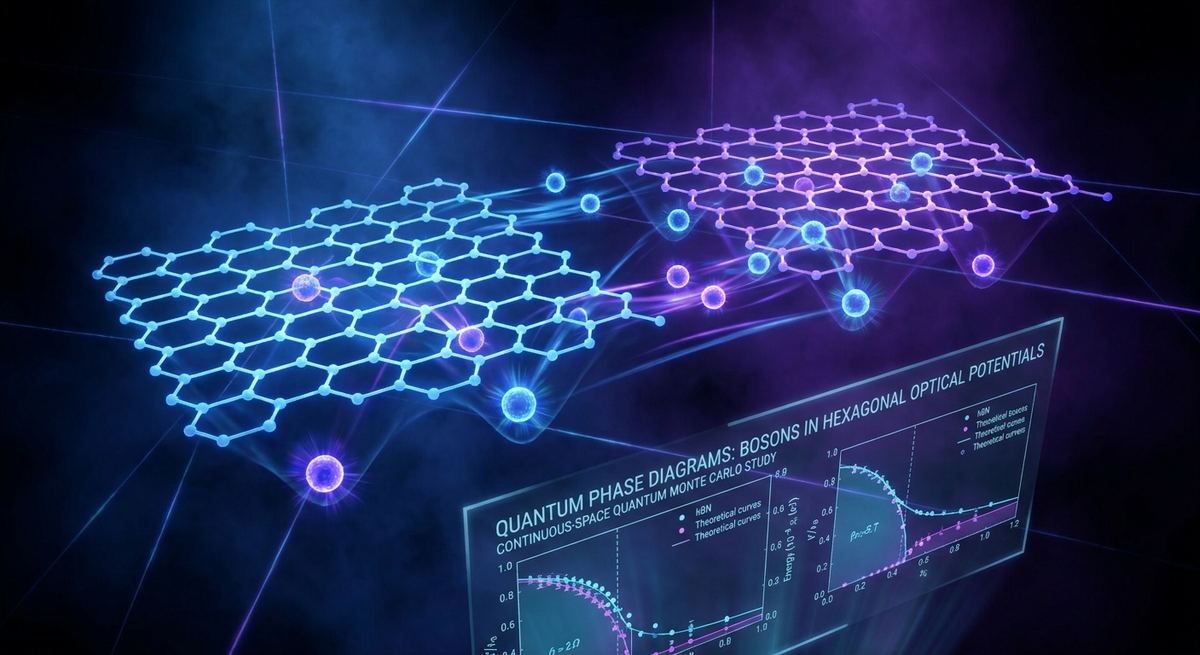
The intersection of condensed matter physics and quantum optics has birthed one of the most exciting fields in modern science: quantum simulation. For years, materials like graphene and hexagonal boron nitride have captivated researchers with their unique electronic properties, stemming directly from their hexagonal lattice structures. However, studying the fundamental quantum mechanics of interacting particles within these solid-state materials is notoriously difficult due to impurities, lattice defects, and the uncontrollable nature of electron-electron interactions. Enter the realm of ultracold atoms in optical lattices. By using laser beams to create perfect, defect-free crystals of light, physicists can trap ultracold atoms in geometries that mimic graphene and hexagonal boron nitride. A recent breakthrough study titled Quantum phase diagrams for bosons in hexagonal optical potentials: A continuous-space quantum Monte Carlo study has pushed the boundaries of what we know about these systems. By employing advanced continuous-space exact diagonalization and quantum Monte Carlo simulations, researchers have uncovered critical deviations from standard theoretical models, revealing a hidden world of suppressed insulating phases and intricate quantum phase diagrams. This article explores the profound implications of these findings for the future of quantum materials and synthetic graphene systems.
To truly appreciate the magnitude of this recent study, one must first understand the architecture of quantum simulators. In traditional solid-state materials like true graphene, electrons navigate a honeycomb arrangement of carbon atoms. The physics governing these electrons is dictated by the Fermi-Dirac statistics, as electrons are fermions. However, the true power of an optical lattice lies in its sheer versatility. By interfering multiple laser beams in a high-vacuum chamber, researchers create a standing wave of light. This light creates a periodic potential energy landscape, much like an egg carton, where atoms can be trapped in the localized minima.
Unlike real materials, these optical lattices can be dynamically tuned. The depth of the lattice can be adjusted by changing the laser intensity, and the geometry can be altered by changing the angle and phase of the intersecting beams. Furthermore, researchers can choose to populate these artificial crystals with either fermions or bosons. The study in question focuses on ultracold bosons, such as rubidium or potassium atoms cooled to a fraction of a degree above absolute zero. Bosons, obeying Bose-Einstein statistics, can occupy the same quantum state, leading to macroscopic quantum phenomena like superfluidity.
Simulating graphene with bosons offers a unique window into strongly correlated quantum matter. While fermionic graphene is renowned for its Dirac cones and massless charge carriers, bosonic graphene allows researchers to explore the interplay between kinetic energy and strong repulsive interactions in a hexagonal geometry. The transition between a fluid-like state where atoms flow without friction and an insulating state where atoms are pinned to the lattice sites is a central theme in many-body physics. The optical lattice provides the ultimate pristine playground to observe these phase transitions, free from the messy realities of chemical synthesis and material imperfections.
For decades, the standard theoretical framework for understanding interacting bosons in a lattice has been the Bose-Hubbard model. This model is celebrated for its elegant simplicity. It relies on two primary parameters: the hopping amplitude, which describes the kinetic energy associated with a particle tunneling from one lattice site to a neighboring site, and the on-site interaction energy, which represents the repulsive energy cost when two particles occupy the exact same lattice site.
In the traditional Bose-Hubbard model, the phase diagram is characterized by a competition between these two parameters. When the hopping amplitude dominates, the particles are delocalized across the entire lattice, forming a superfluid phase. The system exhibits phase coherence, and the atoms behave as a single macroscopic quantum wave. Conversely, when the repulsive interaction dominates, typically achieved by cranking up the intensity of the optical lattice lasers to make the potential wells deeper, the particles become localized. The system enters a Mott insulator phase, characterized by an integer number of atoms pinned to each lattice site and a complete loss of global phase coherence.
However, the standard Bose-Hubbard model is an approximation. It assumes that the spatial wavefunctions of the atoms are highly localized, known as the lowest-band Wannier function approximation. It neglects higher-orbital bands, long-range interactions, and, crucially, density-dependent tunneling effects. The recent study demonstrates unequivocally that for hexagonal optical potentials, this standard model falls drastically short. The unique geometry of the honeycomb lattice, combined with the continuous nature of the spatial potential, introduces complex dynamics that the standard Bose-Hubbard model simply cannot capture. Relying on this simplified model for artificial graphene leads to inaccurate predictions of the phase boundaries and the fundamental nature of the quantum states involved.
To overcome the limitations of the Bose-Hubbard model, the researchers turned to a far more sophisticated and computationally demanding approach: continuous-space quantum Monte Carlo simulations. Unlike lattice models that restrict particles to perfectly discrete points in space, continuous-space methods treat the positions of the particles as continuous variables in the actual sinusoidal potential created by the laser beams. This is a crucial distinction because it allows the simulation to naturally incorporate all the complex orbital physics, band excitations, and non-standard interactions that are artificially truncated in the tight-binding approximations.
Quantum Monte Carlo is a stochastic numerical method used to evaluate the complex multidimensional integrals inherent in many-body quantum mechanics. By mapping the quantum system onto an equivalent classical system spanning an extra dimension corresponding to imaginary time, the algorithm samples the statistical mechanics of the interacting bosons exactly, subject only to statistical error bars. The continuous-space variant, often implemented via the path-integral formulation, constructs world-lines that trace the trajectories of the bosons through space and imaginary time.
This methodology is a computational paradigm shift for studying hexagonal optical lattices. By avoiding the projection onto a localized basis, the continuous-space quantum Monte Carlo approach captures the true extended nature of the atomic wavefunctions, especially when the lattice is relatively shallow or when interactions cause the wavefunctions to swell and overlap. The researchers also utilized continuous-space exact diagonalization for smaller system sizes to benchmark their results and gain deep insights into the microscopic wavefunctions. This dual-method approach provides an unprecedented, high-fidelity map of the quantum phase diagram, revealing phenomena that are entirely invisible to the standard theoretical toolkit.
The application of continuous-space quantum Monte Carlo to the symmetric honeycomb lattice, the direct analog of graphene, yielded surprising and profound results. The most striking discovery was the significant deviation from the Bose-Hubbard phase diagram, even in regimes where the lattice was considered strongly interacting. Specifically, the researchers observed a dramatic suppression of the Mott insulator lobes.
In a typical square lattice, as the interaction strength increases, one expects to see a series of Mott insulator phases corresponding to one, two, three, or more particles per site. In the honeycomb lattice, however, the continuous-space simulations revealed that the primary Mott insulator lobe, corresponding to one particle per site, is significantly smaller than predicted by the standard model. Even more astonishing is the complete absence of higher-order insulating phases. Mott insulators with two or more particles per site simply do not materialize in this geometry under the studied conditions.
The physical mechanism driving this suppression is identified as strong density-assisted tunneling. In the standard model, the probability of a particle hopping to a neighboring site is considered independent of the presence of other particles. In reality, when two particles occupy the same site or adjacent sites, their strong repulsive interaction alters their spatial wavefunctions. They push each other outward, effectively broadening their presence in the potential well. This broadening drastically increases the overlap with the wavefunction of a neighboring site, thereby enhancing the tunneling rate.
In the honeycomb lattice, this density-assisted tunneling acts as a powerful catalyst for superfluidity. The enhanced mobility of the particles counteracts the localizing effect of the repulsive interactions. Consequently, the superfluid phase encroaches deeply into the territory that would otherwise be occupied by the Mott insulator. For fillings higher than one particle per site, the density-assisted tunneling becomes so dominant that it entirely destabilizes the localized state, preventing the formation of higher-order Mott lobes altogether. This revelation fundamentally alters our understanding of bosonic artificial graphene, showing it to be inherently more fluid than previously imagined.
The researchers did not stop at the symmetric honeycomb lattice; they extended their continuous-space investigation to the hexagonal boron nitride geometry. In real hexagonal boron nitride, the lattice consists of alternating boron and nitrogen atoms. Because these atoms are different elements, they present different electrostatic potentials to the electrons. This breaks the inversion symmetry of the lattice, meaning that the two triangular sublattices that make up the honeycomb structure are no longer energetically equivalent.
In the realm of optical lattices, this broken inversion symmetry can be beautifully engineered. Experimentalists can superimpose an additional triangular optical lattice onto the primary honeycomb lattice. By carefully tuning the phase between these laser patterns, they can introduce an energy offset between sublattice A and sublattice B. One sublattice becomes a set of deep potential wells, while the other becomes a set of shallower wells. This creates an artificial hexagonal boron nitride crystal.
Introducing this energy offset, often denoted as a parameter delta, adds a massive layer of complexity to the system. The bosons must now navigate a landscape where they not only experience kinetic hopping and repulsive interactions but also a fundamental preference to reside in the deeper wells of one specific sublattice. The competition between the tendency to minimize potential energy by crowding into the deep wells and the tendency to minimize interaction energy by spreading out evenly across both sublattices gives rise to a highly non-trivial quantum many-body problem.
The phase diagram that emerges from the continuous-space quantum Monte Carlo simulations of the artificial hexagonal boron nitride lattice is a rich and intricate tapestry, vastly different from the symmetric graphene case. The broken inversion symmetry resurrects the Mott insulator phases, but in a highly complex manner governed by the specific sublattice occupations.
Because of the energy offset, the system can form Mott insulators where the number of particles on sublattice A differs from the number of particles on sublattice B. As the overall particle density is varied, the system undergoes a series of transitions through different commensurate localized states. For instance, at low densities, the particles might entirely populate the deeper sublattice A, leaving sublattice B empty, forming a specific type of Mott insulator. As the density increases, the interaction energy penalty of putting more particles into sublattice A eventually outweighs the potential energy cost of occupying the shallower sublattice B.
This interplay results in multiple, distinct Mott insulator lobes in the phase diagram, characterized by different combinations of sublattice fillings. The researchers meticulously mapped these boundaries, showing how the lobes grow, shrink, and shift depending on the exact magnitude of the lattice asymmetry and the interaction strength. The continuous-space treatment proved essential here, as the localized wavefunctions in the shallow and deep wells differ significantly in their spatial extent, heavily influencing both the on-site interactions and the tunneling rates between the unequal sites. Capturing this physics requires the exact spatial resolution that only continuous-space simulations can provide.
The theoretical predictions laid out in this study are not mere mathematical curiosities; they serve as a direct roadmap for the next generation of ultracold atom experiments. The technology to create these specific hexagonal and asymmetric optical lattices already exists in several cutting-edge laboratories around the world. The challenge now is to probe the system with enough precision to verify the presence of density-assisted tunneling and the complex sublattice-dependent Mott lobes.
One of the most promising tools for this task is the quantum gas microscope. These advanced optical systems allow researchers to image individual atoms residing in the optical lattice with single-site resolution. By taking snapshot images of the atomic distribution, experimentalists can directly measure the local density and observe the sublattice populations in the hexagonal boron nitride analog. They can visually confirm whether the atoms are localized in a Mott insulator or fluctuating in a superfluid state.
Furthermore, techniques such as lattice modulation spectroscopy or time-of-flight imaging can be used to probe the excitation spectra and the phase coherence of the system. The continuous-space quantum Monte Carlo results provide precise quantitative benchmarks for these experiments. If the experimental data aligns with the continuous-space predictions rather than the standard Bose-Hubbard model, it will definitively prove that density-assisted tunneling and multi-orbital effects are not negligible corrections, but fundamental drivers of the quantum physics in these hexagonal geometries.
Question: What exactly is a hexagonal optical lattice and how does it mimic graphene?
Answer: A hexagonal optical lattice is an artificial crystal created by interfering multiple laser beams in a vacuum. The light creates a periodic pattern of high and low intensity, which acts as a potential energy landscape for ultracold atoms. By arranging the lasers at specific angles, typically 120 degrees apart, the resulting potential wells form a honeycomb pattern, structurally identical to the arrangement of carbon atoms in a single layer of graphene. This allows physicists to study graphene-like physics in a highly controlled, tunable environment without the impurities found in real materials.
Question: Why does this study focus on bosons instead of fermions, since electrons in real graphene are fermions?
Answer: While electrons are indeed fermions, using ultracold bosons in artificial graphene allows researchers to explore entirely different, yet equally fundamental, quantum phenomena. Bosons can occupy the same quantum state and form superfluids, a state of matter with zero viscosity. Studying bosons in a honeycomb lattice helps physicists understand how the unique Dirac-like energy bands and the specific geometry of the lattice affect the transition between a flowing superfluid and a frozen Mott insulator. It provides a complementary perspective to fermionic systems, expanding our general understanding of strongly correlated quantum matter.
Question: The article mentions density-assisted tunneling. What is this phenomenon and why is it important?
Answer: Density-assisted tunneling is a quantum mechanical effect where the probability of a particle hopping from one lattice site to another is influenced by the presence of other particles nearby. In standard models, hopping is considered an independent event. However, when atoms repel each other strongly, they push against the confines of their potential wells, causing their spatial wavefunctions to spread out. This spreading increases the overlap with neighboring sites, making it easier for them to tunnel. The study found that in honeycomb lattices, this effect is so strong that it significantly enhances superfluidity and prevents the formation of highly populated insulating states.
Question: How does the artificial hexagonal boron nitride lattice differ from the artificial graphene lattice?
Answer: Structurally, both are based on a hexagonal geometry. However, graphene has a symmetric honeycomb lattice where every site is energetically identical. Hexagonal boron nitride, consisting of alternating boron and nitrogen atoms, has broken inversion symmetry. In an optical lattice, this is simulated by making one set of alternating sites deeper than the other. This creates an energy offset between the two sublattices. This asymmetry drastically changes the physics, creating a complex competition between the atoms wanting to sit in the deeper wells and wanting to avoid each other due to repulsive interactions, leading to a much more complicated phase diagram.
Question: Why was continuous-space quantum Monte Carlo necessary for this study? Could they not use simpler mathematical models?
Answer: Simpler models, like the standard Bose-Hubbard model, rely on approximations that assume the particles are strictly confined to the very bottom of the lattice sites. They ignore the continuous spatial nature of the laser potential and overlook complex interactions like density-assisted tunneling. Because the researchers were investigating regimes where interactions are strong and particles spread out, these approximations fail. Continuous-space quantum Monte Carlo is an exact numerical method that simulates the particles moving through the actual continuous potential energy landscape. It is computationally expensive but necessary to capture the true, unapproximated quantum physics of the system.
The exploration of quantum phase diagrams for bosons in hexagonal optical potentials marks a critical turning point in the field of quantum simulation. By moving beyond the simplified approximations of the standard Bose-Hubbard model and embracing the rigorous, computationally intensive continuous-space quantum Monte Carlo methodology, researchers have unveiled a far richer and more dynamic quantum landscape. The discovery of heavily suppressed Mott insulators due to density-assisted tunneling in the honeycomb lattice, and the emergence of a complex tapestry of sublattice-dependent insulating phases in the hexagonal boron nitride analog, challenges our preconceived notions of strongly correlated matter. As experimental techniques continue to advance, allowing for unprecedented control and imaging of ultracold atoms, the insights gained from this study will be instrumental in guiding future discoveries. Ultimately, this research not only deepens our fundamental understanding of artificial graphene systems but also paves the way for the design and realization of novel quantum materials with tailored properties, solidifying the role of optical lattices as the premier platform for quantum discovery.
Serious about B2B integration? Test our premium Pulsed Electrical Resistive Carbon Heating turbostratic graphene in your lab. 100g sample packs available now.
Explore More
Twisted trilayer graphene allows for remote electronic control of a decoupled layer, a breakthrough in moiré physics that could enable cleaner quantum devices.

Learn a practical, polymer-free method for building a graphene FET using muscovite mica for clean transfer, assembly, and contact patterning.

New research reveals that graphene can accept energy from a 2D semiconductor in a highly selective, momentum-dependent way, paving the path for next-gen...