
Graphene Nanoplasmonics: Tuning Scintillators for Better Medical Imaging
Explore how researchers are using graphene-based nanoplasmonic scintillators to tune light-matter interactions, paving the way for faster, more sensitive...
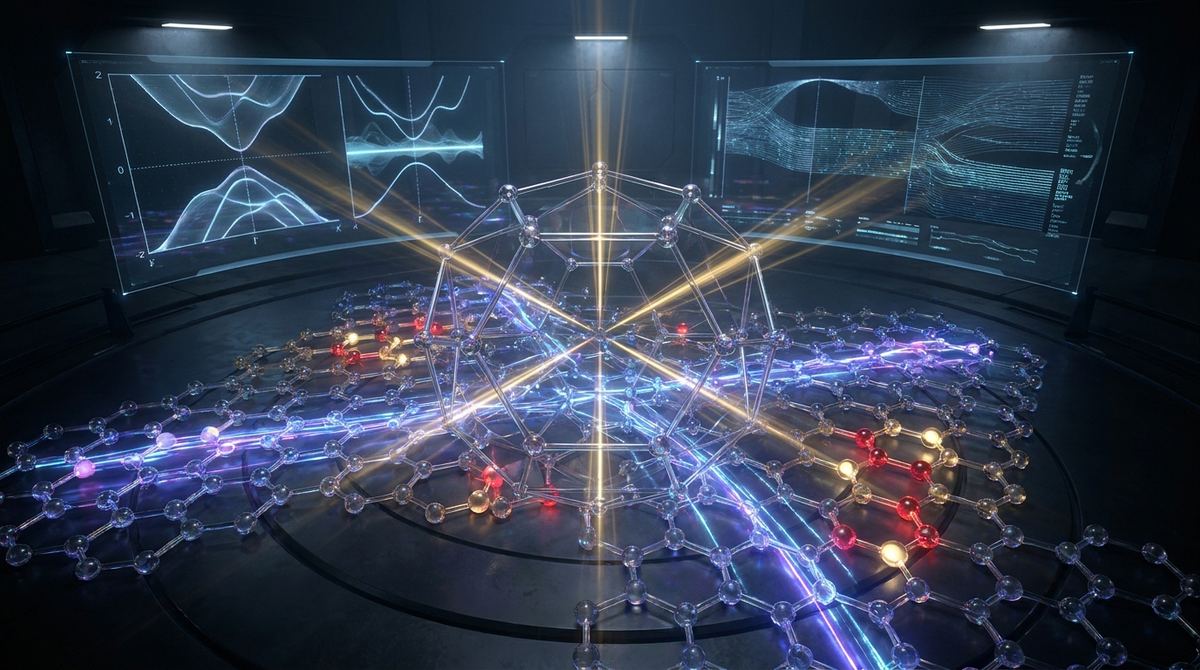
Graphene, the celebrated one-atom-thick sheet of carbon atoms arranged in a hexagonal lattice, continues to captivate the scientific community with its unparalleled electronic and mechanical properties. Its exceptional electron mobility and thermal conductivity hold immense promise for next-generation electronics, ranging from ultrafast transistors to highly efficient sensors. However, a significant hurdle in graphene's path to widespread technological adoption is its intrinsic lack of a band gap. As a semimetal, graphene possesses Dirac cones where the conduction and valence bands meet at specific points (K and K' points) in its Brillouin zone, leading to zero band gap. This characteristic, while responsible for its high electron mobility, makes it difficult to switch current on and off effectively, a fundamental requirement for transistors and other digital electronic components.
Numerous strategies have been explored to induce a band gap in graphene, including quantum confinement in nanoribbons, doping with foreign atoms, applying electric fields in bilayer graphene, and introducing strain. While each approach offers unique advantages, they often come with trade-offs in terms of material quality, scalability, or the size and tunability of the induced gap. A recent groundbreaking study by Diyan Unmu Dzujah, Hongde Yu, and Thomas Heine offers a sophisticated, symmetry-based route to band-gap opening through the strategic placement of periodic π-vacancies in graphene superlattices (GSLs). Their work, detailed in their paper, provides crucial guidelines for designing these superlattices to effectively modify graphene's electronic band structure and achieve the elusive band gap.
A graphene superlattice is essentially a periodic modulation of the graphene lattice, which can be achieved by various means, such as placing it on a periodically structured substrate, introducing periodic strain, or, as in this research, by creating a periodic distribution of vacancies. The core idea behind superlattices is to introduce a new, larger periodicity that 'folds' the original Brillouin zone. This folding can bring the K and K' Dirac points from the corners of the original hexagonal Brillouin zone to the Γ point (the center of the new, smaller superlattice Brillouin zone). When these Dirac points coincide at Γ, and the symmetry of the superlattice is appropriately broken, the degeneracy can be lifted, leading to the opening of a band gap.
In this context, π-vacancies are not simply missing carbon atoms in the traditional sense, but rather represent sites where the π-electron system is locally disrupted. This disruption can arise from various physical phenomena: actual missing carbon atoms, functionalization of specific carbon sites with chemical groups, or substitution of carbon atoms with other elements that do not contribute to the π-electron system. The authors model these π-vacancies as site deletions, meaning all hopping matrix elements (representing the probability of an electron jumping between adjacent carbon atoms) to and from the deleted sites are set to zero. This effectively removes the pz orbital contribution from these sites, directly impacting the π-band dispersion, which is crucial for graphene's electronic properties.
To investigate the intricate interplay between vacancy patterns and electronic structure, Dzujah, Yu, and Heine employed a nearest-neighbor tight-binding model. This theoretical framework is a powerful and computationally efficient tool for studying the electronic properties of materials, particularly those with strong covalent bonding like graphene. In this model, it is assumed that electrons are tightly bound to individual atoms and can only 'hop' to their nearest neighbors. For graphene, this typically involves considering one pz orbital per carbon site, which forms the delocalized π-electron system responsible for its unique electrical conductivity.
By simplifying the complex quantum mechanical interactions, the tight-binding model allows researchers to systematically explore how different arrangements of π-vacancies affect the energy levels and electron pathways within the graphene lattice. The 'site deletion' approach for vacancies is a straightforward yet effective way to simulate the local perturbation to the π-system, enabling the researchers to precisely identify the symmetry requirements for band gap opening without the heavy computational cost of more elaborate ab initio methods for large superlattice structures.
The key to opening a band gap in graphene via superlattices lies in the phenomenon of band folding. Graphene's pristine band structure exhibits Dirac cones at the K and K' points. For a band gap to open at the Γ point of the superlattice Brillouin zone – which is often the most desirable location for device applications due to zero momentum – the K and K' points of the original graphene Brillouin zone must be 'folded' onto the Γ point of the superlattice. This occurs when the superlattice periodicity is commensurate with the original graphene lattice in a specific way.
The research highlights the importance of using 3n x 3n graphene superlattices, where 'n' is an integer scaling factor (1, 2, 3, etc.) multiplying the primitive cell vectors of pristine graphene. This specific scaling ensures that the K and K' points of the original graphene Brillouin zone are precisely mapped to the Γ point of the superlattice Brillouin zone. This condition is a fundamental prerequisite for the possibility of a band gap opening at Γ. Without this precise folding, the Dirac cones would remain at different points in the superlattice Brillouin zone, making it much harder to achieve a clean band gap opening at the center.
The study meticulously examines the impact of different vacancy symmetries on the Dirac cones. The first category investigated comprises π-vacancy motifs with C3 point-group symmetry. C3 symmetry implies that the vacancy pattern looks identical after a 120-degree rotation. Examples include a single carbon atom vacancy (monovacancy) or a cluster of three vacancies arranged in a triangle.
For C3-type vacancies, the research found that the Dirac cones remain robustly pinned at high-symmetry points in the Brillouin zone. Consequently, in the context of the essential 3n x 3n GSLs, these C3-symmetric vacancy patterns ensure that the folded Dirac cones stay precisely at the Γ point. This stability is highly advantageous for band gap engineering. When the Dirac cones are pinned at Γ, the conditions are optimal for the superlattice potential to lift the degeneracy and open a clear band gap, making C3-symmetric vacancy patterns a promising candidate for controlled band gap induction.
The behavior of C2-type vacancies (which possess two-fold rotational symmetry, meaning they look the same after a 180-degree rotation) is more nuanced and reveals the deeper intricacies of symmetry's role. Here, the global point group symmetry of the entire graphene superlattice becomes a critical factor. The research distinguishes between two scenarios for C2 vacancies:
### Preserving D2h Symmetry: Cones Pinned at Γ
When C2-type vacancies are arranged in a pattern that reduces the global point group of the GSL to D2h symmetry, a specific and desirable outcome emerges. D2h symmetry is characterized by the presence of a center of inversion and three perpendicular mirror planes (specifically, a pair of perpendicular mirror symmetries, σv ⊥ σd, which pass through the carbon bonds and between them, respectively). These mirror planes act as powerful symmetry constraints. In such cases, the Dirac cones are constrained to remain at the Γ point within the 3n superlattice. The presence of these specific mirror symmetries dictates that the electronic states associated with the Dirac cones must transform in a particular way, effectively forcing their confluence at Γ. This makes GSLs with D2h symmetry and C2 vacancies also viable for opening a band gap at the center of the Brillouin zone.
### Absence of D2h Symmetry: Cones Shift Away from Γ
In contrast, when the C2-type vacancies do not preserve the D2h global point group of the GSL – specifically, when the crucial σv and σd mirror planes are absent – the behavior of the Dirac cones changes dramatically. Without these constraining mirror symmetries, the Dirac cones are no longer forced to remain at Γ. Instead, they are allowed to shift away from the Γ point to new positions, denoted as (±Δq, ±Δq), within the 3n superlattice Brillouin zone. This shifting means that even if a band gap were to open, it would not be at the Γ point, potentially complicating device design and operation. The absence of these specific mirror symmetries removes the electronic constraints that would otherwise keep the Dirac cones centered, highlighting the delicate balance between local vacancy symmetry and global superlattice symmetry in determining the electronic band structure.
These findings provide invaluable guidelines for experimentalists and theoretical materials scientists aiming to engineer graphene-based electronic devices. The precise control over vacancy patterns, even at the atomic scale, is a significant challenge. However, advancements in techniques like focused electron beam irradiation, scanning probe microscopy-assisted atomic manipulation, and sophisticated chemical functionalization methods are making such atomic-scale engineering increasingly feasible.
For practical applications, the ability to predictably open a band gap at the Γ point is highly desirable. This research indicates that designers should prioritize 3n x 3n superlattices and choose vacancy motifs that either exhibit C3 symmetry or, in the case of C2 symmetry, ensure that the global superlattice point group retains D2h symmetry with the perpendicular mirror planes. Understanding these symmetry rules will guide the rational design of functionalized graphene, allowing for the creation of robust and tunable band gaps, which is a critical step towards realizing graphene-based transistors, optoelectronic devices, and high-frequency electronics.
The work by Dzujah, Yu, and Heine represents a significant stride in our fundamental understanding of how to manipulate graphene's electronic properties. By elucidating the precise symmetry conditions required for band gap opening, they have provided a powerful theoretical framework that can accelerate the development of future graphene technologies. The insights gained from this research pave the way for more efficient design principles, moving beyond trial-and-error to a guided, symmetry-informed approach to materials engineering.
Future research may focus on experimentally validating these theoretical predictions, exploring the effects of different types of vacancies (e.g., adatoms, impurities), and investigating the tunability of the band gap size with varying vacancy concentrations and superlattice periodicities. The ultimate goal remains the creation of robust, scalable, and controllable graphene-based semiconductors that can seamlessly integrate into the next generation of electronic devices, leveraging graphene's extraordinary properties to their fullest potential. This symmetry-driven approach offers a compelling pathway to unlock graphene's vast promise.
### What is a band gap in graphene and why is it important?
A band gap is an energy range where no electron states can exist in a material. In semiconductors, electrons need to overcome this gap to move from the valence band to the conduction band, allowing for controlled switching of electrical current. Graphene naturally has no band gap (it's a semimetal), which makes it difficult to turn off current, thus limiting its use in transistors and other digital electronic devices. Opening a band gap is crucial for these applications.
### What are π-vacancies in this context?
In this research, π-vacancies are sites in the graphene lattice where the π-electron system is disrupted. This can be due to a missing carbon atom, a carbon atom substituted by another element that doesn't contribute to the π-system, or a carbon atom functionalized with a chemical group. They are modeled as site deletions where electron hopping is prevented, directly affecting the π-band structure.
### How do superlattices help open a band gap in graphene?
A graphene superlattice introduces a new, larger periodicity to the graphene lattice. This larger periodicity 'folds' the original electronic band structure, effectively mapping the K and K' Dirac points (where the conduction and valence bands meet) from the corners of graphene's Brillouin zone to the Γ point (the center) of the superlattice's Brillouin zone. When these points coincide at Γ, and certain symmetry conditions are met, the degeneracy can be lifted, opening a band gap.
### What is the significance of 3n x 3n superlattices?
3n x 3n superlattices (where 'n' is an integer) are specifically designed to ensure that the K and K' Dirac points of pristine graphene are precisely folded onto the Γ point of the superlattice Brillouin zone. This condition is a necessary prerequisite for a band gap to open at the Γ point, which is often the most desirable location for device applications.
### What is the difference between C2 and C3 vacancies in this context?
C3-type vacancies (e.g., a single missing atom or a triangular cluster) possess three-fold rotational symmetry. Due to this high symmetry, they tend to keep the folded Dirac cones pinned at high-symmetry points, specifically at Γ in 3n superlattices, which is favorable for band gap opening. C2-type vacancies (e.g., a pair of missing atoms) possess two-fold rotational symmetry. Their effect is more complex: they can either pin the cones at Γ (if the global superlattice maintains D2h symmetry with specific mirror planes) or allow the cones to shift away from Γ (if these mirror symmetries are absent).
### Why are mirror symmetries (σv, σd) important for C2 vacancies?
For C2-type vacancies, the presence of specific perpendicular mirror symmetries (σv and σd) that characterize the D2h point group of the overall superlattice is critical. These mirror planes act as symmetry constraints that force the Dirac cones to remain at the Γ point in the superlattice Brillouin zone. If these mirror symmetries are absent, the constraints are lifted, allowing the Dirac cones to shift away from Γ, potentially hindering the formation of a clean band gap at the Brillouin zone center.
Serious about B2B integration? Test our premium Pulsed Electrical Resistive Carbon Heating turbostratic graphene in your lab. 100g sample packs available now.
Explore More
Explore how researchers are using graphene-based nanoplasmonic scintillators to tune light-matter interactions, paving the way for faster, more sensitive...

Learn to build air-stable quantum circuit components using graphene-encapsulated superconductors. This guide details a practical fabrication process.

Researchers discover a moiré heterostructure with a unique "dual-flatness" electronic property, enabling continuous electrical tuning between exotic quantum...