
Practical Guide: Graphene-Released Membranes for Strain-Tunable Magnetic Devices
Learn to build a prototype strain-tunable magnetic device using graphene as a sacrificial layer to create freestanding MnPtGa membranes. This guide covers...
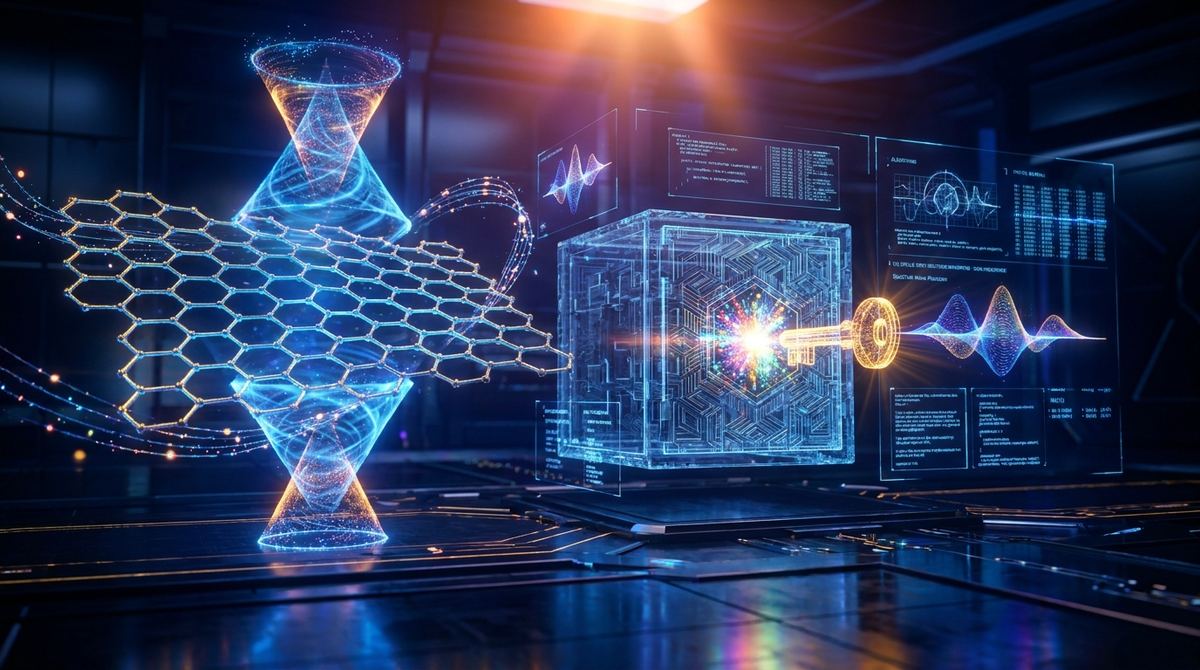
TITLE: Unlocking Quantum Secrets: New QMC Algorithm Reveals Critical Point in Graphene-like Dirac Fermion Systems
EXCERPT: Researchers have developed a new Quantum Monte Carlo algorithm to solve complex mathematical models describing Dirac fermions, potentially uncovering new quantum phases in materials like graphene.
IMAGE_PROMPT: A high-end scientific visualization of a two-dimensional lattice of interconnected quantum wavefunctions. The image should show a complex, undulating surface representing a topological landscape with subtle shifts in color to indicate different quantum phases. The aesthetic should be clean, professional, and cinematic, using a palette of deep blues, violets, and glowing cyan. 16:9 aspect ratio, no text, no labels, no watermark.
BODY:
The study of condensed matter physics is often a journey into the invisible, attempting to map the complex ways that electrons behave when they are packed tightly together in a material. In many common materials, electrons move somewhat independently, following predictable paths that allow us to understand conductivity and magnetism. However, in certain advanced materials, the electrons begin to act as a collective, their movements deeply intertwined through strong interactions. This phenomenon, known as strong correlation, leads to exotic states of matter that defy standard descriptions and hold the key to the next generation of quantum technologies.
To understand these exotic states, physicists rely on mathematical models that describe how particles interact. One of the most important classes of particles in this field is the Dirac fermion. Unlike standard electrons, which follow certain classical rules of motion, Dirac fermions behave as if they have no mass, moving through a crystal lattice at a constant speed, much like light. This unique behavior is a hallmark of graphene, a single layer of carbon atoms that has revolutionized our understanding of two-dimensional materials.
When these Dirac fermions are half-filled—meaning there is exactly one electron for every available state in the energy band—the physics becomes incredibly difficult to calculate. At this specific density, the interactions between electrons become dominant, and the standard mathematical tools used to predict material behavior begin to fail. This is because the electrons are no longer behaving like individual actors but are instead part of a highly synchronized, strongly correlated system.
The mathematical models used to describe these systems, such as the SO(5) nonlinear sigma model, are notoriously difficult to solve. They involve complex symmetries and topological terms, such as the Wess-Zumino-Witten term, which adds a layer of mathematical complexity that traditional computational methods struggle to handle. Without a way to solve these models, scientists cannot accurately predict the phase transitions—the points where a material might suddenly switch from being a conductor to an insulator, or from being magnetic to being a superconductor. This gap between theoretical models and computational capability prevents us from fully predicting how new 2D materials might behave before we actually manufacture them in a lab.
The research conducted by Yuan Da Liao, Bin-Bin Chen, Fakher F. Assaad, Lukas Janssen, and Zi Yang Meng aims to bridge this gap by introducing a new computational framework. Instead of trying to solve the equations through simple arithmetic, they used a method called Quantum Monte Carlo (QMC). This approach uses statistical sampling to find the most likely state of a quantum system, much like how a computer might simulate millions of dice rolls to determine the odds of a specific outcome.
The specific focus of their work was the SO(5) nonlinear sigma model combined with a Wess-Zumino-Witten (WZW) term. To understand this without the heavy math, imagine a landscape of hills and valleys. The SO(5) part of the model describes the general shape of this landscape, representing different ways the electrons can organize themselves. The WZW term acts like a topological twist in that landscape, creating "knots" or specific patterns that the electrons must follow. These twists can force the material into very specific, stable quantum states that wouldn't exist otherwise.
By creating a new algorithm capable of navigating this twisted landscape, the researchers were able to simulate how these Dirac fermions behave in a (2+1) dimensional spacetime. In this context, (2+1) dimensions refers to two dimensions of space (the flat plane of the material) and one dimension of time. This is the natural environment for materials like graphene, where the physics is essentially confined to a two-dimensional sheet.
The system described in this research is a theoretical model of half-filled Dirac fermions. In a real-world material like graphene, the "half-filled" state refers to the level at which the electronic energy bands are occupied. When the bands are exactly half-full, the system is at its most sensitive to interactions. This is where the competition between different types of order occurs. For example, the electrons might want to align their spins to create magnetism, or they might want to pair up to create superconductivity.
The researchers focused on how these different types of order compete or coexist. The SO(5) symmetry is a mathematical way of saying that several different types of physical order—such as different types of magnetism—are essentially equivalent or can transform into one another under certain conditions. This symmetry is a powerful tool because it simplifies the complex interactions into a more manageable mathematical structure.
The introduction of the Wess-Zumino-Witten term is what makes this specific problem so challenging and so interesting. In quantum field theory, this term represents a topological effect. It means that the state of the system depends not just on the local properties of the electrons, but on the overall "shape" or topology of the quantum wavefunction. This can lead to the emergence of new phases of matter that are protected by topology, meaning they are resistant to small disturbances or defects in the material. This topological protection is a holy grail for quantum computing, as it could allow for the creation of qubits that are much more stable than current versions.
Using their new Quantum Monte Carlo algorithm, the research team was able to map out the global phase structure of this complex model. Their most significant finding was the identification of a critical point within the system. In physics, a critical point is a specific set of conditions where a material undergoes a phase transition, similar to the point where water turns from a liquid to a gas.
By locating this critical point, the researchers have provided a roadmap for how these Dirac fermion systems behave as their interaction strengths change. They were able to show how the system moves between different quantum states as the parameters of the model are adjusted. This discovery is vital because it tells us exactly where the boundaries lie between different types of matter in these highly correlated systems.
Furthermore, the study demonstrated that their new computational framework is highly effective at handling the complexities introduced by the WZW term. This means that the algorithm can navigate the "topological twists" that previously made these models too difficult to simulate accurately. The ability to resolve these phase structures provides a theoretical confirmation that certain exotic quantum states are mathematically possible and stable within these models, providing a target for experimentalists to look for in real-world materials.
The implications of this research extend far beyond the realm of pure mathematics. By providing a way to solve these complex models, the researchers have given the scientific community a more powerful tool for material discovery. In the past, many theoretical predictions about new quantum states remained unverified because the math was too difficult to simulate. Now, with a more robust QMC algorithm, researchers can more accurately predict the properties of new two-dimensional materials before they are even synthesized in a laboratory.
This is particularly important for the development of topological quantum computers. One of the biggest hurdles in quantum computing is decoherence, where the quantum state of a system is destroyed by environmental noise. Materials that host topologically protected states, like those described by the WZW term, are much more resilient to this noise. By understanding the phase diagrams and critical points of these systems, scientists can better identify which materials are most likely to host these stable, protected states.
Additionally, this work contributes to our understanding of high-temperature superconductivity and other strongly correlated phenomena. Many of the most interesting materials in modern physics do not follow the simple rules of traditional solid-state physics. Understanding the fundamental "dance" of electrons in Dirac fermion systems helps us build a more complete picture of how matter behaves at the most fundamental level, which is essential for designing next-generation electronic and quantum devices.
It is important to note that this research is a theoretical and computational study. The researchers have solved a mathematical model that is highly relevant to graphene, but they have not conducted experiments on physical, lab-grown graphene. While the SO(5) model is an excellent "effective field theory"—meaning it captures the essential physics of the system—it is still a simplification of the incredibly messy reality of real atoms and impurities in a physical crystal.
The results obtained are based on simulations, and while the algorithm is a significant advancement, there is always a gap between a mathematical model and a physical sample. Future research will need to focus on verifying these theoretical phases in actual experimental settings. This involves creating highly pure, two-dimensional materials and using advanced spectroscopic techniques to observe whether the predicted phase transitions and critical points actually occur.
Furthermore, while the algorithm handles the WZW term well, the computational cost of simulating large-scale quantum systems remains high. As researchers move toward more complex models that include more realistic details of real materials, the need for even more efficient computational methods will continue to grow. The current study provides a foundation, but the journey from a mathematical model to a commercial quantum chip is a long and complex one.
The practical applications of this research are most evident in the fields of quantum technology and advanced materials science. As we move toward an era of quantum information processing, the ability to predict and control quantum states is paramount. The discovery of stable phases in Dirac fermion systems provides a theoretical blueprint for designing the building blocks of quantum computers.
In the realm of electronics, this research could lead to the development of "topological electronics." These would be devices where information is carried by topological states that are immune to the imperfections and heat that plague current silicon-based technology. This could lead to much faster, much more energy-efficient processors.
In the field of sensor technology, materials that operate near a critical point are incredibly sensitive to external stimuli. By understanding the exact nature of these critical points, engineers could design new types of highly sensitive sensors for detecting minute changes in magnetic fields, pressure, or chemical environments. This has wide-ranging implications for everything from medical imaging to autonomous vehicle navigation.
If you take away only one point from this research, let it be that our ability to design new materials depends heavily on our ability to solve the complex mathematics of electron interactions. By developing new computational tools like this new Quantum Monte Carlo algorithm, scientists are moving from simply observing what materials do to being able to predict and engineer entirely new states of matter for the quantum age.
What exactly is a Dirac fermion?
A Dirac fermion is a type of particle that behaves differently than the electrons we typically encounter in standard materials. In certain materials like graphene, these particles act as if they have no mass and move at a constant speed, regardless of their energy. This unique behavior is described by the Dirac equation, which is a fundamental part of relativistic quantum mechanics.
Why is graphene so important to this research?
Graphene is the quintessential material for studying Dirac fermions. Because it is a two-dimensional sheet of carbon, its electrons are confined to a plane, which makes them much easier to model using the (2+1) dimensional spacetime framework. Its unique electronic properties make it the perfect testing ground for theories about how electrons behave when they are strongly correlated.
What is the purpose of a Quantum Monte Carlo algorithm?
Quantum Monte Carlo is a computational method that uses statistical sampling to solve complex quantum mechanical problems. Because it is impossible to calculate every possible interaction in a quantum system, the algorithm takes many random samples to estimate the most likely state of the system. This allows scientists to study systems that are far too complex for traditional mathematical equations.
What is a phase transition in a quantum material?
A phase transition is a sudden change in the physical properties of a material, such as when ice turns into water. In quantum materials, these transitions happen when parameters like temperature, pressure, or electron density are changed, causing the electrons to reorganize into a new state, such as moving from a magnetic state to a superconducting state.
How does this theoretical work help engineers?
While this work is theoretical, it provides the "rules of the game" for material design. By using these mathematical models and new algorithms, researchers can predict which materials will have the properties needed for quantum computing or high-speed electronics. This saves engineers and manufacturers years of trial and error by telling them exactly what kind of material they should try to create in the lab.
The work by Liao, Chen, Assaad, Janssen, and Meng represents a significant leap forward in our ability to model the complex, topological landscape of quantum materials. By introducing a new way to simulate the SO(5) nonlinear sigma model with a Wess-Zumino-Witten term, they have unlocked a clearer view of the critical points that govern Dirac fermion systems. As we continue to refine these computational tools, the bridge between theoretical physics and the practical engineering of quantum materials will only grow stronger, paving the way for a new era of technological innovation.
END_OF_ARTICLE
Serious about B2B integration? Test our premium Pulsed Electrical Resistive Carbon Heating turbostratic graphene in your lab. 100g sample packs available now.
Explore More
Learn to build a prototype strain-tunable magnetic device using graphene as a sacrificial layer to create freestanding MnPtGa membranes. This guide covers...

Researchers revisit a graphene, n-heptane, and permalloy system, observing apparent ideal diamagnetism at ambient conditions, a key property of superconductors.

Researchers are using artificial intelligence to autonomously discover optimal recipes for growing graphene, a breakthrough in AI-driven graphene synthesis...