
Practical Guide: Graphene-Released Membranes for Strain-Tunable Magnetic Devices
Learn to build a prototype strain-tunable magnetic device using graphene as a sacrificial layer to create freestanding MnPtGa membranes. This guide covers...
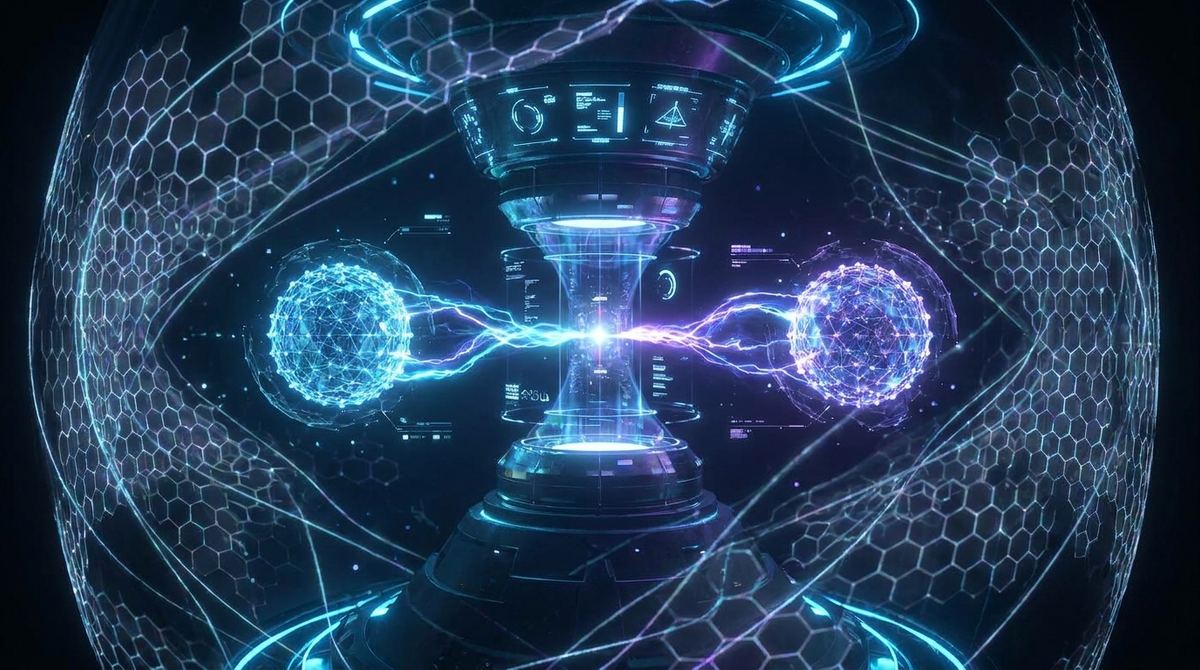
In the burgeoning field of quantum information science, the ability to precisely characterize and control the quantum states of matter is paramount. Quantum dots, often referred to as 'artificial atoms,' represent a particularly promising platform due to their tunable electronic properties and potential for scalability. However, understanding the intricate thermodynamic properties of these nanoscale systems, especially when they interact, has presented a significant challenge. A groundbreaking study, led by Owen Sheekey, Tim Child, Elena Cornick, Saeed Fallahi, Geoffrey C. Gardner, Michael J. Manfra, Eran Sela, Yaakov Kleeorin, Yigal Meir, Silvia Lüscher, and Joshua Folk, has introduced a novel technique for remotely measuring the entropy of entire coupled quantum dot systems. This innovation, detailed in their recent work, marks a pivotal advancement in our capacity to probe complex quantum interactions, holding profound implications for the development of next-generation quantum technologies, including those based on graphene.
Quantum dots are semiconductor nanocrystals so small that they confine electrons in all three spatial dimensions, leading to quantized energy levels much like those of an atom. This 'artificial atom' characteristic makes them ideal testbeds for fundamental quantum mechanics and potential building blocks for quantum computers. One of the most fundamental thermodynamic properties of any system is entropy, a measure of disorder or, more precisely, the number of available microstates corresponding to a given macroscopic state. In the realm of quantum dots, entropy provides crucial information about the spin and orbital degeneracy of the electron states. For instance, if an electron can occupy multiple spin orientations or orbital configurations at a given energy, the system's entropy will be higher, reflecting these multiple possibilities. Accurately quantifying this entropy is essential for identifying and manipulating the quantum states that could serve as qubits – the fundamental units of quantum information.
Traditional methods for measuring entropy in quantum dots typically involve adding a single electron to a dot and observing the associated change in thermodynamic quantities. This is often achieved through Maxwell relation-based measurements, which link various partial derivatives of thermodynamic potentials. For a single quantum dot, such measurements have successfully quantified the entropy change associated with the added electron, thereby revealing its spin and orbital characteristics. This approach works well for isolated systems or when the focus is solely on the properties of the individual electron being added. However, the true complexity and potential of quantum systems often lie in the interactions between multiple particles or components. When quantum dots are coupled, their electrons interact, leading to entangled states and collective phenomena that cannot be understood by simply examining individual particles in isolation. The challenge has been to devise a method that probes not just the entropy of an added electron, but the entropy of the *entire system* as it responds to that addition.
The breakthrough reported by Sheekey and his team addresses this very challenge. They have demonstrated that Maxwell relation-based measurements can be extended to probe the entropy change of an entire coupled quantum dot system, even when the measurement itself is performed on only one part of that system. This 'remote' measurement capability is a game-changer, allowing researchers to gain a holistic understanding of how interactions influence the overall quantum state.
The core of their innovation lies in a clever application of thermodynamic Maxwell relations. These powerful mathematical identities, derived from the exactness of differentials of state functions, establish relationships between partial derivatives of thermodynamic variables. In this context, they allow the researchers to infer entropy changes in the entire system by meticulously measuring changes in charge on one of the coupled dots. Imagine a scenario where two quantum dots are in close proximity, interacting capacitively – meaning their electrical fields influence each other without direct physical contact or electron transfer. When an electron is added to one dot, it perturbs the entire two-dot system. This perturbation not only changes the entropy of the dot receiving the electron but also induces changes in the energy levels and occupation probabilities of the capacitively coupled neighbor. By carefully monitoring the charge response of the *measured* dot to changes in gate voltages and temperature, the researchers can use Maxwell relations to deduce the entropy change of the *entire two-dot system*, including the contributions from the 'remote' dot.
To demonstrate their technique, the researchers utilized a pair of capacitively coupled gallium arsenide (GaAs) quantum dots. GaAs is a well-established semiconductor material known for its high electron mobility and the ability to fabricate high-quality, gate-defined quantum dots. This material system provides an excellent platform for fundamental studies of electron transport and quantum phenomena due to its clean interfaces and relatively weak spin-orbit coupling, which can simplify theoretical interpretations in some regimes. The experimental setup involved carefully fabricating two such dots, positioned close enough to interact capacitively, yet distinct enough for individual gate control and measurement. This allowed the team to precisely control the electron populations and energy levels within each dot and monitor the charge response of one dot using sensitive electrometers.
The strength of the remote entropy measurement technique was rigorously tested across different coupling regimes, revealing its versatility and robustness. In the weak dot-reservoir coupling regime, where the quantum dots interact only weakly with the surrounding electron reservoirs, the system behaves somewhat like a collection of independent entities. Here, the addition of an electron can be understood through microstate counting – a straightforward enumeration of the possible spin and orbital states an electron can occupy. Even in this simpler scenario, the remote measurement technique accurately captured the entropy changes, validating its fundamental principles. This demonstrated that the method provides reliable information even when traditional, less complex theoretical models are applicable.
The true power of the technique became apparent when the system was driven into the stronger coupling regime. In this scenario, the interactions between the electrons in the two dots, and between the dots and the electron reservoirs, become much more significant. Simple microstate counting breaks down, as the electrons no longer behave as independent entities. Instead, complex many-body phenomena emerge, requiring sophisticated theoretical tools such as numerical renormalization group (NRG) calculations to accurately describe the system's behavior. The Sheekey team showed that their remote entropy measurements accurately reflected these complex interactions, providing experimental data that aligned well with the predictions of NRG theory. This crucial finding underscores the method's ability to probe exotic quantum entropies that arise from strong correlations and entanglement – precisely the kind of information needed to understand and harness complex quantum systems for advanced applications.
The development of remote entropy measurement carries profound implications for both fundamental physics and the engineering of quantum technologies. For quantum computing, the ability to characterize the collective entropy of coupled qubit systems is invaluable. Quantum computers rely on maintaining coherent superpositions and entanglement across multiple qubits. Decoherence, the loss of quantum information due to interaction with the environment, is a major hurdle. A diagnostic tool that can reveal the system-wide entropy provides a powerful means to understand the sources of decoherence, identify complex entangled states, and ultimately, design more robust quantum processors. This method could, for example, help in verifying the integrity of multi-qubit states or diagnosing errors in a quantum circuit.
From a fundamental physics perspective, this work opens new avenues for exploring the thermodynamics of interacting quantum systems at the nanoscale. It allows researchers to investigate how entropy behaves in systems far from equilibrium, how it is distributed among entangled components, and how it evolves during quantum processes. This pushes the boundaries of our understanding of statistical mechanics in the quantum regime.
While the experiments were performed using GaAs quantum dots, the abstract of the research paper explicitly mentions 'graphene-based quantum dots' as a relevant platform. This connection is particularly significant for usa-graphene.com and the broader graphene community. Graphene, a single layer of carbon atoms arranged in a hexagonal lattice, possesses extraordinary electronic properties, including exceptionally high electron mobility, a unique Dirac band structure, and long spin coherence times. Graphene quantum dots, typically formed by confining electrons within nanometer-sized regions of graphene, offer tantalizing prospects for novel quantum technologies. However, working with graphene quantum dots also presents unique challenges.
These challenges include the precise control of edge states, the influence of strain, and the complex interplay between spin and valley degrees of freedom, which are intrinsic to graphene's electronic structure. For these reasons, a powerful diagnostic tool like remote entropy measurement could be even *more* critical for advancing graphene quantum technologies. It could enable researchers to:
* Characterize Spin and Valley Qubits: Graphene offers the potential for qubits based on electron spin or valley degrees of freedom. Remote entropy measurement could help in identifying and characterizing the degeneracy of these states, which is crucial for building stable and controllable graphene qubits.
* Probe Edge States and Topological Phenomena: The properties of graphene quantum dots are heavily influenced by their edges. This technique could provide insights into the entropic contributions of different edge configurations and even help in the search for exotic topological states that might emerge in carefully engineered graphene heterostructures.
* Diagnose Complex Interactions: Graphene quantum dots often exhibit stronger electron-electron interactions due to their reduced screening. The remote entropy measurement can effectively probe these complex many-body interactions, providing crucial data for validating theoretical models and optimizing device design.
* Accelerate Quantum Computing Development: By offering a sophisticated way to 'see' the collective quantum state of interacting graphene qubits, this method could significantly accelerate the development of robust and scalable graphene-based quantum computers, helping to overcome current limitations in characterization and control.
The demonstration of remote entropy measurement is a pivotal step towards a deeper understanding and control of complex quantum systems. Future research will likely focus on extending this technique to larger arrays of quantum dots, exploring different material systems beyond GaAs (with graphene being a prime candidate), and investigating other thermodynamic quantities. The ability to non-invasively probe the collective quantum state of interacting systems opens up exciting possibilities for real-time monitoring of quantum processes, validation of quantum algorithms, and the discovery of new quantum phenomena. As the quest for scalable and robust quantum technologies continues, tools like remote entropy measurement will be indispensable in charting the path forward, especially for materials with such rich and complex physics as graphene.
### 1. What is a quantum dot?
A quantum dot is a nanoscale semiconductor particle that confines electrons in all three spatial dimensions. Because of this confinement, electrons within a quantum dot can only occupy discrete energy levels, similar to how electrons in an atom occupy specific orbitals. This has earned them the nickname 'artificial atoms,' and they are promising candidates for qubits in quantum computers.
### 2. Why is entropy important in quantum systems?
In quantum systems, entropy is a fundamental thermodynamic property that quantifies the number of accessible quantum microstates corresponding to a given macroscopic state. For quantum dots, measuring entropy changes associated with adding an electron reveals crucial information about the degeneracy of its spin and orbital states. This understanding is vital for characterizing and manipulating the quantum states used in quantum information processing.
### 3. How is this 'remote' measurement different from previous methods?
Previous entropy measurement methods typically focused on the entropy change associated with the addition of a single electron to an *isolated* quantum dot. The new 'remote' method, however, allows researchers to measure the entropy change of an *entire coupled system* (e.g., two interacting quantum dots) by performing measurements on only one of the dots. This provides a more holistic view of how interactions influence the overall quantum state, rather than just the properties of an individual added particle.
### 4. What are Maxwell relations, and how are they used here?
Maxwell relations are thermodynamic identities that link various partial derivatives of thermodynamic potentials (like internal energy, enthalpy, Helmholtz free energy, and Gibbs free energy). They are derived from the fact that these potentials are exact differentials. In this research, they are used to relate experimentally measurable quantities (like changes in charge with respect to gate voltage and temperature) to the entropy changes of the system, allowing the inference of entropy without directly measuring it.
### 5. Why did the researchers use GaAs, and what's the relevance to graphene?
The researchers used gallium arsenide (GaAs) quantum dots because it is a well-established material system with high electron mobility and precise fabrication control, making it excellent for fundamental studies of quantum phenomena. While the experiments were performed on GaAs, the research has direct relevance to graphene because the abstract explicitly mentions 'graphene-based quantum dots.' Graphene's unique electronic properties make it a strong candidate for advanced quantum technologies, and this new remote entropy measurement technique could be invaluable for characterizing the complex quantum states and interactions within graphene quantum dots, which are often more challenging to probe.
### 6. What are the implications of this research for quantum computing?
This research provides a powerful new diagnostic tool for quantum computing. By enabling the measurement of system-wide entropy in coupled quantum dots, it helps researchers to better understand and characterize entangled states, identify sources of decoherence, and verify the integrity of multi-qubit systems. This is crucial for building more robust, scalable, and error-tolerant quantum computers, whether based on semiconductors like GaAs or advanced materials like graphene.
Serious about B2B integration? Test our premium Pulsed Electrical Resistive Carbon Heating turbostratic graphene in your lab. 100g sample packs available now.
Explore More
Learn to build a prototype strain-tunable magnetic device using graphene as a sacrificial layer to create freestanding MnPtGa membranes. This guide covers...

Researchers revisit a graphene, n-heptane, and permalloy system, observing apparent ideal diamagnetism at ambient conditions, a key property of superconductors.

Researchers are using artificial intelligence to autonomously discover optimal recipes for growing graphene, a breakthrough in AI-driven graphene synthesis...