
Understanding the Lifetime of Topological Heavy Fermions in Graphene Systems
New research provides a theoretical framework for calculating the lifetime and spectral function of topological heavy fermions, a key step for developing...
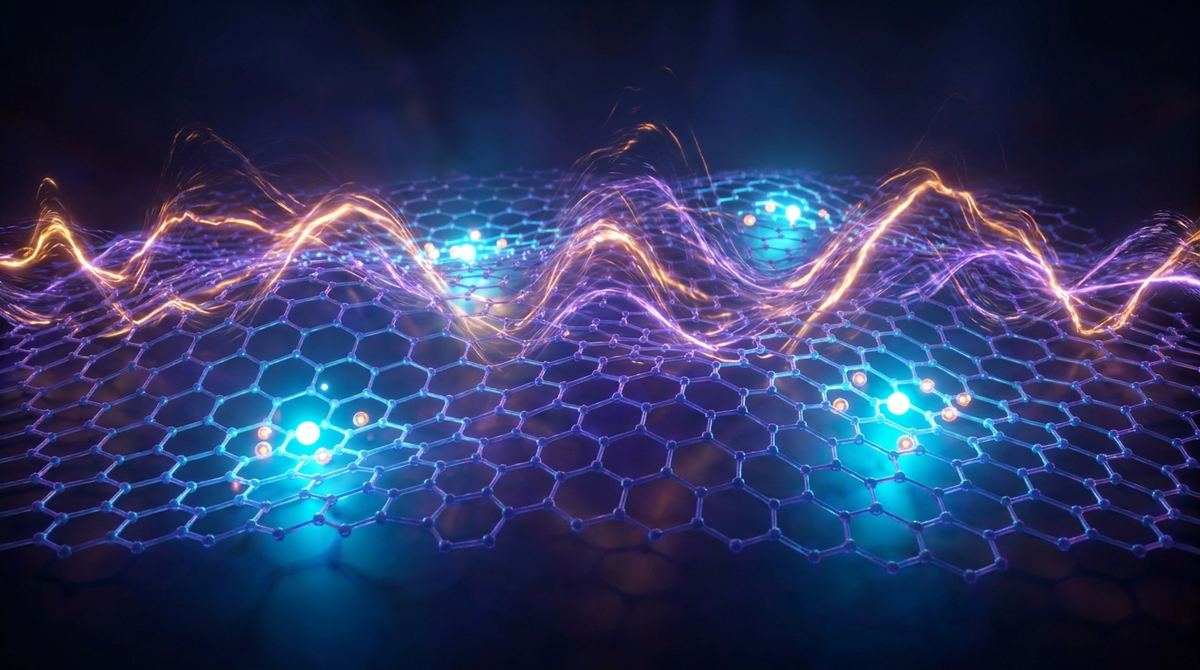
Researchers led by Kamal Azaidaoui, Ahmed Jellal, Hocine Bahlouli, A. Al Luhaibi, Michael Vogl have conducted a study that presents a groundbreaking analytical treatment of noise-suppressed Klein tunneling in graphene. Graphene has long been celebrated for its extraordinary electron mobility, but the relativistic nature of its charge carriers makes them notoriously difficult to confine using standard methods. This phenomenon, known as Klein tunneling, allows Dirac fermions to pass perfectly through electrostatic barriers at normal incidence regardless of the barrier dimensions. The inability to trap these particles has historically hindered the development of functional graphene-based quantum dots and traditional logic semiconductor devices. By introducing a time-fluctuating potential barrier modeled by Gaussian white noise, the research team has discovered a novel mechanism to suppress this unwanted quantum transmission. Their theoretical framework maps these stochastic dynamics onto a time-independent Lindblad equation, offering a fully analytical solution to a notoriously complex open quantum system problem. The resulting mathematical model demonstrates that noise induces dissipation, fundamentally altering the transport properties of the material and paving the way for advanced spin qubit architectures.
The quest to tame the ultra-relativistic charge carriers in two-dimensional carbon lattices represents one of the most significant hurdles in modern condensed matter physics. Ever since the experimental isolation of monolayer graphene, scientists have marveled at its ballistic transport properties and its potential to revolutionize the microelectronics industry. However, the very properties that make it an excellent conductor simultaneously render it highly problematic for applications requiring defined on-and-off states. Traditional semiconductors rely on physical energy bandgaps to block electron flow, a feature intrinsically absent in the pristine Dirac cone band structure of monolayer graphene. Previous attempts to artificially induce bandgaps through chemical functionalization or spatial confinement often resulted in severe degradation of the material's much-desired electron mobility. The theoretical approach proposed in this recent study sidesteps the need for physical material alteration by manipulating the temporal dimension of the applied external fields. This innovative perspective shifts the paradigm from static structural engineering to dynamic temporal control over the quantum states of traversing electrons.
To appreciate the significance of this theoretical breakthrough, one must deeply understand the fundamental mechanics of electron transport within monolayer graphene. The charge carriers in this two-dimensional honeycomb carbon lattice behave as massless Dirac fermions, governed by the relativistic Dirac equation rather than the standard non-relativistic Schrödinger equation. A defining characteristic of these exotic quasi-particles is their pseudospin, a quantum degree of freedom intrinsically tied to the two equivalent carbon sublattices that make up the crystal structure. When a Dirac fermion encounters an electrostatic potential barrier at a perfectly normal angle of incidence, pseudospin conservation strictly dictates that it must transmit with unit probability. This perfect transmission occurs regardless of the height or width of the applied potential barrier, a highly counterintuitive relativistic scattering effect known in literature as Klein tunneling. While this unhindered transport property contributes heavily to the exceptional electrical conductivity of graphene, it poses a severe, almost insurmountable challenge for nanoscale device engineering. Without the fundamental ability to reflect electrons using standard electrostatic gates, engineers cannot easily create the isolated localized states required for transistors.
The physical reality of Klein tunneling means that any attempt to pinch off an electron channel using a static electric field will ultimately fail. In conventional semiconductor heterostructures like gallium arsenide, applying a negative voltage to a top gate creates a depletion region that effectively bounces incoming electrons back toward the source. In graphene, the incoming electron simply transforms into a hole state within the barrier region, propagates through the barrier, and emerges as an electron on the other side. This seamless transition is facilitated by the gapless nature of the Dirac point, where the conduction and valence bands meet perfectly at the corners of the Brillouin zone. The lack of backscattering at normal incidence ensures that the electrical resistance of a pristine graphene junction can never be tuned to infinity using electrostatics alone. Researchers have spent over a decade trying to circumvent this relativistic quirk through various complex geometric and magnetic confinement schemes. The necessity for a reliable, non-destructive method to shut down Klein tunneling remains a central driving force in theoretical and applied graphene research.
Beyond the realm of basic logic gates, the persistence of Klein tunneling severely impacts the development of quantum information processing platforms based on carbon materials. Quantum computing architectures often rely on the precise spatial isolation of single charge carriers to serve as distinct quantum bits with long coherence times. If an electron cannot be securely confined within a designated potential well, the very foundation of the quantum dot architecture completely collapses. The continuous leakage of the electron wave function out of the intended confinement zone leads to rapid decoherence and the loss of any stored quantum information. Consequently, the field has desperately needed a mechanism that can selectively break the pseudospin conservation that guarantees this unwanted perfect transmission. The introduction of time-dependent noise into the barrier potential represents a brilliant theoretical circumvention of the static conservation laws governing the Dirac equation. By making the barrier height fluctuate, the researchers have found a way to scramble the delicate phase relationships that make Klein tunneling possible.
The traditional approach to overcoming the limitations of gapless graphene typically involves physical nanoribbon etching, applying massive perpendicular magnetic fields, or utilizing biased bilayer graphene. The methodology rigorously developed by the research team diverges entirely from these structural and static modifications by focusing strictly on the temporal dynamics of the applied potential. Instead of analyzing a static electrostatic gate, the authors mathematically model a one-dimensional potential barrier whose amplitude fluctuates rapidly and unpredictably over time. These temporal fluctuations are mathematically characterized as Gaussian white noise, representing an idealized stochastic process with a completely flat power spectrum and zero correlation time. In the rigorous context of quantum mechanics, introducing a time-dependent, noisy potential transforms the theoretical setup from an isolated, purely coherent system into a complex open quantum system. The charge carriers interacting with this violently fluctuating barrier no longer undergo purely unitary time evolution, as the external noise continuously interacts with their quantum state. This stochastic interaction serves as the fundamental physical mechanism for disrupting the delicate quantum interference required for perfect wave transmission.
Gaussian white noise serves as an excellent mathematical approximation for the rapid, uncorrelated thermal or electronic fluctuations that can be artificially injected into a local gate. By driving a gate electrode with a high-frequency noise generator, experimentalists can physically realize the fluctuating potential barrier described in this theoretical paper. The theoretical formulation assumes that the noise fluctuates on a timescale much faster than the typical transit time of the electron crossing the barrier region. Because the noise has zero mean but a finite variance, the electron experiences a constantly shifting energetic landscape that disrupts its phase accumulation. This continuous phase randomization acts as a powerful source of environmental decoherence, functionally mimicking the effects of inelastic scattering without requiring physical impurities in the carbon lattice. The mathematical elegance of using white noise lies in its complete lack of memory, which drastically simplifies the complex integro-differential equations typically associated with non-Markovian open quantum systems. Consequently, the researchers were able to extract profound physical insights regarding electron transport without getting bogged down in intractable numerical simulations.
Understanding the impact of this noise requires analyzing the scattering matrix of the traversing wave packet as it enters the fluctuating region. In a static system, the incident wave function splits deterministically into a reflected component and a transmitted component based on the boundary conditions. When the barrier height becomes a stochastic variable, the boundary conditions themselves fluctuate, causing the transmitted wave function to become a statistical ensemble rather than a pure state. The researchers focused their attention on calculating the ensemble average of the transmission probability, which represents the physically measurable conductance of the noisy junction. This averaging process mathematically washes out the coherent interference terms that normally lead to resonant tunneling peaks and perfect Klein transmission. The stochastic dynamics essentially force the electron to lose its memory of the initial pseudospin state, breaking the chiral symmetry protection that normally prevents backscattering. The resulting theoretical framework provides a rigorous quantitative link between the intensity of the applied noise and the corresponding drop in the transmission coefficient.
Analyzing the quantum dynamics of a many-body system subjected to continuous stochastic noise presents formidable mathematical and computational challenges for theoretical physicists. To solve this problem analytically, the researchers mapped the stochastic Schrödinger equation governing the noisy barrier onto a robust density matrix formalism. Specifically, they derived an equivalent time-independent Lindblad master equation, which serves as the standard mathematical workhorse for describing non-unitary, Markovian evolution in open quantum systems. The Lindblad equation elegantly and rigorously separates the coherent Hamiltonian dynamics of the system from the incoherent dissipative processes induced by the Gaussian white noise. By transforming a highly complex time-dependent stochastic problem into a deterministic time-independent density matrix equation, the team unlocked the ability to calculate exact analytical solutions. This rigorous mathematical mapping ensures that the theoretical predictions regarding transmission suppression are not merely approximate numerical artifacts but exact consequences of the underlying physical assumptions. The resulting analytical solutions provide profound, exact insights into how the quantum states of traversing particles evolve and exponentially decay.
The derivation of the Lindblad equation in this specific context involves tracing out the environmental degrees of freedom represented by the stochastic noise field. By averaging over the Gaussian white noise realizations, the researchers obtained an equation of motion for the reduced density matrix of the electron spatial modes. The dissipator term in the resulting Lindblad equation contains specific jump operators that describe the localized phase-breaking events occurring solely within the barrier region. Because the noise is applied only to the localized barrier and not to the surrounding pristine graphene leads, the dissipative action is highly spatially confined. This spatial inhomogeneity requires careful mathematical treatment of the boundary conditions matching the coherent leads to the dissipative interior of the barrier. The researchers successfully navigated this mathematical hurdle, providing a seamless theoretical description of an electron entering, traversing, and exiting the noisy potential landscape. The analytical tractability of their model stands as a major triumph, offering a highly reusable mathematical template for future studies involving localized dissipation in Dirac materials.
A particularly striking feature of the derived Lindblad framework is its ability to handle both non-relativistic Schrödinger particles and ultra-relativistic Dirac fermions within the same broad mathematical structure. By simply swapping the underlying unperturbed Hamiltonian, the researchers could directly compare the effects of localized noise on standard two-dimensional electron gases versus monolayer graphene. In the density matrix formalism, the observable quantities such as electrical current and transmission probability are calculated directly from the steady-state or dynamically averaged matrix elements. The time-independent nature of the mapped equation means that the researchers could employ standard transfer matrix techniques typically reserved for static, coherent scattering problems. This clever adaptation of the transfer matrix method to a dissipative density matrix problem greatly simplifies the extraction of the complex transmission coefficients. The resulting closed-form algebraic expressions for the transmission probabilities allow for immediate identification of the critical physical parameters controlling the suppression of the electron current. This level of mathematical clarity is incredibly rare in the study of driven open quantum systems and represents a significant methodological advancement.
The exact analytical solutions derived from the Lindblad equation reveal dramatic, quantifiable changes in the transmission characteristics of both standard Schrödinger particles and relativistic Dirac fermions. For conventional non-relativistic particles traversing a static barrier, the transmission spectrum typically exhibits pronounced Fabry-Pérot oscillations due to the constructive and destructive interference of multiply reflected waves. The introduction of white noise into the barrier potential introduces a strong, continuous dissipative component to the multiple scattering processes occurring inside the potential region. This localized dissipation effectively destroys the phase coherence of the bouncing wave function, leading to the complete mathematical suppression of the resonant Fabry-Pérot oscillations. Consequently, the transmission probability for Schrödinger particles transitions smoothly from an oscillatory pattern into a monotonic exponential decay curve as a function of the barrier width. The noise effectively acts as an absorbing medium, analogous to a highly lossy optical cavity that prevents the buildup of resonant standing electromagnetic waves. This fundamental destruction of quantum interference confirms that stochastic potential fluctuations behave as a powerful source of localized environmental decoherence.
When the researchers applied this exact same mathematical formalism to the massless Dirac fermions in graphene, they discovered an even more remarkable and technologically significant phenomenon. In the static case, Dirac fermions at normal incidence perfectly transmit through the barrier without experiencing any Fabry-Pérot oscillations, a direct signature of unhindered Klein tunneling. However, the exact solutions to the Lindblad equation demonstrate that the noise mathematically induces a complex longitudinal wavevector within the localized barrier region. This induced complex wavevector fundamentally alters the spatial propagation of the electron wave packet, introducing an imaginary component to the quantum mechanical momentum. The imaginary part of the wavevector physically manifests as a strict exponential damping of the wave function amplitude, even when the electron strikes the barrier at perfectly normal incidence. Because the pseudospin conservation relies on perfectly coherent evolution through the potential step, the noise-induced phase disruption breaks the chiral symmetry protecting the traversing particle. As a direct result, the previously unstoppable Klein tunneling is strongly and exponentially suppressed, completely altering the transport paradigm of the two-dimensional material.
The magnitude of the transmission suppression is analytically shown to be highly dependent on the variance, or physical intensity, of the applied Gaussian white noise. As the noise intensity increases, the imaginary component of the longitudinal wavevector grows larger, leading to a much steeper exponential decay of the transmitted electron probability. This mathematical relationship implies that a relatively thin barrier can become highly opaque to Dirac fermions if the applied temporal noise is sufficiently aggressive. Interestingly, the analytical model also accounts for the angle of incidence, showing that while oblique angles already experience some classical reflection, the normal incidence transmission collapses completely. The ability to suppress transmission across all incident angles effectively seals the energetic leaks that traditionally plague electrostatic confinement schemes in pristine monolayer graphene. The researchers carefully plotted these transmission probabilities, visually demonstrating the collapse of the Klein tunneling regime as the noise parameter moves from zero to a finite value. These theoretical plots provide a direct, testable prediction that experimental physicists can attempt to verify using high-frequency arbitrary waveform generators coupled to nanoscale top gates.
The profound theoretical discovery that noise can completely suppress Klein tunneling opens up entirely new paradigms for the practical design of graphene-based nanoelectronics. Instead of viewing electrical noise solely as a detrimental environmental factor that degrades device performance, engineers can now deliberately harness it as a functional, tunable control mechanism. By intentionally applying noisy radio-frequency voltage signals to localized electrostatic gates, researchers can dynamically alter the quantum transmission probability across a graphene junction. This groundbreaking capability allows a dynamically modulated barrier to act as a highly tunable dissipative element, effectively functioning like a synthetic energy bandgap. Unlike a physical bandgap created by etching or chemical doping, this synthetic dissipative gap can be switched on or off electronically in real time. Such unprecedented, dynamic control over relativistic electron transport could lead to the development of novel field-effect transistor architectures that do not require structurally compromised nanoribbons. The pristine, high-mobility nature of the graphene channel can be preserved everywhere except directly underneath the active, noise-driven gate electrode.
Furthermore, the intensity and statistical variance of the applied noise provide continuous, analog variables for fine-tuning the resistance of the potential barrier. In a traditional semiconductor transistor, the gate voltage modulates the height of the barrier to control the subthreshold leakage current exponentially. In this proposed noise-driven graphene device, the amplitude of the static gate voltage determines the baseline scattering, while the noise variance controls the localized decoherence rate. This dual-knob control scheme offers device physicists a unique method to shape the current-voltage characteristics of a graphene junction tailored to specific circuit applications. The theoretical framework thus beautifully bridges the gap between fundamental relativistic quantum mechanics, non-equilibrium statistical physics, and practical semiconductor device engineering. By treating dissipation as a designable feature rather than an unavoidable bug, the research team has completely reframed the engineering challenges associated with gapless Dirac materials. The analytical formulas derived in this study will serve as the foundational design equations for this new class of noise-modulated nanoelectronic components.
The implementation of tunable dissipative elements also holds massive potential for the development of advanced analog signal processing components and high-frequency modulators. Because the noise-induced suppression relies on the rapid scrambling of quantum phase, the switching speed of such a device would theoretically be limited only by the bandwidth of the noise generator. A graphene junction equipped with a noise-injected gate could serve as an ultrafast, electronically controlled attenuator for high-frequency ballistic electron currents. Additionally, the ability to selectively suppress coherent transport could be utilized to filter out purely quantum mechanical noise in highly sensitive metrology applications. The localized dissipative region acts as a quantum phase filter, allowing only incoherently scattered classical particles to pass through while destroying delicate quantum interference signatures. This unique filtering capability could prove invaluable in designing complex electron optics experiments where maintaining strict control over the phase coherence length is absolutely paramount. The integration of deliberately noisy gates into standard graphene device fabrication flows requires minimal architectural changes, making this theoretical proposal highly viable for near-term experimental realization.
The ultimate technological promise of suppressing Klein tunneling lies in the potential realization of highly stable, electrostatically defined graphene quantum dots. Quantum dots require strict spatial confinement of charge carriers in all three dimensions to create discrete, artificial atom-like energy levels suitable for computation. Because traditional static electrostatic gates fundamentally fail to confine Dirac fermions, constructing pure monolayer graphene quantum dots has historically relied on physical etching. Unfortunately, physically etching graphene into localized dots introduces massive amounts of uncontrollable edge defects and localized trap states that ruin device predictability. The noise-induced suppression mechanism offers a completely non-destructive alternative, allowing electrostatic gates driven by fluctuating voltages to perfectly trap electrons in a defined central region. By surrounding a central pristine graphene island with a ring of noise-driven gates, physicists can create a dynamically tunable, impenetrable wall for Dirac fermions. This elegant confinement strategy completely eliminates the need for physical edges, preserving the ultra-high mobility and pristine crystalline environment of the trapped charge carrier.
Once a single electron is securely confined within this dynamic quantum dot, its intrinsic quantum properties can be manipulated to serve as a quantum bit. In the realm of solid-state quantum computing, utilizing the spin state of a trapped electron as a qubit is one of the most heavily researched architectures. Graphene is considered an exceptionally attractive host material for spin qubit architectures due to its extraordinarily weak intrinsic spin-orbit coupling. Furthermore, the standard carbon lattice is composed almost entirely of the carbon-12 isotope, which entirely lacks a disruptive nuclear magnetic spin. These two pristine material characteristics minimize unwanted magnetic interactions, theoretically allowing for exceptionally long quantum spin coherence and relaxation times. However, the historic inability to reliably confine single electrons without edge-defect scattering has prevented graphene spin qubits from surpassing the performance of silicon or gallium arsenide devices. By utilizing noisy potential barriers to achieve robust, edge-free confinement, researchers can finally leverage the pristine spin coherence properties of monolayer graphene.
The brief discussion provided by the researchers regarding quantum dot applications highlights the profound interdisciplinary impact of their analytical mathematical treatment. The Lindblad master equation approach not only solves a fundamental scattering problem but also provides the theoretical blueprint for the next generation of carbon-based quantum hardware. Future theoretical work will likely focus on adapting these exact analytical solutions to two-dimensional confinement geometries, moving beyond the one-dimensional barrier analyzed in this initial study. Experimentalists will undoubtedly attempt to construct these noise-driven quantum dots, utilizing state-of-the-art cryogenic microwave setups to inject the necessary high-frequency fluctuations. If successful, these devices could dramatically accelerate the development of scalable, high-temperature solid-state quantum processors that outperform current superconducting architectures. The seamless integration of stochastic mathematics, relativistic quantum mechanics, and cutting-edge quantum information science makes this research a monumental stepping stone. The suppression of Klein tunneling via tailored dissipation stands as a testament to the power of theoretical physics in overcoming seemingly insurmountable engineering barriers.
Question One asks how Gaussian white noise suppresses Klein tunneling in this specific theoretical framework. The answer lies in the mathematical introduction of a complex longitudinal wavevector within the violently fluctuating potential barrier region. When the electrostatic barrier height fluctuates according to a white noise profile, the stochastic dynamics fundamentally induce a dissipative effect on the traversing electron wave packet. This continuous localized dissipation completely alters the transmission probability, changing it from a perfectly transparent state to a strictly exponentially decaying one. Consequently, even at normal incidence where pseudospin conservation typically guarantees perfect quantum transmission, the environmental noise decisively breaks the necessary phase coherence. This rigorous mathematical treatment proves that dynamic barrier modulation can effectively trap massless Dirac fermions without requiring a physical energy bandgap.
Question Two inquires about the specific mathematical tools utilized by the researchers to achieve fully analytical solutions for this problem. The research team achieved this by mapping the highly complex stochastic Schrödinger equation onto an equivalent time-independent Lindblad master equation. The Lindblad equation is a specialized mathematical construct used extensively to describe the non-unitary, dissipative evolution of open quantum systems interacting with an environment. By transforming the time-dependent noisy problem into a time-independent density matrix formulation, they bypassed the need for resource-intensive numerical simulations. This elegant mathematical mapping allowed the physicists to utilize standard transfer matrix techniques to extract exact, closed-form algebraic expressions for the transmission probabilities. The resulting analytical clarity provides an incredibly robust theoretical foundation for predicting the behavior of relativistic particles in fluctuating potentials.
Question Three addresses why traditional static electrostatic gates fail to confine electrons in pristine monolayer graphene devices. The fundamental failure stems from a relativistic quantum scattering phenomenon known strictly as Klein tunneling, which uniquely affects massless Dirac fermions. In pristine graphene, charge carriers possess a quantum property called pseudospin, which is perfectly conserved when an electron hits a potential barrier at a normal angle. Because of this strict conservation law, the electron perfectly transmits through the barrier by temporarily turning into a hole state, regardless of the barrier dimensions. Therefore, applying a massive static voltage to a local gate simply cannot create an impenetrable wall for electrons approaching at a perpendicular trajectory. This inability to pinch off the electrical current has historically prevented the creation of simple, edge-free quantum dots and traditional field-effect transistors in graphene.
Question Four explores the practical implications of these theoretical results for the future design of graphene-based nanoelectronic devices. The primary implication is that engineers can deliberately use injected electrical noise as a functional, tunable control mechanism rather than viewing it as a nuisance. By applying high-frequency voltage fluctuations to a gate electrode, device designers can create a synthetic, dynamically adjustable dissipative barrier that blocks electron flow. This noise-driven architecture effectively allows for the creation of completely tunable electronic switches that do not rely on damaging the graphene lattice via etching. Such an approach preserves the ultra-high intrinsic electron mobility of the pristine carbon lattice while still providing the necessary on-off switching capabilities. Ultimately, this methodology offers a revolutionary pathway to enhanced, dynamic control of relativistic electron transport in advanced semiconductor applications.
Question Five questions the specific advantages of utilizing graphene for the development of advanced solid-state spin qubit architectures. Graphene is considered a highly superior host material for spin qubits primarily because it exhibits extraordinarily weak intrinsic spin-orbit coupling. Additionally, the standard carbon lattice is composed almost entirely of the carbon-12 isotope, which entirely lacks a disruptive nuclear magnetic spin. These two pristine material characteristics minimize unwanted magnetic interactions, theoretically allowing for exceptionally long quantum spin coherence and relaxation times. If researchers can successfully confine single electrons using the proposed noise-suppressed barriers, they can finally isolate these pristine spins without introducing damaging edge defects. This combination of robust electrostatic confinement and an ultra-clean magnetic environment could drastically accelerate the realization of highly scalable, fault-tolerant quantum computing processors.
The analytical treatment of noise-suppressed Klein tunneling represents a watershed moment in the theoretical understanding of relativistic electron transport in two-dimensional materials. By ingeniously mapping stochastic potential fluctuations onto a time-independent Lindblad equation, the researchers have provided an exact mathematical solution to a historically intractable confinement problem. Their rigorous demonstration that localized dissipation induces a complex longitudinal wavevector fundamentally rewrites the rules of quantum scattering in pristine monolayer graphene. The complete suppression of Fabry-Pérot oscillations and the subsequent exponential decay of transmission probabilities confirm that temporal noise can effectively shatter the chiral symmetry protecting Dirac fermions. This groundbreaking theoretical framework transitions electrical noise from an unwanted environmental nuisance into a highly tunable, functional tool for advanced nanoelectronic design. As experimentalists begin to test these analytical predictions, the prospect of creating dynamically modulated, pristine graphene quantum dots moves closer to reality. Ultimately, this research not only solves a long-standing fundamental physics puzzle but also provides the critical architectural blueprint necessary for realizing scalable, carbon-based spin qubit quantum computers.
Serious about B2B integration? Test our premium Pulsed Electrical Resistive Carbon Heating turbostratic graphene in your lab. 100g sample packs available now.
Explore More
New research provides a theoretical framework for calculating the lifetime and spectral function of topological heavy fermions, a key step for developing...

Learn to build a prototype strain-tunable magnetic device using graphene as a sacrificial layer to create freestanding MnPtGa membranes. This guide covers...

Researchers revisit a graphene, n-heptane, and permalloy system, observing apparent ideal diamagnetism at ambient conditions, a key property of superconductors.