
Modeling Graphene Resonators: New Software Unlocks Advanced Optical Design
New software for the modal analysis of electromagnetic resonators now includes 2D materials, accelerating the design of advanced graphene optical and...
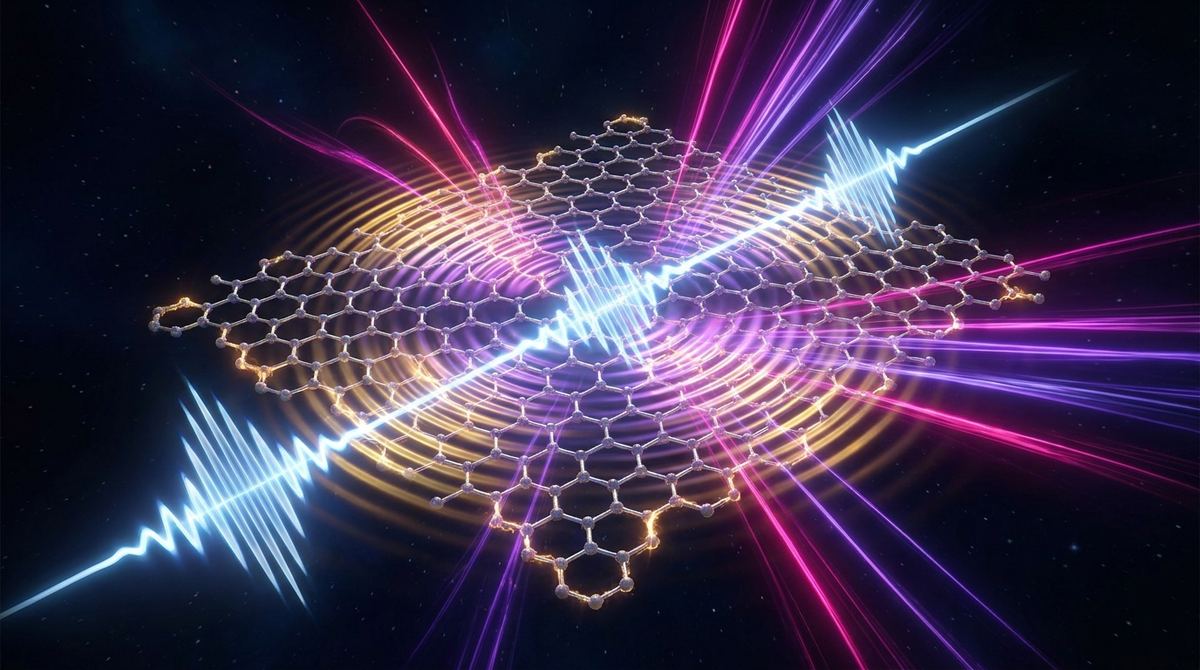
Researchers led by Adam Herling and Ofer Neufeld have conducted a study that fundamentally reshapes our understanding of high harmonic generation in solid-state materials, specifically focusing on the intricate dynamics within graphene. High harmonic generation is a widely explored nonlinear optical process where intense laser fields drive attosecond-to-femtosecond electron dynamics, ultimately causing high-energy photon emission. Historically, physicists have treated this phenomenon as an exclusive interplay between electrons and photons, largely ignoring the atomic lattice vibrations known as phonons. The prevailing assumption has been that phonons operate on timescales far too slow to influence the ultrafast electronic maneuvers that characterize high harmonic generation. However, this theoretical framework reveals that optical phonons in the static limit exert a profound influence on electronic behavior, even when the lattice appears frozen on the timescale of the laser pulse. By computing high harmonic generation through the sampling of thermally occupied phonons and employing ensemble averaging, the research demonstrates that these lattice vibrations are far from negligible. This paradigm-shifting investigation not only resolves long-standing discrepancies between theoretical predictions and experimental observations but also redefines the role of thermal phonons in attosecond science.
The implications of this research extend far beyond the specific case of two-dimensional carbon lattices, challenging the foundational approximations used in computational solid-state physics. For years, the rigid lattice approximation provided a comfortable, simplified model that yielded qualitatively acceptable results for a variety of strong-field phenomena. Yet, as experimental laser technologies advanced to probe material responses with unprecedented temporal and spectral resolution, the cracks in this purely electronic model became impossible to ignore. The work of Herling and Neufeld provides the critical mathematical and conceptual bridge necessary to incorporate quantum thermodynamic effects into attosecond electron dynamics. Their findings confirm that the instantaneous structural fluctuations inherent to any physical crystal at finite temperatures actively dictate the coherence limits of driven electron-hole pairs. Consequently, the scientific community must now reevaluate numerous ultrafast processes, ranging from light-induced anomalous Hall currents to the transient opening of Floquet bandgaps.
High harmonic generation in solids represents one of the most exciting frontiers in modern condensed matter physics and ultrafast optical science. When a material is subjected to an intense, low-frequency driving laser, the alternating electric field forces electrons to undergo complex, highly non-perturbative trajectories within their respective energy bands. These strongly driven electrons accumulate substantial kinetic energy and quantum phase information before eventually recombining with their corresponding holes or scattering off other quasiparticles. Upon recombination, the system emits secondary photons at integer multiples of the fundamental driving laser frequency, producing a broad spectrum of coherent extreme ultraviolet radiation. The underlying physical mechanism is broadly categorized into intraband current oscillations, where electrons surf along the energy dispersion curves, and interband polarization dynamics, involving quantum transitions between distinct energy bands. Both of these distinct mechanisms contribute simultaneously to the final emission spectrum, creating a highly complex interference pattern that carries encoded information about the material structure.
For decades, the theoretical modeling of these extreme nonlinear dynamics relied almost exclusively on the purely electronic band structure of the pristine, unperturbed crystal lattice. Researchers meticulously mapped out the momentum-space trajectories of electrons while treating the underlying atomic nuclei as a perfectly rigid, static background that merely provided the periodic electrostatic potential. This simplified purely electronic model successfully explained many early empirical observations and provided an intuitive framework for understanding the basic physics of solid-state harmonics. However, the model began to falter noticeably as experimental techniques achieved higher precision and researchers began probing more complex, highly correlated, or low-dimensional materials. The primary justification for ignoring the lattice was a perceived massive timescale mismatch between the incredibly fast electronic motion and the comparatively sluggish nuclear vibrations. Physicists assumed that because an electron completes its complex strong-field trajectory in a fraction of a femtosecond, the heavy atomic nuclei simply would not have time to move and alter the interaction. This assumption that the lattice remains functionally invisible during attosecond-scale electron excursions is precisely what the current theoretical advancements aim to dismantle.
Graphene offers a uniquely fertile testing ground for exploring extreme nonlinear optical phenomena due to its strictly linear energy-momentum dispersion and corresponding zero bandgap. The massless Dirac fermions residing in this two-dimensional honeycomb carbon allotrope exhibit extraordinary mobility and can be driven to highly non-equilibrium states by relatively modest optical fields. Because the electrons behave as relativistic particles, their interaction with intense infrared or terahertz laser pulses generates exceptionally strong nonlinear currents compared to conventional bulk semiconductors. Despite these ideal theoretical characteristics, experimental efforts to observe high harmonic generation in graphene consistently encountered an unexpected and highly frustrating barrier. Laboratory measurements repeatedly showed that the high harmonic emission yield abruptly plummeted at photon energies above approximately three electron-volts, falling well short of theoretical predictions. Traditional models relying solely on electron-photon interactions could not adequately explain this sudden, steep suppression, leading to widespread speculation about uncharacterized extrinsic scattering mechanisms or microscopic sample impurities.
The missing piece of this persistent puzzle lay hidden within the intrinsic dynamics of optical phonons, which are quantized modes of high-frequency lattice vibrations. In the optical phonon modes of graphene, adjacent carbon atoms within the unit cell move in opposite directions, creating strong, localized perturbations in the electronic potential landscape. Because the vibrational periods of these optical phonons are typically on the order of tens to hundreds of femtoseconds, conventional wisdom dictated that they could not interact meaningfully with electrons moving on sub-femtosecond timescales. Consequently, the global scientific community developed a persistent conceptual blind spot, completely omitting electron-optical-phonon coupling from the governing time-dependent Schrödinger equations of ultrafast strong-field dynamics. Theorists focused entirely on electron-electron interactions or impurity scattering to explain any deviations from the pristine rigid lattice model. Overcoming this pervasive blind spot required a fundamental conceptual leap regarding how essentially static, instantaneous lattice distortions could exert a profound influence on ultrafast quantum coherences.
To accurately capture the subtle influence of lattice vibrations on ultrafast electronic processes, computational physicists must adopt a theoretical formalism that effectively bridges vastly different temporal regimes. The methodology employed in this groundbreaking study utilizes the static limit, an ingenious approximation that treats the atomic lattice as effectively frozen during the ultrashort duration of the driving laser pulse. Even though the carbon atoms do not have sufficient time to complete a full vibrational cycle while the laser is active, their instantaneous displacements from perfect equilibrium profoundly alter the local electronic band structure. At any given moment, the lattice is distorted in a highly specific configuration dictated by the thermal distribution of phonon states within the material. These momentary structural distortions break the perfect periodicity of the pristine crystal, altering the transition dipole moments and scattering rates that govern high harmonic emission. By recognizing that the lattice does not need to move dynamically to affect the electrons, researchers can incorporate phonon effects without requiring prohibitively expensive multiscale molecular dynamics simulations.
Implementing this static limit formalism requires a robust statistical approach to ensure that the calculated optical response accurately reflects the macroscopic reality of the material. The researchers accomplished this by computationally generating a vast ensemble of distinct lattice configurations, each representing a specific momentary snapshot of thermally occupied optical phonon states. By computing the full high harmonic generation response for each individual frozen lattice configuration, they could capture the exact quantum mechanical influence of that specific momentary structural distortion. The final, observable macroscopic high harmonic spectrum is then obtained by rigorously ensemble-averaging the individual quantum responses across the entire statistical distribution of accessible phonon states. This advanced statistical methodology ensures that the final macroscopic observable accurately reflects both the inherent quantum zero-point fluctuations and the thermal vibrations of the solid. Crucially, because this phenomenon relies entirely on instantaneous spatial displacements rather than the temporal evolution of the lattice, the resulting quantum interference effects are completely independent of the intrinsic phonon timescale.
The application of this sophisticated static limit formalism to the graphene lattice yielded a dramatic theoretical revelation regarding the mysterious suppression of high-energy harmonic emission. The numerical calculations revealed that optical phonons strongly and preferentially couple to the interband polarization currents, which are the primary drivers responsible for generating the higher-order spectral harmonics. This intense electron-phonon coupling introduces spatially and temporally varying phase shifts into the complex quantum wavefunctions of the driven electron-hole pairs. As the electrons traverse the extended Brillouin zone under the extreme influence of the strong laser field, the instantaneous lattice distortions cause macroscopic harmonic phase scrambling. This continuous phase scrambling fundamentally destroys the delicate quantum coherence required to efficiently emit high-energy photons, leading directly to massive destructive interference among the emitted electromagnetic waves. Ultimately, this theoretical mechanism of phonon-induced destructive interference perfectly explains the empirical lack of experimentally observed high harmonic generation in graphene above the notorious three electron-volt threshold.
The research team also thoroughly explored the temperature dependence of this phase scrambling phenomenon, investigating whether cooling the material could potentially recover the lost high-energy harmonics. In a classical thermodynamic framework, higher macroscopic temperatures exponentially increase the population of excited phonon states, which should theoretically exacerbate the spatial distortions and resulting phase scrambling. The calculations indeed confirm that the high harmonic yields become temperature-dependent due to these varying phonon occupations across different thermal regimes. However, in the specific quantum mechanical case of graphene, the study reveals that this temperature dependence remains surprisingly weak even up to room temperature conditions. This weak thermal sensitivity occurs because the relevant high-frequency optical phonon energy scales in carbon lattices are overwhelmingly dominated by intrinsic zero-point quantum motion rather than thermal excitation. Therefore, even at absolute zero temperature, the unavoidable quantum fluctuations of the carbon atoms provide sufficient structural distortion to trigger the phase scrambling and enforce the three electron-volt emission ceiling.
Beyond simply suppressing the macroscopic emission yield, the fundamental interaction with optical phonons irrevocably limits the underlying quantum coherence of the strongly driven electron-hole pairs. In the standard theoretical modeling of high harmonic generation, physicists almost universally introduce a phenomenological dephasing time parameter to mathematically account for various uncharacterized decoherence mechanisms. This critical parameter acts as an exponential decay constant that artificially dampens the interband polarization in the semiconductor Bloch equations. For many years, identifying the precise physical microscopic origins of this dephasing time and justifying its exact numerical magnitude has constituted a major unresolved issue known as the dephasing time problem. Theorists fiercely debated whether the rapid loss of coherence was primarily driven by complex electron-electron Auger scattering, electron-hole recombination, or some other exotic many-body quantum interaction. The theoretical framework presented in this study provides a definitive, quantifiable answer by demonstrating that instantaneous optical phonon interactions are actually the primary culprits behind this rapid decoherence.
The rigorous ensemble-averaged calculations reveal an astonishingly rapid decoherence rate, fundamentally reshaping our understanding of ultrafast scattering dynamics in strongly driven solids. The researchers extracted an equivalent dephasing time of approximately five point seven femtoseconds for the interband coherences in graphene subjected to strong mid-infrared driving fields. This incredibly brief timescale is substantially faster than the typical decoherence rates associated with standard electron-electron scattering events under similar extreme non-equilibrium conditions. This rapid, phonon-induced decoherence unequivocally confirms that thermal and zero-point lattice fluctuations fundamentally dominate the electronic decoherence landscape in strong-field optical environments. By clearly identifying the primary physical driver of coherence loss, this groundbreaking research provides a much firmer, physically grounded foundation for all future quantitative models of ultrafast electron dynamics. The profound realization that ostensibly slow lattice fluctuations actively govern the quantum coherence of attosecond processes necessitates a complete reevaluation of how theorists approach strong-field phenomena across all condensed matter systems.
The pervasive influence of optical phonons also extends deeply into the specific polarization properties of the emitted harmonics, particularly affecting the ellipticity-dependent yield curves. In pristine electronic models that completely omit phonon coupling, the calculated harmonic yield often exhibits extremely sharp, highly sensitive variations as the ellipticity of the driving laser pulse is gradually adjusted. These purely electronic theoretical predictions consistently clash with actual experimental measurements, which historically showcase much broader, smoother, and far less sensitive ellipticity profiles in the laboratory. When the researchers incorporated the static limit phonon ensemble into their sophisticated computational models, they found that the random lattice fluctuations effectively smoothened these theoretical ellipticity-dependent curves. The presence of instantaneous structural distortions breaks the perfect crystalline symmetry, allowing multiple competing quantum trajectories to contribute to the emission and thereby washing out the sharp polarization sensitivities. This critical phonon-induced smoothing brings the theoretical predictions into significantly better qualitative and quantitative alignment with the established experimental literature for graphene and similar two-dimensional materials.
The most profound conceptual takeaway from this entire investigation is the remarkable fact that all of these dramatic effects arise purely within the static picture of electron-phonon interactions. Because the phase scrambling and decoherence do not rely on the actual physical movement of the atoms over time, the underlying physics is fundamentally timescale-independent. Consequently, the vital insights gained from this specific study of high harmonic generation in graphene are directly transferable to a vast array of other attosecond phenomena across diverse material platforms. Furthermore, this rapid, phonon-induced phase scrambling will have massive implications for the deliberate engineering of Floquet gaps, where intense lasers are used to temporarily hybridize electronic bands. Similarly, the generation and precise control of ultrafast photocurrents in optoelectronic devices will be fundamentally limited by the rapid decoherence imposed by these ubiquitous static lattice distortions. Ultimately, any future quantum technology relying on the coherent manipulation of electronic energy bands with strong optical fields must now explicitly account for the instantaneous influence of the vibrating atomic lattice.
The comprehensive theoretical investigation conducted by Adam Herling and Ofer Neufeld establishes a monumental paradigm shift in our understanding of ultrafast light-matter interactions. By rigorously integrating optical phonons into the static limit formalism, their work decisively dismantles the long-standing rigid lattice approximation that has dominated attosecond physics for decades. The discovery that instantaneous lattice distortions cause massive harmonic phase scrambling perfectly resolves the enduring mystery surrounding the three electron-volt emission ceiling in graphene. Furthermore, identifying an equivalent dephasing time of five point seven femtoseconds definitively crowns lattice fluctuations as the primary driver of electronic decoherence in strong-field environments. These insights bridge a critical gap between theoretical predictions and empirical observations, ensuring that future computational models accurately reflect the messy, fluctuating reality of physical crystals.
Moving forward, the profound implications of this timescale-independent phase scrambling will ripple across multiple disciplines within condensed matter physics and quantum optics. Researchers attempting to engineer exotic quantum states, such as transient Floquet insulators, must now carefully account for the rapid decoherence imposed by these ubiquitous optical phonons. Similarly, the development of next-generation optoelectronic devices relying on ultrafast photocurrents will be fundamentally constrained by the instantaneous structural distortions inherent to the host materials. As laser technologies continue to push the boundaries of temporal resolution, the theoretical framework established here will serve as an indispensable tool for deciphering complex material responses. Ultimately, this research elegantly proves that in the extreme realm of attosecond science, the subtle vibrations of the atomic lattice can never truly be ignored.
Serious about B2B integration? Test our premium Pulsed Electrical Resistive Carbon Heating turbostratic graphene in your lab. 100g sample packs available now.
Explore More
New software for the modal analysis of electromagnetic resonators now includes 2D materials, accelerating the design of advanced graphene optical and...

New research provides a theoretical framework for calculating the lifetime and spectral function of topological heavy fermions, a key step for developing...

Learn to build a prototype strain-tunable magnetic device using graphene as a sacrificial layer to create freestanding MnPtGa membranes. This guide covers...