
Twisted Bilayer Graphene: A New Formula for Electron Lifetimes
Researchers derived an analytic formula for twisted bilayer graphene electron lifetimes, providing a key design tool for future quantum and electronic devices.
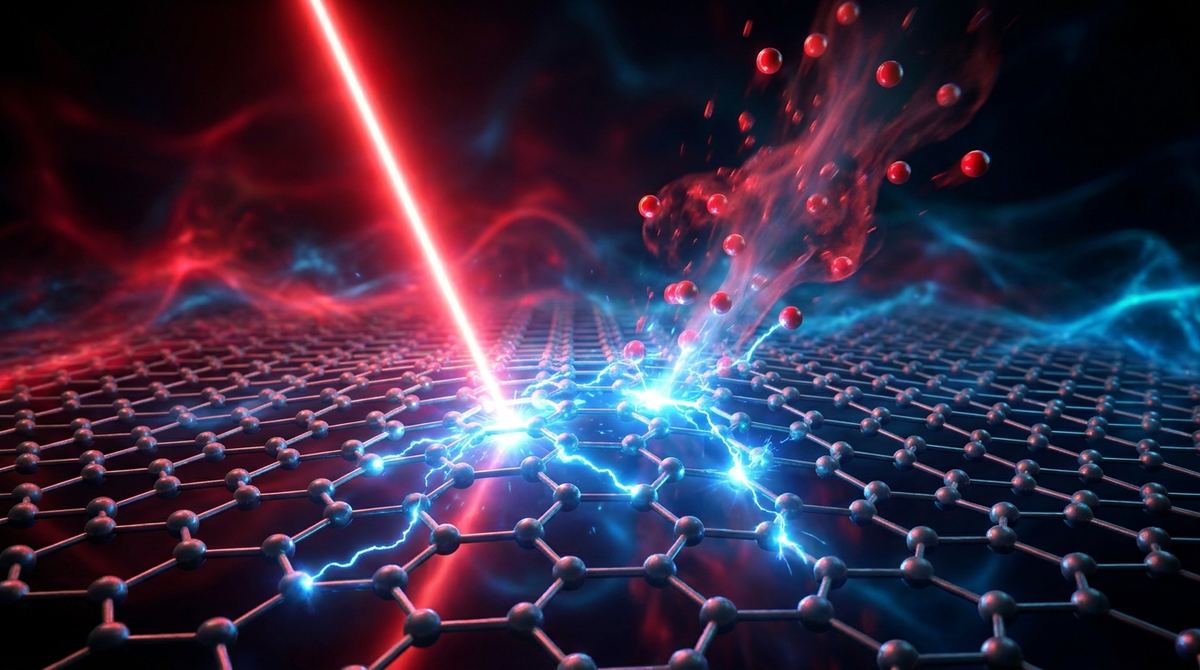
Researchers led by Israt Ali, Hilaire Mba, Matthieu Picher, Shruti Verma, Florian Banhart, Kenneth R. Beyerlein have conducted a study that addresses one of the most persistent bottlenecks in carbon nanomaterial processing. Rapid and controllable reduction of graphene oxide remains a critical challenge for realizing its full technological potential across various industrial applications. Conventional reduction techniques often struggle to balance processing speed with the precise control required to maintain structural integrity. This groundbreaking research introduces a synergistic electron-beam-assisted single-pulse near-infrared laser process to achieve highly efficient reduction. The methodology represents a significant departure from traditional chemical or prolonged thermal reduction techniques by leveraging ultrafast photothermal dynamics.
The overarching goal of reducing graphene oxide is to strip away oxygen-containing functional groups to restore the pristine conjugated carbon network. Achieving this efficiently without damaging the underlying two-dimensional lattice requires highly localized energy deposition and rapid dissipation. The newly proposed technique accomplishes this by pre-treating the material with an electron beam before hitting it with a targeted near-infrared laser pulse. This dual approach fundamentally alters the optical properties of the precursor material to facilitate an unprecedentedly fast deoxygenation process. Understanding the precise mechanisms behind this transformation opens up new pathways for manufacturing high-quality reduced graphene oxide at scale.
Graphene oxide serves as a highly versatile precursor for mass-producing graphene-based materials due to its solubility and ease of functionalization. However, the basal plane and edges of this material are heavily decorated with hydroxyl, epoxide, carbonyl, and carboxyl groups that disrupt electrical conductivity. Removing these functional groups to restore the desirable sp2 hybridized carbon network typically involves toxic chemical reducing agents or high-temperature thermal annealing. Chemical methods are notoriously slow, environmentally hazardous, and often leave behind significant residual functional groups or introduce unwanted dopants. Thermal annealing requires substantial energy inputs and prolonged heating cycles that can cause the macroscopic restacking of sheets or catastrophic structural degradation.
Finding a balance between rapid processing and high-fidelity structural restoration has driven researchers to explore alternative energy sources like microwave irradiation and laser treatment. While continuous wave lasers and standard flash reduction methods offer spatial control, they frequently suffer from inhomogeneous heating profiles and unpredictable defect generation. The complex interplay between localized heating, gas evolution from departing oxygen species, and the structural relaxation of the carbon lattice makes precise control incredibly difficult. When oxygen escapes too violently in the form of carbon dioxide or carbon monoxide gases, the resulting pressure can physically tear the delicate two-dimensional sheets. Therefore, developing a technique that drives rapid out-of-plane oxygen diffusion without inducing massive mechanical damage is essential for advancing graphene oxide commercialization.
The integration of near-infrared laser pulses presents a compelling solution to the spatial and temporal control issues inherent in older methodologies. Near-infrared light can penetrate deep into layered structures, providing a volumetrically uniform energy deposition profile if the material exhibits appropriate optical absorption characteristics. Unfortunately, pristine graphene oxide typically exhibits relatively poor optical absorptivity in the near-infrared region, which limits the efficiency of direct laser reduction. This inherent optical limitation necessitates a fundamental modification of the precursor material to enhance its interaction with the incoming laser photons. Overcoming this absorption barrier is precisely where the synergistic application of electron beam irradiation prior to laser exposure becomes a transformative engineering strategy.
To bypass the poor near-infrared absorption of standard graphene oxide, the research team implemented a pre-activation step using targeted electron beam irradiation. When high-energy electrons interact with the functionalized carbon lattice, they induce highly localized electronic excitations and structural modifications. This electron-matter interaction selectively cleaves certain weaker carbon-oxygen bonds and creates a specific population of vacancies and structural defects within the lattice. These newly formed defect sites significantly alter the electronic band structure of the material, effectively narrowing the bandgap and introducing mid-gap states. Consequently, the optical absorptivity of the electron-beam-activated graphene oxide in the near-infrared region experiences a dramatic and highly beneficial enhancement.
Once the material is optically activated by the electron beam, a single pulse from a near-infrared laser is directed onto the modified region. Because the local absorptivity has been artificially elevated, the material absorbs the laser energy with remarkable efficiency compared to non-irradiated areas. This sudden influx of photon energy is rapidly converted into thermal energy through non-radiative relaxation processes within the carbon lattice. The resulting photothermal heating cycle is both intensely localized and incredibly brief, driving the temperature of the film up to the critical threshold required for deoxygenation. By confining the thermal spike to the nanosecond regime, the process minimizes unwanted lateral heat diffusion that could damage adjacent structural zones.
The synergistic nature of this dual-beam approach provides a level of control that neither technique could achieve independently. The electron beam acts as a precise spatial primer, defining the exact geometry of the region that will undergo subsequent photothermal reduction. The near-infrared laser then provides the massive, instantaneous energy payload required to drive the chemical reduction kinetics to completion. Simulating the thermal heating cycle resulting from the laser pulse reveals a sharp temperature gradient that perfectly mirrors the defined irradiation zone. This exquisite spatio-temporal control effectively solves the problem of inhomogeneous reduction that plagues conventional bulk processing methods.
Observing chemical transformations that occur on the nanosecond timescale at the nanoscale requires highly specialized and advanced characterization instrumentation. The researchers utilized a dynamic transmission electron microscope equipped with time-resolved electron energy-loss spectroscopy to monitor the reduction process in real time. Standard transmission electron microscopy is typically limited to static or very slow processes due to the continuous nature of the electron source. In contrast, dynamic transmission electron microscopy utilizes a pulsed electron source synchronized with the initiating laser pulse to capture ultrafast transient states. This configuration acts as an ultra-high-speed camera capable of resolving structural and chemical changes as they happen at the atomic level.
Electron energy-loss spectroscopy is particularly well-suited for tracking the concentration of specific elements like oxygen within a carbon matrix. As the pulsed electron beam passes through the sample, electrons lose specific, quantifiable amounts of energy corresponding to the core-shell excitations of the atoms they encounter. By monitoring the intensity of the oxygen K-edge signal relative to the carbon K-edge signal over time, the researchers could precisely track the deoxygenation process. The temporal resolution afforded by the dynamic transmission electron microscope allowed them to construct a detailed kinetic profile of the departing oxygen species. This capability provides unprecedented empirical insights into the transient intermediate states of graphene oxide reduction that are usually completely invisible to researchers.
The integration of these advanced spectroscopic and microscopic techniques effectively bridges the gap between macroscopic material properties and nanoscale chemical dynamics. Locally tracking the oxygen concentration evolution after the near-infrared laser pulse irradiation yields a direct measurement of the reaction rate under extreme non-equilibrium conditions. The data extracted from these time-resolved experiments feed directly into the calculation of fundamental thermodynamic parameters that govern the reduction mechanism. Without the precision of the dynamic transmission electron microscope, confirming the sheer speed and efficiency of the electron-beam-assisted single-pulse process would be virtually impossible. This methodological triumph highlights the critical importance of developing new analytical tools to keep pace with advanced nanomaterial synthesis techniques.
The quantitative kinetic data extracted from the time-resolved electron energy-loss spectroscopy measurements reveal staggering speeds for the deoxygenation process. The researchers determined an oxygen diffusivity of approximately one point six plus or minus zero point four times ten to the negative eighth square meters per second. This remarkable diffusion coefficient translates to the expulsion of oxygen species at a rate vastly superior to conventional thermal annealing models. Specifically, the measurements confirmed a ninety percent reduction of a forty-six nanometer thick graphene oxide film within a mere nine hundred and sixty nanoseconds. Achieving such a profound degree of chemical reduction in less than a microsecond represents a monumental leap forward in carbon nanomaterial processing capabilities.
Understanding the physical implications of this ultra-fast reduction requires analyzing the pathway by which oxygen escapes the layered two-dimensional structure. In typical thermal reduction, oxygen species migrate laterally along the basal plane until they find an edge or a pre-existing pore to exit the lattice. This lateral diffusion is intrinsically slow and often results in the formation of trapped gas pockets that cause structural exfoliation or layer delamination. The remarkably high oxygen diffusivity observed in this study suggests a fundamentally different escape route dominated by out-of-plane, normal diffusion directly through the stacked layers. The synergistic electron beam and laser treatment actively facilitates this vertical escape pathway, drastically shortening the distance oxygen must travel to leave the film.
The kinetic efficiency of this normal diffusion mechanism is directly tied to the specific thermal profile generated by the near-infrared laser pulse. The simulated thermal heating cycle indicates that the peak temperature is reached almost instantaneously, providing a massive thermodynamic driving force for bond cleavage. Because the heating duration is so brief, the structural integrity of the carbon lattice is maintained while the highly mobile oxygen species are rapidly ejected. The sub-microsecond timescale prevents the extensive carbon-carbon bond rearrangement that typically leads to the formation of amorphous carbon domains during slow thermal processing. Consequently, the ultra-fast kinetics not only accelerate production times but fundamentally preserve the quality of the resulting reduced graphene oxide film.
Beyond tracking the chemical departure of oxygen, evaluating the structural quality of the final reduced material is paramount for practical applications. The researchers employed selected-area electron diffraction alongside high-resolution transmission electron microscopy to thoroughly characterize the crystallographic state of the post-irradiation material. These techniques provide distinct yet complementary views of the atomic arrangement, revealing both long-range crystalline order and highly localized structural anomalies. The selected-area electron diffraction patterns indicated a significant localized restoration of the sp2 hybridized conjugated carbon network characteristic of pristine graphene. This restoration is the ultimate objective of the reduction process, as it directly dictates the recovery of electrical and thermal conductivity in the final material.
However, the structural recovery is not entirely perfect, as the high-resolution transmission electron microscopy images revealed the presence of distinct crystallographic complexities. The ultrafast expulsion of oxygen leaves behind a lattice that exhibits pronounced turbostratic disorder within the newly reduced graphene oxide domains. Turbostratic disorder refers to the rotational misalignment and random shifting of adjacent graphene layers relative to one another, deviating from the highly ordered Bernal stacking found in bulk graphite. This type of disorder is a common consequence of rapid out-of-plane gas evolution, as the departing oxygen physically nudges the layers out of their lowest-energy stacking configuration. Interestingly, turbostratic graphene often exhibits superior electronic decoupling between layers, which can actually be advantageous for certain high-performance electrochemical applications.
The localized nature of the sp2 restoration perfectly mirrors the spatial profile of the incident electron beam used for the initial activation step. This correlation definitively proves that the structural evolution is tightly controlled by the synergistic interaction rather than broadly distributed thermal effects. The high-resolution transmission electron microscopy confirms that while the planar hexagonal lattice is largely reconstituted, the structural defects initially introduced by the electron beam remain partially embedded. These residual defects play a crucial role in maintaining the turbostratic disorder by acting as pinning sites that prevent the layers from relaxing back into a perfectly ordered graphitic state. Understanding this intricate relationship between rapid deoxygenation, structural restoration, and induced disorder is vital for tailoring the material properties to specific technological needs.
The culmination of the spectroscopic and crystallographic data points toward a highly specialized mechanism driving this ultra-fast chemical transformation. The core of this mechanism involves the deliberate creation of defects and vacancies produced by the initial electron beam irradiation phase. Rather than viewing defects purely as detrimental flaws, this process leverages them as functional active sites that dictate the subsequent photochemistry of the material. These vacancies disrupt the continuous pi-electron network of the graphene oxide, creating localized energy states that strongly resonate with near-infrared photon frequencies. This deliberate defect engineering is the fundamental key to increasing the efficiency of near-infrared light absorption to the levels required for instantaneous photothermal heating.
Once the near-infrared laser pulse strikes these highly absorbing defect sites, the localized temperature spikes drastically, initiating the rapid cleavage of remaining carbon-oxygen bonds. Furthermore, the vacancies created by the electron beam serve a secondary, equally critical mechanical function during the actual reduction event. These atomic-scale holes act as direct physical channels through the basal plane, actively facilitating the normal diffusion of oxygen perpendicular to the stacked layers. Without these pre-existing out-of-plane channels, the departing oxygen would be forced into the slow lateral diffusion pathways, negating the speed advantage of the laser pulse. Therefore, the electron beam does not merely heat the sample; it fundamentally structurally primes the lattice to act as a high-speed conduit for oxygen expulsion.
This study ultimately demonstrates the profoundly important role of engineered defects in controlling the overall photochemistry of graphene oxide. The response of the material to near-infrared illumination is completely transformed from sluggish and inefficient to explosive and highly directed. By manipulating the defect density through varying electron beam dosages, researchers can theoretically fine-tune the absorption characteristics and the resulting reduction kinetics. This level of tunable photochemistry opens the door to creating intricate, chemically graded microstructures within a single contiguous graphene oxide film. The precise control over defect-mediated photothermal mechanisms represents a sophisticated advancement in the broader field of nanoscale materials engineering.
The ability to rapidly and controllably reduce graphene oxide using this synergistic methodology has massive implications for commercial device manufacturing. Traditional reduction methods are often incompatible with complementary metal-oxide-semiconductor processing lines due to high thermal budgets or the use of corrosive liquid chemicals. The highly localized, sub-microsecond nature of this near-infrared laser process allows for integration directly onto delicate substrates, including flexible polymers used in wearable electronics. Because the thermal spike is confined strictly to the targeted nanometric volume, adjacent sensitive components remain completely unaffected by the extreme transient temperatures. This spatial precision enables the direct writing of highly conductive graphene circuits onto virtually any platform without requiring complex masking or transfer steps.
Energy storage devices, particularly high-performance supercapacitors and advanced lithium-ion batteries, stand to benefit immensely from this specific type of reduced graphene oxide. The turbostratic disorder observed in the final material prevents the restacking of individual sheets, thereby preserving a massive electrochemically active surface area. Furthermore, the residual defects that facilitate the out-of-plane oxygen diffusion also provide excellent permeation channels for electrolyte ions during rapid charging and discharging cycles. Materials produced via this ultrafast synergistic method could hypothetically deliver energy densities approaching those of pristine graphene while maintaining the scalable production advantages of graphene oxide precursors. The commercial realization of these advanced energy storage systems heavily depends on optimizing this precise defect-mediated reduction technique.
Finally, the tunable nature of the electron-beam activation provides a novel platform for developing highly sensitive and selective chemical sensors. By precisely controlling the degree of reduction and the concentration of residual oxygen functional groups, the surface chemistry of the material can be tailored to bind specific target molecules. The direct laser writing capability allows for the fabrication of complex sensor arrays on a single chip, each tuned to a different analyte through varying irradiation parameters. As the demand for miniaturized, flexible, and highly integrated diagnostic devices continues to grow, this processing methodology offers a highly viable manufacturing pathway. The transition from fundamental dynamic transmission electron microscopy studies to macro-scale roll-to-roll manufacturing will undoubtedly be the next major frontier for this technology.
What is the main challenge with traditional graphene oxide reduction processes currently used in industry? Traditional reduction techniques typically rely on harsh chemical agents or prolonged high-temperature thermal annealing processes. Chemical methods are often environmentally toxic, slow, and frequently fail to remove all oxygen functional groups or introduce unwanted chemical dopants. Thermal annealing requires massive energy inputs and long processing times, which can lead to the macroscopic restacking of graphene sheets. Achieving a balance between rapid processing speed and maintaining high structural fidelity remains a massive hurdle for commercial scalability.
How exactly does the preliminary electron beam irradiation assist in the subsequent laser reduction process? The electron beam acts as a highly precise spatial primer that fundamentally alters the optical properties of the precursor material. High-energy electrons interact with the lattice to induce localized electronic excitations and cleave specific carbon-oxygen bonds. This interaction creates a population of structural vacancies and defects that narrow the electronic bandgap of the material. Consequently, these newly formed defect sites drastically increase the optical absorptivity of the graphene oxide in the near-infrared region.
What is dynamic transmission electron microscopy and why was it necessary for this specific research? Dynamic transmission electron microscopy is an advanced imaging technique that utilizes a pulsed electron source synchronized with an initiating laser pulse. Unlike standard electron microscopes that provide static images, this dynamic configuration acts like an ultra-high-speed camera for capturing nanoscale transient states. The researchers needed this specialized equipment to observe chemical transformations occurring on the extremely fast nanosecond timescale. By coupling this microscope with electron energy-loss spectroscopy, they could locally track the rapidly changing oxygen concentration in real time.
What does the term turbostratic disorder mean in the context of newly reduced graphene oxide? Turbostratic disorder refers to a specific structural anomaly where adjacent layers of graphene are rotationally misaligned or randomly shifted. This arrangement deviates entirely from the highly ordered, mathematically predictable Bernal stacking typically found in highly crystalline bulk graphite. In this study, the rapid out-of-plane evolution of oxygen gases physically pushes the layers out of their lowest-energy stacking configurations. While it represents a form of crystallographic disorder, it is actually highly beneficial for many advanced electrochemical applications by preventing tight layer restacking.
Why is normal, out-of-plane oxygen diffusion so critical for the success of this rapid reduction technique? In standard thermal reduction, oxygen typically diffuses laterally along the flat basal plane until it finds a distant edge to escape. This lateral diffusion is extremely slow and causes gas to become trapped, which can violently rupture the delicate carbon lattice upon expansion. Normal diffusion allows the oxygen species to escape directly upward through the stacked layers via the structural vacancies created by the electron beam. This drastically shortens the physical distance the oxygen must travel, enabling the astonishingly fast sub-microsecond reduction speeds observed in the study.
The synergistic application of electron beam irradiation and near-infrared laser pulsing represents a paradigm shift in the processing of carbon nanomaterials. By fundamentally altering the optical absorptivity of graphene oxide through targeted defect engineering, researchers have unlocked an ultra-fast, highly localized reduction mechanism. The unprecedented capability to achieve ninety percent deoxygenation within less than a microsecond shatters the kinetic limitations of conventional thermal and chemical methodologies. Furthermore, the employment of dynamic transmission electron microscopy has provided invaluable real-time empirical data regarding nanoscale oxygen diffusion kinetics and transient structural states. This rigorous analytical approach ensures that the underlying thermodynamic and photochemical principles governing the transformation are thoroughly understood and quantifiable.
Moving forward, the strategic utilization of electron-beam-induced vacancies to control photothermal dynamics opens up vast new territories for advanced materials engineering. The localized restoration of sp2 bonding, coupled with advantageous turbostratic disorder, yields a material ideally suited for next-generation energy storage and flexible electronic devices. Scaling this precise, sub-microsecond processing technique could eventually eliminate the need for toxic wet-chemical processing in commercial graphene manufacturing facilities entirely. As the demand for high-quality, architecturally complex two-dimensional materials accelerates, innovative methodologies like this synergistic dual-beam approach will become increasingly vital. Ultimately, this research provides a robust foundational framework for mastering the complex photochemistry of graphene oxide and propelling its integration into advanced commercial technologies.
Serious about B2B integration? Test our premium Pulsed Electrical Resistive Carbon Heating turbostratic graphene in your lab. 100g sample packs available now.
Explore More
Researchers derived an analytic formula for twisted bilayer graphene electron lifetimes, providing a key design tool for future quantum and electronic devices.

Learn to build a high-responsivity 1.5 µm graphene photodetector. This guide details the materials and steps for a prototype based on upconversion...

New software for the modal analysis of electromagnetic resonators now includes 2D materials, accelerating the design of advanced graphene optical and...