
Twisted Bilayer Graphene: A New Formula for Electron Lifetimes
Researchers derived an analytic formula for twisted bilayer graphene electron lifetimes, providing a key design tool for future quantum and electronic devices.
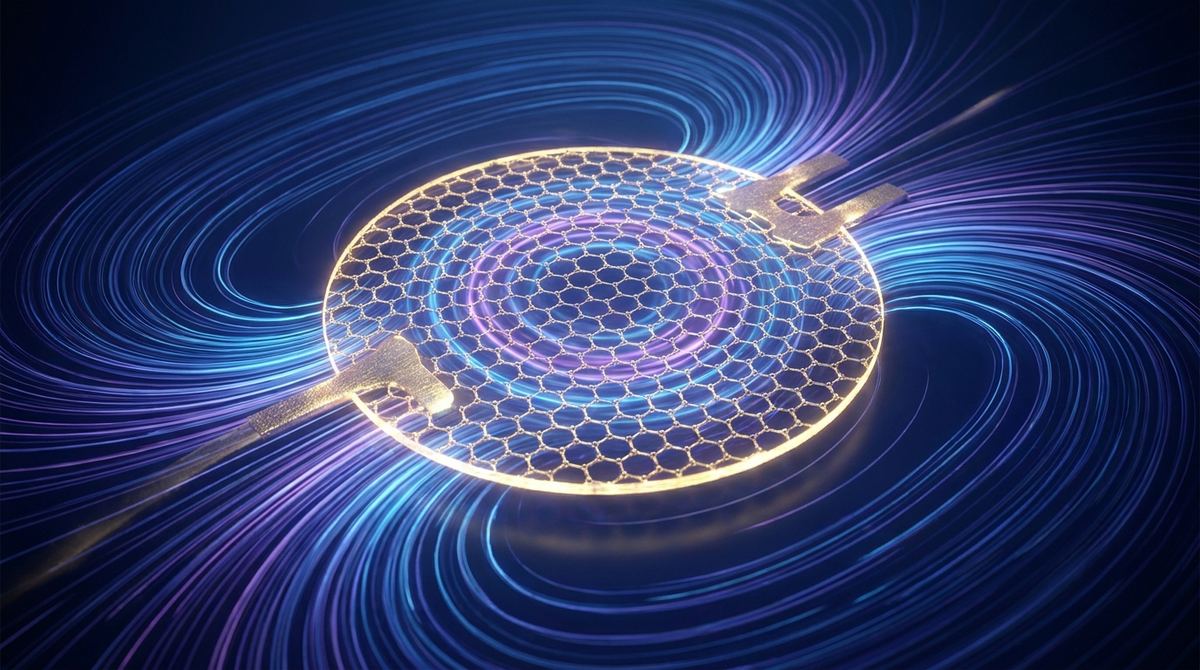
The exploration of quantum coherence in solid-state devices continually pushes the boundaries of condensed matter physics and advanced materials science. Researchers led by Adam Rycerz have conducted a groundbreaking study that investigates the mesoscopic Josephson effect within a graphene disk subjected to a specific magnetic field regime. This investigation provides crucial insights into the complex current-phase relations that define superconductor-graphene-superconductor junctions operating beyond the traditional tunneling paradigms. By focusing on the unique topological and electronic properties of graphene arranged in a Corbino geometry, the research elucidates how magnetic field tuning fundamentally alters the transport of Cooper pairs. The findings challenge conventional theoretical frameworks and offer a deeper understanding of mesoscopic transport phenomena. The meticulous theoretical work lays a robust foundation for future experimental validations in quantum electronics.
For decades, the classical tunneling Josephson junction has served as a foundational component in superconducting electronics and quantum computing architectures. In these conventional systems, the relationship between the supercurrent and the phase difference across the junction is elegantly described by a simple sine function. The standard theoretical model dictates that the product of the critical current and the normal-state resistance strictly follows a specific mathematical relation dependent on the superconducting gap and the elementary charge. However, as junction dimensions shrink to the mesoscopic scale and highly transparent materials like graphene are introduced, this simplistic current-phase relation breaks down. The transmission probabilities in these advanced junctions approach unity, necessitating a completely different theoretical approach to accurately capture the transport dynamics. Scientists must now rely on advanced quantum mechanical models to decode the intricate behaviors of these highly transparent interfaces.
Mesoscopic Josephson junctions represent a significant departure from their macroscopic, tunneling-based counterparts due to the profound influence of quantum phase coherence over the entire device length. When the normal region separating two superconductors is highly transparent, the transmission probabilities for charge carriers become comparable to a value of one. This high transparency leads to a phenomenon known as skewness in the current-phase relation, which deviates markedly from the standard sinusoidal curve observed in classical tunnel junctions. The skewness fundamentally alters the harmonic content of the Josephson current, introducing higher-order terms that complicate the phase dynamics of the system. Understanding this skewed relationship is critical for designing next-generation superconducting circuits that rely on precise phase control and non-linear inductive properties. The forward-leaning nature of the current-phase curve is the ultimate signature of this mesoscopic transport regime.
The theoretical foundation for understanding these highly transparent junctions relies on analyzing the Andreev reflection process at the interfaces between the normal metal and the superconductors. In a typical reflection event, an electron from the normal region strikes the superconducting interface and is reflected as a hole, simultaneously transferring a Cooper pair into the superconducting condensate. In mesoscopic systems with near-perfect transmission, these Andreev bound states carry the supercurrent and their energy levels are highly sensitive to the phase difference across the junction. The mathematical description of these bound states naturally yields a skewed current-phase relation when the transmission coefficients approach unity. The resulting forward-leaning current-phase curve is a hallmark of mesoscopic transport and serves as a primary indicator of high interface transparency in the fabricated device. Accurately modeling these bound states is therefore paramount to predicting device performance.
Graphene has emerged as an ideal platform for studying mesoscopic superconductivity due to its pristine crystal structure, high carrier mobility, and tunable carrier density via the electric field effect. When graphene is coupled to superconducting electrodes to form a superconductor-graphene-superconductor junction, it inherits superconducting properties through the proximity effect. The specific spatial arrangement of these electrodes plays a massive role in determining the nature of the quantum transport through the carbon lattice. In the study conducted by the research team, the device is modeled using a disk-shaped configuration known as the Corbino geometry. This specific annular arrangement consists of a central circular electrode surrounded by a ring-shaped outer electrode, with the graphene sheet bridging the gap between them. This geometric configuration is intentionally chosen to isolate specific transport phenomena from external interference.
The primary advantage of utilizing the Corbino geometry in mesoscopic transport studies is the complete elimination of physical edges along the direction of current flow. In standard rectangular graphene junctions, edge states can introduce spurious transport channels and scattering events that obscure the intrinsic bulk properties of the Dirac fermions. By employing a disk-shaped topology, researchers can effectively isolate the bulk transport mechanisms and study the pure proximity-induced superconductivity within the two-dimensional electron gas. The radial symmetry of the Corbino disk also imposes unique boundary conditions on the quantum wavefunctions, leading to distinct interference patterns and resonance effects. This edge-free environment is highly advantageous for isolating the subtle signatures of the mesoscopic Josephson effect and achieving a clearer theoretical understanding of the underlying physics. It provides a pristine arena for observing unadulterated quantum coherence.
The application of an external magnetic field introduces an additional layer of control and complexity to the transport properties of the graphene Corbino disk. Magnetic fields penetrate the junction area and modulate the phase of the superconducting order parameter, a phenomenon that typically leads to Fraunhofer-like interference patterns in rectangular junctions. However, in the Corbino geometry, the magnetic flux threading the annular region induces a circulating vector potential that profoundly alters the trajectories of the charge carriers. The research focuses on a specific regime where the magnetic field is meticulously adjusted to drive the critical current toward zero while simultaneously pushing the normal-state resistance toward infinity. This extreme operational state provides a unique window into the fundamental limits of superconducting transport in two-dimensional Dirac systems. It forces the system into a boundary state where classical approximations completely fail.
Operating in a regime where the critical current vanishes and the resistance diverges might initially seem counterproductive for practical device applications. Nevertheless, this precise tuning allows physicists to isolate and analyze the residual quantum coherence effects that persist even when macroscopic supercurrents are suppressed. The asymptotic behavior of the transport coefficients in this magnetic field limit reveals the intrinsic scaling laws governing the superconductor-graphene-superconductor junction. By pushing the system to these extreme boundaries, the researchers can extract fundamental constants and mathematical relationships that are otherwise masked by dominant transport channels in zero-field conditions. This methodology underscores the importance of magnetic field tuning as a powerful diagnostic tool in the study of mesoscopic quantum phenomena. It highlights the invisible quantum dynamics that govern the foundation of the material.
To accurately model the complex interplay between relativistic Dirac fermions and proximity-induced superconductivity, the researchers employed the Dirac-Bogoliubov-De-Gennes equation. This sophisticated mathematical framework extends the traditional Bogoliubov-De-Gennes equations, which describe standard superconductors, to incorporate the linear dispersion relation characteristic of monolayer graphene. The inclusion of the Dirac Hamiltonian is absolutely essential for capturing the chiral nature of the charge carriers and their unique scattering behaviors at the superconducting interfaces. Solving this complex system of coupled differential equations requires advanced quantum-mechanical mode-matching techniques to ensure the continuity of the wavefunctions across the distinct regions of the Corbino disk. This rigorous analytical approach provides a highly detailed picture of the energy spectrum and the spatial distribution of the Andreev bound states. It stands as a monumental achievement in theoretical condensed matter physics.
The quantum-mechanical mode-matching analysis involves expanding the wavefunctions in terms of cylindrical harmonics due to the inherent radial symmetry of the Corbino geometry. By matching the normal and anomalous components of the spinor wavefunctions at the inner and outer circular interfaces, the researchers can derive the exact transmission and reflection amplitudes for all propagating modes. This exact analytical solution allows for the precise calculation of the Josephson current as a function of the macroscopic phase difference between the superconducting leads. The mathematical rigor of this approach ensures that all quantum interference effects, including those arising from the applied magnetic field, are naturally incorporated into the final transport equations. The resulting theoretical predictions offer an unprecedented level of detail regarding the microscopic mechanisms driving the mesoscopic Josephson effect in graphene. This level of precision is rarely achieved in complex mesoscopic systems.
While the exact quantum-mechanical solution provides a comprehensive description of the system, it is often mathematically dense and computationally intensive to evaluate across all parameter spaces. To provide a more intuitive physical picture, the researchers compared their rigorous Dirac-Bogoliubov-De-Gennes results with a significantly simpler theoretical construct. This alternative model assumes an incoherent scattering process occurring between the two circular interfaces that separate the graphene sample from the superconducting leads. By intentionally neglecting the coherent phase accumulation of the charge carriers as they traverse the normal region, this simplified model isolates the effects of interface transparency from the bulk ballistic transport. Comparing the outcomes of these two disparate modeling approaches allows scientists to identify which transport features are strictly dependent on quantum coherence. This comparative technique is invaluable for dissecting complex physical interactions.
The comparison between the fully coherent quantum model and the incoherent scattering approximation yields surprising and highly informative results. Even when phase coherence within the central graphene disk is artificially suppressed in the simpler model, certain universal features of the mesoscopic Josephson effect remain remarkably robust. This resilience suggests that the fundamental geometry of the Corbino disk and the inherent transparency of the graphene-superconductor interfaces play a dominant role in shaping the current-phase relation. The incoherent model successfully captures the general trends of the critical current and normal-state resistance under the influence of the magnetic field, albeit lacking the fine interference fringes predicted by the exact solution. This comparative analysis not only validates the rigorous mathematical framework but also provides a practical approximation tool for experimentalists designing complex graphene-based superconducting circuits. It bridges the gap between abstract theory and practical engineering.
The most striking quantitative outcomes of this research involve the precise values calculated for the critical current-resistance product and the skewness parameter. In standard tunneling junctions, the Ambegaokar-Baratoff theory dictates that the product of the critical current and normal-state resistance equals exactly pi divided by two, multiplied by the superconducting gap over the elementary charge. However, in the highly specific magnetic field regime investigated for the graphene Corbino disk, this product evaluates to approximately one point eight five times the superconducting gap over the electron charge. This significant enhancement over the classical theoretical limit is a direct manifestation of the high transmission probabilities and the unique density of states characteristic of Dirac fermions in a radial geometry. The anomalous product serves as a distinct signature of the mesoscopic transport regime operating within the device. It unequivocally proves that the system has transcended classical tunneling behavior.
Equally important is the calculation of the skewness parameter, which quantifies the deviation of the current-phase relation from a pure sine wave. The theoretical analysis reveals a skewness value of approximately zero point one four for the Corbino junction under the tuned magnetic field conditions. A positive skewness value of this magnitude indicates a pronounced forward-leaning distortion in the current-phase curve, confirming the presence of highly transparent Andreev transport channels. This specific numerical value provides a critical benchmark for future experimental verification, as it can be directly measured using advanced microwave interferometry techniques. The precise determination of both the anomalous current-resistance product and the skewness parameter represents a major leap forward in characterizing mesoscopic superconductivity in advanced two-dimensional materials. These metrics will undoubtedly guide the next generation of experimental device fabrication.
What is the mesoscopic Josephson effect? The mesoscopic Josephson effect occurs in superconducting junctions where the normal material separating the superconductors is highly transparent to charge carriers. Unlike classical tunneling junctions that exhibit a simple sinusoidal relationship between current and phase, mesoscopic junctions display complex, skewed current-phase relations. This complexity arises because the transmission probabilities of electrons and holes across the junction are close to unity, allowing for multiple Andreev reflections. The phenomenon is highly sensitive to the quantum phase coherence maintained over the entire physical length of the device. Understanding this fundamental effect is crucial for developing advanced quantum electronic components.
Why is graphene used in this specific research study? Graphene is a single layer of carbon atoms arranged in a hexagonal lattice, known for its exceptional electrical conductivity and the unique behavior of its electrons as massless Dirac fermions. These properties make it an incredibly highly transparent medium when placed between two superconducting electrodes, allowing for the efficient transfer of Cooper pairs via the proximity effect. Its tunable carrier density also allows researchers to dynamically alter the electronic properties of the junction using external electric fields. In the context of mesoscopic physics, graphene provides an almost perfect, defect-free platform to study complex quantum interference and coherent transport phenomena. The material effectively bridges the gap between relativistic quantum mechanics and solid-state superconductivity.
What is the Corbino geometry and why is it advantageous? The Corbino geometry is an annular, disk-shaped device configuration consisting of a central circular electrode surrounded by a concentric outer ring electrode. The primary advantage of this specific layout in transport experiments is the complete elimination of physical edges along the path of the electrical current. In traditional rectangular devices, edge states can introduce unpredictable scattering and alternative transport channels that complicate the analysis of the material. By using a disk shape, physicists can isolate the bulk properties of the graphene and observe the pure, unadulterated proximity effect. Furthermore, the radial symmetry of the design imposes unique boundary conditions that facilitate highly rigorous mathematical modeling.
How does the applied magnetic field affect the junction? Applying an external magnetic field to the superconductor-graphene-superconductor junction fundamentally alters the trajectories and quantum phase of the charge carriers. The magnetic flux induces a circulating vector potential within the annular region of the Corbino disk, modifying the interference patterns of the Andreev bound states. In this specific study, the magnetic field is precisely tuned to a regime that drives the critical supercurrent toward zero while simultaneously causing the normal-state resistance to diverge toward infinity. This extreme tuning helps researchers isolate the residual quantum coherence effects and extract fundamental scaling laws that govern the device. It provides a highly controlled environment to test the limits of current theoretical models.
What is the significance of the skewness parameter mentioned in the findings? The skewness parameter is a mathematical value that quantifies how much the current-phase relation of a Josephson junction deviates from a standard sine wave. A positive skewness value, such as the zero point one four calculated in this study, indicates that the current-phase curve is leaning forward, a direct result of high transmission probabilities across the junction interfaces. Measuring this parameter is essential because it reveals the microscopic nature of the Andreev transport channels and the overall transparency of the device. The specific value calculated provides a rigorous benchmark that experimental physicists can target when fabricating and testing these advanced graphene circuits. It ultimately confirms the transition from a classical tunneling regime to a fully mesoscopic transport regime.
The meticulous theoretical investigation into the mesoscopic Josephson effect within a graphene Corbino disk represents a substantial advancement in the field of condensed matter physics. By rigorously applying the Dirac-Bogoliubov-De-Gennes framework, the research successfully maps the complex interplay between relativistic Dirac fermions and proximity-induced superconductivity under extreme magnetic field conditions. The discovery of an anomalous critical current and resistance product, alongside a distinctly positive skewness parameter, challenges the traditional boundaries of the Ambegaokar-Baratoff theory. These findings underscore the profound impact of device geometry and interface transparency on the fundamental quantum transport properties of two-dimensional materials. The comparative analysis with simpler scattering models further solidifies our understanding of which phenomena are strictly driven by overarching quantum coherence. This research provides a definitive theoretical roadmap for future investigations into topological superconductivity.
Looking toward the future, the insights generated by this theoretical study hold immense potential for the development of next-generation superconducting technologies. The precise control over current-phase relations demonstrated in the Corbino geometry could pave the way for highly advanced, non-linear inductive components utilized in quantum computing architectures. Furthermore, the ability to tune the transport parameters using external magnetic fields offers a versatile mechanism for operating highly sensitive quantum interference devices and topological quantum circuits. As fabrication techniques continue to improve, experimentalists will undoubtedly seek to physically realize these theoretical predictions and harness the unique properties of mesoscopic graphene junctions. The continued exploration of these complex quantum systems will inevitably drive innovation across the entire spectrum of superconducting electronics. The integration of high-transparency graphene interfaces will likely become a cornerstone of future quantum hardware design.
Serious about B2B integration? Test our premium Pulsed Electrical Resistive Carbon Heating turbostratic graphene in your lab. 100g sample packs available now.
Explore More
Researchers derived an analytic formula for twisted bilayer graphene electron lifetimes, providing a key design tool for future quantum and electronic devices.

Learn to build a high-responsivity 1.5 µm graphene photodetector. This guide details the materials and steps for a prototype based on upconversion...

New software for the modal analysis of electromagnetic resonators now includes 2D materials, accelerating the design of advanced graphene optical and...