
A New Era of Graphene Engineering: Pre-Designing Twist Angles on Demand
Researchers have developed a breakthrough method for growing twisted bilayer graphene with pre-designed angles, a key step toward manufacturable quantum...
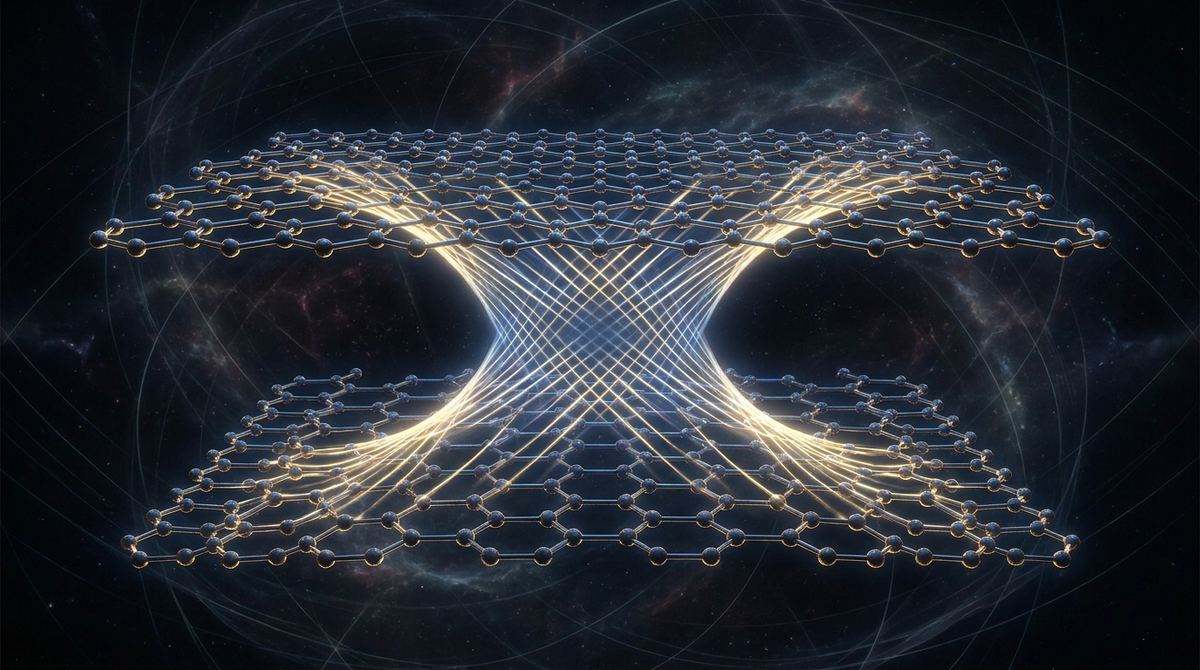
Researchers led by Petr Červenka and Vít Jakubský have developed a groundbreaking theoretical framework for designing quantum couplers based on Dirac materials that can precisely modulate the polarization of transmitted quasiparticles. Their pioneering study introduces a novel methodology to control quantum states without significantly perturbing the fundamental propagation of these particles through the material medium. The research specifically highlights the immense potential of utilizing advanced carbon-based nanostructures for next-generation electronic and quantum information systems. By focusing on the unique electronic properties inherent to Dirac materials, the scientific team has unlocked new pathways for manipulating charge carriers at the quantum level. This achievement marks a substantial leap forward in our ability to engineer nanoscale devices where traditional semiconductor physics no longer applies. The framework offers a comprehensive understanding of how symmetry can be weaponized to dictate the behavior of subatomic entities traversing complex atomic lattices. Consequently, the findings presented by the research duo serve as a crucial foundation for the future development of highly efficient, polarization-controlling quantum couplers.
The conceptual foundation of this research relies heavily on the intrinsic symmetries present within the crystalline lattices of Dirac materials. In these unique substances, electrons behave as relativistic massless fermions governed by the Dirac equation rather than the standard Schrödinger equation. This relativistic behavior imparts extraordinary mobility to the charge carriers but simultaneously introduces significant challenges regarding their confinement and directional control. The theoretical framework proposed in this study utilizes spatial and parity symmetries to construct a mathematical model wherein quasiparticle trajectories can be accurately predicted and manipulated. By carefully aligning the geometric configuration of the material with its inherent electronic symmetries, the researchers demonstrated that it is possible to create specialized coupling regions. These regions act as quantum gateways that selectively interact with the phase and polarization of the incoming electron wavefunctions. Ultimately, this symmetry-guided approach provides an elegant solution to the long-standing problem of controlling massless Dirac fermions without destroying their delicate quantum coherence.
To fully appreciate the elegance of this symmetry-guided design, one must delve into the mathematical intricacies of the Hamiltonian operators used to describe the system. The researchers formulated a coupled Hamiltonian that explicitly incorporates the symmetry constraints required to prevent unwanted scattering events at the interfaces of the quantum coupler. This mathematical rigor ensures that the coupling mechanism only affects the internal degrees of freedom, such as pseudospin or valley index, while leaving the kinetic momentum largely unaltered. By enforcing strict symmetry rules, the model effectively isolates the polarization dynamics from the spatial propagation dynamics, creating a decoupled system that is much easier to engineer. The theoretical derivations show that any breaking of these fundamental symmetries would immediately lead to a degradation of the transmission efficiency. Therefore, maintaining exact symmetry becomes the primary design directive for creating flawless quantum couplers in any Dirac material. This stringent requirement pushes the boundaries of current nanofabrication theoretical limits, demanding unprecedented precision in theoretical modeling.
Furthermore, the symmetry-guided framework is not strictly limited to a single type of carbon lattice, although the primary focus remains on specialized graphene configurations. The underlying principles derived from the Dirac equation can theoretically be extended to other two-dimensional materials that exhibit similar relativistic Dirac cones in their band structures. Materials such as silicene, germanene, or even topological insulators could potentially benefit from the mathematical models established in this comprehensive study. The universality of the symmetry constraints means that researchers across various fields of condensed matter physics can adapt these equations to suit their specific material platforms. This broad applicability significantly amplifies the impact of the research, transforming it from a niche graphene study into a generalized blueprint for quantum device engineering. As theoretical physics continues to explore the exotic properties of novel two-dimensional materials, this framework will undoubtedly serve as a critical reference point. The ability to mathematically guarantee polarization modulation through symmetry is a monumental achievement in theoretical materials science.
One of the most fascinating phenomena observed in Dirac materials is Klein tunneling, a quantum mechanical effect where relativistic particles pass through high potential barriers with perfect transmission. In traditional parabolic semiconductors, an electron encountering a sufficiently high energy barrier will be reflected, leading to an exponential decay of the wavefunction inside the barrier. However, in graphene and similar materials, the conservation of pseudospin allows electrons striking a barrier at normal incidence to pass through completely unimpeded. This study leverages the mechanics of Klein tunneling not as a nuisance to be avoided, but as a fundamental mechanism to ensure the perfect transmission of quasiparticles through the coupler. By carefully engineering the potential landscape of the coupling region, the researchers guarantee that the incoming quantum states undergo Klein tunneling. This precise manipulation ensures that the particle flux remains constant, preventing any loss of signal or energy as the quasiparticle traverses the active region of the device. The mastery over this relativistic tunneling phenomenon is central to the efficacy of the proposed quantum coupler.
The challenge, therefore, lies in modulating the internal state of the quasiparticle while it is undergoing this perfect transmission through the potential barrier. The theoretical model demonstrates that while the forward momentum is preserved due to Klein tunneling, the off-diagonal elements of the coupling Hamiltonian can interact with the pseudospin vector. This interaction causes the pseudospin to precess or flip as the particle moves through the defined coupling zone, effectively changing its polarization state. Because this precession occurs simultaneously with the tunneling process, the particle emerges on the other side with a newly defined polarization but without any reduction in its transmission probability. The spatial extent of the coupling region and the strength of the interaction potentials dictate the exact degree of polarization transformation achieved. Achieving a complete polarization inversion requires a meticulously calibrated barrier width that perfectly matches the spatial frequency of the pseudospin precession. This delicate balancing act represents a significant theoretical triumph in the realm of quantum control within relativistic solid-state systems.
To quantify the conditions required for this flawless operation, the researchers conducted an exhaustive analytical evaluation of the scattering matrix associated with the coupler interface. The scattering matrix formalism provides a rigorous mathematical description of how incoming wavefunctions are distributed into transmitted and reflected components. By setting the reflection coefficients to zero, the team was able to extract the exact physical parameters necessary to sustain perfect transmission across various energy levels. This analysis revealed that Klein tunneling in the coupler is highly sensitive to the incidence angle of the incoming quasiparticles, with perfect transmission strictly guaranteed only for specific trajectories. Deviations from these optimal pathways introduce minor backscattering, which must be carefully managed in any practical realization of the device. The detailed mapping of the transmission probabilities across different angles and energies creates a comprehensive operational phase space for the proposed coupler. Understanding these boundaries is essential for the future integration of these components into larger, more complex quantum electronic circuits.
In the context of Dirac materials, the concept of polarization extends beyond the classical understanding of electromagnetic waves and delves into the quantum mechanical properties of the charge carriers. Quasiparticles in graphene possess an internal degree of freedom known as pseudospin, which arises from the bipartite nature of the hexagonal carbon lattice. This pseudospin behaves mathematically like real electron spin, dictating the phase relationship between the wavefunction amplitudes on the two distinct sublattices. The quantum coupler designed in this theoretical study specifically targets this pseudospin, utilizing it as the primary medium for encoding and processing quantum information. By manipulating the pseudospin state of the transmitted quasiparticles, the device acts as a polarization filter or waveplate, analogous to optical components used in photonics. This ability to reliably modulate pseudospin without altering the physical path of the electron is a massive breakthrough for the emerging field of pseudospintronics. The precision achieved in this theoretical model opens the door to entirely new paradigms of logic and memory devices based on sublattice polarization.
The mechanism driving this polarization modulation is deeply rooted in the localized interactions intentionally engineered within the coupling region of the device. As the quasiparticle enters the coupler, it encounters a carefully tailored perturbative field that breaks the degeneracy of the pseudospin states. This perturbation induces a coherent oscillation between the different polarization states, a phenomenon that can be accurately described using the formalism of Rabi oscillations. The spatial length of the coupler determines the duration of this interaction, thereby dictating the final polarization state of the quasiparticle upon its exit. If the length is calibrated to match exactly half of the oscillation spatial period, the coupler will output a quasiparticle with a completely inverted pseudospin. This deterministic control over the quantum state is essential for building reliable logic gates that operate on pseudospin rather than traditional electronic charge. The detailed mathematical analysis provided by the researchers ensures that these oscillations remain coherent even in the presence of minor structural imperfections.
Furthermore, the study explores the possibility of extending this polarization control to the valley degree of freedom, another defining characteristic of the graphene band structure. The Dirac cones in graphene are located at two distinct points in the Brillouin zone, labeled as the K and K-prime valleys, which act as an additional quantum number. The theoretical framework indicates that by introducing specific types of symmetry-breaking potentials, the coupler could potentially modulate the valley polarization alongside the pseudospin. This dual-modulation capability would exponentially increase the information density that could be processed by a single nanoscale quantum device. Operating on both pseudospin and valley index simultaneously requires a highly sophisticated understanding of the intervalley scattering dynamics within the localized coupling region. The researchers have laid the necessary mathematical groundwork to explore these complex interactions, providing a clear path forward for future theoretical investigations. Ultimately, the successful manipulation of these internal degrees of freedom represents the ultimate goal of next-generation quantum materials engineering.
The explicit model chosen to demonstrate this theoretical framework is a quantum coupler constructed from AA-stacked bilayer graphene nanoribbons. Unlike the more common AB-stacked or Bernal-stacked bilayer graphene, the AA-stacking configuration aligns the carbon atoms of the top layer directly above the carbon atoms of the bottom layer. This specific crystallographic arrangement preserves the linear Dirac dispersion relations characteristic of single-layer graphene while introducing an interlayer coupling parameter. The preservation of the Dirac cones is absolutely critical, as it ensures that the charge carriers continue to behave as relativistic massless fermions within the bilayer system. The AA-stacked architecture effectively creates two parallel transport channels that can interact through the highly localized interlayer electronic coupling. This configuration provides the perfect physical canvas for implementing the symmetry-guided design principles outlined in the broader theoretical framework. The unique band structure of AA-bilayer graphene is therefore not merely a structural choice, but a fundamental prerequisite for the operation of the proposed quantum coupler.
The physical geometry of the nanoribbons plays an equally important role in the proper functioning of the theoretical quantum coupler model. The researchers specifically selected nanoribbons with armchair-shaped edges, as opposed to zigzag edges, due to their unique boundary conditions and electronic properties. Armchair edges inherently mix the states from the two distinct valleys in the graphene Brillouin zone, preventing the formation of localized edge states that plague zigzag configurations. This absence of zero-energy edge states ensures that the bulk transport properties dominate the behavior of the device, leading to much cleaner and more predictable transmission profiles. Furthermore, the transverse confinement provided by the nanoribbon geometry quantizes the perpendicular momentum, creating distinct subbands that the quasiparticles can occupy. The careful selection of the nanoribbon width allows the researchers to tune the energy spacing between these subbands, optimizing the coupler for specific operating frequencies. The armchair edge geometry is thus a critical architectural component that directly contributes to the high-fidelity polarization modulation observed in the theoretical results.
The localized interlayer interaction within the AA-stacked bilayer is the actual engine that drives the coupling and polarization transformation processes. In the proposed model, this interaction is not uniform across the entire device but is spatially restricted to a precisely defined coupling zone. Outside this zone, the two graphene layers are assumed to be electronically isolated, acting merely as independent waveguides for the incoming and outgoing quasiparticles. When a quasiparticle enters the localized interaction region, the wavefunction overlaps between the top and bottom layers, initiating the coherent transfer of probability amplitude. The strength and spatial distribution of this interlayer hopping parameter must be meticulously controlled to achieve the desired quantum interference effects. The mathematical model provides explicit formulas for designing this interaction profile, demonstrating that even subtle variations can drastically alter the transmission characteristics. Engineering this localized interaction in a physical device will require advanced fabrication techniques, but the theoretical blueprint is now definitively established.
The operational characteristics of the AA-bilayer graphene quantum coupler exhibit significant variations depending on the transverse dimensions of the nanoribbons utilized. The researchers conducted a rigorous comparative analysis between narrow and wide coupler configurations to understand how geometric scaling impacts the quantum transport properties. In narrow couplers, the strict transverse confinement leads to a large energy separation between the quantized subbands, simplifying the transmission dynamics. This large subband spacing ensures that at low energies, only a single transverse mode is available for quasiparticle propagation, creating an effective one-dimensional transport regime. Under these conditions, the mathematical modeling of the polarization modulation becomes highly tractable, allowing for pristine analytical solutions to the scattering problem. The narrow configuration is therefore highly desirable for applications requiring absolute deterministic control over a single quantum channel. However, the strict dimensional requirements for narrow ribbons pose immense challenges for current state-of-the-art nanolithography and chemical synthesis techniques.
Conversely, transitioning to a wide coupler configuration introduces a multitude of complex quantum mechanical interactions that fundamentally alter the device performance. As the width of the nanoribbon increases, the energy spacing between the transverse subbands decreases proportionally, leading to a highly dense spectrum of available states. At any given operational energy, the incoming quasiparticle may couple to multiple transverse modes simultaneously, triggering complex multimode interference patterns within the interaction region. The theoretical framework demonstrates that maintaining perfect transmission and controlled polarization in this multimode regime requires significantly more sophisticated potential engineering. The localized interlayer interactions must be carefully tuned to prevent unwanted inter-subband scattering, which would otherwise scramble the polarization state and degrade transmission efficiency. Despite these complexities, wide couplers offer the distinct advantage of higher total current carrying capacity and greater robustness against localized atomic defects. Understanding the nuanced physics of wide nanoribbons is crucial for scaling up these quantum devices for practical macroscopic applications.
The scaling dynamics also heavily influence the spatial footprint required for the coupler to achieve a complete polarization inversion. In the single-mode regime characteristic of narrow couplers, the required length of the interaction region is directly proportional to the inverse of the interlayer coupling strength. This straightforward relationship allows for the design of extremely compact quantum logic gates that could be densely packed onto a single carbon-based chip. However, in wide couplers where multimode interference dominates, the optimal interaction length becomes a complex function of the various subband propagation constants. The researchers utilized advanced numerical simulations to map out the optimal dimensions for wide couplers, revealing intricate periodicities in the transmission spectra. These simulations prove that while wide couplers are more difficult to optimize analytically, they can still achieve flawless polarization modulation if the geometric parameters are strictly adhered to. The comprehensive analysis of both scaling extremes provides a robust operational matrix for future device engineers to reference.
One of the most powerful features of the proposed theoretical framework is the ability to actively tune the transmission and polarization profiles using external fields. The researchers demonstrated that the application of an external perpendicular electric field introduces a tunable asymmetry between the top and bottom layers of the AA-stacked graphene. This electric field creates an electrostatic potential difference, often referred to as a bias voltage, which directly modifies the localized interlayer interaction dynamics. By dynamically adjusting this bias voltage, the operator can actively control the rate of pseudospin precession within the coupling region in real time. This active tunability transforms the quantum coupler from a static, passive component into a highly versatile, active quantum modulator capable of on-the-fly signal processing. The theoretical models show that the polarization state of the transmitted quasiparticle can be smoothly swept across the entire Bloch sphere simply by varying the electric field strength. This electrostatic control mechanism is highly compatible with existing semiconductor architectures, facilitating easier integration into future hybrid technologies.
In addition to electrostatic gating, the study investigates the profound effects of applying localized magnetic fields to the quantum coupling region. The introduction of a perpendicular magnetic field breaks time-reversal symmetry, fundamentally altering the propagation characteristics of the Dirac fermions within the nanoribbon. The magnetic field induces a vector potential that shifts the transverse momentum of the quasiparticles, modifying the effective coupling between the various quantized subbands. The researchers found that carefully calibrated magnetic fields can be used to suppress unwanted backscattering channels, further enhancing the purity of the perfect transmission regime. Furthermore, the interplay between the magnetic field and the intrinsic properties of the AA-stacked bilayer leads to the emergence of exotic magneto-electric coupling phenomena. These complex interactions provide an additional layer of control, allowing for the precise steering of quasiparticle trajectories and the fine-tuning of their internal polarization states. The utilization of magnetic fields thereby significantly expands the operational bandwidth and functionality of the proposed quantum device.
The synergetic application of both electric and magnetic fields opens up the possibility for unprecedented, multidimensional control over the quantum transport properties. By navigating the multidimensional parameter space defined by the external fields, the coupler can be dynamically reconfigured to perform a variety of distinct quantum operations. For instance, the device could operate as a perfect transmission waveguide under one set of field parameters, and instantly switch to a polarizing beam splitter under another. This immense flexibility is a direct result of the symmetry-guided design methodology, which ensures that the fundamental quantum coherence is maintained regardless of the external perturbations applied. The theoretical calculations provided by the research team offer a precise mapping of how these external fields influence the localized interlayer interactions. Consequently, this research lays the definitive theoretical groundwork for the realization of fully programmable, field-effect quantum processing units based on Dirac materials. The ability to manipulate relativistic quasiparticles with such high fidelity using standard macroscopic fields represents a massive leap forward for quantum engineering.
What exactly is a quantum coupler in the context of Dirac materials? A quantum coupler is a specialized nanoscale architecture designed to interface different quantum states or transport channels without destroying the delicate quantum information they carry. In Dirac materials like graphene, these couplers manage the flow of relativistic massless fermions, manipulating their internal properties such as pseudospin or valley index. The coupler operates by creating a localized interaction region where wavefunctions can coherently overlap and exchange probability amplitude. This specific theoretical model uses localized interlayer interactions within a bilayer graphene system to achieve this precise quantum control. The ultimate goal is to process quantum information on the fly as the particle propagates through the material.
Why do the researchers specify AA-stacked bilayer graphene instead of the more common AB-stacked variety? The choice of AA-stacked bilayer graphene is driven by its unique electronic band structure, which perfectly preserves the linear Dirac dispersion relations found in single-layer graphene. In traditional AB-stacked, or Bernal-stacked, bilayer graphene, the low-energy charge carriers behave as massive fermions with parabolic dispersion, which eliminates the relativistic effects necessary for this specific coupler design. AA-stacking ensures that the electrons continue to act as massless Dirac fermions, allowing the device to leverage relativistic phenomena like Klein tunneling for perfect transmission. The strict alignment of the carbon atoms in the AA configuration also simplifies the theoretical modeling of the localized interlayer interactions. This specific crystallographic arrangement is therefore a fundamental requirement for the proposed symmetry-guided design.
How does Klein tunneling contribute to the functionality of this proposed device? Klein tunneling is a quantum mechanical phenomenon where relativistic particles can pass through high potential barriers with absolute perfect transmission, experiencing zero reflection. In traditional semiconductor devices, potential barriers cause electrons to reflect, which would disrupt the flow of information and degrade the signal. The researchers intentionally engineered their theoretical coupler to operate within the Klein tunneling regime to guarantee that quasiparticles pass through the interaction zone completely unimpeded. This perfect transmission ensures that the device can modulate the polarization state of the particle without suffering any loss in particle flux or signal intensity. Harnessing this relativistic effect is what allows the coupler to be both highly efficient and perfectly transparent to the forward propagation of the charge carriers.
What is the significance of using armchair edges for the graphene nanoribbons? Armchair edges are specifically chosen for their unique boundary conditions that profoundly impact the electronic properties of the graphene nanoribbon. Unlike zigzag edges, which inherently produce highly localized, zero-energy edge states that can interfere with bulk transport, armchair edges generally avoid these disruptive localized states. Furthermore, armchair boundaries naturally mix the quantum states from the two distinct valleys in the graphene Brillouin zone, which is a critical factor for managing intervalley scattering. This geometric configuration provides a much cleaner, more predictable quantum transport channel, allowing the theoretical models to accurately predict the polarization modulation. By eliminating the unpredictable variable of edge-state interference, the researchers can focus entirely on the bulk interlayer coupling dynamics.
How can external fields be used to improve or alter the performance of the quantum coupler? External electric and magnetic fields provide a mechanism for actively tuning the internal dynamics of the quantum coupler in real time. An applied perpendicular electric field creates a bias voltage between the top and bottom graphene layers, which directly alters the rate of pseudospin precession and polarization. A perpendicular magnetic field breaks time-reversal symmetry, introducing a vector potential that can suppress unwanted scattering and modify the transverse momentum of the quasiparticles. By carefully calibrating these macroscopic external fields, operators can dynamically reconfigure the nanoscale device to act as a variable waveplate or a perfect waveguide. This active tunability is essential for integrating these theoretical components into practical, programmable quantum electronic circuits in the future.
Conclusion
The comprehensive theoretical framework developed by this scientific team represents a monumental advancement in our understanding of quantum transport within Dirac materials. By successfully merging the abstract concepts of symmetry-guided mathematical design with the tangible physical properties of AA-stacked bilayer graphene, the researchers have created a highly viable blueprint for future quantum technologies. The meticulous analysis of perfect transmission mechanics, specifically the intentional leveraging of relativistic Klein tunneling, solves major hurdles previously associated with quasiparticle confinement and control. Furthermore, the detailed exploration of geometric scaling and external field tunability ensures that this theoretical model possesses the necessary flexibility for eventual real-world application. As the demand for faster, more efficient quantum information processing systems continues to escalate, the principles of polarization modulation outlined in this study will become increasingly vital. Ultimately, this pioneering research establishes a new paradigm for engineering nanoscale devices where the relativistic nature of electrons is utilized as a powerful tool rather than an obstacle. The physical realization of these advanced quantum couplers will undoubtedly mark the beginning of a new era in carbon-based pseudospintronics.
Serious about B2B integration? Test our premium Pulsed Electrical Resistive Carbon Heating turbostratic graphene in your lab. 100g sample packs available now.
Explore More
Researchers have developed a breakthrough method for growing twisted bilayer graphene with pre-designed angles, a key step toward manufacturable quantum...

Learn how deep learning is revolutionizing the structural characterization of twisted bilayer materials, accelerating the development of next-generation...

Learn to build a prototype graphene FET biosensor for sensitive DNA detection. This guide covers materials, fabrication, and testing for point-of-care...