
AI-Powered Characterization of Twisted Bilayer Graphene and 2D Materials
Learn how deep learning is revolutionizing the structural characterization of twisted bilayer materials, accelerating the development of next-generation...
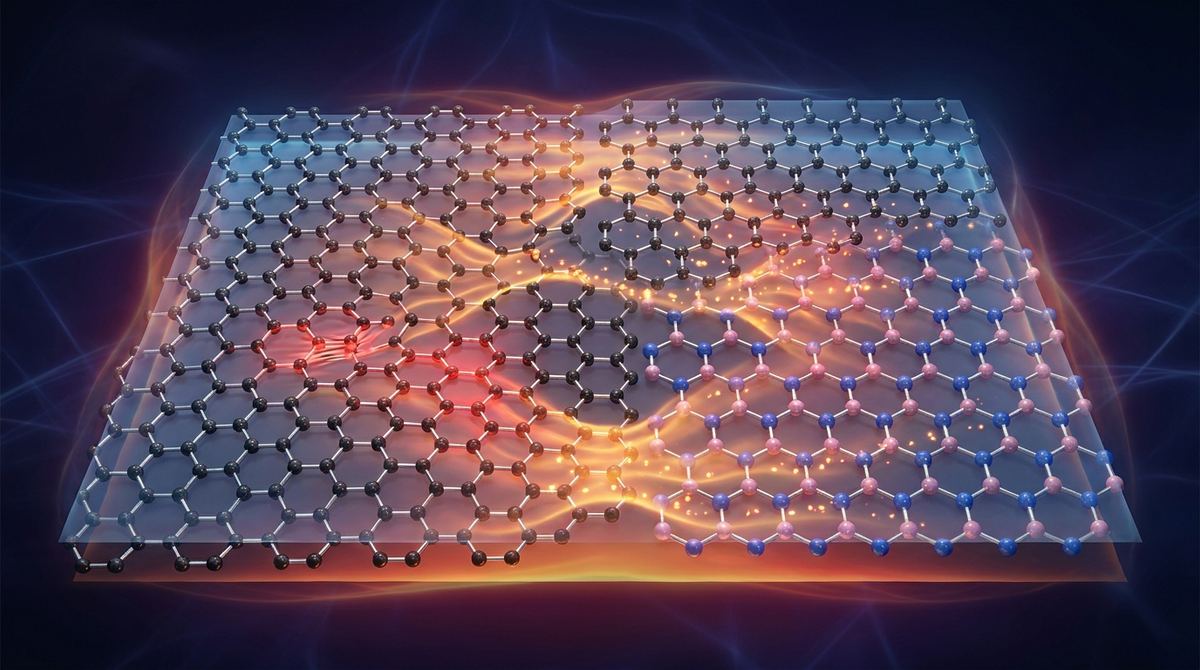
Researchers led by Wenwu Jiang, Huasong Qin, Yilun Liu, Wengen Ouyang, Oded Hod, and Michael Urbakh have conducted a study that fundamentally reshapes our understanding of thermal dissipation in low-dimensional nanoscale electronics. Their pioneering research investigates the intricate dynamics of interfacial thermal transport across homogeneous and heterogeneous junctions of graphene and hexagonal boron nitride. As the semiconductor industry relentlessly pursues miniaturization, the management of heat generated within ultra-compact devices has emerged as a critical bottleneck limiting performance and longevity. Two-dimensional materials assembled into van der Waals heterostructures offer a promising pathway to overcome these limitations, provided their thermal properties can be precisely engineered. The research team focused on how mechanical perturbations, specifically in-plane strain and interfacial twist, influence the vertical flow of thermal energy across these atomically thin boundaries. By leveraging advanced computational techniques, the investigators uncovered a profound divergence in how different material pairings respond to identical structural deformations. This discovery not only elucidates the fundamental physics governing nanoscale heat transfer but also provides a pragmatic roadmap for designing next-generation thermal management systems in flexible electronics and densely packed integrated circuits.
The integration of two-dimensional materials into functional electronic devices requires stacking distinct atomic layers to create complex van der Waals heterostructures. While these architectures exhibit exceptional electronic and optoelectronic properties, they inherently possess high thermal resistance at the interfaces between adjacent layers. This interfacial thermal resistance severely impedes the efficient dissipation of waste heat, leading to localized hotspots that degrade device performance and accelerate structural failure. Understanding the mechanisms that govern heat flow across these junctions is therefore absolutely essential for the viability of future high-power density electronics. Historically, researchers have struggled to predict how mechanical deformations inherent in flexible device applications alter the thermal conductance of these atomic interfaces. The application of external forces such as bending, stretching, or twisting inevitably alters the atomic registry between layers, thereby modifying the pathways available for thermal energy transfer. Consequently, establishing a comprehensive theoretical framework that links macroscopic mechanical perturbations to microscopic thermal transport phenomena represents a paramount challenge in contemporary materials science.
To address this challenge, scientists have increasingly turned to strain and twist engineering as non-destructive methods to tune the physical properties of two-dimensional materials. Strain engineering involves applying tensile or compressive forces to alter the interatomic spacing within a crystal lattice, thereby shifting its electronic band structure and phononic dispersion relations. Twist engineering, on the other hand, entails rotating adjacent atomic layers relative to one another to create moire superlattices that profoundly influence charge carrier and phonon dynamics. These techniques have previously yielded remarkable breakthroughs in superconductivity and optoelectronics, but their impact on vertical thermal conductance has remained comparatively underexplored. The complex interplay between in-plane structural modifications and out-of-plane heat transfer requires highly sophisticated modeling to accurately capture the subtle phononic interactions at play. By systematically isolating these variables, physicists can begin to decipher the underlying rules that dictate whether a specific interface will act as a thermal conduit or a thermal barrier under operational stress. This detailed understanding is the precise objective of the comprehensive investigation undertaken by the aforementioned research team.
To unravel the complexities of nanoscale heat transport, the research team employed rigorous atomistic simulations capable of tracking the microscopic movements of individual atoms within the crystal lattices. These computational models provide an unprecedented window into the dynamic behavior of graphene and hexagonal boron nitride interfaces under varying degrees of mechanical stress. By simulating the precise interactions between carbon, boron, and nitrogen atoms across the van der Waals gap, the investigators could measure the exact rate of thermal energy transfer from one layer to the next. The simulation framework was meticulously designed to account for both the strong covalent bonds within the two-dimensional planes and the much weaker van der Waals forces that bind the distinct layers together. This dual-force approach is critical for accurately modeling the out-of-plane vibrations that are primarily responsible for vertical heat conduction. Furthermore, the simulations were subjected to rigorous validation protocols to ensure that the predicted thermal conductance values aligned with established theoretical boundaries. The resulting dataset provides a robust foundation for analyzing the intricate relationship between structural deformation and thermal transport efficiency.
Beyond standard molecular dynamics, the researchers utilized Fermi's golden rule and the density of phonon modes analyses to rationalized their empirical observations on a quantum mechanical level. Fermi's golden rule serves as a mathematical principle to calculate the transition rates of phonons scattering across the interface, which is the fundamental mechanism of interfacial heat transfer. By analyzing the density of phonon modes, the team could identify exactly which vibrational frequencies were available to carry heat across the junction at any given moment. This spectral analysis is crucial because thermal transport relies heavily on the overlap of phonon density of states between the two adjacent materials. When the vibrational modes of the donor layer closely match those of the acceptor layer, heat flows relatively unimpeded, whereas a mismatch creates a significant thermal bottleneck. The integration of these advanced analytical tools allowed the researchers to move beyond merely observing thermal conductance changes to actually explaining the precise quantum mechanical phenomena driving those changes. This deep methodological rigor elevates the study from a simple observational report to a foundational text in nanoscale thermodynamics.
The investigation into homogeneous interfaces, specifically pure graphene-on-graphene and pure hexagonal boron nitride-on-hexagonal boron nitride junctions, revealed highly sensitive thermal transport behaviors. When these uniform bilayer systems were subjected to in-plane strain, the researchers observed a precipitous decline in vertical thermal conductance. This reduction occurs because stretching or compressing the crystalline lattice alters the intrinsic vibrational frequencies of the atoms, leading to a severe mismatch in the phonon density of states between the adjacent layers. Even minute amounts of strain were found to significantly disrupt the highly ordered phononic pathways that normally facilitate efficient heat transfer in pristine, unstrained homogeneous crystals. The application of interfacial twist produced an equally dramatic reduction in thermal conductance across these uniform material pairings. As the adjacent layers are rotated out of their optimal crystallographic registry, the perfect symmetry of the homogeneous interface is broken, creating complex moire patterns that scatter incoming phonons. This scattering effect creates substantial thermal resistance, demonstrating that homogeneous junctions are highly vulnerable to thermal degradation under mechanical perturbation.
The underlying physical mechanism driving this strong conductance reduction in homogeneous interfaces is intimately tied to the disruption of low-frequency acoustic phonons. In perfectly aligned, unstrained graphene or hexagonal boron nitride bilayers, these long-wavelength vertical phonons travel effortlessly across the van der Waals gap, carrying the bulk of the thermal energy. However, the introduction of twist angles or in-plane strain causes the local interlayer distance to fluctuate, creating an uneven energetic landscape that effectively reflects these crucial heat-carrying phonons back into the source layer. The research clearly indicates that preserving the pristine stacking order of homogeneous two-dimensional materials is paramount for maintaining their thermal dissipation capabilities. Any mechanical deformation that forces the atoms out of their lowest-energy stacking configuration will inevitably penalize the vertical heat flow. This finding poses a significant challenge for the integration of pure graphene or pure hexagonal boron nitride components in flexible electronics, where bending and twisting are fundamental operational requirements. Consequently, engineers must carefully consider these thermal degradation effects when designing flexible devices reliant on homogeneous material junctions.
In stark contrast to the uniform systems, the heterogeneous junctions composed of alternating graphene and hexagonal boron nitride layers exhibited a profoundly different thermal response to mechanical stress. The most striking discovery was the complete insensitivity of the vertical thermal conductance to interfacial twist deformations in these mixed-material systems. Regardless of the rotational angle applied between the graphene and hexagonal boron nitride layers, the rate of heat transfer across the boundary remained remarkably stable. This anomalous behavior stems from the intrinsic lattice mismatch between the two distinct materials, which inherently prevents the formation of perfectly registered, uniform stacking configurations even in the unstrained state. Because the heterogeneous interface is already structurally complex and lacks the perfect symmetry of a homogeneous bilayer, rotating the layers does not significantly alter the overall landscape of phonon scattering sites. This inherent thermal stability under torsional stress makes graphene and hexagonal boron nitride heterostructures exceptionally attractive candidates for components in flexible and foldable electronic devices.
While twist deformations proved inconsequential, the application of in-plane strain to the heterogeneous junctions produced highly tunable thermal conductance effects. The researchers discovered that applying compressive strain to the graphene and hexagonal boron nitride heterostructure led to a significant increase in vertical heat transport. Compressing the lattice forces the atoms closer together, enhancing the coupling strength of the out-of-plane van der Waals interactions and facilitating more efficient phonon transmission across the gap. Conversely, the application of tensile strain, which pulls the atoms further apart, resulted in a measurable decrease in thermal conductance due to the weakening of these critical interlayer bonds. This asymmetric response to mechanical pulling and pushing provides engineers with a powerful mechanism to actively modulate the thermal properties of a device during operation. By carefully controlling the applied strain, it becomes theoretically possible to construct dynamic thermal switches that can dissipate heat rapidly under compression and insulate sensitive components under tension. This level of precise thermal control represents a massive leap forward in the engineering of adaptive nanoscale electronics.
To fully comprehend the divergent behaviors of homogeneous and heterogeneous interfaces, one must examine the specific phononic mechanisms dictating interlayer heat transport. Heat conduction in dielectric and semiconducting two-dimensional materials is almost entirely mediated by phonons, which are quantized lattice vibrations propagating through the crystal structure. The efficiency of vertical heat transfer across a van der Waals interface is primarily governed by the transmission of low-frequency out-of-plane acoustic phonons, often referred to as vertical phonons. The atomistic simulations and subsequent density of phonon modes analyses confirmed that the population and transmission rates of these vertical phonons are highly sensitive to local stacking configurations. In homogeneous interfaces, twist and strain destroy the uniform stacking that supports vertical phonon transmission, leading to massive thermal resistance. In heterogeneous interfaces, the baseline stacking is already mixed due to lattice mismatch, meaning vertical phonons are already accustomed to navigating a complex energetic terrain. Therefore, additional twist does not further degrade the phonon transmission channels, explaining the observed insensitivity to rotational deformation.
The interaction between in-plane vibrational modes and out-of-plane vibrational modes also plays a central role in the overall thermal conductance equation. When two-dimensional materials are subjected to strain, the frequencies of the in-plane optical and acoustic phonons shift, which subsequently alters how they couple with the vertical phonons responsible for crossing the interfacial gap. The research demonstrates that the overlap of the phonon density of states between graphene and hexagonal boron nitride is uniquely modulated by compressive and tensile forces. Compressive strain tends to broaden the phonon density of states, increasing the probability of frequency overlap between the two distinct materials and thereby enhancing the cross-plane thermal conductance. Tensile strain narrows and shifts these vibrational spectra apart, reducing the available channels for energy transfer and causing the interface to act as a thermal insulator. This detailed quantum mechanical insight confirms that structural engineering at the atomic scale directly dictates the macroscopic thermal characteristics of the material. Such granular understanding is absolutely essential for the deterministic design of heat management architectures in next-generation solid-state devices.
Recognizing the need for accessible design tools, the research team synthesized their complex atomistic findings into a simple, elegant phenomenological model. This highly practical mathematical framework predicts the vertical heat conductance of any given interface based primarily on two variable parameters, which are the local interlayer distance and the localized atomic stacking configuration. By mapping the intricate relationship between mechanical deformation and these two structural parameters, the model circumvents the need for computationally expensive molecular dynamics simulations for every new device design. The model accurately captures the fact that regions with minimal interlayer distance and optimal atomic registry contribute the most to interfacial heat transfer. It also mathematically formalizes the observation that heterogeneous interfaces, with their inherently varied local stacking, average out the thermal degradation effects of macroscopic twisting. This predictive capability is incredibly valuable for materials scientists and device engineers who require rapid estimations of thermal performance during the prototyping phase of semiconductor manufacturing. The accuracy of this phenomenological model in replicating the rigorous atomistic simulation data validates its utility as a foundational engineering tool.
The implications of this phenomenological model extend far beyond the specific graphene and hexagonal boron nitride systems analyzed in the primary study. The underlying principles of localized interlayer distance and stacking-dependent phonon transmission can theoretically be applied to a vast array of other van der Waals heterostructures, including transition metal dichalcogenides and black phosphorus. By utilizing this model, researchers can systematically screen countless combinations of two-dimensional materials to identify the optimal pairings for specific thermal management applications. For instance, engineers looking to design a flexible microprocessor could use the model to select interfacial materials that maintain high thermal conductance regardless of the bending angle. Alternatively, designers of thermoelectric energy harvesters could leverage the model to engineer interfaces with maximum thermal resistance, thereby maintaining the temperature gradients necessary for efficient power generation. Ultimately, the creation of this phenomenological model transforms the theoretical discoveries regarding strain and twist engineering into actionable, predictive methodologies for the broader scientific and engineering communities.
Question One inquires about the primary difference in thermal behavior between homogeneous and heterogeneous two-dimensional interfaces under mechanical stress. Answer One explains that homogeneous interfaces, like pure graphene bilayers, suffer severe thermal conductance reduction when subjected to strain or twist. Heterogeneous interfaces, such as a graphene and hexagonal boron nitride junction, are completely insensitive to twist and can actually increase their thermal conductance under compressive strain. This divergence is rooted in the intrinsic lattice mismatch of heterogeneous systems, which stabilizes the thermal transport pathways against rotational deformation. Understanding this distinction is crucial for selecting the appropriate materials for specific thermal engineering applications.
Question Two addresses the physical mechanism responsible for the reduction of heat transfer in twisted homogeneous interfaces. Answer Two details that twisting a pure bilayer breaks the perfect atomic registry, creating moire superlattices that disrupt the uniform energetic landscape of the interface. This disruption heavily scatters the low-frequency out-of-plane acoustic phonons that are primarily responsible for carrying thermal energy across the van der Waals gap. The scattering events reflect the heat-carrying phonons back into their source layer, drastically increasing the interfacial thermal resistance. Consequently, maintaining pristine crystallographic alignment is essential for maximizing heat dissipation in uniform material stacks.
Question Three explores why compressive strain increases the thermal conductance of the graphene and hexagonal boron nitride heterostructure. Answer Three clarifies that applying compressive forces to the in-plane lattice physically pushes the atoms of the two adjacent layers closer together. This reduction in the local interlayer distance significantly strengthens the out-of-plane van der Waals interactions, creating a stiffer coupling between the distinct materials. The enhanced coupling facilitates a much smoother transmission of vertical phonons across the boundary, thereby elevating the overall thermal conductance. This property allows for the dynamic tuning of heat flow through controlled mechanical compression.
Question Four asks about the role of Fermi's golden rule and the density of phonon modes in this specific research context. Answer Four states that these advanced analytical techniques were utilized to explain the atomistic simulations on a rigorous quantum mechanical level. Fermi's golden rule was applied to calculate the exact transition rates of phonons scattering across the varying atomic interfaces. The density of phonon modes analysis allowed the researchers to identify the specific vibrational frequencies available for heat transfer and how strain altered their alignment between layers. Together, these tools confirmed that structural deformations directly modulate the phononic overlap required for efficient interfacial heat transport.
Question Five focuses on the practical utility of the phenomenological model developed by the research team. Answer Five notes that the model provides a simplified, highly accurate mathematical framework for predicting vertical heat conductance without requiring constant, computationally heavy atomistic simulations. It calculates thermal performance based solely on the local interlayer distance and the specific local stacking configurations of the constituent atoms. This makes it an incredibly powerful predictive tool for engineers designing new flexible electronics or advanced thermal management systems. The model effectively translates complex nanoscale thermodynamic physics into an accessible format for rapid industrial and academic material screening.
The groundbreaking research detailed in this study fundamentally advances our comprehension of nanoscale thermal dynamics in two-dimensional material architectures. By systematically isolating the variables of strain and twist, the investigators have illuminated the profound differences in phonon transmission between homogeneous and heterogeneous atomic junctions. The revelation that graphene and hexagonal boron nitride heterostructures resist thermal degradation under torsional stress while remaining highly tunable via compressive strain opens entirely new avenues for adaptive thermal engineering. Furthermore, the translation of these complex quantum mechanical interactions into a practical phenomenological model bridges the critical gap between theoretical physics and applied materials engineering. As the technological landscape continues to demand smaller, more powerful, and increasingly flexible electronic devices, mastering the flow of heat at the atomic level is no longer optional. The insights provided by this comprehensive investigation will undoubtedly serve as a cornerstone for the development of next-generation thermal management solutions, ensuring the continued evolution and reliability of ultra-compact solid-state technologies.
Serious about B2B integration? Test our premium Pulsed Electrical Resistive Carbon Heating turbostratic graphene in your lab. 100g sample packs available now.
Explore More
Learn how deep learning is revolutionizing the structural characterization of twisted bilayer materials, accelerating the development of next-generation...

Learn to build a prototype graphene FET biosensor for sensitive DNA detection. This guide covers materials, fabrication, and testing for point-of-care...

Discover how hopping-mediated charge transport explains graphene's electrical behavior beyond the ideal ballistic regime, a key insight for creating...