
A New Era of Graphene Engineering: Pre-Designing Twist Angles on Demand
Researchers have developed a breakthrough method for growing twisted bilayer graphene with pre-designed angles, a key step toward manufacturable quantum...
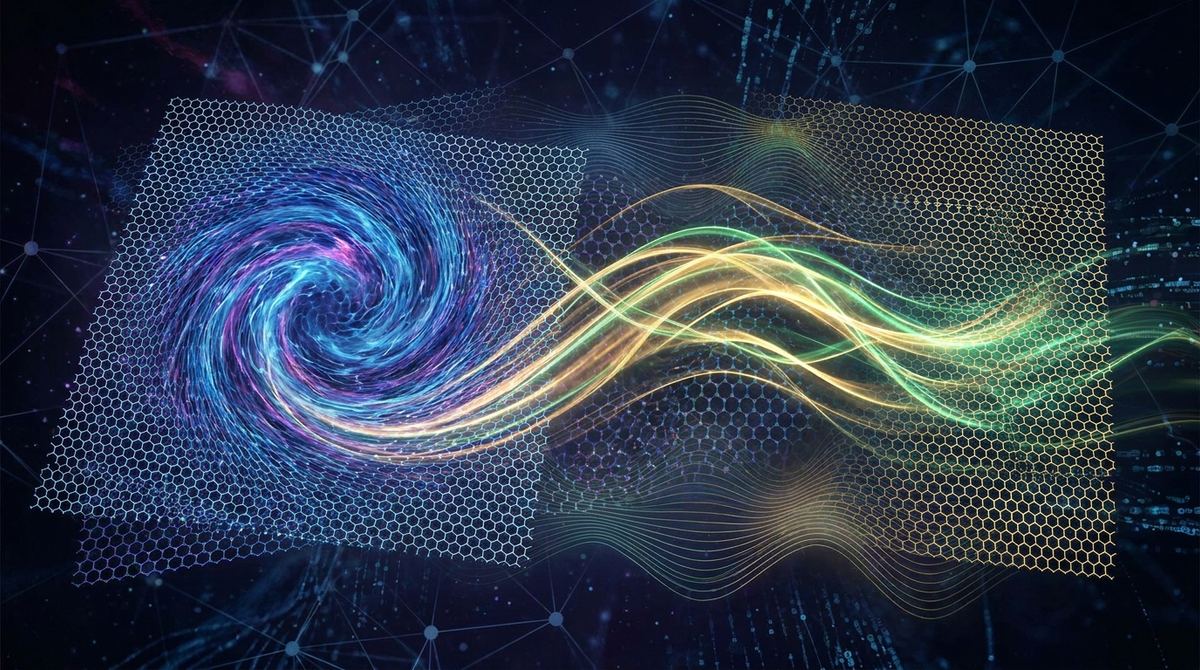
The advent of twistronics has fundamentally transformed our understanding of condensed matter physics by demonstrating how a simple spatial rotation between adjacent atomic layers can yield profound correlated electronic phenomena. Twisted bilayer graphene emerged as the archetypal system in this domain, exhibiting flat moiré bands that host an array of exotic states including superconductivity and correlated insulators. When aligned with a substrate of hexagonal boron nitride, this system undergoes a further symmetry-breaking process that unlocks a rich tapestry of topological quantum phases. The interplay between the internal degrees of freedom of the graphene sheets and the periodic potential of the substrate creates an unprecedented playground for engineering electron behavior. Researchers have recently focused on understanding how these subtle structural parameters dictate the topology of the moiré flat bands.
Topological properties in these two-dimensional systems are typically characterized by their Chern numbers, which define the quantized Hall conductivity of the insulating states. The flat bands in twisted bilayer graphene aligned with hexagonal boron nitride are particularly susceptible to topological phase transitions because of their vanishing kinetic energy and enhanced electron-electron interactions. However, the precise dependence of these topological states on the various material parameters within the established continuum models has remained somewhat opaque. A systematic exploration of the parameter space is therefore essential to bridge the gap between theoretical predictions and the growing body of experimental observations. This recent research brief systematically maps the combined influence of interlayer coupling and substrate potentials on the topological landscape.
By manipulating the interlayer hopping strengths and the substrate-induced staggered potential, physicists can effectively navigate through a complex phase diagram of topological states. The research delineates how variations in these parameters trigger distinct band-inversion mechanisms that radically alter the Berry curvature of the system. These alterations are not merely mathematical curiosities but manifest physically as measurable changes in the quantized transport properties of the material. Understanding the precise conditions that give rise to high-Chern number states opens new pathways for the realization of robust quantum anomalous Hall effects at elevated temperatures. The theoretical framework presented in this study provides a crucial roadmap for experimentalists attempting to synthesize and characterize these advanced quantum materials.
The structural foundation of twisted bilayer graphene consists of two monolayer graphene sheets stacked with a slight relative rotation angle. This rotational misalignment generates a large-scale periodic interference pattern known as a moiré superlattice, which fundamentally alters the electronic band structure of the pristine material. At specific magic angles, the Fermi velocity of the Dirac fermions vanishes, leading to the formation of nearly flat electronic bands separated by energy gaps from the dispersive bands. The introduction of a hexagonal boron nitride substrate adds an additional layer of complexity by breaking the inversion symmetry of the carbon lattice. Hexagonal boron nitride possesses a lattice constant remarkably close to that of graphene, allowing for near-perfect alignment while introducing a staggered sublattice potential due to the alternating boron and nitrogen atoms.
When the graphene layers are crystallographically aligned with the hexagonal boron nitride substrate, the system experiences a secondary moiré potential that competes with the primary graphene-graphene moiré pattern. This dual-moiré system exhibits a highly complex energetic landscape where the spatial variations in the electrostatic potential strongly modulate the local density of states. The symmetry breaking induced by the substrate is the critical ingredient required to open a primary bandgap at the Dirac points, thereby isolating the flat bands. Isolated flat bands with non-zero Berry curvature are the prerequisite for the emergence of Chern insulator states and the quantum anomalous Hall effect. The precise magnitude of this staggered potential depends intimately on the exact vertical distance and atomic registry between the graphene and the substrate layer.
Beyond the simple staggered potential, the hexagonal boron nitride layer also imposes a spatially varying moiré potential that further reconstructs the electronic bands. This substrate moiré potential can couple states of different momenta within the original Brillouin zone, leading to the opening of secondary and tertiary mini-gaps. The interplay between the intrinsic graphene moiré physics and the extrinsic substrate-induced periodic potential creates a highly tunable platform for topological engineering. Researchers must carefully account for both the staggered potential and the substrate moiré potential to accurately capture the full topological phase diagram of the composite material. The continuum model must be meticulously parameterized to reflect these competing energy scales and their spatial symmetries.
The theoretical description of twisted bilayer graphene relies heavily on the Bistritzer-MacDonald continuum model, which captures the low-energy physics of the moiré superlattice with remarkable accuracy. Within this framework, the interlayer interaction is parameterized by two distinct hopping amplitudes that characterize the tunneling of electrons between the layers. The first parameter dictates the tunneling strength in regions where the carbon atoms are perfectly aligned, known as the AA stacking regions. The second parameter governs the tunneling in the AB and BA stacking regions, where the atoms of one layer sit in the center of the hexagons of the other layer. In an idealized rigid lattice, these two hopping parameters are identical, but realistic systems undergo significant atomic reconstruction that breaks this degeneracy.
Lattice relaxation occurs because the system seeks to minimize its total elastic and van der Waals energies, leading to an expansion of the energetically favorable AB and BA domains. Consequently, the AA stacking regions shrink into small, highly localized nodes, which drastically reduces the effective AA interlayer hopping parameter relative to the AB hopping parameter. This unequal interlayer coupling is a fundamental driver of the flat band formation and dictates the width of the magic angle energy gaps. The ratio of these two hopping strengths serves as a critical tuning knob in the continuum model, determining the degree of spatial confinement of the moiré electrons. By systematically varying these hopping parameters in their theoretical models, researchers can simulate the effects of external pressure or different dielectric environments.
The inclusion of the hexagonal boron nitride substrate into the continuum model introduces additional terms that represent the staggered potential and the substrate-induced moiré modulation. The staggered potential acts essentially as a mass term for the Dirac fermions, breaking the sublattice symmetry and generating a non-trivial Berry curvature distribution. The phase space defined by the variations in the AA hopping, the AB hopping, and the substrate potential is incredibly vast and requires substantial computational resources to map entirely. Advanced numerical techniques are employed to calculate the band structure and the corresponding topological invariants at each point within this multi-dimensional parameter space. The resulting phase diagrams reveal a striking sensitivity of the topological state to even minute changes in the interlayer coupling dynamics.
To unravel the topological complexity of this hybrid system, researchers systematically compute the Chern numbers of the isolated moiré flat bands across a wide range of parameter values. The Chern number is a topological invariant that integrates the Berry curvature over the entire Brillouin zone, providing a macroscopic quantization of the Hall conductivity. In standard twisted bilayer graphene aligned with hexagonal boron nitride, the flat bands typically exhibit a Chern number of positive or negative one. However, the comprehensive mapping of the parameter space reveals a progressive enrichment of the topological landscape as the hopping parameters and substrate potentials are tuned. The phase diagrams illustrate a series of sharp boundaries where the Chern number of the system abruptly changes, indicating a topological phase transition.
One of the most significant findings of this exhaustive parameter mapping is the discovery of multiple high-Chern number states residing within experimentally accessible regimes. Researchers identified robust topological phases characterized by Chern numbers of three, four, and even five, which had previously been considered highly unlikely in simple moiré systems. These high-Chern states emerge from complex multi-band interactions and require a specific balance between the interlayer hopping asymmetry and the substrate-induced symmetry breaking. The existence of these phases suggests that twisted bilayer graphene heterostructures could support multiple chiral edge modes, leading to enhanced quantized transport channels. Such high-Chern insulators are highly sought after for applications in low-power topological electronics and advanced quantum information processing architectures.
The phase diagrams also highlight the critical role of the hexagonal boron nitride moiré potential in stabilizing these exotic high-Chern number states. When the substrate moiré potential is artificially turned off in the simulations, the topological landscape becomes significantly less diverse, dominated primarily by lower Chern numbers. The periodic spatial modulation provided by the substrate facilitates the necessary band crossings and inversions required to accumulate large amounts of Berry curvature. This theoretical insight provides a clear directive for experimentalists, emphasizing the importance of precise crystallographic alignment not just for symmetry breaking, but for maximizing the substrate moiré effect. The detailed maps generated by this research serve as an invaluable atlas for navigating the topological possibilities inherent in these two-dimensional heterostructures.
Topological phase transitions in condensed matter systems are fundamentally driven by the closing and reopening of energy gaps between adjacent electronic bands. In the twisted bilayer graphene and hexagonal boron nitride system, these gap-closing events occur at specific points within the moiré Brillouin zone as the material parameters are varied. The researchers identified distinct band-inversion mechanisms that correspond to the transitions between different Chern insulator states observed in the phase diagrams. Some transitions are characterized by Dirac-like band crossings at high-symmetry momenta, such as the Gamma or K points of the superlattice Brillouin zone. Other transitions occur at generic points that preserve the three-fold rotational symmetry of the lattice, leading to simultaneous gap closings at multiple locations in momentum space.
Parabolic band touchings represent another exotic mechanism driving these topological phase transitions, where the bands meet with a quadratic dispersion rather than a linear one. These quadratic touchings are particularly effective at transferring large amounts of Berry curvature between bands, facilitating sudden jumps in the Chern number by magnitudes greater than one. As the system undergoes a band inversion, the local Berry curvature experiences a dramatic redistribution, often exhibiting massive peaks near the gap-closing points. The integral of this evolving Berry curvature is precisely what dictates the discrete change in the macroscopic topological invariant of the material. Tracking the flow of Berry curvature during these transitions provides deep physical insight into the microscopic origins of the high-Chern number states.
The evolution of the Berry curvature is highly sensitive to the delicate interplay between the spatial symmetries of the graphene and the periodic potential of the substrate. When a band inversion occurs at a high-symmetry point, the resulting Berry curvature distribution typically maintains the underlying rotational symmetries of the moiré lattice. However, inversions at generic momentum points can lead to highly anisotropic Berry curvature hotspots that significantly influence the optical and transport properties of the material. The theoretical models allow researchers to visualize these topological hotspots in high resolution, confirming that the high-Chern states are the result of cumulative band inversions across the Brillouin zone. This detailed mechanistic understanding is crucial for predicting the stability of these topological phases against disorder and thermal fluctuations.
The theoretical phase diagrams generated by this comprehensive study are not merely abstract mathematical constructs but have direct and profound implications for ongoing experimental efforts. In the laboratory, researchers can traverse the theoretical parameter space by applying hydrostatic pressure, which alters the interlayer distance and subsequently modifies the hopping strengths. Similarly, the substrate-induced staggered potential can be tuned by varying the dielectric environment or applying out-of-plane displacement fields via external gate electrodes. The ability to dynamically tune these parameters means that a single experimental device could potentially be driven through multiple topological phase transitions. The predictions of high-Chern number states provide a specific target for experimentalists utilizing state-of-the-art transport and scanning tunneling microscopy techniques.
The intersection of non-trivial band topology and strong electron-electron interactions in these flat bands gives rise to the fascinating realm of correlated topological phases. When a topological flat band is partially filled with electrons, the system can spontaneously break time-reversal symmetry to form a fractional Chern insulator. These fractional states are the lattice analogs of fractional quantum Hall states, but they occur at zero magnetic field, making them highly desirable for topological quantum computation. The discovery of parameter regimes hosting high-Chern numbers suggests that twisted bilayer graphene could support an entirely new family of exotic fractionalized excitations. Observing these fractional states requires materials with minimal disorder, highlighting the necessity of understanding exactly which parameter combinations yield the most robust topological gaps.
Recent experimental observations of the quantum anomalous Hall effect in twisted bilayer graphene aligned with hexagonal boron nitride align remarkably well with the theoretical predictions outlined in this research. The mapping of the topological landscape helps elucidate why certain devices exhibit robust quantization while others, seemingly identical, fail to show topological signatures. Minute variations in the twist angle or the relative alignment with the substrate can drastically shift the system within the multi-dimensional parameter space. By utilizing the phase diagrams as a diagnostic tool, experimentalists can better interpret their transport data and optimize their device fabrication protocols. This synergy between advanced continuum modeling and precise experimental characterization is rapidly accelerating the pace of discovery in the field of twistronics.
The methodologies and insights developed in the study of twisted bilayer graphene aligned with hexagonal boron nitride provide a powerful template for exploring other moiré materials. Researchers are actively extending these continuum models to investigate twisted trilayer graphene, which offers an even richer parameter space due to the presence of multiple moiré interference patterns. Transition metal dichalcogenide heterostructures represent another incredibly promising frontier, as they inherently possess the strong spin-orbit coupling that graphene lacks. Applying the systematic parameter mapping techniques to these alternative materials is expected to uncover a vast array of novel topological and correlated phases. The ultimate goal is to establish a predictive theoretical framework that can guide the design of bespoke topological materials with customized quantum properties.
The realization of robust high-Chern number insulators and their fractional counterparts holds immense potential for the development of next-generation quantum technologies. Topologically protected edge states offer a pathway toward dissipationless electronic interconnects, which could drastically reduce the power consumption of classical computing architectures. Furthermore, the non-Abelian anyons predicted to exist in certain fractional Chern insulators are considered the holy grail of fault-tolerant topological quantum computing. By braiding these exotic quasiparticles, quantum information can be processed in a manner that is inherently immune to local environmental decoherence. The detailed mapping of topological phase transitions brings the scientific community one step closer to isolating and manipulating these elusive quantum states.
As computational power increases, future theoretical studies will likely incorporate more sophisticated many-body techniques to directly simulate the interacting ground states of these moiré systems. While the single-particle continuum model provides an exceptional foundation, the true nature of the correlated insulating states requires advanced treatments such as exact diagonalization or density matrix renormalization group methods. Coupling these advanced interacting models with the highly detailed single-particle phase diagrams will yield unprecedented insights into the competition between topology and strong correlations. The continuous refinement of both our theoretical models and our experimental capabilities ensures that the field of moiré quantum matter will remain at the forefront of condensed matter physics. The systematic unraveling of these topological landscapes guarantees a steady stream of scientific breakthroughs in the decades to come.
What is the primary function of the hexagonal boron nitride substrate in this moiré system? The hexagonal boron nitride substrate serves fundamentally to break the inversion symmetry of the twisted bilayer graphene lattice. Because its lattice constant is nearly identical to that of graphene, it can be crystallographically aligned to create a secondary moiré pattern. This alignment introduces a staggered sublattice potential that acts as a mass term for the Dirac fermions, opening energy gaps at the Dirac points. Without this symmetry breaking, the flat bands would remain topologically trivial and the material would not exhibit the quantum anomalous Hall effect. The precise alignment dictates the strength of both the staggered potential and the secondary moiré modulation.
How do interlayer hopping parameters influence the formation of topological flat bands? Interlayer hopping parameters dictate the probability of an electron tunneling between the two distinct layers of graphene. The parameter representing tunneling in the fully aligned regions typically becomes much smaller than the parameter for the offset regions due to atomic lattice relaxation. This asymmetry in the hopping strengths is a critical requirement for the isolation and flattening of the moiré energy bands. By tuning the ratio of these parameters, researchers can simulate changes in the spatial confinement of the electrons and navigate through different topological phases. The exact values of these hopping strengths determine the magnitude of the Berry curvature and the resulting Chern number of the system.
What is the significance of discovering high-Chern number states in this material? The discovery of high-Chern number states indicates that the material can support multiple topologically protected chiral edge channels simultaneously. A higher Chern number corresponds directly to a larger quantized Hall conductivity, which could lead to more robust and easily measurable macroscopic quantum effects. Previously, most moiré systems were believed to only support simple topological states with a Chern number of one. The existence of these complex states suggests a much richer internal band structure driven by multi-band inversions and parabolic touchings. These high-Chern insulators provide a highly desirable platform for engineering complex quantum circuits and exploring novel fractionalized electronic states.
By what mechanisms do these topological phase transitions actually occur in the momentum space? Topological phase transitions occur through the closing and subsequent reopening of energy gaps between the flat bands and adjacent dispersive bands. This gap closing can happen at high-symmetry points within the Brillouin zone, such as the corners or the center of the hexagonal lattice. Alternatively, the inversions can occur at generic momentum points that preserve the underlying three-fold rotational symmetry of the moiré superlattice. During these band crossings, massive amounts of Berry curvature are transferred between the bands, radically altering the topological invariant of the entire system. Parabolic band touchings represent a particularly efficient mechanism for transferring this curvature and triggering jumps in the Chern number.
How can experimental physicists utilize these theoretical phase diagrams in their laboratory research? Experimental physicists can use these detailed phase diagrams as a predictive map to guide the fabrication and tuning of their moiré devices. By applying hydrostatic pressure, they can modify the interlayer distance and effectively move their device along the hopping parameter axis of the diagram. Applying out-of-plane electric fields allows them to tune the substrate-induced potential, navigating the other dimensions of the phase space. The diagrams help explain why seemingly identical devices might exhibit completely different topological properties due to minute variations in twist angle or strain. Ultimately, this theoretical framework allows researchers to target specific regions of the parameter space to hunt for elusive high-Chern or fractional states.
The systematic investigation into the topological phase transitions of twisted bilayer graphene aligned with hexagonal boron nitride marks a significant milestone in the field of twistronics. By meticulously mapping the influence of interlayer coupling and substrate-induced potentials, researchers have illuminated the complex mechanisms that govern the topology of moiré flat bands. The revelation of multiple high-Chern number states hidden within this multidimensional parameter space dramatically expands the known topological capabilities of two-dimensional carbon heterostructures. This research seamlessly bridges the gap between abstract continuum modeling and observable experimental phenomena, providing a robust framework for future investigations. The detailed cataloging of band-inversion mechanisms and Berry curvature evolution offers profound physical insights into the microscopic origins of macroscopic quantum quantization.
As the demand for novel quantum materials continues to accelerate, the insights gleaned from these comprehensive phase diagrams will prove absolutely invaluable. The ability to engineer specific topological invariants by finely tuning structural parameters offers an unprecedented level of control over the quantum properties of matter. This precision engineering is a fundamental prerequisite for the development of advanced topological electronics and fault-tolerant quantum computing architectures. The methodologies established in this study will undoubtedly be adapted to explore a vast menagerie of other moiré systems, from twisted multilayers to transition metal dichalcogenides. Ultimately, the continuous exploration of these intricate topological landscapes promises to yield transformative technologies that capitalize on the robust nature of quantized edge transport.
Serious about B2B integration? Test our premium Pulsed Electrical Resistive Carbon Heating turbostratic graphene in your lab. 100g sample packs available now.
Explore More
Researchers have developed a breakthrough method for growing twisted bilayer graphene with pre-designed angles, a key step toward manufacturable quantum...

Learn how deep learning is revolutionizing the structural characterization of twisted bilayer materials, accelerating the development of next-generation...

Learn to build a prototype graphene FET biosensor for sensitive DNA detection. This guide covers materials, fabrication, and testing for point-of-care...