
A New Era of Graphene Engineering: Pre-Designing Twist Angles on Demand
Researchers have developed a breakthrough method for growing twisted bilayer graphene with pre-designed angles, a key step toward manufacturable quantum...
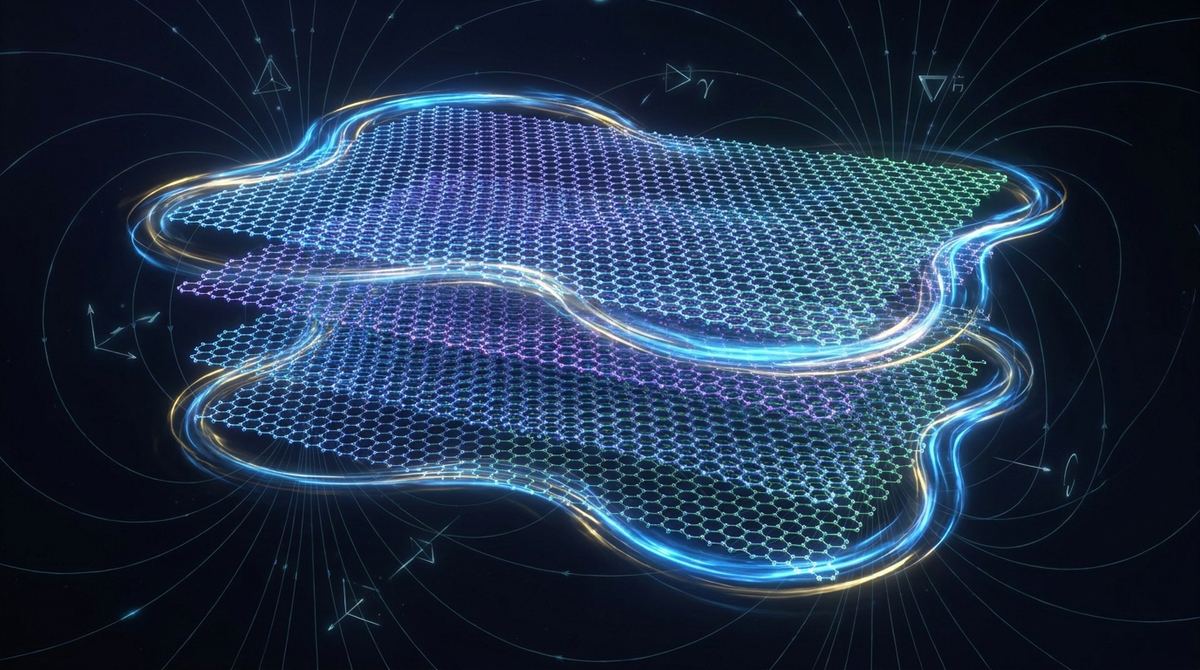
Moiré superlattices have fundamentally revolutionized condensed matter physics by providing an unprecedented platform for engineering correlated topological phases in two-dimensional materials. Among the myriad configurations being explored, rhombohedral multilayer graphene has emerged as a particularly versatile candidate due to its inherent susceptibility to external tuning and strongly correlated electron behaviors. Recent research has systematically investigated the transport properties of the hole-doped regime in rhombohedral tetralayer graphene coupled with hexagonal boron nitride moiré superlattices. This specific heterostructure allows physicists to probe the delicate interplay between electronic correlations, structural symmetries, and topological invariants across an expansive range of twist angles and alignment orientations. The findings reveal a rich tapestry of quantum anomalous Hall effects and topological insulating phases that challenge previous theoretical limits. These unprecedented observations firmly establish this multi-layer carbon system as a premier environment for investigating complex quantum geometric phenomena.
The significance of this rigorous research lies in the direct observation of multiple high-Chern-number Chern insulators within a singular, highly tunable solid-state device architecture. Researchers successfully identified the previously reported integer Chern insulator featuring a Chern number of negative four at the precise moiré filling factor of negative one. More astonishingly, they discovered newly emerged symmetry-broken Chern insulating states exhibiting Chern numbers of positive three, positive or negative two, and positive or negative one at fractional moiré fillings of negative two point five and negative two point six. These fractional and integer states emerge across different hexagonal boron nitride alignment configurations but exhibit an acute sensitivity to the underlying moiré wavelength. Such discoveries underscore the distinct topological landscape realized in hole-doped rhombohedral tetralayer graphene superlattices, pushing the boundaries of what is possible in engineered quantum materials. The ability to manipulate these robust topological phases through external electrostatic and magnetic parameters opens entirely new pathways for next-generation quantum device engineering.
To comprehend the profound implications of these topological discoveries, one must first examine the specific crystallographic architecture of rhombohedral tetralayer graphene. Unlike the more thermodynamically stable Bernal stacking found in natural graphite, the rhombohedral stacking sequence follows an alternating shifted pattern that creates a unique electronic band structure. In this four-layer configuration, the low-energy charge carriers are largely confined to the outermost layers, generating a highly polarizable electronic system that responds dramatically to perpendicular electric fields. This spatial distribution of wavefunctions essentially primes the material for the opening of tunable bandgaps when an out-of-plane displacement field is applied across the layers. The resulting isolated flat bands are characterized by a massive density of states where kinetic energy is heavily suppressed relative to Coulombic interactions. Understanding this fundamental structural baseline is essential before introducing the complexities of moiré superlattices.
The isolation of pure rhombohedral tetralayer graphene requires painstaking fabrication techniques, as the material naturally tends to relax into the lower-energy Bernal configuration during mechanical exfoliation. Researchers must utilize advanced optical identification and precise transfer methodologies to preserve the delicate rhombohedral stacking sequence throughout the device assembly process. Once successfully isolated, the four-layer system presents a pristine canvas for exploring multi-valley physics and complex orbital magnetizations that are absent in simpler monolayer or bilayer graphene systems. The inherent inversion symmetry breaking induced by the external displacement field interacts synergistically with the intrinsic spin-orbit coupling, albeit fundamentally weak in carbon, to produce non-trivial Berry curvature hotspots in the momentum space. These hotspots serve as the geometric foundation for the emergence of topological phases when the system is further modified by an external periodic potential. Consequently, the pristine tetralayer system acts as a highly sensitive topological amplifier waiting for the appropriate structural trigger. This pristine starting point is absolutely critical for the subsequent observation of high Chern numbers.
Furthermore, the intrinsic electronic properties of the rhombohedral tetralayer architecture exhibit a profound sensitivity to the specific doping levels introduced via electrostatic gating. By shifting the Fermi level deeply into the hole-doped regime, experimentalists can access specific van Hove singularities where the density of states diverges dramatically. This divergence fundamentally alters the screening mechanisms within the two-dimensional electron gas, allowing long-range Coulomb interactions to drive spontaneous symmetry breaking across the entire lattice. The hole-doped side proves particularly fruitful for topological investigations because the valence band structure intrinsically hosts a larger degree of orbital hybridization compared to the conduction band. Such hybridization enhances the effective spin-valley coupling, creating an environment where electrons spontaneously organize into intricate correlated phases to minimize their overall energy. This complex interplay of doping, stacking, and interaction provides the perfect precursor for introducing the hexagonal boron nitride superlattice.
The introduction of a hexagonal boron nitride layer adjacent to the rhombohedral tetralayer graphene fundamentally transforms the electronic landscape through the creation of a moiré superlattice. Because the lattice constant of hexagonal boron nitride is nearly identical to that of graphene, with only a slight mismatch of less than two percent, overlaying the two materials generates a long-range periodic interference pattern. The precise twist angle between the crystallographic axes of the graphene and the boron nitride dictates the spatial wavelength of this moiré pattern, which can extend to several tens of nanometers. This artificially engineered periodicity imposes a superlattice potential onto the itinerant charge carriers, folding the original Brillouin zone into a much smaller moiré Brillouin zone. The zone folding mechanism effectively splinters the continuous electronic bands into a series of highly isolated, narrow moiré minibands separated by distinct energy gaps. These minibands represent the ultimate playground for strong correlation physics due to their vanishingly small electronic bandwidths. Navigating the energy scales of these flat bands allows researchers to unlock previously inaccessible quantum states.
Controlling the precise alignment orientation between the tetralayer graphene and the encapsulating hexagonal boron nitride is a monumental experimental challenge that yields profound physical consequences. The researchers systematically investigated various twist angles to map the evolution of the topological phases, discovering that the moiré wavelength acts as a critical tuning parameter for the entire system. When the twist angle is minimized to near zero degrees, the resulting maximal moiré wavelength creates the optimal conditions for electrons to localize within the periodic potential minima. This localization dramatically amplifies the ratio of Coulomb interaction energy to kinetic energy, driving the system into a strongly correlated regime where conventional single-particle band theory completely breaks down. Interestingly, the high-Chern-number insulating states emerge in multiple alignment configurations, suggesting a robust topological mechanism that transcends specific crystallographic registry. However, the precise energy scales and thermodynamic stability of these states remain acutely dependent on the exact moiré wavelength achieved during device fabrication. Small deviations in this wavelength can precipitously collapse the topological gap.
The interaction between the rhombohedral graphene and the hexagonal boron nitride is not merely electrostatic but also involves complex structural relaxation effects that modify the moiré potential. As the two atomic lattices strive to find a commensurate energy minimum, the graphene layers undergo subtle physical deformations, creating alternating regions of high and low atomic registry. These strain fields act as fictitious gauge potentials for the charge carriers, effectively mimicking the presence of massive external magnetic fields without the need for an actual laboratory magnet. The combination of the periodic electrostatic potential and these pseudo-magnetic fields fundamentally alters the quantum geometric tensor of the moiré minibands. This alteration manifests as a non-zero integral of the Berry curvature across the moiré Brillouin zone, assigning a definitive topological invariant known as the Chern number to the isolated flat bands. It is precisely this intricate structural engineering that allows for the realization of topological phases capable of supporting dissipationless edge currents. This physical deformation is a key ingredient in realizing the reported macroscopic topological phenomena.
To probe the electronic nature of the engineered moiré superlattice, researchers employed highly precise low-temperature magnetotransport measurements across a wide range of carrier densities. By tuning the applied gate voltages, they systematically adjusted the moiré filling factor, which quantifies the number of charge carriers per moiré unit cell. The most prominent feature observed in the transport data was the emergence of an exceptionally robust integer Chern insulator at the exact moiré filling factor of negative one. At this precise hole-doped concentration, the longitudinal resistance drops to zero while the Hall resistance quantizes to a precise fraction of the von Klitzing constant, indicative of a macroscopic quantum anomalous Hall effect. This specific state is characterized by a remarkable Chern number of negative four, a value that reflects the complex multi-valley and multi-layer nature of the rhombohedral tetralayer system. The observation of such a high integer topological invariant confirms the unique capacity of this heterostructure to host highly entangled electronic wavefunctions. Such a massive topological invariant is rarely observed in conventional two-dimensional electron gases.
Beyond the integer filling regime, the experimental transport data revealed an even more astonishing array of topological phenomena at fractional carrier concentrations. The researchers meticulously mapped the longitudinal and Hall resistivities around the fractional moiré fillings of negative two point five and negative two point six. In these delicate density regimes, the system spontaneously organizes into newly discovered symmetry-broken Chern insulating states that possess positive three, positive or negative two, and positive or negative one Chern numbers. The existence of these high-Chern-number states at fractional fillings represents a paradigm shift in our understanding of correlated topological matter, as such phases typically require integer filling of isolated topological bands. These observations suggest that the electrons are forming complex generalized Wigner crystal states or fractional Chern insulator phases driven by intense long-range Coulomb interactions. Deciphering the exact microscopic origins of these fractional states remains a primary objective for theoretical condensed matter physicists worldwide. The ability to measure these states with such clarity is a testament to modern nanofabrication.
The precise identification of these filling factors and their associated Chern numbers relies on analyzing the Streda formula, which relates the charge density of a topological gap to the applied magnetic field. By plotting the location of the resistance minima in the parameter space of carrier density and magnetic field, the researchers construct a comprehensive Landau level fan diagram. The slopes of the resulting trajectories directly yield the Chern numbers of the underlying insulating gaps, providing unambiguous experimental proof of the topological invariants. This rigorous analytical approach ensures that the observed high-Chern-number states are not artifacts of contact resistance or disordered transport, but rather intrinsic thermodynamic properties of the moiré superlattice. The clarity of the transport data at both integer and fractional fillings is a testament to the exceptional quality of the fabricated tetralayer devices. These precise measurements definitively establish rhombohedral tetralayer graphene as a premier platform for exploring exotic quantum Hall physics in the absence of strong external magnetic fields. The resulting data plots provide a perfectly quantized map of the system's quantum geometry.
The emergence of high-Chern-number states in this moiré superlattice is fundamentally inextricably linked to the concept of spontaneous symmetry breaking within the interacting two-dimensional electron gas. In an ideal, non-interacting scenario, the rhombohedral tetralayer system preserves time-reversal symmetry, which mandates that the net Berry curvature integrated over the Brillouin zone must equal exactly zero. However, when the kinetic energy is quenched by the moiré potential and the system is tuned to specific filling factors, electron-electron interactions forcefully drive the system to spontaneously break time-reversal symmetry. This spontaneous symmetry breaking manifests as an intrinsic orbital magnetization, where the charge carriers collectively circulate within the moiré unit cells to generate a macroscopic internal magnetic field. The resulting valley polarization effectively isolates a single valley degree of freedom, allowing the non-zero Berry curvature of that specific valley to dictate the topological transport properties. Consequently, the system transitions into a Chern insulating state capable of hosting multiple chiral edge modes. This spontaneous internal ordering fundamentally replaces the need for massive external magnetic coils.
The specific value of the Chern number dictates the exact number of dissipationless, one-dimensional chiral edge channels propagating along the boundary of the insulating bulk material. The observation of a Chern number equal to negative four at the integer filling factor implies the simultaneous existence of four distinct, perfectly conducting channels carrying current without backscattering. Achieving such a high topological invariant requires a massive reorganization of the electronic band structure, driven by the intricate interplay between the layer-dependent electrostatic potential and the moiré superlattice modulation. Similarly, the symmetry-broken states observed at fractional fillings with Chern numbers of positive three or positive two indicate highly complex topological orders that defy conventional single-particle explanations. These fractional filling states likely originate from the spontaneous breaking of additional spatial symmetries, such as the discrete rotational symmetry of the underlying moiré lattice. The resulting nematic topological phases represent a fascinating intersection between strongly correlated liquid crystal behaviors and rigorous topological quantization. Such an intersection provides a fertile ground for discovering entirely new phases of matter.
The delicate balance of competing energy scales determines which specific symmetry-broken state ultimately condenses at a given carrier density and temperature. The researchers noted that the emergence of these high-Chern-number insulators exhibits an acute sensitivity to the precise moiré wavelength established during the heterostructure fabrication. Variations in the twist angle by mere fractions of a degree can dramatically alter the interaction matrix elements, pushing the system from a topologically trivial Mott insulator into a robust high-Chern-number phase. This extreme sensitivity highlights the highly tunable nature of the topological landscape, but also presents significant challenges for reproducible device scaling. Theoretical models suggest that the moiré wavelength directly controls the bandwidth of the topological flat bands, which in turn dictates the critical transition temperatures for the spontaneous symmetry breaking. Understanding and mastering this wavelength dependence is absolutely crucial for the future design of customized topological quantum materials based on graphene superlattices. Only through meticulous control of this wavelength can engineers reliably access the desired Chern numbers.
One of the most remarkable aspects of the rhombohedral tetralayer graphene moiré superlattice is its exceptional tunability via externally applied, highly controllable physical fields. The primary tuning knob utilized by the researchers is the out-of-plane displacement electric field, generated by applying asymmetric voltages to the top and bottom electrostatic gates. This displacement field explicitly breaks the inversion symmetry of the tetralayer system, opening a tunable bandgap and actively modifying the distribution of the Berry curvature across the momentum space. By carefully sweeping the displacement field, the experimentalists can actively drive the system through a series of complex topological quantum phase transitions. During these transitions, the fundamental topological invariants of the isolated flat bands change abruptly, causing the Chern number of the system to jump between various integer and fractional values. This in-situ electrostatic control over the macroscopic topological state is entirely impossible in traditional magnetically driven quantum Hall systems, showcasing the revolutionary nature of moiré materials. Such dynamic control effectively turns the device into a programmable topological switch.
In addition to the displacement electric field, the application of an external perpendicular magnetic field provides another powerful axis for navigating the complex topological phase diagram. While the high-Chern-number states are intrinsically driven by spontaneous orbital magnetization and can exist at zero magnetic field, applying a small external field helps to energetically stabilize these delicate phases. The external magnetic field couples directly to the spontaneous orbital magnetic moments of the symmetry-broken states, lifting the degeneracy between competing topological orders. By meticulously mapping the transport properties in the dual parameter space of displacement field and external magnetic field, the researchers uncovered a vast, interconnected network of topological phases. This comprehensive mapping reveals a fractal-like Hofstadter butterfly spectrum modified by intense electron-electron interactions, offering profound insights into the underlying quantum geometry of the system. The magnetic field effectively acts as a magnifying glass, allowing scientists to resolve closely spaced energy levels and identify the precise phase boundaries of the high-Chern-number insulators. This dual-field approach represents the pinnacle of modern condensed matter characterization.
The synergistic combination of moiré wavelength selection, displacement field tuning, and external magnetic field manipulation affords researchers an unprecedented degree of control over the quantum state of matter. This multi-dimensional tuning capability allows for the precise engineering of specific topological responses tailored for targeted advanced technological applications. For instance, by adjusting the external fields, one could theoretically switch a device from a topologically trivial insulating state to a state hosting three or four dissipationless edge channels almost instantaneously. The ability to dynamically route quantum information through these protected chiral edge states represents a massive leap forward in the field of topological electronics. Furthermore, the systematic investigation of these tunable parameters provides an invaluable dataset for refining sophisticated computational models of strongly correlated electrons. Ultimately, the exceptional tunability demonstrated in this research solidifies the rhombohedral tetralayer graphene system as a cornerstone material for the next generation of highly programmable quantum technologies. The sheer versatility of this platform guarantees its prominence in future topological research.
The groundbreaking discovery of tunable high-Chern-number Chern insulators in rhombohedral tetralayer graphene superlattices holds profound implications for the future of advanced technological paradigms. In the realm of classical low-power electronics, the existence of multiple dissipationless chiral edge channels offers a revolutionary pathway to completely eliminate Joule heating in nanoscale interconnects. Because the charge carriers in these topological edge states are strictly forbidden from backscattering by fundamental quantum mechanical laws, electrical currents can propagate with absolute zero resistance even in the absence of a superconducting state. Utilizing a Chern insulator with a high Chern number, such as negative four, essentially quadruples the current-carrying capacity of the edge boundary compared to a standard quantum anomalous Hall insulator. This massive increase in dissipationless conductivity could eventually enable the design of densely packed, ultra-efficient integrated circuits that operate entirely without thermal degradation. The ability to electrostatically switch these states on and off provides the necessary foundation for creating topological transistors of unprecedented efficiency. The commercial implications for energy-efficient computing architectures are staggering.
Beyond classical energy-efficient electronics, these highly tunable topological states present incredibly exciting opportunities for the rapidly evolving field of fault-tolerant topological quantum computing. The fractional symmetry-broken states discovered at filling factors of negative two point five and negative two point six are particularly intriguing candidates for hosting non-Abelian anyons. Non-Abelian anyons are exotic quasiparticles whose quantum states depend entirely on the history of their spatial braiding, making them inherently immune to local environmental decoherence. If the fractional states observed in this tetralayer system can be definitively shown to support non-Abelian statistics, they could serve as the foundational building blocks for topologically protected topological qubits. The fact that these states exist in a pure carbon-based material, which can be seamlessly integrated into existing semiconductor fabrication workflows, makes this a highly attractive alternative to fragile ultracold atom or complex superconductor platforms. The race to definitively identify and manipulate these exotic quasiparticles within moiré superlattices is now officially underway. Success in this endeavor would fundamentally alter the trajectory of quantum information science.
However, translating these extraordinary fundamental physics discoveries into viable commercial technologies will require overcoming several immense engineering and materials science hurdles. Currently, the robust observation of these delicate high-Chern-number states relies entirely on ultra-low cryogenic temperatures, typically lingering just fractions of a degree above absolute zero. Raising the critical temperature of these topological phases closer to liquid nitrogen temperatures or even room temperature remains the ultimate holy grail for condensed matter physicists and materials engineers. Achieving this monumental goal will likely involve discovering new combinations of two-dimensional materials or engineering even tighter moiré confinement potentials to dramatically enhance the interaction energy scales. Furthermore, developing scalable, wafer-level synthesis techniques for pure rhombohedral tetralayer graphene, rather than relying on manual mechanical exfoliation, is an absolute necessity for industrial adoption. Despite these daunting challenges, the fundamental principles demonstrated in this remarkable research provide a clear, illuminated roadmap for the future development of revolutionary topological quantum devices. The journey from cryogenic laboratories to ubiquitous technological deployment has undeniably begun.
Question: What precisely defines a Chern insulator in the context of two-dimensional materials? Answer: A Chern insulator is a unique topological phase of matter that behaves as an electrical insulator in its two-dimensional bulk interior while supporting perfectly conducting, one-dimensional channels along its physical boundaries. Unlike conventional topological insulators, Chern insulators intrinsically break time-reversal symmetry, usually through spontaneous orbital magnetization or intrinsic magnetic ordering, eliminating the need for massive external magnetic fields. The defining characteristic is the Chern number, a quantized topological invariant derived from integrating the Berry curvature across the Brillouin zone. This integer value strictly dictates the exact number of dissipationless chiral edge modes that propagate along the perimeter of the material. In the studied tetralayer system, researchers observed states with high Chern numbers up to negative four, indicating the presence of four distinct, highly protected conducting channels. These protected channels are fundamentally immune to backscattering from non-magnetic impurities, making them exceptionally valuable for low-power electronic applications.
Question: Why is rhombohedral tetralayer graphene utilized instead of standard monolayer or bilayer graphene? Answer: Rhombohedral tetralayer graphene provides a significantly distinct electronic band structure characterized by uniquely flat bands when subjected to a perpendicular displacement electric field. The specific staircase-like stacking sequence of the four carbon layers confines the low-energy charge carriers predominantly to the top and bottom surfaces, making the entire system incredibly responsive to external electrostatic tuning. This inherent architecture fundamentally suppresses the kinetic energy of the electrons, allowing long-range Coulomb interactions to dominate the system's overall Hamiltonian. Consequently, the material becomes highly susceptible to spontaneous symmetry breaking and the formation of strongly correlated topological phases. Monolayer and standard Bernal-stacked bilayer graphene simply do not possess the requisite density of states or structural symmetry properties to easily host such robust, high-Chern-number insulating states without extreme magnetic fields. The tetralayer geometry essentially provides the perfect energetic landscape for these topological phenomena to flourish.
Question: How does the moiré wavelength influence the emergence of these exotic topological phases? Answer: The moiré wavelength acts as the fundamental spatial period of the artificial superlattice potential imposed on the graphene electrons by the adjacent hexagonal boron nitride layer. This wavelength is exquisitely sensitive to the precise crystallographic twist angle between the two distinct two-dimensional materials. A longer moiré wavelength implies larger superlattice unit cells, which fundamentally alters the energy bandwidth of the isolated moiré minibands and drastically modifies the strength of electron-electron interactions. The researchers discovered that the high-Chern-number states exhibit a profound dependence on this wavelength, meaning that even infinitesimal variations in the twist angle can completely destroy or create specific topological phases. Mastering the control of the moiré wavelength is therefore absolutely critical for reliably engineering and reproducing these advanced quantum states in future solid-state electronic devices. Without precise twist angle control, the resulting topological landscape becomes entirely unpredictable.
Question: What is the profound significance of discovering Chern insulators at fractional moiré filling factors? Answer: Observing Chern insulating states at fractional filling factors, such as negative two point five, indicates that the electrons have spontaneously organized into highly complex, strongly correlated phases beyond simple single-particle band filling. In standard topological band theory, quantum anomalous Hall effects typically emerge only when an entire, isolated moiré miniband is completely filled with integer numbers of electrons. The fractional states imply the spontaneous breaking of additional spatial symmetries, leading to generalized Wigner crystal states or potentially exotic fractional Chern insulators driven entirely by Coulomb repulsion. These specific fractional phases are highly sought after because they are theoretical candidates for hosting non-Abelian anyons, which are critical for fault-tolerant quantum computing architectures. Therefore, discovering these states in a tunable graphene platform opens an entirely new experimental frontier for probing deeply entangled topological quantum matter. This breakthrough dramatically narrows the search space for topologically protected quantum bits.
Question: How do displacement electric fields and external magnetic fields tune these topological states? Answer: The displacement electric field fundamentally alters the structural symmetry of the tetralayer system by creating an electrostatic potential difference between the topmost and bottommost carbon layers. This field explicitly breaks inversion symmetry, opens tunable energy gaps, and dynamically shifts the distribution of the Berry curvature hotspots within the momentum space, driving the system through various topological phase transitions. Meanwhile, an external perpendicular magnetic field couples directly to the spontaneous orbital magnetic moments generated by the interacting electrons. This magnetic coupling energetically stabilizes specific symmetry-broken states, lifting degeneracies and allowing researchers to map out a highly detailed, multi-dimensional topological phase diagram. Together, these two independent tuning knobs provide experimentalists with unprecedented, precise control over the macroscopic quantum state, enabling the real-time manipulation of the system's topological invariants. Such precise tuning mechanisms are exactly what is required for designing functional topological microprocessors.
The systematic investigation of hole-doped rhombohedral tetralayer graphene and hexagonal boron nitride moiré superlattices has definitively unveiled a remarkably rich and highly tunable topological landscape. By meticulously engineering the moiré wavelength and expertly manipulating external displacement and magnetic fields, researchers have successfully realized multiple high-Chern-number Chern insulators. The astonishing discovery of symmetry-broken states at both integer and fractional filling factors challenges existing theoretical paradigms and expands our fundamental understanding of strongly correlated quantum matter. These robust topological phases, capable of supporting multiple dissipationless edge channels, present revolutionary pathways for the development of ultra-low-power electronics and advanced fault-tolerant quantum computing architectures. As materials science fabrication techniques continue to rapidly advance, the profound physical principles demonstrated in this extraordinary solid-state platform will undoubtedly accelerate the global transition toward next-generation topological quantum technologies. The era of programmable topological matter is rapidly approaching.
Serious about B2B integration? Test our premium Pulsed Electrical Resistive Carbon Heating turbostratic graphene in your lab. 100g sample packs available now.
Explore More
Researchers have developed a breakthrough method for growing twisted bilayer graphene with pre-designed angles, a key step toward manufacturable quantum...

Learn how deep learning is revolutionizing the structural characterization of twisted bilayer materials, accelerating the development of next-generation...

Learn to build a prototype graphene FET biosensor for sensitive DNA detection. This guide covers materials, fabrication, and testing for point-of-care...