
A New Era of Graphene Engineering: Pre-Designing Twist Angles on Demand
Researchers have developed a breakthrough method for growing twisted bilayer graphene with pre-designed angles, a key step toward manufacturable quantum...
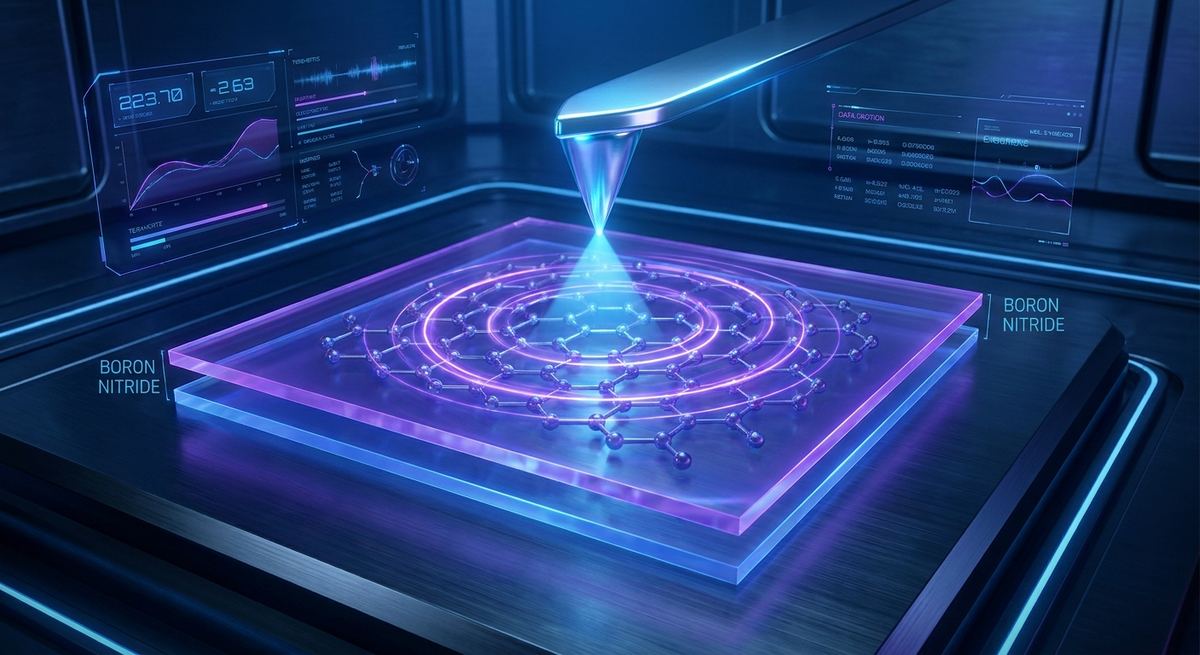
The exploration of two-dimensional quantum materials relies heavily on our ability to map electronic responses at the deepest possible spatial limits. Monolayer graphene has long served as the primary testing ground for these investigations due to its unique linear dispersion relation and the presence of massless Dirac fermions. Researchers constantly push the boundaries of extreme environments, subjecting these delicate atomic lattices to cryogenic temperatures and intense magnetic fields to uncover latent quantum phenomena. A recent breakthrough study successfully merges these extreme conditions with advanced near-field imaging techniques to reveal unprecedented details about nanoscale conductivity. This highly specialized methodology opens an entirely new observational window into the terahertz magneto-optical dynamics of encapsulated graphene systems.
Operating at temperatures plummeting to five Kelvin and magnetic fields reaching one Tesla requires exceptionally robust and precise experimental architectures. The researchers utilized scattering-type scanning near-field optical microscopy to probe the terahertz spectral region directly at the nanoscale. Their focus centered heavily on the behavior of graphene when tuned exceedingly close to the charge neutrality point. Observing the interactions between terahertz radiation and Dirac fermions under these strict parameters yields entirely new datasets regarding field-tunable cyclotron resonance. These meticulous observations provide the foundational steps required to fully decode temperature and magnetic-field effects on nanoscale transport across various two-dimensional quantum materials.
Understanding the intrinsic conductivity of graphene requires a deep dive into the quantum mechanical behavior of its charge carriers. Unlike traditional semiconductors governed by Schrödinger equations with effective masses, charge carriers in graphene behave as ultra-relativistic particles described by the Dirac equation. This distinct physical reality results in a conical band structure where the conduction and valence bands meet precisely at the Dirac point. As the system approaches this exact charge neutrality point, the density of states vanishes, leading to highly complex and exotic transport behaviors. Accurately measuring these subtle shifts in local conductivity demands instrumentation capable of resolving spatial features far below the diffraction limit of conventional optics.
Traditional macroscopic transport measurements typically average out the microscopic heterogeneities that dictate the true physical reality of the material. Nanoscale conductivity mapping bypasses this limitation by interrogating localized electronic environments and revealing the spatial distribution of charge carrier dynamics. In the terahertz frequency domain, the optical conductivity of graphene is dominated by intraband transitions that strongly depend on carrier concentration and mobility. High-frequency probing allows researchers to isolate the Drude-like response of the Dirac fermions without the interference of interband absorption typical at visible wavelengths. Mapping this specific spectral region at the nanometer scale requires sophisticated near-field techniques capable of coupling long-wavelength terahertz light to atomic-scale variations.
The introduction of external magnetic fields fundamentally alters these localized conductive states by quantizing the continuous energy spectrum into discrete Landau levels. This magnetic confinement forces the charge carriers into highly localized cyclotron orbits, heavily modifying the macroscopic and microscopic transport signatures. Observing the spatial variations of these magneto-conductive states provides crucial insights into edge states, local defect interactions, and overall quantum coherence. Theoretical models predict specific spatial patterns corresponding to the varying local density of states under these quantized conditions. The experimental challenge has always been achieving the necessary spatial resolution while maintaining the extreme cryogenic and magnetic environments required to stabilize these quantum states.
Bare graphene resting on a standard silicon dioxide substrate suffers from severe environmental degradation that masks its intrinsic quantum properties. Charge puddles induced by substrate impurities and surface optical phonons dramatically scatter the Dirac fermions, significantly lowering the overall carrier mobility. To mitigate these detrimental effects, researchers now universally employ an encapsulation technique utilizing pristine flakes of hexagonal boron nitride. This wide-bandgap insulator shares a similar lattice structure with graphene but remains entirely free of dangling bonds or surface trap states. Sandwiching the monolayer graphene between two atomically flat layers of hexagonal boron nitride creates a perfectly protected internal electronic environment.
The encapsulation process fundamentally alters the dielectric landscape surrounding the graphene, which profoundly influences its optical and plasmonic responses. Hexagonal boron nitride possesses its own set of highly active hyperbolic phonon polaritons that can couple directly with the plasmons of the encapsulated graphene. This hybridization creates complex new quasiparticles that propagate through the heterostructure with exceptionally low loss and high momentum. The dielectric screening provided by the encapsulating layers also suppresses Coulomb interactions among the charge carriers, further enhancing their mean free path. Consequently, the encapsulated system exhibits an ultra-clean Dirac fluid behavior that is absolutely essential for resolving delicate magneto-optical phenomena. Researchers meticulously align the crystallographic axes of these layered materials to avoid unintended moiré superlattice effects that would complicate the conductivity measurements.
Constructing these pristine heterostructures requires painstaking deterministic transfer techniques performed inside highly controlled environments. Each individual layer must be mechanically exfoliated, optically identified, and sequentially stacked with micrometer precision using specialized polymer stamps. Once assembled, the entire stack is typically etched into specific geometries and fitted with one-dimensional edge contacts to ensure optimal electrical connection. This rigorous fabrication pipeline guarantees that the resulting device behaves as an ideal platform for high-resolution near-field optical interrogation. The sheer quality of these encapsulated devices directly enables the observation of the subtle terahertz responses reported in this groundbreaking nanoscopy study.
Traditional optical microscopy remains fundamentally constrained by the Abbe diffraction limit, which prevents the resolution of features smaller than half the wavelength of the illuminating light. In the terahertz regime, this physical barrier restricts conventional imaging resolution to hundreds of micrometers, entirely obscuring the nanoscale physics of quantum materials. Scattering-type scanning near-field optical microscopy elegantly circumvents this limitation by utilizing a sharp metallic atomic force microscope tip as an optical antenna. The apex of this specialized tip concentrates the incident terahertz electric field into a highly localized, intense evanescent hot spot. This localized field interacts exclusively with the immediate nanoscopic volume of the sample directly beneath the tip apex.
As the oscillating tip interacts with the local dielectric environment of the graphene, it scatters a tiny fraction of the incident radiation back into the far-field detector. This scattered light contains vital phase and amplitude information that is mathematically linked to the complex local optical conductivity of the material. Because the tip oscillates at a specific mechanical resonance frequency, the near-field signal can be isolated from the overwhelming background scattering. Researchers employ higher-order harmonic demodulation techniques via lock-in amplifiers to perfectly extract the pure near-field interaction. This highly sophisticated extraction process guarantees that the resulting images solely reflect the nanoscale properties of the target quantum material.
Operating this delicate instrumentation at cryogenic temperatures and under strong magnetic fields introduces monumental engineering challenges. Standard atomic force microscope components often fail or drift uncontrollably when subjected to liquid helium temperatures and high magnetic flux. The researchers utilized a custom-built cryogenic near-field microscope designed specifically to maintain extreme mechanical stability under these harsh conditions. Specialized interferometric detection schemes were implemented to capture the faint terahertz scattering signals with maximized signal-to-noise ratios. The successful integration of these technologies marks a significant instrumentation milestone that broadens the horizons of entire quantum material investigations.
The application of a perpendicular magnetic field up to one Tesla fundamentally reorganizes the charge carriers within the encapsulated graphene layer. The resulting Lorentz force drives the Dirac fermions into circular trajectories, leading to the formation of highly degenerate Landau levels. When the frequency of the incident terahertz radiation matches the orbital frequency of these charge carriers, a phenomenon known as cyclotron resonance occurs. This resonance drastically alters the local optical absorption and reflection properties, generating a distinct signature in the near-field scattering amplitude. By carefully sweeping the magnetic field strength, researchers can actively tune this cyclotron resonance across the terahertz probing frequency.
Near the charge neutrality point, the behavior of these fermions under magnetic fields becomes remarkably complex due to the vanishing carrier density. The interplay between the external magnetic field and the intrinsic quantum capacitance of the graphene dictates the exact spectral position of the resonance. Terahertz frequencies are perfectly suited for probing these specific transitions because their photon energies closely match the spacing between the lowest Landau levels. The scattering-type scanning near-field optical microscopy technique captures the spatial variations of this resonance, revealing local fluctuations in carrier density. These high-resolution maps expose the underlying charge puddles that persist even within the highly protected encapsulated environment. Observing these localized magneto-optical dynamics at a temperature of five Kelvin ensures that thermal broadening does not obscure the delicate quantum transitions.
The ability to spatially resolve cyclotron resonance represents a massive leap forward in our understanding of two-dimensional electron gases. Prior to this methodology, scientists relied strictly on macroscopic transmission experiments that completely averaged out the local electronic landscape. The near-field approach clearly demonstrates that the magneto-optical response is highly heterogeneous at the nanometer scale. This spatial variance profoundly impacts our theoretical understanding of how magnetic fields influence localized transport mechanisms in Dirac systems. The detailed nanoscopy data provides a stringent test for existing theories regarding magneto-plasmonic coupling and localized defect scattering.
One of the most fascinating observations from this study is the near-perfect high-momentum reflector behavior of the encapsulated graphene. In the context of near-field optics, high momentum refers to the massive wavevectors associated with the highly confined evanescent fields generated by the tip. When these strongly localized fields interact with the highly conductive graphene sheet, the material acts essentially as a perfect mirror for the evanescent waves. This intense reflection creates a powerful near-field signal that dominates the scattering amplitude, even when the system is tuned close to charge neutrality. The robustness of this high-momentum reflection underscores the exceptional electronic quality and high mobility of the encapsulated Dirac fluid.
As the magnetic field is introduced and carefully ramped up to one Tesla, researchers observed very subtle yet distinct changes in this reflector behavior. The magnetic field effectively modifies the local complex dielectric function of the graphene, slightly altering its capacity to screen the evanescent fields. This modification manifests as minute variations in the near-field scattering amplitude and phase, which the sensitive cryogenic equipment accurately records. These subtle changes confirm that the magnetic field is actively manipulating the local density of states and the corresponding intraband scattering rates. Quantifying these small deviations requires extraordinary instrumental precision and highly rigorous data processing protocols to eliminate systemic noise. The capacity to track such minute changes highlights the sheer power of terahertz magneto-nanoscopy as a premier diagnostic tool.
The exact physical mechanism behind this persistent high-momentum reflection near charge neutrality remains a subject of intense theoretical scrutiny. Thermal excitations, even at five Kelvin, alongside residual local charge puddles likely contribute to a non-zero minimum conductivity that sustains the reflection. The encapsulating hexagonal boron nitride layers also play a crucial role by modifying the electromagnetic boundary conditions of the system. Understanding the exact interplay between the pristine graphene layer and its dielectric environment is necessary to decode the full reflection mechanism. These direct empirical observations provide physicists with the exact parameters needed to refine their computational models of near-field light-matter interactions.
Experimental observations in quantum physics carry little weight unless they can be meticulously validated against rigorous theoretical frameworks. The research team developed comprehensive mathematical models calculating the magneto-optical conductivity of graphene using the Kubo formula. These dense calculations account for both intraband and interband transitions while incorporating the specific dampening parameters associated with the encapsulated environment. By integrating these conductivity models into a finite dipole model of the near-field tip interaction, they generated simulated nanoscopy contrast maps. The resulting theoretical predictions matched the experimental terahertz scattering data with remarkable accuracy across various magnetic field strengths.
This alignment between theory and cryogenic nanoscopy data confirms that the field-tunable cyclotron resonance of Dirac fermions is accurately described by current quantum physical models. The simulated near-field spectroscopic contrast successfully captured the subtle reflector behavior shifts induced by the magnetic field near charge neutrality. Extracting the local carrier scattering times from these matched models revealed an exceptionally long mean free path indicative of pristine device quality. The theoretical framework also successfully isolated the pure graphene response from the complex background dielectric signatures of the encapsulating layers. This rigorous cross-validation proves that terahertz magneto-nanoscopy is not merely a qualitative imaging technique, but a highly quantitative analytical platform. Such precise quantification is essential for the future engineering of advanced optoelectronic devices based on two-dimensional materials.
The successful bridging of these theoretical calculations with empirical data sets a robust precedent for future investigations into other complex quantum materials. Transition metal dichalcogenides, topological insulators, and twisted bilayer systems all present unique magneto-optical properties waiting to be explored. The analytical pipeline established in this study provides a direct roadmap for mapping the highly correlated states within these exotic materials. Expanding this specific methodology to higher magnetic fields and lower temperatures will undoubtedly unveil entirely new phases of quantum matter. The fusion of advanced theory and cutting-edge nanoscale microscopy continues to drive the rapid evolution of modern condensed matter physics.
### What is scattering-type scanning near-field optical microscopy?
Scattering-type scanning near-field optical microscopy is an advanced imaging technique that completely bypasses the traditional optical diffraction limit. It utilizes a highly sharpened atomic force microscope tip to focus incident light into a tiny nanoscale hotspot. The tip scatters the localized light back to a detector, carrying detailed information about the optical properties of the sample directly beneath it. This specialized process allows scientists to achieve spatial resolutions on the order of ten to twenty nanometers regardless of the illuminating wavelength. It is particularly valuable in the terahertz spectral region where conventional lenses can only resolve features hundreds of micrometers across.
### Why is hexagonal boron nitride used to encapsulate graphene?
Bare graphene is heavily susceptible to environmental contamination and surface scattering from typical substrates like silicon dioxide. Hexagonal boron nitride provides an atomically smooth, totally insulating protective barrier free of dangling surface bonds or active charge traps. Encapsulating graphene between layers of this material drastically reduces unwanted electron scattering and dramatically boosts the overall carrier mobility. This pristine environment is absolutely critical for preserving the delicate quantum mechanical properties of the ultra-relativistic Dirac fermions. Without this specialized encapsulation, the subtle magneto-optical effects observed at cryogenic temperatures would be completely masked by background noise.
### How does a magnetic field affect the conductivity of graphene?
Applying a strong perpendicular magnetic field to graphene forces its moving charge carriers into circular, highly localized cyclotron orbits. This magnetic confinement reorganizes the previously continuous energy spectrum of the material into highly discrete, quantized energy levels called Landau levels. The formation of these distinct levels fundamentally alters both the macroscopic and microscopic electrical conductivity of the atomic lattice. When probed with specific frequencies of light, the carriers can jump between these levels, creating a massive spike in optical absorption. This specific absorption event is known as cyclotron resonance and it provides deep insights into the effective mass and mobility of the system.
### What is a high-momentum reflector in the context of near-field optics?
In near-field microscopy, the extreme confinement of light at the tip apex generates electromagnetic waves with massive momentum vectors. When these high-momentum evanescent waves strike a highly conductive material like pristine graphene, they are strongly reflected rather than absorbed. The material acts as an incredibly efficient mirror specifically for these highly localized, non-propagating fields. This intense reflection produces a very strong, easily detectable scattering signal that highlights the superior electronic quality of the underlying sample. The study noted that graphene maintains this strong reflector behavior even when depleted of charge carriers near the charge neutrality point.
### Why are cryogenic temperatures required for these specific nanoscale measurements?
At normal room temperatures, severe thermal energy fluctuations cause immense chaotic scattering among the charge carriers within the material. This intense thermal broadening completely washes out the delicate quantum signatures associated with discrete Landau levels and cyclotron resonance. Cooling the specialized experimental apparatus down to five Kelvin effectively freezes out these unwanted thermal vibrations and phonon interactions. This extreme cold preserves the quantum coherence of the system, allowing the pristine physics of the Dirac fermions to emerge clearly. Operating high-resolution scanning probe equipment at these freezing temperatures represents a massive feat of modern mechanical and optical engineering.
The successful deployment of terahertz magneto-nanoscopy on encapsulated monolayer graphene marks a pivotal achievement in condensed matter physics. By combining extreme cryogenic temperatures, strong magnetic fields, and near-field optics, researchers accessed an unprecedented view of nanoscale conductivity. The clear observation of highly localized cyclotron resonance reveals the complex interplay between pristine Dirac fermions and external magnetic flux. Tracking the subtle shifts in the high-momentum reflector behavior near charge neutrality provides critical data for refining existing quantum transport models. This specialized methodology entirely bypasses the limitations of macroscopic averaging, exposing the true heterogeneous reality of the two-dimensional electronic landscape. The deep alignment between theoretical calculations and the empirical scattering data thoroughly validates the accuracy of this advanced imaging platform.
The implications of this research extend far beyond the immediate properties of monolayer graphene systems. Establishing a reliable technique for mapping magneto-optical dynamics at the nanoscale equips scientists with a powerful tool for exploring other highly correlated materials. Future investigations will naturally adapt this exact cryogenic near-field architecture to probe twisted moiré lattices, delicate topological insulators, and complex superconducting arrays. As instrumentation continues to evolve, the capacity to resolve finer spatial details under increasingly extreme environmental parameters will rapidly expand. This initial step fundamentally transforms our approach to investigating temperature and magnetic-field effects across the vast spectrum of two-dimensional quantum materials.
Serious about B2B integration? Test our premium Pulsed Electrical Resistive Carbon Heating turbostratic graphene in your lab. 100g sample packs available now.
Explore More
Researchers have developed a breakthrough method for growing twisted bilayer graphene with pre-designed angles, a key step toward manufacturable quantum...

Learn how deep learning is revolutionizing the structural characterization of twisted bilayer materials, accelerating the development of next-generation...

Learn to build a prototype graphene FET biosensor for sensitive DNA detection. This guide covers materials, fabrication, and testing for point-of-care...