The realm of condensed matter physics has been irrevocably transformed by the advent of two-dimensional materials, with graphene leading the vanguard. While the initial discovery of monolayer graphene unveiled a world of massless Dirac fermions and relativistic quantum electrodynamics in a solid-state system, recent years have seen a paradigm shift toward multilayer graphene systems. Among these, rhombohedral (ABC-stacked) graphene has emerged as a profoundly rich playground for exploring strongly correlated electron physics and topological states of matter. Unlike twisted bilayer graphene, which relies on the delicate and often challenging fabrication of precise "magic" moire angles to achieve flat energy bands, rhombohedral graphene intrinsically possesses ultra-flat bands simply by virtue of its crystalline stacking order.
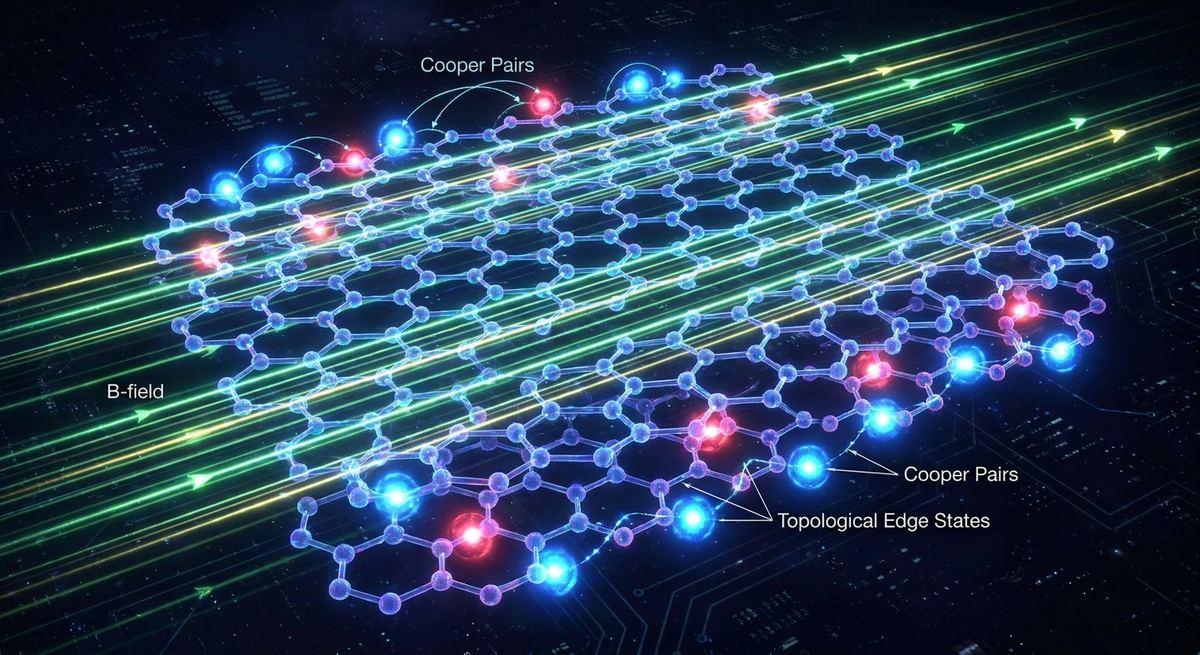
Recently, groundbreaking experiments have revealed that applying an in-plane magnetic field to rhombohedral multilayer graphene—specifically trilayer and tetralayer systems—catalyzes extraordinary quantum phenomena. Chief among these are the deterministic reversal of the Chern number and the emergence of robust, spin-triplet superconductivity. These phenomena are deeply intertwined, resting on the delicate interplay between spontaneous symmetry breaking, topological band structures, and complex orbital-magnetic interactions. In this comprehensive technical article, we will dissect the theoretical underpinnings and experimental manifestations of Chern number reversal and emergent superconductivity in rhombohedral graphene, exploring how in-plane magnetic fields act as a precise tuning knob for topological quantum phase transitions.
The Unique Architecture of Rhombohedral Graphene
To understand the exotic physics of rhombohedral graphene, one must first appreciate its distinct crystallographic architecture. In naturally occurring graphite, the most common stacking order is Bernal (ABA) stacking, where the atoms of the third layer lie exactly above the atoms of the first layer. However, a metastable polytype exists: rhombohedral (ABC) stacking. In an ABC-stacked N-layer graphene system, each subsequent layer is shifted by a specific vector, creating a staircase-like atomic arrangement. This seemingly simple geometric shift has profound consequences for the electronic band structure.
In rhombohedral trilayer graphene (RTG) and tetralayer graphene, the low-energy charge carriers are localized predominantly on the outermost layers (the top and bottom surfaces). Because the interlayer hopping parameters couple the sublattices of adjacent layers in a highly specific manner, the low-energy effective Hamiltonian yields a dispersion relation where the energy E is proportional to the momentum k raised to the power of N (E ∝ k^N), where N is the number of layers. For RTG, this results in a cubic dispersion (E ∝ k^3), and for tetralayer, a quartic dispersion (E ∝ k^4).
This high-order momentum dependence fundamentally flattens the electronic bands near the Dirac points (the corners of the Brillouin zone, K and K'). When bands become flat, the kinetic energy of the electrons is drastically reduced, and the density of states (DOS) diverges, creating what is known as a van Hove singularity. In this regime, the kinetic energy is no longer the dominant force governing electron dynamics; instead, electron-electron Coulomb interactions take the wheel. This strongly correlated regime is the fertile soil from which exotic quantum phases, such as isospin magnetism and unconventional superconductivity, blossom.
Electronic Band Structure and Flat Bands
In the pristine state of rhombohedral graphene, the system is a semi-metal. However, experimentalists can break the inversion symmetry of the system by applying a perpendicular electric displacement field (D) using dual-gate device architectures. By independently tuning the top and bottom gate voltages, researchers can control both the total carrier density (n) and the perpendicular displacement field (D).
The application of a displacement field introduces an electrostatic potential difference between the topmost and bottommost layers, breaking the layer-inversion symmetry. This symmetry breaking opens a tunable bandgap at the charge neutrality point. More importantly, the displacement field modifies the shape of the flat bands, pushing the van Hove singularities to higher densities and creating multiple local extrema in the band structure. The Fermi surface undergoes a series of Lifshitz transitions—topological changes in the geometry of the Fermi surface—as the carrier density is tuned. The electrons can transition from a single, simply connected Fermi sea to an annular (ring-like) Fermi sea, or split into multiple disconnected Fermi pockets.
These van Hove singularities are characterized by an overwhelming concentration of available quantum states at a specific energy level. When the Fermi level is tuned into these singularities via electrostatic gating, the system becomes highly unstable to spontaneous symmetry breaking. According to the Stoner criterion, if the product of the density of states and the interaction strength exceeds a critical threshold, the electrons will spontaneously organize themselves to minimize their repulsive Coulomb energy, typically by polarizing into specific spin or valley states.
Symmetry Breaking and Correlated Phases
In rhombohedral graphene, the internal degrees of freedom are not limited to spin (up and down); they also include the valley degree of freedom (K and K' points in the Brillouin zone). Together, these form a four-fold degenerate flavor space (spin × valley), often referred to as "isospin."
When the system is tuned to a van Hove singularity, the intense Coulomb repulsion forces the electrons to spontaneously break this four-fold symmetry. The system undergoes a ferromagnetic phase transition, but this is not necessarily traditional spin ferromagnetism. Instead, it is an isospin ferromagnetism, where the electrons spontaneously polarize into a subset of the available spin and valley flavors. For instance, the system might become a "half-metal," where two of the four flavors are completely filled and the other two are empty, or a "quarter-metal," where all electrons are spin-polarized and valley-polarized into a single flavor.
When the system spontaneously polarizes into a single valley, time-reversal symmetry is broken. This is a critical prerequisite for the emergence of topological phases. Because the two valleys in graphene carry opposite Berry curvature—a pseudo-magnetic field in momentum space that acts on the electron wavefunctions—a valley-polarized state results in a net, non-zero Berry curvature across the Brillouin zone. The integral of this Berry curvature over the occupied electronic states yields a topological invariant known as the Chern number (C).
In a valley-polarized quarter-metal phase of rhombohedral graphene, the system can exhibit a Quantum Anomalous Hall (QAH) effect, characterized by a quantized Hall resistance and chiral edge states, even in the absence of an external perpendicular magnetic field. The specific Chern number depends on the detailed band topology and the number of layers, but values of C = 1, C = 2, or even higher are theoretically and experimentally accessible.
The Role of In-Plane Magnetic Fields
Traditionally, in two-dimensional electron systems, an in-plane magnetic field (B_parallel) is assumed to couple exclusively to the electron spin via the Zeeman effect. Because the electrons are confined to a strictly 2D plane, there is seemingly no vertical dimension for the in-plane field to generate a Lorentz force, meaning orbital effects should be negligible.
However, rhombohedral multilayer graphene is not strictly 2D. The finite thickness of the multilayers (e.g., trilayer or tetralayer) provides a small but crucial vertical spatial extent. Consequently, an in-plane magnetic field generates a subtle but highly impactful orbital coupling. This orbital effect induces a momentum shift of the electronic states, effectively pushing the Dirac cones of the K and K' valleys in opposite directions in momentum space.
This interplay between the Zeeman effect and the finite-thickness orbital effect is the secret to unlocking the most exotic phases in rhombohedral graphene. The in-plane magnetic field does not merely tilt the spins; it actively distorts the band structure, altering the energy landscape of the van Hove singularities and shifting the energetic balance between different competing correlated phases. By carefully tuning the in-plane magnetic field, researchers can drive the system across quantum phase transitions that would be otherwise inaccessible.
Topology at the Edge: Chern Number Reversal
The ability of an in-plane magnetic field to distort the band structure leads to one of the most striking phenomena observed in modern condensed matter physics: the deterministic reversal of the Chern number.
Imagine a rhombohedral graphene system tuned to a valley-polarized, topologically non-trivial state with a Chern number of C = 2. This state is characterized by two chiral edge channels conducting electricity without dissipation around the perimeter of the sample. The topological nature of this state is protected by the energy gap separating the occupied bands from the empty bands.
As an in-plane magnetic field is applied and gradually increased, the orbital effect pushes the valley-polarized bands in momentum space. Concurrently, the Zeeman effect alters the spin energy. At a critical threshold of the in-plane magnetic field, the distortion becomes so severe that the energy gap between the topologically distinct bands closes. At this exact juncture, a Lifshitz transition occurs, accompanied by a band inversion. The Dirac points from different bands touch, allowing the exchange of Berry curvature hotspots (such as Dirac or Weyl nodes) between the bands.
As the magnetic field is increased further, the gap reopens, but the topological invariant has been fundamentally altered. The system transitions from a C = 2 state to a C = -2 state (or similar transitions like C = 1 to C = -1, depending on the exact carrier density and displacement field). Macroscopically, this Chern number reversal manifests as a sudden, dramatic flip in the sign of the anomalous Hall conductivity. The chiral edge states, which were previously propagating clockwise around the sample boundary, abruptly reverse direction and propagate counter-clockwise.
This phenomenon is profoundly significant because it demonstrates that the topological class of a material is not permanently fixed by its chemical composition or static crystal structure. Instead, the topology can be dynamically, continuously, and reversibly tuned in situ using an in-plane magnetic field. This provides an unprecedented level of control over topological quantum states, paving the way for advanced topological electronics and spintronics.
Emergent Superconductivity: Beyond the Pauli Limit
The narrative of rhombohedral graphene becomes even more compelling with the discovery of emergent superconductivity in the immediate vicinity of these isospin-polarized and topologically non-trivial phases. When the system is tuned just outside the boundaries of the ferromagnetic quarter-metal or half-metal phases, superconductivity miraculously appears at temperatures around 100 to 200 millikelvin.
What makes this superconductivity truly remarkable is its relationship with the applied in-plane magnetic field. In conventional Bardeen-Cooper-Schrieffer (BCS) superconductors, electrons pair up with opposite spins (spin-singlet pairing) and opposite momenta. If a magnetic field is applied, the Zeeman effect splits the energy of the spin-up and spin-down electrons. If this Zeeman splitting exceeds the superconducting gap energy, the Cooper pairs are ripped apart, and superconductivity is destroyed. This absolute upper limit for the magnetic field in a conventional superconductor is known as the Pauli paramagnetic limit (or Chandrasekhar-Clogston limit).
In stark contrast, the superconductivity observed in rhombohedral graphene spectacularly violates the Pauli limit. Experimentalists have applied in-plane magnetic fields heavily exceeding the Pauli limit, and rather than destroying the superconducting state, the field often stabilizes or even enhances the critical temperature (Tc) in certain regions of the phase diagram.
This robust survival against extreme in-plane magnetic fields is the smoking gun signature of spin-triplet superconductivity. In a spin-triplet state, the electrons forming the Cooper pair have aligned spins (e.g., both spin-up or both spin-down). Because their spins are already parallel, the Zeeman effect from an in-plane magnetic field does not penalize the pairing mechanism; it simply shifts the energy of the entire pair simultaneously. The observation of Pauli-limit-breaking superconductivity strongly suggests that rhombohedral graphene hosts unconventional, spin-polarized Cooper pairs, making it a rare and highly sought-after p-wave or f-wave superconductor.
Interplay Between Topology and Superconductivity
The exact microscopic mechanism binding the electrons into spin-triplet Cooper pairs in rhombohedral graphene remains a subject of intense theoretical debate, but the proximity to topological phase transitions and isospin magnetic boundaries provides crucial clues.
One leading hypothesis is that the superconductivity is mediated by quantum fluctuations of the surrounding magnetic order. Just as phonons (lattice vibrations) glue electrons together in conventional superconductors, "paramagnons" (fluctuations of the isospin ferromagnetic state) might act as the pairing glue in rhombohedral graphene. Because the adjacent insulating or semi-metallic phases are spin- and valley-polarized, the fluctuations inherently carry spin and valley quantum numbers, naturally favoring a spin-triplet pairing symmetry.
Furthermore, the precise alignment of the superconducting domes with the topological phase transitions—specifically the regions where the in-plane magnetic field drives the Chern number reversal—suggests a deep connection between the gap-closing topological transitions and the pairing strength. When the bands undergo inversion and the density of states spikes during the Lifshitz transition, the enhanced phase space for electron scattering can dramatically amplify the electron-electron pairing interactions. The orbital effects of the in-plane field therefore not only drive the topological reversal but simultaneously sculpt the Fermi surface to optimize the conditions for unconventional superconductivity.
Experimental Signatures and Fabrication Challenges
Observing these delicate quantum phenomena requires state-of-the-art nanofabrication and ultra-low temperature measurement techniques. Rhombohedral graphene is thermodynamically less stable than Bernal stacked graphene, meaning that mechanical exfoliation of graphite rarely yields large, pristine ABC-stacked flakes. Researchers must painstakingly search for these rare flakes using advanced optical contrast and Raman spectroscopy techniques.
Once identified, the rhombohedral flakes must be encapsulated between atomically flat layers of hexagonal boron nitride (hBN). This encapsulation protects the graphene from environmental contaminants and provides a pristine dielectric environment, maximizing the mobility of the charge carriers. Local graphite gates are typically placed above and below the hBN dielectrics to create the dual-gated architecture necessary for independent tuning of the carrier density and displacement field.
The experimental signatures of Chern number reversal are primarily extracted from low-frequency lock-in transport measurements. By measuring the longitudinal resistance (Rxx) and the transverse Hall resistance (Rxy) as functions of the displacement field, carrier density, and in-plane magnetic field, researchers can map out the intricate phase diagram. A non-zero, quantized Rxy at zero perpendicular magnetic field indicates the QAH phase, and a sudden change in its sign as B_parallel is ramped up confirms the Chern number reversal. Superconductivity is identified by a precipitous drop in Rxx to absolute zero, accompanied by highly nonlinear current-voltage characteristics that define the critical current of the superconducting state.
Future Perspectives and Technological Implications
The discovery of in-plane magnetic field-driven Chern number reversal and Pauli-limit-violating spin-triplet superconductivity in rhombohedral graphene is a watershed moment in condensed matter physics. It definitively proves that crystalline, non-moire graphene multilayers are just as phenomenologically rich as their twisted counterparts, with the added benefit of avoiding the structural inhomogeneity and strain gradients inherent to moire superlattices.
Looking to the future, the implications of this research are vast. Spin-triplet superconductors are the primary theoretical candidates for hosting Majorana zero modes—exotic quasiparticles that are their own antiparticles. Majorana zero modes are theoretically predicted to appear at the boundaries or vortices of topological superconductors. Because they obey non-Abelian exchange statistics, they form the bedrock of proposed topological quantum computers. Unlike current quantum computers, which are plagued by decoherence and require massive error-correction overheads, a topological quantum computer would store information globally in the topological properties of the system, rendering it intrinsically fault-tolerant and immune to local environmental noise.
Furthermore, the ability to dynamically switch the chirality of edge states (via Chern number reversal) using an in-plane magnetic field opens novel avenues for topological spintronics. One could envision low-power memory devices or logic gates where information is encoded in the propagation direction of dissipationless edge currents, toggled rapidly by local magnetic fields or spin-orbit torques.
Conclusion
Rhombohedral graphene stands today at the absolute frontier of quantum materials research. The elegant simplicity of its carbon-only, crystalline lattice belies the staggering complexity of its interacting electron system. By utilizing an in-plane magnetic field as a sophisticated tuning parameter, physicists have uncovered a landscape where orbital effects, spin-triplet Cooper pairing, and topological invariants dance in a delicate, highly correlated interplay. The deterministic reversal of Chern numbers and the emergence of ultra-robust superconductivity not only rewrite our understanding of two-dimensional electron gases but also chart a clear, albeit challenging, path toward the next generation of topological quantum technologies. As fabrication techniques improve and theoretical models are refined, rhombohedral graphene will undoubtedly continue to yield profound insights into the quantum nature of matter.