
Beyond Perfection: How Electrons Hop in Real-World Graphene Electronics
Discover how hopping-mediated charge transport explains graphene's electrical behavior beyond the ideal ballistic regime, a key insight for creating...
The landscape of condensed matter physics has been irrevocably altered by the discovery and manipulation of two-dimensional materials. Among these, graphene has consistently remained at the forefront. While single-layer graphene offered a platform for massless Dirac fermions, and twisted bilayer graphene introduced the world to moiré-induced superconductivity and flat bands, crystalline rhombohedral graphene (RG) has recently emerged as a pristine, twist-free system hosting a rich tapestry of strongly correlated and topological phases.
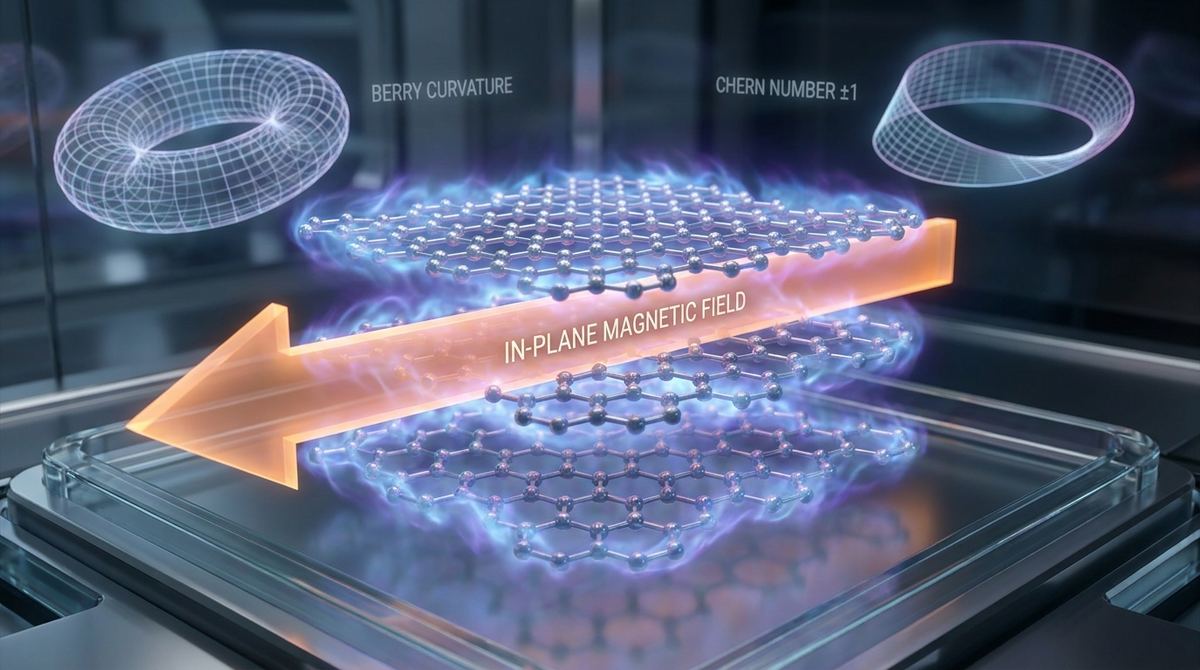
For researchers and industry professionals aligned with the mission of usa-graphene.com, understanding the frontier of graphene physics is paramount. Recent breakthroughs have demonstrated that applying an in-plane magnetic field to rhombohedral graphene can induce profound topological phase transitions—specifically, the reversal of the Chern number—and simultaneously drive the emergence of robust superconductivity. This article provides a deeply detailed, highly technical examination of the mechanisms driving these phenomena, exploring the underlying band structure, the role of electron-electron correlations, the unique orbital effects of in-plane magnetic fields in finite-thickness 2D systems, and the profound implications for future topological quantum computing and advanced electronics.
To grasp the origin of these exotic quantum states, one must first understand the structural distinctiveness of rhombohedral graphene. Multilayer graphene naturally crystallizes in two predominant stacking orders: the thermodynamically stable Bernal (ABA) stacking, and the metastable rhombohedral (ABC) stacking. In Bernal stacking, the third layer lies directly above the first layer, leading to a band structure characterized by coexisting linear and massive parabolic bands.
Conversely, in rhombohedral (ABC) stacking, each successive layer is shifted by the same vector relative to the layer below it. This continuous translation breaks the inversion symmetry present in Bernal stacked layers when an external perpendicular electric field is applied. More critically, the low-energy effective Hamiltonian for ABC-stacked $N$-layer graphene dictates that the low-energy electronic excitations are confined to the outermost layers. The dispersion relation for these low-energy states scales as $E \propto q^N$, where $q$ is the momentum measured from the Dirac point and $N$ is the number of layers.
For rhombohedral trilayer graphene (RTG, $N=3$), the dispersion is cubic ($E \propto q^3$). This remarkably shallow dispersion curve results in a divergent density of states (DOS) near the charge neutrality point. In momentum space, the band structure features an extended, nearly flat band region. When the kinetic energy of electrons is quenched by such flat bands, the Coulomb repulsion between electrons—the interaction energy—dominates the system's Hamiltonian. This strongly correlated regime is the fertile ground from which exotic quantum phases, such as Stoner ferromagnetism, Wigner crystallization, and superconductivity, spontaneously emerge.
Graphene possesses a four-fold internal degree of freedom, often referred to as isospin, arising from the two physical spin states (up and down) and the two momentum valleys ($K$ and $K'$). Under non-interacting conditions, this results in an SU(4) symmetry. However, in the ultra-flat bands of rhombohedral graphene, the dominant Coulomb interactions drive the system to minimize its energy by spontaneously breaking this SU(4) symmetry. The electrons polarize into one or more of these isospin flavors.
When an out-of-plane displacement field ($D$) is applied to RTG via dual electrostatic gates, an energy gap opens at the Dirac points, and the flat bands acquire a non-trivial Berry curvature. The integral of this Berry curvature over the Brillouin zone defines the valley Chern number. In the absence of interactions, time-reversal symmetry dictates that the Berry curvature in valley $K$ is exactly opposite to that in valley $K'$, resulting in a net Chern number of zero.
However, the strong electron-electron interactions in RTG can lead to spontaneous valley and spin polarization. If the system fully polarizes into a single valley and a single spin—a state known as a quarter-metal—time-reversal symmetry is spontaneously broken. The system then exhibits a non-zero macroscopic Chern number (e.g., $C = 2$ for RTG). This is the hallmark of a Chern insulator or a quantum anomalous Hall (QAH) state, where gapless, chiral edge states conduct electricity without dissipation, even in the absence of an external magnetic field.
In standard 2D systems, the application of a magnetic field is generally divided into two orthogonal effects. An out-of-plane magnetic field ($B_{\perp}$) couples to the orbital motion of electrons, quantizing their energy into discrete Landau levels and breaking time-reversal symmetry macroscopically. An in-plane magnetic field ($B_{\parallel}$), on the other hand, is widely assumed to couple strictly to the intrinsic spin of the electrons via the Zeeman effect ($E_z = g \mu_B B_{\parallel}$), leaving the orbital motion largely unaffected due to the atomic thinness of the 2D material.
However, in finite-thickness 2D materials like rhombohedral trilayer graphene, this assumption breaks down. The physical thickness of the trilayer ($d \approx 0.67$ nm) is small but non-zero. When an in-plane magnetic field is applied, the vector potential $\mathbf{A}$ penetrates the layers differently. According to the Peierls substitution, this introduces a layer-dependent phase shift in the electron hopping terms.
Physically, this layer-dependent vector potential exerts a Lorentz force that shifts the Dirac cones in momentum space. Crucially, the momentum shift is opposite for the two valleys due to time-reversal symmetry properties prior to interaction. Therefore, an in-plane magnetic field in RTG has a profound dual role: it splits the energy bands via the Zeeman effect (favoring spin-polarized states) AND it exerts a subtle but powerful orbital effect that shifts and distorts the band structure, altering the van Hove singularities and modifying the Berry curvature distribution.
The interplay between the intrinsic strongly correlated states of RTG and the dual (Zeeman and orbital) effects of an in-plane magnetic field leads to one of the most fascinating phenomena in modern condensed matter physics: the reversal of the Chern number.
Imagine the system is tuned via a displacement field and carrier density to a spontaneous QAH state with a Chern number of $C = 2$. In this state, the system is fully valley-polarized and spin-polarized. As an in-plane magnetic field is introduced and gradually increased, the orbital effect begins to shift the momentum-space position of the polarized bands. Simultaneously, the Zeeman effect alters the energetic hierarchy of the spin-split bands.
At a critical magnetic field strength, the shifting bands undergo a Lifshitz transition—a topological change in the Fermi surface. The energy gap that protected the $C = 2$ state closes. The Dirac points from differing bands or valleys are forced to cross due to the momentum-space shifting induced by the in-plane field's vector potential. In this highly degenerate state, the strong electron-electron interactions reorganize the system. As the field increases further, the gap reopens, but the topological invariant has changed. The Berry curvature integrates to a new value, and the system settles into a state with a reversed Chern number, such as $C = -2$ or $C = -1$.
This Chern number reversal is a macroscopic manifestation of a field-driven topological phase transition. It is remarkably rare, as it requires a delicate balance between strong Coulomb interactions, tunable band topology via displacement fields, and the precise orbital coupling of an in-plane magnetic field in a finite-thickness atomic lattice. The ability to toggle the chirality of the edge states (from clockwise to counter-clockwise) simply by tuning an in-plane magnetic field opens revolutionary pathways for topological switching devices.
Perhaps the most groundbreaking discovery in the RTG system is the emergence of superconductivity at the boundaries of these symmetry-broken isospin phases, and specifically, how this superconductivity responds to magnetic fields.
In conventional Bardeen-Cooper-Schrieffer (BCS) superconductors, magnetic fields are highly detrimental. An out-of-plane field destroys superconductivity via orbital pair-breaking (creating Abrikosov vortices until the upper critical field is reached). An in-plane field destroys superconductivity via the Pauli paramagnetic limit: the Zeeman energy forces the spins of the Cooper pair (which are anti-aligned in a spin-singlet state) to align with the field, breaking the pair apart.
However, in rhombohedral graphene, the application of an in-plane magnetic field has been observed to not only preserve but in some regimes *induce* or *enhance* superconductivity. When superconductivity survives far beyond the Pauli paramagnetic limit, it is a glaring signature of unconventional pairing.
There are two primary theoretical frameworks for this emergent, field-resilient superconductivity in RTG:
1. **Spin-Triplet Superconductivity:** If the electrons forming the Cooper pairs possess aligned spins (a spin-triplet state, $S=1$), the Zeeman effect from an in-plane magnetic field no longer acts as a pair breaker. Instead, the field can stabilize the spin-triplet state by suppressing competing spin-singlet insulating phases. The proximity of the superconducting dome to the spin-polarized, valley-polarized half-metal phases strongly suggests that the superconductivity is mediated by purely electronic mechanisms—specifically, by the fluctuations of the isospin order parameter. The electrons are bound together not by phonons, but by exchanging magnetic or valley fluctuations.
2. **Finite-Momentum (FFLO) Pairing:** The orbital effect of the in-plane magnetic field shifts the Fermi surfaces of opposite valleys. If a Cooper pair is formed by an electron in valley $K$ and an electron in valley $K'$, the momentum shift means the Cooper pair acquires a net finite center-of-mass momentum. This leads to a Fulde-Ferrell-Larkin-Ovchinnikov (FFLO) superconducting state, where the superconducting order parameter is spatially modulated. RTG is currently considered one of the most promising platforms in the world for realizing robust 2D FFLO states.
For the engineers and scientists following usa-graphene.com, the physical realization of these devices is a masterclass in modern nanofabrication. Creating devices capable of exhibiting Chern reversal and emergent superconductivity requires extraordinary precision and material purity.
The rhombohedral graphene must first be isolated. Because the ABC stacking is metastable, it naturally wants to relax into the Bernal ABA stacking. Researchers use careful mechanical exfoliation of natural graphite, followed by scanning near-field optical microscopy (SNOM) or Raman spectroscopy to identify the rare, pristine ABC domains.
Once identified, the RTG is encapsulated between atomically flat layers of hexagonal boron nitride (hBN). The hBN serves a dual purpose: it protects the graphene from environmental contaminants (which would destroy the delicate correlated states) and acts as an exceptionally high-quality dielectric.
To control the displacement field ($D$) and the carrier density ($n$) independently, the hBN/RTG/hBN stack is sandwiched between top and bottom gate electrodes, typically made from few-layer graphite to avoid the strain and charge impurities associated with deposited metallic gates.
Measurements are conducted in ultra-low temperature dilution refrigerators, often reaching base temperatures of 10 millikelvin. Researchers utilize low-frequency lock-in amplifier techniques to measure the longitudinal resistance ($R_{xx}$) and the Hall resistance ($R_{xy}$). Superconductivity is identified by a precipitous drop of $R_{xx}$ to zero, alongside non-linear current-voltage characteristics (the observation of a critical current). The topological Chern insulator phases are identified by the quantization of the Hall resistance to $h/Ce^2$, where $C$ is the Chern number, accompanied by a vanishing $R_{xx}$.
The intersection of topological physics and superconductivity is the precise coordinate where the future of quantum computing lies. The phenomena observed in rhombohedral graphene under in-plane magnetic fields have massive implications for this field.
Currently, the pursuit of fault-tolerant quantum computing relies heavily on the realization of Majorana zero modes—non-Abelian anyons that can be used to encode quantum information in a topological manner, making the qubits inherently immune to local environmental decoherence. Traditionally, generating Majorana modes requires complex heterostructures, such as growing an s-wave superconductor on top of a topological insulator or a semiconductor with strong spin-orbit coupling.
Rhombohedral graphene presents a paradigm shift. Because it can intrinsically host both topological states (Chern insulators) and unconventional superconductivity within the *exact same material*, it eliminates the need for complex, messy interfaces. By patterning local electrostatic gates, one could theoretically create a topological insulator region directly adjacent to a superconducting region within a single continuous flake of RTG. Furthermore, manipulating the in-plane magnetic field to induce a Chern number reversal provides a macroscopic, tunable knob to control the topological boundaries where these Majorana modes are predicted to reside.
Beyond quantum computing, the tunability of these phases offers a blueprint for ultra-low-power topological electronics. Devices that can switch between a trivial insulator, a dissipationless quantum anomalous Hall conductor, and a superconductor—using only small gate voltages and in-plane magnetic fields—could form the basis of next-generation cryogenic logic circuits.
While the physics of RTG is awe-inspiring, the challenge for the industry, and a key focus for networks like usa-graphene.com, is scalability. The reliance on exfoliated flakes is sufficient for fundamental physics discoveries, but commercialization requires wafer-scale growth.
Chemical vapor deposition (CVD) growth of purely ABC-stacked multilayer graphene is currently an area of intense metallurgical and chemical research. Inducing the ABC stacking selectively—perhaps through engineered substrate interactions, carefully controlled cooling rates, or the application of shear forces during growth—is one of the grand challenges in 2D materials science.
Additionally, researchers are exploring the integration of RTG with transition metal dichalcogenides (TMDs) like WSe2. Placing RTG on WSe2 induces strong proximity spin-orbit coupling in the graphene, which can further stabilize the topological phases and potentially increase the critical temperature of the emergent superconductivity, pushing these devices closer to practical operational temperatures.
The discovery of Chern number reversal and emergent superconductivity driven by in-plane magnetic fields in rhombohedral graphene is a watershed moment in condensed matter physics. It shatters previous assumptions about the inert nature of in-plane fields on the orbital mechanics of 2D systems and highlights the spectacular complexity of strongly correlated flat bands. As we continue to decode the quantum mechanical intricacies of rhombohedral graphene, we are not just observing exotic physics; we are laying the foundational architecture for the topological quantum computers and dissipationless electronics of the future. For the broader graphene community, it is a powerful reminder that carbon's potential remains, even now, largely untapped.
Serious about B2B integration? Test our premium Pulsed Electrical Resistive Carbon Heating turbostratic graphene in your lab. 100g sample packs available now.
Explore More
Discover how hopping-mediated charge transport explains graphene's electrical behavior beyond the ideal ballistic regime, a key insight for creating...

A practical guide to fabricating a flexible graphene fiber sensor for the simultaneous detection of nitric oxide and H2O2, key cancer biomarkers.

Explore a new low-noise Pauli-consistent ensemble Monte Carlo simulation for graphene, a powerful computational tool for designing next-generation...