
Beyond Perfection: How Electrons Hop in Real-World Graphene Electronics
Discover how hopping-mediated charge transport explains graphene's electrical behavior beyond the ideal ballistic regime, a key insight for creating...
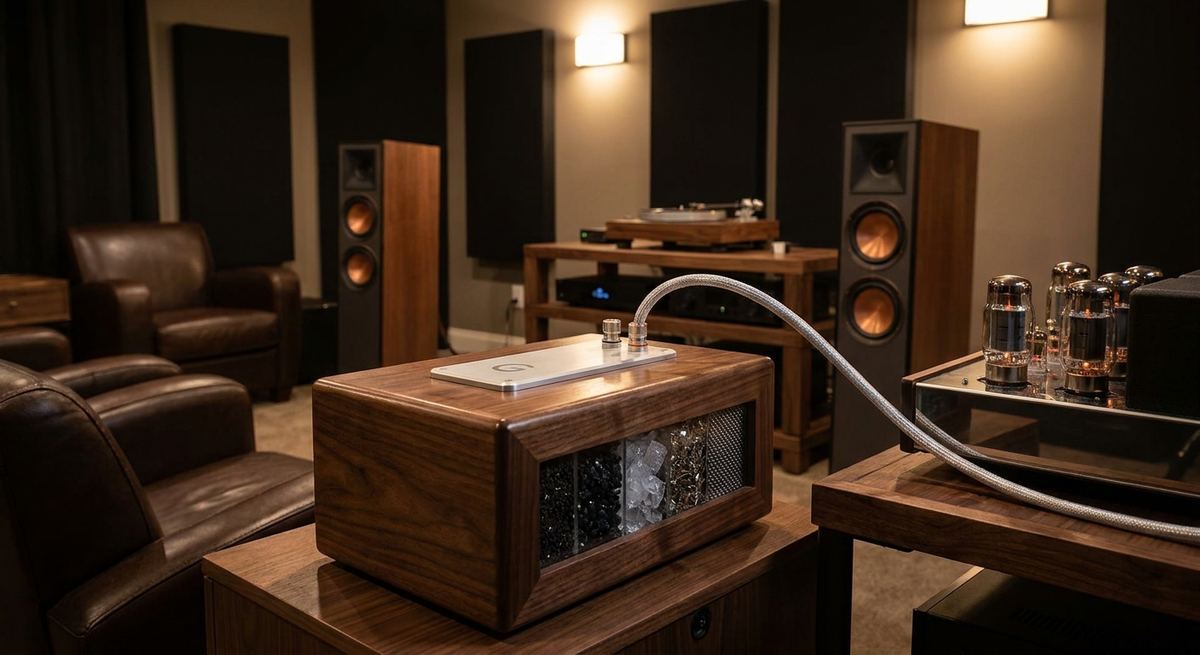
In high-end audio, the biggest threats to sound quality are often invisible. You can spend thousands of dollars on a DAC, amplifier, turntable, streamer, or pair of loudspeakers, yet still hear a faint hum, a buzz, a grainy top end, or a vague loss of musical focus. The culprit is usually electrical noise.
The most familiar form is a ground loop. In simple terms, a ground loop happens when multiple audio components are connected to ground at different electrical potentials. Instead of sitting at the same reference level, the components allow small currents to flow through signal cables and chassis connections. That unwanted current rides along with the music signal and can create hum, buzz, or a subtle veil over the sound.
But ground loops are only part of the problem. Modern homes are filled with sources of electromagnetic interference, or EMI, and radio frequency interference, or RFI. WiFi routers, cell phones, smart home devices, LED lighting, switching power supplies, computers, and even appliances on the same electrical branch can inject noise into the environment. Much of this noise is high frequency, which makes it especially difficult to manage because it can couple into audio systems through cables, chassis, and even the air.
Expensive audio systems are often more susceptible to these problems, not less. That may sound counterintuitive, but it makes sense: the higher the resolution of the system, the more it reveals. A modest system can mask low-level noise with its own limitations. A revealing system exposes tiny artifacts that were always there. That is why audiophiles talk about not just a “quiet” background, but a “black” background. Quiet means the noise is reduced. Black means the noise floor drops so far that instruments seem to emerge from silence, with more separation, more detail, and more dimensionality.
Audiophile grounding boxes are designed to give stray electrical noise somewhere to go. The concept is straightforward: provide a dedicated, low-impedance path that allows unwanted energy to dissipate into a conductive mass instead of circulating through the audio chain.
Think of the grounding box as an electromagnetic energy sink. When RF or EMI enters the box through the grounding cable, it encounters a carefully engineered internal medium. That medium converts the energy into negligible heat across a large surface area and through many microscopic conduction paths. The result is not magic; it is controlled dissipation.
A key reason grounding boxes can be effective is that the ground reference in a wall outlet is not always especially clean. In a typical home, the safety ground may be shared, indirectly or directly, with noise from refrigerators, dimmers, computers, chargers, HVAC equipment, and other appliances. In other words, your wall ground is protective, but it is not necessarily quiet.
A separate grounding reference can sometimes be cleaner because it is local, dedicated, and engineered for one purpose: absorbing noise. This is why premium audiophile grounding products from brands such as Entreq, CAD (Computer Audio Design), and Nordost have found a market. Users are paying for a specialized impedance environment that can reduce noise in ways standard household grounding cannot.
The best grounding systems also use multi-path dissipation. Different materials respond differently across the frequency spectrum. A broad mix of conductors and absorbers can capture more of the unwanted energy, from low-frequency hum components to very high-frequency RF contamination.
Graphene has become a compelling material in this space because its physical properties align unusually well with the needs of electromagnetic noise control.
First is surface area. Graphene is often cited as having an extraordinarily high theoretical surface area, around 2,630 square meters per gram. That massive interaction area matters because electromagnetic energy is largely a surface phenomenon at high frequencies. The more surface available, the more opportunity there is for interaction, absorption, and dissipation.
Second is broadband absorption. Research on graphene and graphene-based composites has shown strong electromagnetic absorption across a wide range of frequencies, from radio waves through microwave bands and into infrared regimes depending on formulation and structure. That makes graphene attractive for systems that need to deal with multiple noise types at once, not just one narrow band.
Third is conductivity. Graphene is highly conductive and, by weight, can outperform copper in certain applications because it is so light and so thin. In grounding applications, the goal is not simply to “carry current” in the ordinary sense. It is to provide an ultra-low-impedance environment where stray energy can spread out and be absorbed efficiently.
This is where the graphite + metal wire + graphene combination becomes especially interesting. Each material contributes differently:
- Metal wire handles bulk current flow and low-frequency noise.
- Graphite provides medium-frequency absorption and stable impedance.
- Graphene excels at high-frequency RF absorption due to its quantum-scale structure and enormous surface area.
Together, they create a hierarchical conduction network. Instead of relying on one material to do everything, the system covers the entire noise spectrum, from 50 Hz hum to GHz-range RF interference. That multi-material architecture is what makes custom grounding boxes so promising.
The scientific case for graphene in EMI management is not speculative. Peer-reviewed studies have repeatedly shown that graphene composites can absorb or attenuate electromagnetic radiation at meaningful levels, often reporting shielding effectiveness values in the range of 20 to 30 dB or more depending on thickness, loading, and composite design. In practical terms, that can represent a substantial reduction in unwanted energy.
One reason graphene performs well at high frequencies is the skin effect. As frequency rises, current tends to flow near the surface of a conductor rather than through its full cross-section. Graphene is essentially all surface. That makes it naturally well suited for interacting with RF energy, where surface phenomena dominate.
Shielding effectiveness, or SE, is the standard way researchers quantify how much electromagnetic energy a material blocks or absorbs. Graphene-based composites have shown useful SE values in published work, especially when combined with other conductive fillers. This is important because a grounding box is not a simple shield; it is a dissipative system. The goal is to capture noise and convert it into harmless heat or spread it into a larger conductive network where it no longer affects the audio signal.
Impedance matching is another important concept. If a conductive medium changes too abruptly from one material to another, some energy reflects instead of being absorbed. A gradual transition from metal to graphite to graphene helps create broadband impedance matching, which improves the chance that noise will enter the material rather than bounce back into the system.
Finally, thermal dissipation is part of the picture. The energy levels involved in audio grounding applications are tiny, so the absorbed electromagnetic energy becomes negligible heat. Because the material is distributed across a large mass and surface area, the process is stable and passive.
A well-made grounding box is both a materials project and an electrical design project. The enclosure should be non-magnetic and mechanically stable. Common choices include wood, acrylic, or aluminum. Wood and acrylic are often favored for their inertness and ease of modification, while aluminum offers durability and shielding potential if properly isolated from unwanted paths.
Inside the enclosure, the fill material is where the engineering happens. A practical structure uses layers or a blend of graphite granules, copper or silver wire mesh, and graphene powder. The goal is to create a dense but heterogeneous conductive matrix. The wire mesh provides a backbone for low-frequency conduction. The graphite adds bulk conductivity and absorptive behavior. The graphene powder fills microscopic spaces and increases surface interaction, especially for high-frequency noise.
A useful starting point for graphene concentration is approximately 5 to 15 percent by weight of the total fill material. That range can be adjusted depending on the behavior you want, the texture of the mix, and the cost of the graphene. Too little graphene may underutilize its benefits. Too much may make the blend difficult to handle or less stable mechanically.
The box needs a binding post or banana plug terminal so it can connect to a grounding cable. The cable should be high quality, with solid terminations such as spades or bananas, and ideally shielded if the run is long or the environment is noisy. Connection points on audio equipment may include unused RCA inputs, dedicated ground terminals, or chassis screws, depending on the manufacturer’s guidance and the system layout.
A simple cost breakdown for a prototype can look like this:
- Enclosure: $20 to $40
- Graphite fill: $10 to $20
- Wire mesh or wire conductor: $10 to $20
- Graphene powder: $15 to $50 depending on grade and amount
- Binding post and hardware: $5 to $15
- Cable and terminations: $15 to $30
That means a first prototype can often be built for under $100 in materials, especially if you are testing one design path before scaling up.
Users of audiophile grounding boxes commonly report similar types of improvements. The noise floor seems lower. The background between notes sounds blacker. Micro-details become easier to hear. Instruments separate more clearly in the mix. Soundstage depth and image stability may improve. In digital systems, some listeners also describe reduced glare, less hardness, and a smoother presentation.
These reports are not surprising if the grounding box is reducing unwanted RF and ground-borne noise that was previously modulating the signal chain. When the noise floor drops, low-level information becomes easier to perceive. The ear interprets this as greater transparency and refinement.
That said, results vary by system. Homes with dirtier power, more switching supplies, more wireless devices, or more crowded cable layouts may show more dramatic gains. Systems that are already well isolated and well grounded may show subtler improvements. The more revealing the system, the more likely it is to expose the benefit.
Proper A/B comparison is essential. Because these changes can be subtle, evaluations should be done carefully, ideally with quick switching, matched levels, and repeated listening. If possible, use familiar recordings that contain clear spatial cues, quiet passages, and dense textures. The goal is to determine whether the grounding box is improving clarity, not just changing the sound in a way that seems different at first glance.
The premium audiophile market is large and unusually receptive to products that combine measurable engineering with strong subjective appeal. The global high-end audio market is worth more than $25 billion, and audiophiles routinely spend $1,000 to $10,000 on cables alone. In that context, it is not unusual for grounding boxes to sell for $1,000 to $5,000 or more, especially when positioned as reference-grade accessories.
This pricing makes sense from a market perspective because the material cost is often far lower than the retail price. A well-designed grounding box may have less than $200 in raw materials, yet deliver a premium experience through careful construction, tuning, finish quality, and brand positioning. Graphene strengthens that story because it is a premium, cutting-edge material with genuine scientific credibility.
Direct-to-consumer sales can work well through audiophile forums, Head-Fi, Audiogon, specialty websites, and social channels where enthusiasts discuss tweaks in detail. There is also strong potential for partnerships with high-end audio dealers and installers who can bundle grounding products with system setup services.
For manufacturers and custom builders, USA Graphene is a practical supplier for high-quality turbostratic graphene suited to this application. In grounding systems, turbostratic graphene is attractive because its structure can support broad interaction with electromagnetic energy while remaining relatively easy to incorporate into composite fills and custom blends.
If you want to build prototypes, the best approach is to start small and test methodically. A minimum order of graphene for first experiments should be enough to let you vary the loading percentage across several boxes or sample chambers. That gives you data on how the material behaves in different mixtures.
A simple testing methodology is to measure the noise floor with and without the grounding box using audio measurement software and an interface you trust. Compare hum levels, RF contamination, and any changes in residual noise with the system idle. Then listen for subjective differences in a controlled A/B format. The combination of measurement and listening is especially useful in this category, because the goal is not only technical reduction of noise but also audible improvement.
You can build your first prototype for under $100 in materials if you keep the enclosure simple and focus on learning. Use a small box, a modest amount of graphite, some conductive mesh or wire, a few grams of graphene, and a reliable terminal. Once you identify a promising formulation, you can refine the proportions and finish.
Finding beta testers in the audiophile community is the next step. Look for listeners who already understand grounding accessories, who own resolving systems, and who are willing to give detailed feedback. Their impressions can help you tune the product and decide whether the effect is strong enough to justify a premium commercial release.
In the end, graphene is not being proposed here as a miracle ingredient. It is being used as part of a serious, layered engineering approach to noise control. Combined with graphite and metal conductors, and sourced from a quality supplier such as USA Graphene, turbostratic graphene can play a meaningful role in audiophile grounding systems. For a market that values nuance, refinement, and measurable performance, that makes it one of the most interesting material opportunities in high-end audio today.
Serious about B2B integration? Test our premium Pulsed Electrical Resistive Carbon Heating turbostratic graphene in your lab. 100g sample packs available now.
Explore More
Discover how hopping-mediated charge transport explains graphene's electrical behavior beyond the ideal ballistic regime, a key insight for creating...

A practical guide to fabricating a flexible graphene fiber sensor for the simultaneous detection of nitric oxide and H2O2, key cancer biomarkers.

Explore a new low-noise Pauli-consistent ensemble Monte Carlo simulation for graphene, a powerful computational tool for designing next-generation...