
A New Era of Graphene Engineering: Pre-Designing Twist Angles on Demand
Researchers have developed a breakthrough method for growing twisted bilayer graphene with pre-designed angles, a key step toward manufacturable quantum...
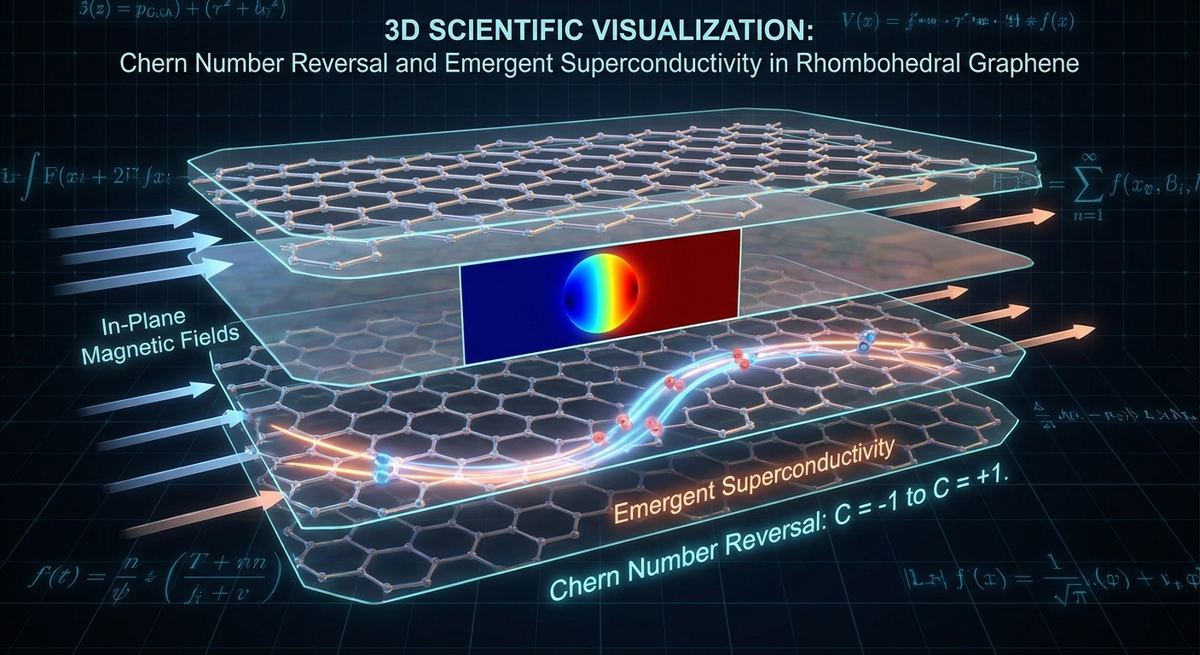
Rhombohedral (ABC-stacked) graphene has emerged as a premier platform for exploring strongly correlated and topological phases of matter. In its multilayer form, the low-energy electronic states become increasingly flat, enhancing interaction effects and enabling spontaneous symmetry breaking, Chern insulating behavior, and unconventional superconductivity. When aligned with hexagonal boron nitride (hBN), the resulting moiré superlattice further reconstructs the band structure, producing narrow topological minibands that can host quantum anomalous Hall (QAH) states and superconducting phases within the same device architecture.
Here we consider hBN-aligned eight-layer rhombohedral graphene moiré superlattices, in which robust QAH order coexists with three distinct superconducting phases. This system provides an unusually rich setting for examining how topology, magnetism, and pairing interact under external control parameters, especially displacement field and in-plane magnetic field. The central findings are twofold: first, in electron-doped regimes away from the moiré potential, the QAH Chern number can be reversed by tuning displacement fields and in-plane magnetic fields; second, in hole-doped regimes near the moiré superlattice, the three superconducting phases respond very differently to in-plane magnetic field, revealing distinct pairing mechanisms and symmetry constraints.
A key result is the observation of Chern number reversal in the QAH state. In a conventional Chern insulator, the sign and magnitude of the Chern number are fixed by the topology of the occupied bands and the direction of spontaneous orbital magnetization. In rhombohedral graphene moiré systems, however, the Chern number is not immutable. By varying the displacement field, one modifies the layer polarization and the energetic hierarchy of spin- and valley-polarized states. An in-plane magnetic field then couples not only through Zeeman splitting, but also through orbital effects enabled by finite layer thickness and spin-orbit coupling induced by the hBN alignment and broken inversion symmetry. The result is a tunable reconfiguration of the topological ground state, including reversal of the QAH Chern number. The isotropic response to in-plane field is particularly notable, since a purely spin-only Zeeman mechanism would not generally account for such behavior. Instead, the data point to an interplay between orbital magnetism and spin-orbit coupling that reshapes the topological band occupation and the associated edge-state chirality.
The superconducting sector is equally striking. Near the moiré superlattice on the hole-doped side, three unconventional superconducting phases are observed, each with a distinct response to in-plane magnetic field. One phase is weakly enhanced, suggesting that modest field application may suppress a competing order or improve nesting/interaction conditions favorable for pairing. A second phase is strongly suppressed, consistent with a pairing state that is sensitive to spin polarization or pair-breaking by Zeeman coupling. Most remarkable is the third phase, which is not merely robust against in-plane magnetic field but is exclusively induced by it. Such field-emergent superconductivity is difficult to reconcile with conventional spin-singlet pairing, for which in-plane fields generally act as a strong depairing mechanism once orbital effects are minimized in thin samples. Instead, the emergence of superconductivity under in-plane field provides compelling evidence for spin-triplet pairing or, more generally, a pairing state with internal structure that can align with the applied field and evade conventional Pauli limiting.
These observations suggest that the superconducting phases are not simply perturbations of a single parent condensate, but rather distinct quantum states stabilized by different combinations of band filling, displacement field, and magnetic field. Because rhombohedral graphene possesses nearly flat bands with strong Coulomb interactions, small changes in external control can dramatically alter the balance between competing orders such as magnetism, valley polarization, and superconductivity. The presence of a QAH state adjacent to multiple superconducting domes indicates that the same underlying electronic manifold can support both topological insulation and Cooper pairing, with the phase realized depending on how interaction-driven symmetry breaking proceeds.
From a theoretical standpoint, the coexistence of Chern insulating and superconducting behavior raises several important questions. One concerns the microscopic origin of the topological band structure under hBN alignment: the moiré potential breaks sublattice symmetry and introduces valley-dependent Berry curvature, while the multilayer rhombohedral stacking amplifies the susceptibility to interaction-driven polarization. Another concerns the mechanism of pairing in the superconducting phases. In a flat-band environment, pairing may arise from repulsive interactions mediated by collective fluctuations, and the symmetry of the order parameter may be unconventional, including spin-triplet, valley-polarized, or mixed-parity components. The field-induced superconducting phase is especially suggestive of equal-spin pairing or a d-vector texture that can rotate under applied field, enabling superconductivity to emerge rather than collapse.
The experimental implication is that in-plane magnetic field acts as a powerful in situ control knob. Unlike perpendicular field, which directly threads flux through the 2D plane and modifies Landau quantization, in-plane field in atomically thin multilayer graphene primarily probes spin, layer, and orbital coupling through finite thickness and spin-orbit effects. This makes it uniquely suited for disentangling the internal structure of correlated phases. The ability to reverse Chern number and to create or suppress superconductivity within the same device underscores the tunability of rhombohedral graphene moiré systems and their promise for quantum engineering.
More broadly, these results establish hBN-aligned eight-layer rhombohedral graphene as a highly versatile platform for studying the interplay of topology and superconductivity. The system supports robust QAH order, multiple superconducting states, and field-driven phase transitions among them. Such coexistence is rare and technologically significant, since topological edge states and superconducting condensates are the essential ingredients for future dissipationless electronics and potentially for topological quantum devices. The observed Chern number reversal and emergent superconductivity demonstrate that correlated moiré materials can be manipulated not only by carrier density and electrostatic gating, but also by magnetic-field direction and magnitude, opening a route toward programmable quantum matter.
In summary, hBN-aligned eight-layer rhombohedral graphene exhibits a rich phase landscape in which displacement fields and in-plane magnetic fields control both topological and superconducting order. The QAH Chern number reversal reveals strong coupling between orbital magnetism and spin-orbit effects, while the field-induced superconducting phase provides strong evidence for nontrivial pairing, likely spin-triplet in character. Together, these findings highlight in-plane magnetic field as a versatile and powerful tool for engineering novel quantum phases in moiré graphene systems.
Serious about B2B integration? Test our premium Pulsed Electrical Resistive Carbon Heating turbostratic graphene in your lab. 100g sample packs available now.
Explore More
Researchers have developed a breakthrough method for growing twisted bilayer graphene with pre-designed angles, a key step toward manufacturable quantum...

Learn how deep learning is revolutionizing the structural characterization of twisted bilayer materials, accelerating the development of next-generation...

Learn to build a prototype graphene FET biosensor for sensitive DNA detection. This guide covers materials, fabrication, and testing for point-of-care...