
AI-Powered Characterization of Twisted Bilayer Graphene and 2D Materials
Learn how deep learning is revolutionizing the structural characterization of twisted bilayer materials, accelerating the development of next-generation...
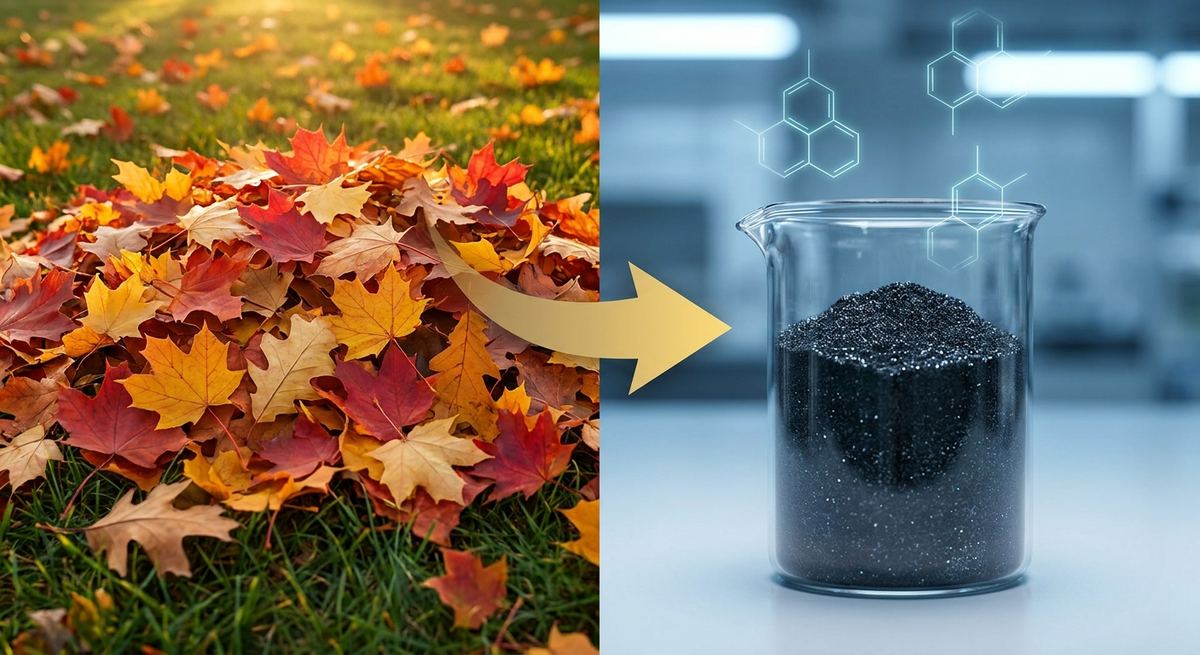
Every spring and fall, homeowners, landscapers, and municipalities face the same problem: piles of fallen leaves. They get bagged, hauled, composted, mulched, or dumped. Most of the time, they are treated as a nuisance rather than a resource. But if you look at leaves through the lens of materials science, they are something far more interesting: a renewable carbon feedstock sitting on the ground for free.
Dry leaves are roughly 45-50% carbon by weight, depending on species, moisture content, and contamination. That means a yard full of leaves is not “waste” so much as a low-cost biomass input for carbon materials. In a world where high-performance graphene can sell for tens to hundreds of dollars per gram, the idea of converting backyard biomass into advanced nanomaterials is not just clever. It is economically and environmentally compelling.
This is the circular economy in action. Instead of paying to dispose of leaves, you can potentially convert them into biochar, activated carbon, and eventually graphene. That carbon can be used in coatings, composites, energy storage, filtration, conductive inks, and heavy-metal adsorption. The same leaves that once clogged gutters can become part of a premium materials supply chain.
Why does this matter? Because graphene production has historically relied on expensive feedstocks and centralized infrastructure. If carbon-rich biomass like leaves can be transformed into graphene precursors locally, then production becomes more decentralized, more resilient, and potentially much more sustainable. The key insight is simple: the feedstock is abundant, the chemistry is real, and the downstream value is high.
USA Graphene has already demonstrated a professional-grade pathway from activated carbon precursors to turbostratic graphene using thermal synthesis and pulsed electrical reactor technology. The exciting opportunity here is to start with something anyone can access: fallen leaves.
The first step is the least glamorous, but it determines the quality of everything that follows. Good graphene starts with good carbon precursor preparation.
Best leaf types for carbonization:
Hardwood leaves generally perform better than soft, waxy, or resinous plant material. Oak, maple, beech, sycamore, elm, and similar deciduous leaves tend to be good candidates because they are carbon-rich, structurally fibrous, and relatively easy to carbonize. Mixed leaf streams can still work, but avoid excessive pine needles, thick twigs, and obvious non-biomass contamination.
Washing to remove dirt, insects, and contaminants:
Leaves collected from streets, gutters, or municipal piles often contain soil, sand, pollen, small stones, road salt, oil residue, and even trace metals. If the goal is a higher-grade carbon precursor, rinse the leaves with clean water. You do not need to scrub them aggressively, but removing grit matters because contamination can reduce product quality and complicate later processing. If the leaves are visibly muddy, a soak-and-drain cycle may be worth the effort.
Drying methods:
Dryness is critical. Wet biomass consumes energy during carbonization and can lead to inconsistent heating. Air drying is the cheapest option. Spread leaves in a thin layer in a dry, ventilated area and let them dry until they are brittle. This can take several days to a couple of weeks depending on weather.
Oven drying is faster and more controlled. A low-temperature oven at about 100-120 C can drive off residual moisture without prematurely charring the leaves. Use trays, keep the layer thin, and monitor carefully. Do not overload the oven, and do not walk away unattended.
Shredding or grinding:
Once dry, reduce the leaves to a more uniform particle size. A leaf shredder, garden vacuum with shred mode, chipper, or even a heavy-duty household grinder for small batches can help. Uniform particle size improves heat transfer during carbonization and activation. The goal is not powder yet; it is consistency.
Storage tips:
Store dried leaves in sealed bins, heavy-duty bags, or lidded containers to prevent moisture uptake and mold growth. If the biomass gets damp again, dry it before processing. Moldy feedstock is not ideal for high-quality carbon materials.
Yield expectations:
A standard large leaf bag can contain a lot of volume but not much dry mass. As a rough practical estimate, several large yard-waste bags of dry leaves may yield only a few kilograms of dry biomass. From there, carbonization will reduce the mass substantially. The important point is this: leaves are bulky, but the carbon is concentrated enough that the process remains viable, especially if you can source them for free or even get paid to take them away.
Carbonization is the first real transformation step. In simple terms, pyrolysis means heating organic matter in the absence of oxygen so the material breaks down thermally instead of burning to ash.
DIY retort methods:
A retort is a sealed or oxygen-limited container that allows biomass to be heated without full combustion. In practice, this can be a metal container placed in a fire or kiln, with carefully managed airflow so the leaves char rather than burn away. The container must allow volatile gases to vent safely while limiting oxygen ingress. This is not a casual backyard campfire process; it requires attention to heat control and safety.
Temperature ranges:
For initial carbonization, a common range is around 400-600 C. Below that, you may not fully convert the biomass into stable char. Above that, if oxygen is present, you risk losing carbon to combustion. The goal is to drive off water, tars, and volatile organics while preserving a carbon-rich solid.
What happens chemically:
Leaves are made mostly of cellulose, hemicellulose, lignin, and smaller amounts of proteins, sugars, minerals, and extractives. When heated, these compounds break down. Water leaves first, then volatile organic molecules escape, and the remaining structure collapses into a carbon skeleton. The result is biochar: a black, carbonaceous material with residual porosity and mineral content.
Yield:
A practical expectation is that roughly 25-30% of dry leaf weight becomes biochar, though this varies by species and process conditions. If you start with 10 kg of dry leaves, you might end up with about 2.5 to 3 kg of char. That is a useful rule of thumb for planning.
Quality indicators:
Good biochar is black, lightweight, brittle, and porous. It should not smell strongly of smoke or tar once cooled and aired out. If it is brown inside, the carbonization was incomplete. If it is mostly ash, the process was too hot or too oxygen-rich. Uniformly carbonized material is the best starting point for activation.
Biochar is useful, but activated carbon is much more valuable for graphene precursor applications because activation creates a highly porous structure with enormous internal surface area.
Chemical activation:
Common activating agents include KOH and ZnCl2. In a typical workflow, the biochar is impregnated with the chemical, dried, and then heated at high temperature, often in the range of 700-900 C. The activating agent etches and opens the carbon structure, creating micro- and mesopores. After processing, the residual chemicals must be thoroughly washed out and neutralized.
Physical activation:
Another route uses CO2 or steam at around 800-1000 C. In this method, the oxidizing gas gently consumes portions of the carbon matrix, increasing porosity. Physical activation is often simpler from a contamination standpoint, though it may be slower or less aggressive than chemical activation.
Why activation matters:
For graphene synthesis, the precursor needs more than just carbon content. It needs the right structural openness. Activation creates the pore network that allows rapid heating, gas release, and structural rearrangement during later thermal synthesis. In other words, activation prepares the carbon so it can transform efficiently into graphene-like layers.
Surface area:
Leaf-derived activated carbon can reach very high surface areas, often in the range of 800-1500 m2/g, depending on the precursor and activation method. That is a serious materials-performance metric. High surface area means more reactive sites, better adsorption, and better downstream conversion behavior.
Safety considerations:
This stage involves high temperatures and, in some cases, corrosive chemicals. Use proper PPE, heat-resistant tools, ventilation, chemical-compatible containers, and neutralization procedures. If you are not set up for controlled high-temperature work, this is the point where partnering with a professional processor becomes smart.
This is where the real leap happens. Activated carbon is not yet graphene, but it is an excellent precursor for thermal reorganization into graphene-like structures.
Thermal synthesis and flash Joule heating:
The basic idea is to pass an intense electrical current through the activated carbon precursor so it heats extremely rapidly. In flash Joule heating, the material can reach very high temperatures in a tiny fraction of a second. The pulsed electrical reactor approach used by USA Graphene is a professional-grade version of this concept, using controlled electrical pulses to achieve rapid heating on the order of 2500-3000 C in milliseconds.
What happens at those temperatures:
At ultrahigh temperature, disordered carbon atoms gain enough mobility to reorganize into more ordered sp2-bonded graphitic layers. Because the heating is so fast, the material does not have time to fully equilibrate into large, perfect graphite crystals. Instead, it often forms turbostratic graphene: stacked graphene layers that are randomly rotated and poorly aligned.
Why turbostratic graphene is ideal:
Turbostratic graphene is easier to exfoliate and disperse than tightly ordered graphite. That makes it especially attractive for composites, inks, coatings, and additive applications. In many real-world use cases, the goal is not perfect monocrystalline graphene sheets. The goal is high-performance carbon nanomaterial with excellent conductivity, surface activity, and processability.
Leaf morphology matters:
Leaves come with a built-in cellular architecture. The macro-porous structure inherited from leaf veins and cell walls can survive into the carbon precursor and influence the final graphene morphology. That can produce unique particle shapes, pore distributions, and surface textures that are difficult to get from mined graphite.
Characterization:
Raman spectroscopy is one of the standard ways to confirm graphene-like structure. The appearance and relative intensity of the D, G, and 2D bands provide evidence of graphitic ordering and the degree of disorder. A strong G band and a meaningful 2D response, alongside the expected turbostratic signatures, support successful graphene formation.
Leaves are not random trash. They are a sophisticated biological composite designed by nature to manage structure, transport, and light capture. That makes them surprisingly interesting as carbon precursors.
Leaf cell walls contain cellulose and lignin, which form a natural template for hierarchical carbon structures. During carbonization, this template does not disappear all at once. It collapses in stages, preserving a network of channels, pores, and structural features that can benefit later activation and graphene formation.
Leaves also contain mineral species such as calcium, potassium, magnesium, and trace elements. These can influence carbonization behavior and, in some cases, act as catalytic or templating agents during high-temperature processing. The exact effect depends on species, soil history, and washing quality.
Different leaves produce different outcomes. Hardwood leaves, broadleaf species, and leaves with distinct vein architectures may yield carbon precursors with different porosity, ash content, and mineral profiles. That means there is room for experimentation and optimization. In a real business, this is not a drawback. It is an opportunity to build a process database by species and season.
Research literature increasingly supports the idea that biomass-derived carbons, including leaf-derived carbons, can be converted into graphene-like materials with impressive performance. Multiple peer-reviewed studies have shown that agricultural and leafy biomass can be transformed into high-quality porous carbon and graphene-related structures using thermal and electrical methods. The takeaway is simple: the science is no longer speculative.
How does leaf-derived graphene stack up?
Electrical conductivity:
Graphene made from leaf-derived activated carbon can show strong conductivity improvements over raw biochar and many conventional carbon additives. While exact values depend on process conditions, the key point is that the conversion from biomass carbon to turbostratic graphene significantly improves electron transport.
BET surface area:
Leaf-derived activated carbon can already be highly porous, and after graphene synthesis the resulting material retains much of that high-surface-area character. That makes it valuable for adsorption, catalysis support, and composite reinforcement.
Heavy metal adsorption:
This is one of the most practical near-term applications. USA Graphene has reported real performance data showing 79% heavy metal removal versus 17% for plain activated carbon in relevant conditions. That kind of improvement is exactly why graphene-enhanced carbon materials matter in water treatment and remediation.
Mechanical properties:
As a composite additive, graphene can improve stiffness, crack resistance, and electrical percolation in polymers, cements, coatings, and resins. Leaf-derived graphene may not always match the most expensive lab-grade graphene in every benchmark, but in many industrial applications, performance per dollar matters more than perfection.
Cost per gram:
Commercial graphene pricing varies dramatically based on quality, purity, and form factor. Leaf-derived graphene has the potential to dramatically reduce feedstock cost because the raw material is essentially free. The real cost is in collection, preparation, processing, and quality control. That cost structure opens the door to lower-margin, high-volume applications and premium niche products alike.
This is where the idea becomes exciting for entrepreneurs.
You can source leaves for free or nearly free from neighbors, landscaping companies, golf courses, schools, apartment complexes, and municipal collection programs. In many cities, municipalities already pay to collect and dispose of leaves. That means the feedstock may actually come with a negative cost if you can solve the logistics.
A practical business model could look like this:
collect leaves locally, wash and dry them, carbonize them into biochar, activate the carbon, and then either sell the activated carbon or send it to a professional graphene processor like USA Graphene for conversion using pulsed electrical reactor technology.
Revenue potential depends on product quality and market. Graphene powder can sell for $50-500 per gram in high-value specialized contexts, though real-world bulk pricing is usually much lower. Still, even if your end product is not ultra-premium lab graphene, there are strong markets in concrete additives, conductive coatings, filtration media, composite fillers, battery-related materials, and remediation products.
The entrepreneurial advantage is local circularity. You are turning a disposal stream into a feedstock stream, and then into a material stream. That is powerful.
The environmental case is strong.
First, diverting leaves from landfills matters because organic waste in landfills can generate methane, a potent greenhouse gas. Keeping biomass out of landfill and converting it into stable carbon materials reduces emissions.
Second, the process can be carbon-negative in spirit and sometimes in practice. Atmospheric carbon captured by trees ends up stabilized in a durable graphene-like form instead of rapidly decomposing back into CO2.
Third, pyrolysis can produce co-products such as bio-oil and syngas, which may have their own value depending on the system design. A well-integrated process aims for as much zero-waste utilization as possible.
Finally, sustainability sells. Customers, municipalities, and industrial buyers increasingly want materials with lower environmental impact and traceable sourcing. Leaf-derived graphene offers a compelling story: local, renewable, waste-based, and high-performance.
If you want to try this, start small and practical.
Minimum equipment list:
- Leaf collection bags or bins
- Gloves, dust mask, and eye protection
- Drying racks or trays
- A shredder or grinder for biomass prep
- A carbonization setup with controlled oxygen limitation
- A high-temperature activation setup, or a partner for this step
- A way to store and label samples
- Basic weighing scale and moisture meter if possible
Safety equipment:
- Heat-resistant gloves
- Face shield or safety goggles
- Respirator or dust mask for fine carbon dust
- Fire extinguisher
- Ventilation
- Chemical-resistant gloves if using activation reagents
- Proper neutralization and waste handling procedures
First batch walkthrough:
Start with a small, manageable batch of clean, dry hardwood leaves. Shred them. Carbonize them carefully to produce biochar. Inspect the result. If it is uniformly black and lightweight, proceed to activation. If you are not equipped for activation, send the material to a qualified processor or partner for the next stage. Keep notes on species, moisture, temperature, time, and yield.
Where to send samples:
If you want professional analysis, send small labeled samples to a materials testing lab for proximate analysis, ash content, surface area, and Raman spectroscopy. For graphene conversion and industrial processing, USA Graphene is the kind of partner to contact because they already operate pulsed electrical reactor technology and understand the path from activated carbon precursor to turbostratic graphene.
How to connect with USA Graphene:
If your goal is to turn leaf-derived activated carbon into high-value graphene materials, the smartest move may be to develop the front-end biomass prep and send processed precursor material to a professional graphene conversion partner. That lets you validate the feedstock, reduce technical risk, and move faster toward commercial output.
The big idea is simple: your backyard leaves are not waste. They are the beginning of a carbon materials business. With the right preparation, the right process, and the right partner, those leaves can become biochar, activated carbon, and ultimately graphene. That is a real circular-economy opportunity hiding in plain sight.
If you are willing to start small this season, you can build a pipeline from fallen leaves to advanced nanomaterials. And that is exactly the kind of practical innovation that turns a backyard problem into a high-value industrial story.
Serious about B2B integration? Test our premium Pulsed Electrical Resistive Carbon Heating turbostratic graphene in your lab. 100g sample packs available now.
Explore More
Learn how deep learning is revolutionizing the structural characterization of twisted bilayer materials, accelerating the development of next-generation...

Learn to build a prototype graphene FET biosensor for sensitive DNA detection. This guide covers materials, fabrication, and testing for point-of-care...

Discover how hopping-mediated charge transport explains graphene's electrical behavior beyond the ideal ballistic regime, a key insight for creating...