
A New Era of Graphene Engineering: Pre-Designing Twist Angles on Demand
Researchers have developed a breakthrough method for growing twisted bilayer graphene with pre-designed angles, a key step toward manufacturable quantum...
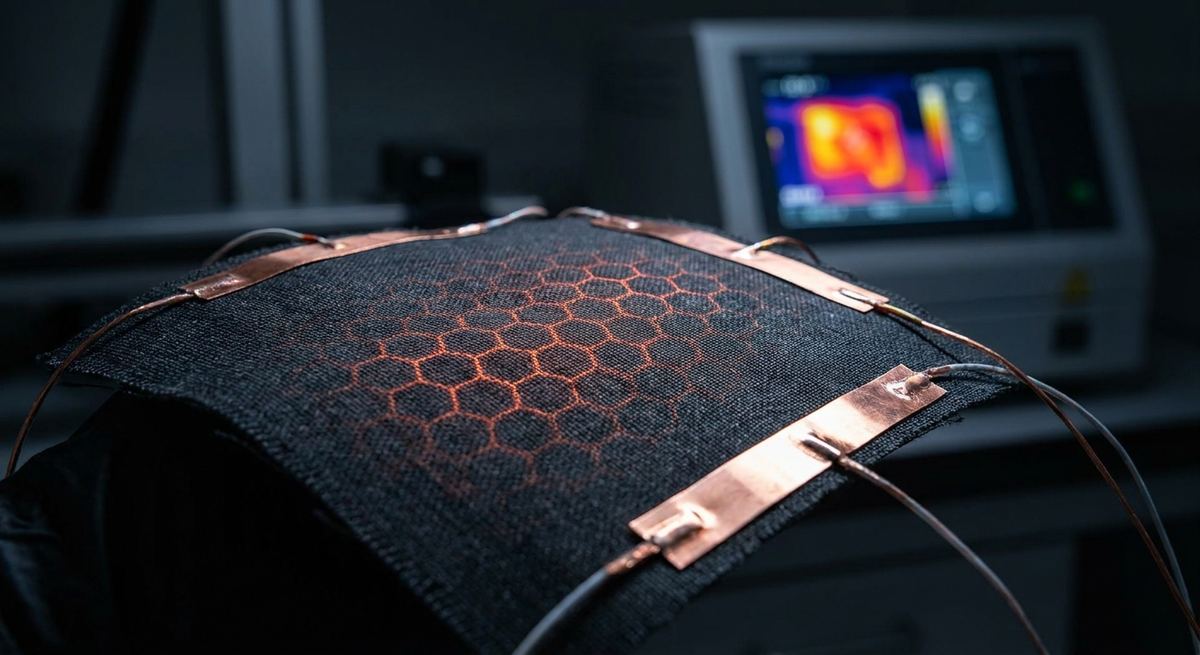
Graphene-infused textiles sit at the intersection of conductive materials, smart textiles, and low-voltage heating. The core idea is simple: disperse graphene into or onto fabric so the textile becomes electrically conductive enough to generate heat when powered, while still remaining flexible, washable, and scalable to manufacture.
Compared with traditional nichrome wire heaters, graphene fabric heaters can be thinner, lighter, more conformable, and easier to integrate into garments or pads. Compared with carbon fiber heater mats, graphene systems can be lower-cost and easier to pattern over large areas. The real advantage, however, is not just conductivity. It is the ability to engineer a fabric that heats uniformly and can self-regulate through the positive temperature coefficient, or PTC, effect.
For commercial development, the most important question is not “Can graphene heat fabric?” It is “How do we make it repeatable, washable, safe, and manufacturable at scale?” That is where infusion methods, sanforization, and polymer-graphene composite design matter.
Suppliers such as USA Graphene, which offers high-quality turbostratic graphene powder, can be useful for fabric infusion and composite formulations because turbostratic graphene tends to disperse and process more easily than many highly ordered graphite-like materials.
There are several practical ways to put graphene into textiles. The best choice depends on the end product, production volume, and whether you need a uniform heating sheet or a patterned conductive circuit.
Dip-coating is the simplest way to prototype. A fabric is immersed in a graphene dispersion, removed, squeezed or wrung to control pickup, then dried. Repeating the cycle builds conductivity.
Practical parameters:
- Graphene concentration: start around 0.5% to 3% by weight in the dispersion for early tests.
- Solvent system: water-based dispersions are safer and cheaper; water plus a small amount of surfactant or binder is common. Alcohol-water blends can improve wetting on hydrophobic fabrics.
- Drying: 60 to 120°C depending on the fabric and binder, for 5 to 20 minutes per cycle.
- Multiple cycles: 2 to 8 cycles are common for prototype heaters.
Dip-coating works best when the graphene is not just deposited loosely on the surface but locked in with a binder or compression process. Without that, wash durability is limited.
Spray-coating is useful when you want more control over layer thickness and pattern coverage. It is especially good for larger panels, localized heating zones, or graded resistance designs.
Practical tips:
- Use a fine HVLP or airbrush-style sprayer for lab work.
- Keep the dispersion well dispersed with agitation to prevent settling.
- Apply multiple light passes rather than one heavy pass to avoid cracking or stiffening.
- Mask zones if you want separate heating regions.
Spray coating is often more uniform than dip-coating for flat textile panels, but the process can be slower for thick or porous fabrics because some material is lost to overspray.
Screen printing is the most production-friendly method when you need defined conductive traces, bus bars, or heating zones. Instead of coating the entire fabric, you print a graphene ink in a pattern.
Benefits:
- Precise geometry
- Good repeatability
- Easy integration with electrodes
- Lower material usage
This method is ideal for:
- Heated seat inserts
- Glove heating zones
- Wearable strips
- Sensor-heater hybrids
The key is ink rheology. The graphene paste must be thick enough to print cleanly but still penetrate the fabric surface enough to anchor to fibers.
Padding, or mangle processing, is the industrial textile route. Fabric passes through a bath of graphene dispersion and then through squeeze rollers that control wet pickup. After that, the fabric is dried and cured.
This is the best method for:
- Roll-to-roll manufacturing
- Uniform treatment over long fabric lengths
- Cost reduction at scale
Typical process logic:
1. Prepare graphene dispersion or printable binder system.
2. Feed fabric through the bath.
3. Use nip rollers to control pickup.
4. Dry and cure.
5. Repeat if needed for target conductivity.
Padding is especially attractive if you want to supply treated yard goods to garment or upholstery manufacturers.
The base fabric matters as much as the graphene formulation.
Cotton:
- Excellent wetting and absorption
- Good for dip and pad processes
- Comfortable for wearables
- Can absorb too much liquid, which may increase stiffness unless binder loading is optimized
Polyester:
- Very common in commercial textiles
- Good dimensional stability
- Less absorbent, so surface treatments and binders are important
- Often excellent for seat covers and technical fabrics
Nylon:
- Strong, flexible, abrasion resistant
- Good for wearables and outdoor products
- Can be harder to wet than cotton
Nonwoven fabrics:
- Very good for pads, blankets, and disposable or semi-disposable heating products
- Easy to impregnate
- Often lower cost
- Less durable in high-abrasion apparel applications
Practical rule:
- For garments: cotton blends, polyester knits, nylon technical fabrics
- For mats and pads: nonwoven polyester or needle-punched structures
- For automotive and industrial use: woven polyester or nylon for durability
Sanforization is a textile finishing process used to reduce shrinkage. Traditionally, fabric is moistened, then mechanically compressed and stabilized using heat, pressure, and often a rubber belt or blanket system. The fabric is deliberately pre-shrunk so it will not change much after consumer washing.
The important part for graphene integration is that sanforization already creates a mechanical environment that can lock materials into the textile structure.
The practical method is to introduce graphene dispersion during the moisture or steam stage of sanforization. The fabric swells as it absorbs moisture, then the mechanical compression step forces graphene particles deeper into the fiber matrix and inter-fiber spaces. As the fabric dries and stabilizes, the graphene becomes physically trapped.
A workable process concept:
1. Pre-clean the fabric.
2. Apply a graphene dispersion during the steam/moisture stage.
3. Pass the fabric through the sanforization compression zone.
4. Dry and cure the fabric so the graphene is fixed in place.
This is not just a surface coating. The compression step helps embed graphene flakes between fibers and, in some cases, into the outer fiber structure itself.
Sanforization causes fiber swelling and compression. When fibers swell, pores open. When compression follows, the structure tightens around the embedded particles. Once dry, the fabric retains a more stable geometry and the graphene is mechanically captured.
This matters because surface coatings are vulnerable to abrasion and washing. By contrast, a sanforized graphene textile can retain conductive pathways much longer because the graphene is not sitting only on top of the surface.
Practical durability expectation:
- Surface-coated fabric: conductivity may degrade after around 10 washes, sometimes sooner depending on binder and abrasion
- Sanforized graphene fabric: conductivity can remain usable through 50+ wash cycles when the formulation and curing are done correctly
Sanforization is already an industrial textile process, so integrating graphene into it is attractive from a business standpoint. You are not inventing an entirely new machine line; you are modifying an established one.
Advantages:
- Roll-to-roll compatibility
- Consistent dimensional control
- Better wash durability
- Easier adoption by textile mills
This is one of the strongest paths to commercial graphene textiles because it combines finishing, shrink control, and conductive material integration in one production step.
This is the most important section for product design.
Self-regulation comes from the positive temperature coefficient effect. In a graphene-polymer composite, the graphene flakes form conductive pathways through the binder and fabric structure. As temperature rises, the polymer matrix expands slightly. That expansion increases the distance between graphene particles and disrupts conductive pathways.
When conductivity drops, resistance rises. With a fixed voltage supply, current falls. Less current means less power dissipation, so heating naturally decreases. The system stabilizes near an equilibrium temperature.
In practical terms:
- Cold heater: low resistance, more current, faster heating
- Warm heater: higher resistance, less current, reduced power
- Stable heater: reaches a balance where heat loss equals heat generation
This is the key safety advantage: the heater tends to self-limit instead of running away thermally.
You can tune the equilibrium temperature by changing several variables.
#### a) Graphene concentration
Higher graphene loading usually lowers resistance and can shift stabilization behavior upward. More conductive networks often support higher current before the PTC breakup becomes dominant.
Low loading:
- Higher resistance
- Lower power
- Lower heat output
High loading:
- Lower resistance
- Higher initial current
- Higher target temperature, within limits
#### b) Fabric density and weave pattern
Tighter weave fabrics improve thermal coupling and can spread heat more evenly. They also influence how well the composite network forms.
Dense weave:
- Better heat distribution
- More stable contact between graphene and fibers
- Faster response
Open weave:
- Lower contact density
- More airflow and heat loss
- Lower equilibrium temperature
#### c) Applied voltage
Voltage is one of the easiest controls. Higher voltage increases power, which shifts the equilibrium temperature upward until self-regulation balances the system.
Typical ranges:
- 5V: wearable, low-power applications
- 12V: automotive and portable pads
- 24V: larger industrial wraps and mats
#### d) Polymer binder selection
The binder is critical. Different binders expand at different rates with heat, which changes the PTC threshold.
Common binder families include:
- Acrylics
- Polyurethanes
- Silicone-based binders
- Latex systems
A softer, more thermally expansive binder often gives stronger self-regulation. A stiffer binder may keep conductivity more stable but reduce PTC response.
#### e) Layer count
Each dip-coat or print cycle adds more conductive material. More layers generally reduce resistance and can shift the heating curve. However, too many layers can reduce flexibility and may weaken the PTC effect if the network becomes too continuous.
A good development approach is to test 2, 4, and 6 layer builds and compare their resistance-temperature curves.
With proper design, graphene fabric heaters can be tuned across a practical range of about 30 to 80°C.
Examples:
- 30 to 40°C: wearable comfort heating
- 40 to 50°C: therapeutic pads and seat warmers
- 50 to 60°C: freeze protection and industrial wraps
- 60 to 80°C: specialized applications with careful insulation and control
Self-regulation reduces the risk of overheating, thermal runaway, and hot spots. That does not mean the product is automatically safe in every form. You still need:
- Fuse protection
- Current-limited power supply
- Good electrode design
- Temperature testing
- Insulation from short circuits
But compared with nichrome wire heaters, the graphene composite approach is inherently more forgiving.
Nichrome wire heaters:
- Fragile under repeated bending
- Can create hot spots
- Needs careful routing and anchoring
- No inherent self-regulation unless paired with electronics
Carbon fiber heaters:
- Good performance
- Flexible
- Often more expensive
- Can be harder to source and pattern economically
Graphene fabric heaters:
- Flexible and lightweight
- Can be made in large sheets
- Can self-regulate through PTC behavior
- Better suited to textile manufacturing
Why it works:
- Low-voltage operation
- Flexible textile form factor
- Comfort heating at 30 to 45°C
A simple prototype can be built for under $500.
Basic materials:
- Graphene powder or dispersion: $40 to $150
- Fabric substrate: $10 to $30
- Binder or polymer medium: $15 to $40
- Copper tape or conductive thread: $10 to $25
- Snap connectors or crimp terminals: $10 to $20
- Small power supply: $15 to $40
- Multimeter: $20 to $40
- IR thermometer or thermal camera access: $20 to $200
- Masking tape, brushes, spray bottle, or small sprayer: $20 to $50
1. Choose the fabric
Use cotton, polyester, or nylon depending on the application. For a first heater, a polyester or cotton-poly blend is a good compromise.
2. Prepare the graphene mixture
Make a water-based dispersion or a printable paste with graphene, binder, and enough solvent to spread evenly. If using high-quality turbostratic graphene powder from a supplier like USA Graphene, start with small test batches and adjust viscosity and loading.
3. Apply the graphene
Use one of these methods:
- Dip-coat for simple prototypes
- Spray-coat for even coverage
- Screen print for patterned heaters
4. Dry and cure
Dry the fabric at a controlled temperature. If the binder requires curing, follow the recommended cure profile.
5. Add electrodes
Attach copper tape along opposite edges of the heating zone, or sew in conductive thread as current collectors. For higher reliability, use snap connectors or crimped terminals at reinforced tabs.
6. Assemble the heater
Sandwich the treated fabric between protective textile layers if needed. This improves durability and reduces direct wear.
7. Connect the power supply
- USB 5V for small wearables and test strips
- 12V for automotive or larger pads
- 24V for industrial wraps and larger heating areas
Copper tape:
- Easy for prototypes
- Good conductivity
- Needs strong mechanical reinforcement
Conductive thread:
- Flexible
- Useful for sewn products
- Higher resistance than copper
Snap connectors:
- Excellent for removable garments and washable products
- Good consumer product option
1. Measure initial resistance at room temperature.
2. Apply power at the intended voltage.
3. Record current draw every 30 to 60 seconds.
4. Measure surface temperature at multiple points.
5. Watch for a rise, then stabilization.
6. Confirm that resistance increases as temperature rises.
7. Test under airflow, under fabric insulation, and under load conditions.
8. Repeat after washing or simulated abrasion.
A good self-regulating sample will show:
- Rapid initial heating
- Slowing temperature rise
- Stable equilibrium
- No dangerous hot spots
A lean startup can begin with:
- Small material inventory
- Basic test equipment
- Simple fabrication tools
- A few prototype SKUs
You do not need a factory to validate demand. Start with samples, photos, performance data, and a narrow product line.
For finished products, pricing should reflect both the technical value and the replacement of traditional wire-based systems.
Possible pricing:
- Small heated pads: $25 to $60
- Heated insoles or gloves: $40 to $100
- Heated seat covers: $60 to $150
- Industrial wraps: priced by size and voltage requirement
For B2B textile supply, pricing can be based on treated yard goods, with premium pricing for wash durability and certified performance.
Etsy:
- Good for handmade wearable and wellness products
- Strong for early validation
Amazon:
- Good for consumer demand at scale
- Requires careful compliance and product photography
B2B to garment manufacturers:
- Best long-term opportunity
- Higher volume
- Requires technical specs, repeatability, and wash test data
The most commercially promising graphene textile heaters are not just coated fabrics. They are engineered textile systems where graphene, binder chemistry, fabric structure, and finishing processes are designed together.
If you want better durability, use sanforization with graphene integration to lock particles into the fiber matrix. If you want safer heating, design around the PTC effect so the fabric self-regulates. If you want scalability, move toward padding, screen printing, or roll-to-roll processing.
For entrepreneurs, the path is straightforward:
- Start with a small prototype
- Test conductivity, temperature, and wash durability
- Tune graphene loading, binder, weave, and voltage
- Build one narrow product with clear demand
- Expand only after performance is repeatable
That combination of textile know-how and graphene engineering is what turns a lab concept into a real product line.
Serious about B2B integration? Test our premium Pulsed Electrical Resistive Carbon Heating turbostratic graphene in your lab. 100g sample packs available now.
Explore More
Researchers have developed a breakthrough method for growing twisted bilayer graphene with pre-designed angles, a key step toward manufacturable quantum...

Learn how deep learning is revolutionizing the structural characterization of twisted bilayer materials, accelerating the development of next-generation...

Learn to build a prototype graphene FET biosensor for sensitive DNA detection. This guide covers materials, fabrication, and testing for point-of-care...