
A New Era of Graphene Engineering: Pre-Designing Twist Angles on Demand
Researchers have developed a breakthrough method for growing twisted bilayer graphene with pre-designed angles, a key step toward manufacturable quantum...
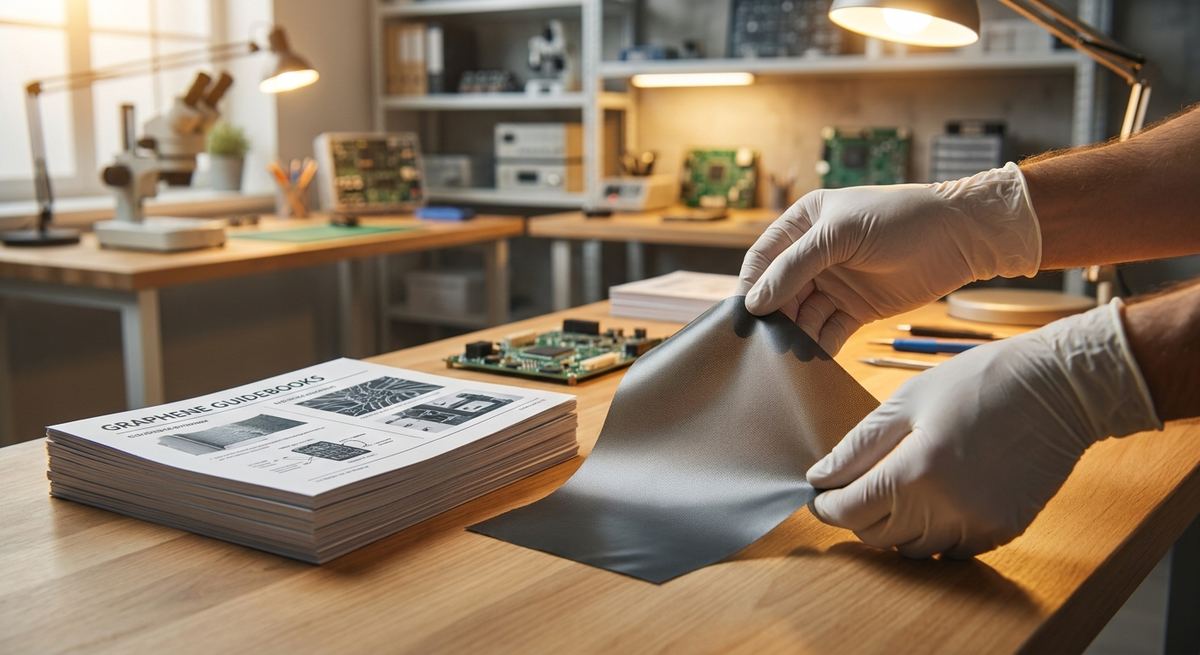
Graphene thermal pads are positioned as a premium alternative to standard silicone thermal pads because they can combine high thermal conductivity, good compressibility, and cleaner long-term performance. In electronics cooling, the real goal is not just a high conductivity number on a datasheet. The material must also fill microscopic air gaps, maintain contact pressure, survive heat cycling, and stay easy to install.
Typical silicone thermal pads used in consumer electronics are rated around 3 to 12 W/mK, with many budget pads landing in the 3 to 6 W/mK range. Premium silicone pads can reach 12 to 15 W/mK, but often become stiffer and harder to compress. Graphene-enhanced pads are commonly marketed in the 15 to 45 W/mK range, though buyers should be careful: some claims are based on lab methods that do not translate directly to real-world system performance. A good practical target for a sellable graphene pad is 12 to 20 W/mK measured by a consistent internal method, with strong compression recovery and low thermal impedance.
What makes graphene attractive is not only conductivity. Graphene fillers can improve heat spreading across the pad surface, helping reduce hot spots on uneven components. In practice, this can matter more than a single conductivity number. For example, on a GPU memory module, the pad must bridge a gap between the memory chip and the heatsink. A pad that is slightly lower in nominal W/mK but conforms better may outperform a stiffer pad with a better spec sheet.
From a business standpoint, graphene gives you a premium story:
- better thermal transfer than standard silicone pads
- better heat spreading for localized hotspots
- premium feel and higher perceived value
- higher gross margin potential
The main challenge is honesty in marketing. If you sell a 20 W/mK pad, you need a believable process and test method to support the claim. Buyers in the PC and IT market are skeptical, especially after years of exaggerated thermal marketing.
The best initial market is not all of electronics cooling. It is specific, visible, and pain-driven use cases.
PC gaming and custom PC building are ideal because buyers already spend on premium cooling:
- GPUs with memory and VRM hotspots
- CPU coolers and direct-die setups
- console mods
- SSD heatsinks
- high-end motherboard VRM cooling
Gamers care about temperatures, noise, stability, and aesthetics. A pad that drops GPU memory temperature by 5 to 10°C can be an easy sell if you show before/after testing. They also buy accessories online and respond well to Amazon listings, YouTube reviews, and Reddit-style community proof.
Data centers and IT departments are a different market. They care less about “graphene” as a buzzword and more about reliability, repeatability, procurement, and documentation. Their pain points are:
- hot-running SSDs and NVMe drives
- edge devices and embedded systems
- telecom gear
- server VRM and power modules
- maintenance standardization
For data centers, the business opportunity is larger but sales cycles are slower. You need:
- datasheets
- lot consistency
- RoHS/REACH awareness
- clear thickness options
- compression and aging data
- professional packaging and traceability
A practical approach is to start with PC enthusiasts, then move into B2B once you have field data and repeatable production.
You can start a small test batch for under $400 if you keep the process simple and focus on one or two SKUs.
A lean starter budget might look like this:
- raw silicone polymer base or thermal pad base material: $60
- graphene or graphite filler blend: $40
- mixing tools, cups, spatulas, scale: $35
- mold sheets or casting frame: $50
- release liners and cutting tools: $25
- silicone mat, rolling pin or press plates: $30
- packaging samples, labels, bags: $40
- basic thermometer and probe: $25
- small clamp press or weights: $60
- shipping and contingency: $35
Total: about $360
This budget assumes a very small pilot line, not industrial manufacturing. At this stage, your goal is to make samples, test them, and validate market demand before buying expensive equipment.
Start with one thickness, ideally 1.0 mm or 1.5 mm, because these are common for GPUs, SSDs, and VRMs. A second SKU at 2.0 mm can come later. Do not launch with too many thicknesses. Too much inventory complexity will kill a small business.
A useful startup target is:
- 1.0 mm pad
- 100 mm x 100 mm sheet
- retail pack with 2 sheets or 4 pre-cut strips
- one premium SKU only
This keeps your manufacturing and packaging manageable.
There are several ways to make thermal pads, but for a small business the most practical method is a cast or calendered silicone-based composite pad with graphene or graphite filler.
Step 1: Define the target specification
Decide your target:
- thermal conductivity: 12 to 20 W/mK
- thickness: 1.0 mm, 1.5 mm, or 2.0 mm
- hardness: medium-soft, around 20 to 40 Shore OO equivalent if you can measure it
- compression: 20 to 35 percent under typical heatsink mounting pressure
- operating temperature: -40°C to 200°C
Step 2: Select materials
Use a silicone elastomer base designed for thermal interface materials. Add graphene, graphite, or a graphene-graphite blend as the conductive filler. In practice, many “graphene” pads use mixed filler systems because pure graphene is expensive and difficult to disperse at high loading. A blend often gives better manufacturability.
A practical blend might be:
- silicone base: 55 to 70 percent
- graphite/graphene filler: 25 to 40 percent
- secondary fillers or coupling agents: 1 to 5 percent
- curing system as required
Step 3: Weigh accurately
Use a digital scale with at least 0.1 g resolution. Filler loading must be consistent batch to batch. Small errors can change viscosity, compression, and final conductivity.
Step 4: Pre-mix filler
Dry mix the conductive powder before adding it to the silicone base. This helps break up clumps and improves dispersion.
Step 5: Blend thoroughly
Mix until the paste is uniform. The mixture should be smooth, without visible dry pockets. Poor dispersion creates weak spots and inconsistent thermal performance.
Step 6: Degas if possible
If you have access to a vacuum chamber, remove trapped air bubbles. Air pockets reduce conductivity and cause uneven thickness. If you do not have a chamber, let the mixture rest and tap the container to release bubbles.
Step 7: Cast into sheets
Spread the compound between release liners using a fixed gap mold, drawdown bar, or flat press plates. For small production, a simple thickness frame is enough. Aim for tight thickness control because buyers care about exact pad thickness.
Step 8: Cure or set
Depending on your base material, cure at room temperature or with mild heat. Follow the material supplier’s recommended cure schedule. Inconsistent curing leads to tackiness, shrinkage, or poor compression recovery.
Step 9: Post-cure and stabilize
Let sheets rest 24 hours before cutting and testing. This helps the material stabilize and gives more reliable thickness readings.
Step 10: Cut and package
Cut into standard sizes:
- 20 x 20 mm
- 30 x 30 mm
- 40 x 40 mm
- 100 x 100 mm sheet
For PC use, pre-cut strips for GPU memory and VRM zones are easier to sell than raw sheets.
Practical thickness guide:
- 0.5 mm: tightly controlled gaps, SSDs, some VRMs
- 1.0 mm: most common enthusiast use
- 1.5 mm: moderate gaps, many GPUs
- 2.0 mm: larger gaps, older hardware, server modules
- 3.0 mm+: only for special cases; compression becomes more important
Compression data matters. A good pad should compress enough to fill the gap but not bottom out or squeeze out excessively. A useful target is 20 to 35 percent compression under typical mounting pressure. If a 1.5 mm pad compresses to about 1.1 to 1.2 mm in service, that is often a good range. Too soft and it may pump out over time; too hard and it won’t make full contact.
You do not need a lab to start, but you do need a repeatable test method.
Best practical methods:
1. Comparative hot plate test
2. CPU/GPU component temperature comparison
3. Simple thermal resistance rig
A basic comparative test can be done with:
- a heated aluminum plate
- a temperature probe on top and bottom
- a controlled clamping force
- identical sample size and thickness
Measure:
- heat source temperature
- cold side temperature
- ambient temperature
- pressure applied
- sample thickness before and after compression
What you want is not only a conductivity number, but thermal resistance under pressure. A pad with 15 W/mK but poor contact may lose to a 10 W/mK pad with better compliance.
Useful performance targets:
- 1.0 mm pad: low thermal resistance, good for tight gaps
- 1.5 mm pad: balanced performance and compliance
- 2.0 mm pad: slightly higher resistance, but useful for uneven surfaces
If you want to publish specs, be careful:
- state test thickness
- state pressure
- state sample size
- state test temperature
- avoid vague “up to” claims without context
For marketing, it is often more credible to say:
“Measured thermal conductivity: 16.2 W/mK under our internal test method at 1.0 mm thickness”
than to claim “45 W/mK” with no explanation.
The best pricing model is premium, not commodity. You are not competing with generic silicone pads. You are selling better performance, better consistency, and better brand trust.
A practical pricing structure:
- production cost per 100 x 100 x 1.0 mm sheet: $1.20 to $2.50 depending on filler and waste
- packaging and fulfillment: $0.60 to $1.50
- total landed cost: $1.80 to $4.00
Retail pricing can be:
- single sheet: $12.99 to $19.99
- 2-pack or 4-pack: $19.99 to $34.99
- pre-cut GPU kit: $24.99 to $39.99
That gives you gross margins in the 65 to 85 percent range before ad spend and platform fees. On Amazon, after fees and advertising, real margins may fall to 25 to 45 percent. Direct sales can be much better.
Premium positioning works best when you emphasize:
- verified performance
- easy installation
- multiple thickness options
- clean-cut packaging
- no mess, no oil bleed, no crumbly texture
- stable performance under heat cycling
Do not price too low. A low price makes buyers assume the pad is generic. Premium thermal products sell on trust and proof.
Gamers buy emotionally, but they still want proof. Your best offer is a simple promise:
lower temperatures, quieter fans, and reliable contact.
For gamers and PC builders:
- show GPU memory temperature reductions
- show compatibility lists for popular cards
- sell kits with enough material for one GPU
- include installation guides and thickness recommendations
A strong product page should answer:
- What thickness should I use?
- Will it fit my GPU?
- How much does it compress?
- Is it electrically insulating?
- Is it reusable?
- Does it dry out?
For IT departments:
- lead with reliability and documentation
- offer bulk packs
- provide datasheets and lot numbers
- include RoHS statements if applicable
- offer sample kits for validation
A practical B2B approach is:
- sell samples to one technician or purchasing manager
- get approval on one device type
- expand to multiple sites
- offer annual supply contracts
The key is to avoid sounding like a hobby product. For B2B, you are a materials supplier.
Amazon FBA is useful for demand capture and trust, but it has high fees and intense competition.
Amazon FBA advantages:
- built-in traffic
- easy Prime shipping
- faster consumer trust
- good for low-friction purchases
Amazon FBA disadvantages:
- referral and fulfillment fees
- ad costs
- review pressure
- listing competition
- returns and packaging damage
Direct sales advantages:
- higher margins
- better customer data
- easier bundling
- better B2B relationships
- more control over branding
A practical strategy is hybrid:
- use Amazon for consumer discovery
- use your own website for education, bundles, and repeat sales
- use direct outreach for IT and industrial accounts
Example unit economics:
- Amazon retail price: $19.99
- product cost: $2.50
- FBA and referral fees: $6.50 to $8.50
- ad spend: $2.00 to $4.00
- net profit: about $4.00 to $8.00 per unit
Direct-to-consumer:
- retail price: $19.99
- product cost: $2.50
- shipping and packaging: $2.50 to $4.00
- payment fees: $0.80
- net profit: about $10 to $13 per unit before ads
For thermal pads, photography matters more than many founders expect. Buyers cannot easily see conductivity, so they judge by presentation and trust.
Use these image types:
- clean hero shot on white background
- close-up showing texture and thickness
- comparison with a ruler or caliper
- installation on GPU, SSD, or heatsink
- temperature graph or before/after result
- packaging and included accessories
Best marketing angles:
- “premium graphene thermal pad”
- “high-compliance electronics cooling pad”
- “ideal for GPU memory, VRM, SSD, and server modules”
- “easy-cut, non-messy, electrically insulating”
Avoid overclaiming. A credible brand beats a hype brand in this category.
Short-form video is powerful:
- show cut-to-fit installation
- show a temperature drop test
- show compression under a heatsink
- show clean removal and reuse if applicable
Once your consumer product is stable, the real scale may come from server and industrial cooling.
Good next markets:
- enterprise SSDs
- telecom equipment
- industrial controllers
- LED power modules
- EV-related low-voltage electronics
- edge AI systems
- server VRM and memory cooling
These customers care about:
- thickness tolerance
- long-term stability
- thermal cycling
- low outgassing
- supply consistency
- documentation and traceability
For industrial markets, you may need:
- tighter thickness tolerances, such as ±0.1 mm or better
- lot coding
- custom die-cut shapes
- larger sheet sizes
- higher-volume pricing tiers
A useful business path is:
1. validate with PC enthusiasts
2. build proof through reviews and test data
3. offer sample packs to technicians
4. develop one or two industrial SKUs
5. move into custom die-cut and contract manufacturing
Profit margins can improve with scale. Consumer retail may deliver 25 to 45 percent net margins after fees, while direct B2B supply can reach 40 to 60 percent gross margins if your production is efficient and your customer acquisition cost is low.
The most important lesson is that graphene thermal pads are not just a material product. They are a trust product. If you can prove performance, maintain thickness consistency, and package the product professionally, you can build a strong niche brand with relatively low startup capital.
Serious about B2B integration? Test our premium Pulsed Electrical Resistive Carbon Heating turbostratic graphene in your lab. 100g sample packs available now.
Explore More
Researchers have developed a breakthrough method for growing twisted bilayer graphene with pre-designed angles, a key step toward manufacturable quantum...

Learn how deep learning is revolutionizing the structural characterization of twisted bilayer materials, accelerating the development of next-generation...

Learn to build a prototype graphene FET biosensor for sensitive DNA detection. This guide covers materials, fabrication, and testing for point-of-care...