
Graphene Sensors and a New Method for Dark Matter Detection
Researchers propose a new method for dark matter detection using angular scanning, a technique that may rely on graphene's unique electronic sensitivity.
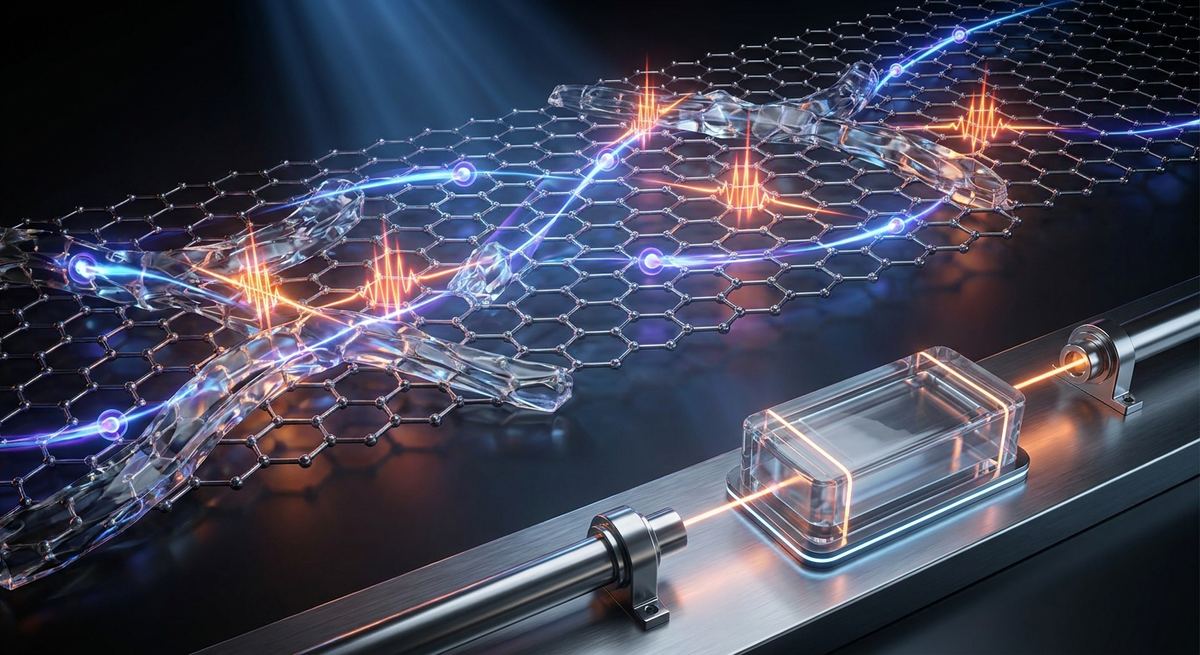
High harmonic generation (HHG) in solids has emerged as a powerful probe of ultrafast quantum dynamics, enabling the conversion of intense near-infrared or mid-infrared laser fields into coherent radiation at integer multiples of the driving frequency. In contrast to gas-phase HHG, where recollision physics dominates, solid-state HHG is governed by the coupled motion of electrons within the band structure, interband polarization, and strong-field transport across the Brillouin zone. This makes condensed matter an attractive platform for compact coherent extreme-ultraviolet sources, ultrafast spectroscopy, and control of electronic wave packets on attosecond-to-femtosecond timescales.
Graphene occupies a special position in this field. As a two-dimensional semimetal with linear Dirac dispersion near the K and K' points, vanishing band gap, exceptionally high carrier mobility, and strong optical response over a broad spectral range, graphene is both scientifically fundamental and technologically relevant. Its electronic structure is simple enough to permit analytical insight, yet rich enough to host nonlinear light-matter interactions that are highly sensitive to symmetry, doping, disorder, and many-body effects. These properties make graphene an ideal testbed for understanding HHG in a truly quantum material.
A recurring assumption in HHG theory is that phonons can be neglected because their characteristic timescales are slower than the sub-femtosecond motion of electrons driven by intense optical fields. This assumption is often reasonable for identifying the primary electronic pathways, but it becomes questionable in materials like graphene, where electron-phonon coupling is strong, optical phonons are high in energy, and lattice symmetry strongly constrains nonlinear current generation. The central question is not whether phonons move on attosecond timescales, but whether their presence modifies the phase, coherence, and symmetry of the electronic response that generates harmonics.
Graphene’s honeycomb lattice gives rise to two sublattices and massless Dirac quasiparticles near the low-energy nodes. The absence of a band gap allows strong interband excitation even at modest field strengths, while the chiral nature of the wave functions produces selection rules distinct from those in conventional semiconductors. Under strong driving, carriers are accelerated through the Brillouin zone and undergo repeated interband transitions, generating nonlinear intraband and interband currents that radiate harmonics.
In pristine graphene, the idealized electronic picture suggests robust HHG extending to relatively high orders because the carrier dynamics are highly nonlinear and the band structure is symmetric. However, experiments have shown that the harmonic spectrum is often weaker than expected, and emission above roughly 3 eV can be difficult to observe. This discrepancy indicates that additional degrees of freedom, beyond electrons and photons, influence the coherence of the strong-field response. Optical phonons are a natural candidate because they couple efficiently to the electronic current and are strongly activated in graphene even at room temperature through zero-point fluctuations and thermal occupation.
Graphene’s optical phonons, especially the in-plane modes near the Brillouin-zone center and edge, are energetically large compared with acoustic phonons and can interact strongly with electronic motion. Although their quantum oscillation period is longer than the driving optical cycle, their effect on HHG can still be profound if they alter the phase evolution of interband polarizations or introduce shot-to-shot fluctuations in the current emitted under a laser pulse. In this sense, phonons need not be fast to be influential; they only need to be coupled strongly enough to reshape the electronic trajectories responsible for harmonic emission.
The theoretical framework considered here treats optical phonons in the static limit. In this approach, the lattice is frozen on the timescale of electron dynamics, and HHG is calculated by sampling thermally occupied phonon configurations and averaging the resulting electronic responses over the ensemble. This is a powerful approximation for ultrafast phenomena because it isolates the effect of lattice disorder and thermal fluctuations without requiring explicit time evolution of phonon coordinates during the laser pulse.
The static picture is especially appropriate when the driving field acts on a timescale much shorter than the phonon period, as is typical for few-cycle or subcycle pulses used in HHG experiments. Under these conditions, the phonon field behaves as a quasi-static perturbation to the electronic Hamiltonian. Each phonon configuration modifies the instantaneous band energies, matrix elements, and phase accumulation of the electronic wave function. The observed harmonic spectrum is then the coherent sum of many such trajectories. If the phase acquired in each configuration differs significantly, the ensemble average can suppress harmonic emission by destructive interference.
This mechanism is fundamentally different from simple energy relaxation. It is a dephasing process arising from fluctuations in the electron-phonon coupling landscape. In graphene, where the electronic response is highly phase-sensitive due to the Dirac structure and symmetry constraints, even static phonon disorder can dramatically alter harmonic yields. The important insight is that the timescale of the phonon does not have to compete with the optical cycle directly; the relevant quantity is the statistical distribution of phonon-induced electronic phases.
The most striking result is that optical phonons strongly suppress HHG in graphene. They couple to interband currents and scramble the phase of the emitted harmonics, leading to destructive interference when the response is ensemble-averaged over phonon configurations. This suppression is not a minor correction. It provides a natural explanation for why experimentally observed harmonics in graphene often fade above a few electronvolts, despite the expectation from purely electronic models that stronger emission should persist to higher orders.
The underlying physics can be understood by separating the harmonic signal into amplitude and phase contributions. The amplitude reflects the strength of the induced current, while the phase determines whether currents from different microscopic realizations add constructively or destructively. Optical phonons shift the local electronic environment and therefore the phase of interband coherence. Because HHG relies on coherent recombination of electron-hole wave packets, phase randomization is especially damaging. A small distribution of phonon-induced phase shifts can wash out a large harmonic response if the emission is built from many interfering pathways.
In graphene, the effect is amplified by the symmetry and topology of the Dirac bands. Strong-field excitation near the Dirac points produces interband polarization that is highly sensitive to perturbations. Optical phonons modify the effective coupling between the laser field and the pseudospin texture of the bands, thereby altering the current waveform and the harmonic spectrum. The result is a pronounced reduction in yield, not simply a broadening of spectral lines. This offers a consistent microscopic explanation for the experimentally observed limitation in high-energy harmonic emission.
Because the static-limit formalism samples thermally occupied phonons, HHG in graphene becomes temperature dependent. Increasing temperature broadens the distribution of phonon configurations and enhances dephasing, leading to further suppression of harmonic yields. However, in graphene this temperature dependence is relatively weak. The reason is that the relevant phonon energy scales are already dominated by zero-point motion, so thermal occupation adds only a modest correction to the quantum fluctuations present even at low temperature.
This behavior is important because it distinguishes graphene from materials in which phonon occupation changes strongly across accessible temperatures. In graphene, the optical phonon contribution to HHG is not primarily a thermal effect but a quantum-lattice effect. Even at low temperature, the lattice is not silent: zero-point fluctuations already generate enough phase disorder to influence the nonlinear optical response. As a result, the harmonic spectrum is intrinsically linked to the quantum nature of the lattice, not just to classical thermal vibrations.
From an experimental perspective, this weak temperature dependence means that improving harmonic yield in graphene by cryogenic cooling alone may have limited effectiveness. Instead, strategies that reduce electron-phonon coupling, modify substrate interactions, tune carrier density, or engineer strain to alter phonon symmetry may be more effective. This has direct implications for graphene-based nonlinear photonic devices, where robust harmonic generation is desired under realistic operating conditions.
A major challenge in strong-field solid-state physics is the so-called dephasing time problem: what is the relevant coherence time governing interband motion under intense driving? The present analysis indicates that optical phonons dephase interband coherences in graphene at a rate equivalent to T2 approximately 5.7 fs, substantially faster than typical electron-electron scattering times. This suggests that thermal phonons, rather than carrier-carrier collisions, may dominate decoherence in graphene under strong optical fields.
This conclusion is significant because many phenomenological HHG models introduce dephasing times as adjustable parameters. If the dominant decoherence channel is phononic and effectively static on the optical timescale, then the coherence time should not be treated as an arbitrary fit parameter but as a material-specific quantity rooted in electron-phonon interactions. Graphene thus provides a concrete case where the dephasing time can be linked to microscopic lattice fluctuations.
The ultrafast T2 scale also affects the interpretation of attosecond experiments. In graphene, the electronic wave packet may be launched and partially dephased within only a few femtoseconds, limiting the buildup of long-lived interband polarization. This short coherence time suppresses high-order harmonics and can reshape the temporal structure of the emitted bursts. Therefore, phonon-induced dephasing is not merely a background effect; it is a central determinant of the nonlinear optical output.
Another important consequence of optical phonons is the smoothing of HHG ellipticity-dependent curves. In a purely electronic picture, harmonic emission as a function of laser ellipticity can be sharply structured, reflecting the symmetry of the band structure and the selection rules for interband and intraband currents. However, phonon-induced phase averaging softens these features, producing smoother ellipticity dependence and improved agreement with experimental data.
This is particularly relevant for graphene, where the response to circularly or elliptically polarized fields is sensitive to the interplay between pseudospin dynamics and lattice symmetry. The static phonon ensemble effectively averages over local perturbations that blur the sharpness of the ideal response. The resulting harmonic signal better matches observations, indicating that real graphene samples are governed by a more complex environment than the idealized lattice alone.
The smoothing of ellipticity dependence has practical importance. Ellipticity-resolved HHG is often used to infer microscopic mechanisms, such as whether intraband acceleration or interband recombination dominates the emission. If phonons are ignored, one may incorrectly attribute smooth experimental curves to electronic scattering or disorder. The present results show that optical phonons can produce similar signatures even in otherwise clean graphene, emphasizing the need for lattice-aware modeling.
A remarkable aspect of the results is that the main phonon effects are timescale-independent in the sense that they arise from the static electron-phonon landscape rather than from explicit phonon dynamics. This makes the conclusions transferable to attosecond phenomena more broadly. Whether the observable is HHG, transient currents, Floquet band engineering, or ultrafast photocurrent generation, the same basic mechanism applies: phonons modify electronic phases and coherence even when they do not evolve appreciably during the pulse.
This transferability is especially valuable for graphene because the material is often used as a benchmark system for nonequilibrium quantum dynamics. If optical phonons already influence HHG through static disorder averaging, they are likely to affect other strong-field processes as well. For example, Floquet gaps induced by periodic driving could be partially masked or broadened by phonon-induced phase fluctuations. Similarly, photocurrents generated by broken symmetry or polarization shaping may be reduced or altered by the same dephasing channels.
The broader message is that ultrafast does not mean phonon-free. In graphene, the lattice acts as a quantum environment that imprints itself on the electronic response even when the pulse duration is far shorter than the phonon oscillation period. This insight bridges the gap between attosecond physics and condensed-matter decoherence.
Understanding HHG in graphene has implications beyond a single material. Graphene is a canonical two-dimensional conductor, a platform for ultrafast optoelectronics, and a building block for van der Waals heterostructures. Its strong sensitivity to optical phonons implies that device designs targeting coherent nonlinear emission must account for lattice-induced dephasing from the outset. In practical terms, this affects the development of graphene-based frequency converters, on-chip harmonic sources, and ultrafast detectors.
At the scientific level, the results clarify why simple electronic models can overestimate harmonic yields and misidentify the dominant decoherence mechanism. They also show that phonons are not merely a source of heating or long-time dissipation; they are active participants in the coherent strong-field response. This understanding is likely relevant to other low-dimensional materials with strong electron-phonon coupling, including transition metal dichalcogenides, topological semimetals, and moiré systems.
For graphene specifically, the findings suggest routes for control. Substrate engineering, strain, isotopic purification, electrostatic doping, and encapsulation may all influence optical phonon coupling and thus HHG efficiency. Because graphene is already central to flexible electronics, photonics, and sensors, any improvement in coherence and harmonic output could be technologically significant. Conversely, the sensitivity of HHG to phonons could be exploited as a diagnostic tool for lattice temperature, disorder, and electron-phonon coupling strength.
Ultrafast electron-optical-phonon interactions play a decisive role in high harmonic generation from graphene. Using a static-limit formalism that samples thermally occupied phonons and ensemble-averages the electronic response, one finds that optical phonons strongly suppress harmonic yields through phase scrambling and destructive interference, help explain the lack of experimentally observed harmonics above about 3 eV, introduce temperature dependence dominated by zero-point motion, and dephase interband coherences on a timescale equivalent to T2 around 5.7 fs. They also smooth ellipticity-dependent HHG curves, bringing theory into closer agreement with experiment.
These effects are not contingent on explicit phonon dynamics during the laser pulse. Instead, they arise from the static electron-phonon landscape and are therefore relevant to attosecond and femtosecond phenomena alike. For graphene, a material celebrated for its exceptional electronic transport and optical properties, the results underscore a central lesson: coherent strong-field dynamics cannot be understood without the lattice. Optical phonons are not spectators in HHG; they are key agents shaping the nonlinear optical signature of graphene and, by extension, the future of ultrafast solid-state photonics.
Serious about B2B integration? Test our premium Pulsed Electrical Resistive Carbon Heating turbostratic graphene in your lab. 100g sample packs available now.
Explore More
Researchers propose a new method for dark matter detection using angular scanning, a technique that may rely on graphene's unique electronic sensitivity.

Build a flexible graphene battery sensor for real-time temperature and strain monitoring, a crucial step toward preventing thermal runaway in Li-ion cells.

Research on 30° quasi-periodic twisted bilayer graphene reveals a unique, fractal-like energy structure under magnetic fields, paving the way for novel...