
A New Era of Graphene Engineering: Pre-Designing Twist Angles on Demand
Researchers have developed a breakthrough method for growing twisted bilayer graphene with pre-designed angles, a key step toward manufacturable quantum...
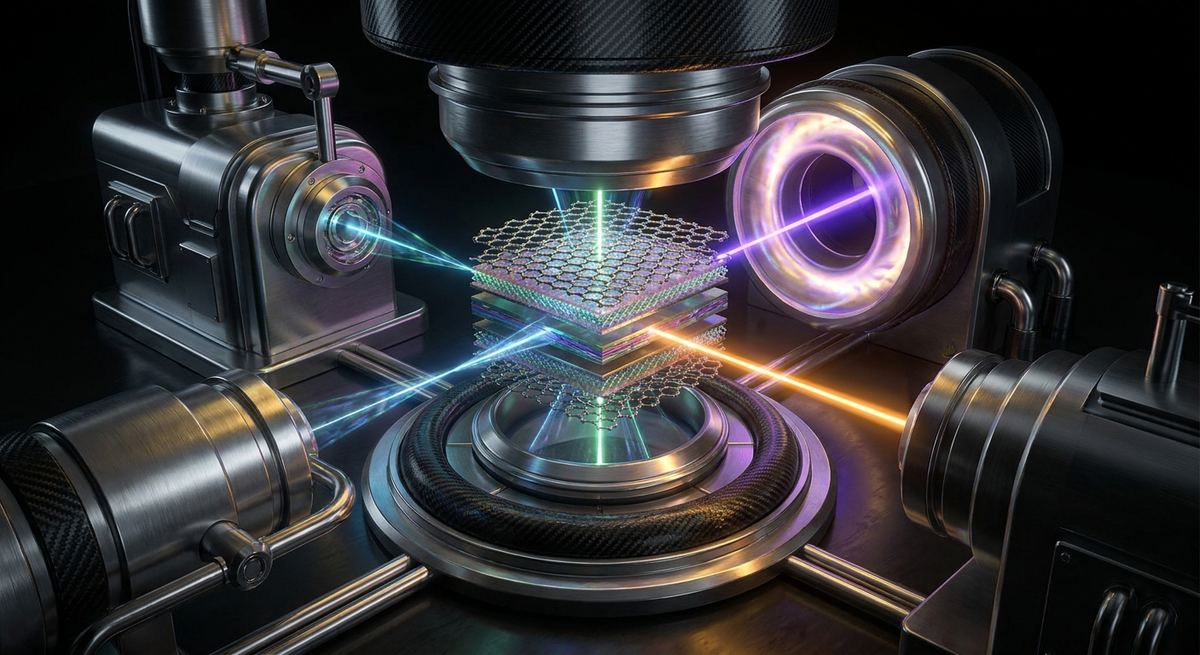
High-order harmonic generation (HHG) is the nonlinear up-conversion of electromagnetic radiation into integer multiples of the driving frequency. In solids, HHG has emerged as a powerful probe of ultrafast carrier dynamics, band topology, and symmetry-breaking interactions because the harmonic spectrum encodes both electronic structure and light–matter coupling pathways. At terahertz (THz) frequencies, harmonic generation is especially attractive: conventional solid-state sources struggle to access the spectral region between microwave electronics and infrared photonics, while nonlinear frequency conversion can bridge this gap using compact platforms.
The harmonic order that appears in a given material is strongly constrained by symmetry. In centrosymmetric media, the electric-dipole response forbids even-order nonlinearities in the bulk, so odd harmonics dominate. When inversion symmetry is broken, even harmonics become allowed. This principle has been clearly demonstrated in graphene, where strong THz-driven HHG yields primarily odd multiples of the pump frequency because the lattice is centrosymmetric. Topological insulators (TIs) offer a more complex setting. Their bulk is insulating with inverted band ordering due to strong spin-orbit coupling, while their surfaces host conducting states protected by time-reversal symmetry. Since the bulk and surface possess different symmetry environments, they can contribute distinct nonlinear responses, potentially enabling both odd and even harmonic generation.
Experimentally isolating these contributions is challenging because the surface states are only a few nanometers thick and are embedded within a much larger bulk volume. A promising route is to place TI thin films into van der Waals metamaterial architectures that enhance the local THz field and tailor symmetry at the unit-cell level. Split-ring resonators, especially single and double split-ring designs, can concentrate incident THz radiation into subwavelength gaps and resonant loops, amplifying the driving field experienced by the TI layer. When Bi2Se3 or (InxBi1-x)2Se3/Bi2Se3 heterostructures are integrated into such resonators, the resulting platform can generate harmonics in the 6.4 THz even and 9.7 THz odd frequency range, revealing the coexistence of bulk centrosymmetric and surface-induced symmetry-broken nonlinearities.
Topological insulators are quantum materials characterized by an insulating interior and metallic boundary states. In canonical three-dimensional TIs such as Bi2Se3, Bi2Te3, and Sb2Te3, strong spin-orbit coupling inverts the band order near the Brillouin-zone center. This inversion produces helical Dirac-like surface states with spin-momentum locking, protected against backscattering by time-reversal symmetry. The surface electronic structure is therefore qualitatively different from the bulk, and this distinction is central to nonlinear optical behavior.
Van der Waals heterostructures extend the TI platform by stacking atomically thin layers with weak interlayer bonding. In (InxBi1-x)2Se3/Bi2Se3 systems, compositional tuning modifies the bandgap, carrier density, and structural symmetry while preserving strong spin-orbit coupling. Such heterostructures can be engineered to create interfaces with reduced inversion symmetry, altered dielectric screening, and modified surface state penetration depths. Because the nonlinear optical response depends sensitively on symmetry and carrier dynamics, these materials are ideal for exploring harmonic generation at THz frequencies.
From a materials perspective, TI thin films offer several advantages. First, the thickness can be made comparable to or smaller than the optical skin depth, ensuring that the surface contribution is not completely masked by bulk absorption. Second, the layered nature of the crystal allows integration with metamaterial resonators without severe lattice mismatch. Third, the electronic response can be tuned through doping, thickness control, and heterostructure design, enabling systematic investigation of the crossover from bulk-dominated to surface-dominated nonlinearities.
The nonlinear polarization induced by an electromagnetic field can be expanded as
P = ε0(χ(1)E + χ(2)E^2 + χ(3)E^3 + ...),
where χ(n) is the nth-order susceptibility. In a centrosymmetric medium, inversion symmetry requires P(E) = -P(-E), which eliminates even-order susceptibilities in the electric-dipole approximation. As a result, second harmonic generation (SHG) is forbidden in the bulk, while third harmonic generation (THG) and higher odd orders remain allowed. If inversion symmetry is broken, χ(2) becomes nonzero and SHG can occur.
For TIs, the symmetry picture is subtle. The bulk crystal structure of Bi2Se3 is globally centrosymmetric, so bulk SHG is expected to be weak or absent. However, the surface breaks inversion symmetry intrinsically because the crystal terminates at a boundary. The surface state itself is not merely a geometric boundary condition; it is a topological electronic phase with a distinct nonlinear susceptibility tensor. Consequently, SHG can arise from the surface even when the bulk remains centrosymmetric. THG, by contrast, may originate from both bulk and surface channels. This coexistence makes harmonic spectra a sensitive fingerprint of topological and symmetry-related electronic processes.
The generation of harmonics in the THz regime is further influenced by the driving field strength. At sufficiently high fields, nonlinear intraband motion, interband tunneling, and Berry-curvature-related anomalous velocities can all contribute. In TIs, spin-orbit coupling and the Dirac-like dispersion of surface states may enhance these effects. The relative phase and amplitude of the harmonics depend on carrier relaxation, resonance with electronic transitions, and the orientation of the crystal with respect to the pump polarization.
Metamaterials provide an artificial route to amplify local fields and engineer nonlinear optical interactions. Split-ring resonators are archetypal metamaterial elements consisting of metallic loops with narrow gaps that support LC resonances. When illuminated by THz radiation, strong circulating currents and gap-localized electric fields are produced. These resonances can increase the effective drive field inside an embedded nonlinear medium by orders of magnitude relative to the incident wave.
Single split-ring resonators are particularly effective at concentrating the electric field in one gap, while double split-ring resonators can support multiple coupled resonances and more complex mode profiles. The geometry determines the resonance frequency, quality factor, polarization sensitivity, and field distribution. When a TI film or heterostructure is placed within or near the gap region, the enhanced local field drives strong nonlinear polarization in the material. Since harmonic generation scales nonlinearly with the field amplitude, even moderate enhancement can dramatically increase the output signal.
This resonant enhancement is crucial for TI-based HHG because the intrinsic nonlinear coefficients of thin-film TIs are typically modest in the THz range. The metamaterial acts as a transducer that converts a weak free-space pump into a concentrated near field. At the same time, the resonator breaks spatial uniformity, which can relax selection rules and facilitate coupling to modes that are otherwise symmetry-forbidden. In this sense, the metamaterial is not merely a passive amplifier; it participates actively in shaping the nonlinear selection rules and radiation pattern.
SHG in topological insulator-based metamaterials is especially informative because it directly probes inversion symmetry breaking. In a bulk centrosymmetric TI such as Bi2Se3, SHG from the interior should be suppressed. Any observed second harmonic signal must therefore arise from surface states, interfaces, defects, strain, or resonator-induced symmetry breaking. In a carefully designed van der Waals metamaterial, the dominant SHG channel is often attributed to the topological surface states because they are intrinsically noncentrosymmetric and can support a nonlinear current at 2ω.
The surface SHG process can be understood in terms of the nonlinear response of Dirac fermions. Under a THz drive, surface carriers are accelerated along the helical dispersion, and the resulting current contains even-order components when inversion symmetry is absent. Spin-momentum locking can further modify the tensor structure of χ(2), making the SHG output polarization-dependent. As a result, rotating the pump polarization or sample orientation changes the second harmonic intensity, providing a diagnostic of surface-state symmetry.
In (InxBi1-x)2Se3/Bi2Se3 heterostructures, the interface may enhance SHG by introducing additional inversion asymmetry and modifying band bending. The compositional layer can act as a symmetry-breaking overlayer that shifts the chemical potential, alters screening, and changes the occupancy of topological surface channels. When combined with resonant field enhancement from a split-ring resonator, the SHG signal can become strong enough to detect in the 6.4 THz range. The appearance of a robust even harmonic in such a system is a key signature that the nonlinear response is not purely bulk-derived.
THG is expected more generically than SHG because it is allowed in centrosymmetric media. In TIs, third harmonic emission can arise from several mechanisms. The bulk electronic states contribute through intraband nonlinearities, especially when the THz field drives carriers across a nonlinear dispersion relation. Interband polarization can also contribute if the pump frequency approaches relevant energy scales or if resonant enhancement is present. Surface states additionally contribute via nonlinear transport in the Dirac cone.
Because THG is symmetry-allowed in the bulk, it often provides a stronger baseline signal than SHG. However, in topological materials the third harmonic can still carry topological information. The Berry curvature, band inversion, and spin texture can all influence the magnitude and phase of the third-order response. In a TI thin film, the bulk THG may coexist with a surface THG channel, and the two can interfere constructively or destructively depending on thickness, carrier density, and field orientation.
The observation of a 9.7 THz odd harmonic in TI-based van der Waals metamaterials is consistent with this picture. Since odd harmonics are permitted by the bulk centrosymmetry, the third harmonic signal can be interpreted as arising from the combined action of centrosymmetric bulk states and topological surface states. The metamaterial resonance enhances the drive field sufficiently to push the system into a nonlinear regime where third-order processes become measurable in the far-field emission.
A major challenge in TI nonlinear optics is disentangling bulk and surface contributions. Several experimental observables can help. Thickness dependence is one of the most direct: surface contributions scale approximately with area, while bulk contributions scale with volume. As the TI film becomes thinner, the relative importance of the surface should increase. Polarization dependence is another key diagnostic because surface-state symmetry differs from that of the bulk lattice. Rotating the pump polarization relative to the crystallographic axes can reveal tensor components associated with the surface.
Temperature dependence can also be informative. Surface states in TIs are robust against moderate temperature changes, whereas bulk carrier populations and phonon-assisted processes may vary more strongly. Likewise, electrostatic gating or chemical doping can shift the Fermi level and selectively enhance or suppress surface conduction. If SHG persists under conditions where bulk absorption is reduced, that supports a surface origin. Conversely, a THG component that scales with carrier density may indicate dominant bulk intraband dynamics.
In metamaterial architectures, the spatial profile of the resonant near field adds another layer of complexity. Since the field is strongest near the resonator gaps and edges, the local symmetry environment may differ from the average crystal symmetry. Careful electromagnetic modeling is therefore necessary to separate genuine material nonlinearities from geometric artifacts. Nonetheless, the coexistence of even and odd harmonics in a TI-based resonator system is itself significant, because it reflects the interplay of centrosymmetric bulk response and symmetry-broken surface response.
The reported up-conversion into 6.4 THz even and 9.7 THz odd spectral components can be understood as harmonic emission from a resonantly driven nonlinear medium. The even harmonic is naturally associated with SHG from the surface or interface, where inversion symmetry is broken. The odd harmonic, especially the third harmonic, is consistent with bulk centrosymmetric nonlinear response supplemented by surface contributions.
The specific frequencies depend on the pump frequency and resonator design. If the fundamental lies in the THz region, the second and third harmonics fall into adjacent THz windows that are accessible to standard THz detectors. The resonator not only enhances the local field but can also spectrally filter the emission, favoring certain harmonic orders through mode matching. In this way, the metamaterial acts as a harmonic-selective antenna.
The coexistence of even and odd harmonics in a single platform provides strong evidence that the nonlinear source is not a conventional centrosymmetric semiconductor alone. Instead, the output reflects the topological character of the embedded TI film, where surface states contribute even-order processes and the bulk supports odd-order processes. This duality is a hallmark of topological insulator optics and is difficult to reproduce in ordinary materials lacking protected surface channels.
TI-based van der Waals metamaterials open a route to compact THz nonlinear devices. Potential applications include frequency multipliers, tunable THz sources, ultrafast detectors, and symmetry-sensitive spectroscopic probes. Because the harmonic response depends on topology, such devices may also serve as sensors for surface degradation, interface quality, and symmetry breaking induced by strain or gating.
From a broader perspective, these systems provide a testbed for nonlinear topological photonics. They enable exploration of how protected electronic states interact with strong fields, how Berry-phase physics affects harmonic spectra, and how metamaterial resonances can be used to control quantum materials at THz frequencies. Future work will likely focus on separating surface and bulk channels more quantitatively, optimizing resonator geometry for higher conversion efficiency, and extending the approach to other topological phases such as Weyl semimetals and magnetic TIs.
The central scientific advance lies in the convergence of three ingredients: topological surface states, centrosymmetric bulk electronic structure, and resonant metamaterial field enhancement. Together they create a nonlinear optical platform in which SHG and THG are not merely higher-order spectral byproducts, but direct probes of symmetry, topology, and interfacial electronic structure. This makes TI-based van der Waals metamaterials a compelling platform for both fundamental studies and THz photonic technologies.
Second and third harmonic generation in topological insulator-based van der Waals metamaterials arises from the interplay of symmetry, topology, and resonant electromagnetic enhancement. In Bi2Se3 and (InxBi1-x)2Se3/Bi2Se3 heterostructures integrated with split-ring resonators, the local THz field is amplified sufficiently to drive nonlinear emission in the 6.4 THz even and 9.7 THz odd ranges. The even harmonic is a signature of inversion symmetry breaking at the topological surface or interface, whereas the odd harmonic reflects centrosymmetric bulk nonlinearities together with surface contributions. Because bulk and surface responses are difficult to disentangle in ordinary measurements, metamaterial engineering provides a powerful route to amplify and separate them.
These results highlight the broader promise of topological materials for nonlinear THz photonics. By exploiting protected surface states, tunable heterostructures, and engineered resonant environments, one can access harmonic pathways that are unavailable in conventional solids. The emerging picture is that topological insulators are not only exotic electronic phases but also versatile nonlinear optical media, capable of converting low-frequency radiation into higher harmonics through symmetry-governed processes that reveal the underlying quantum geometry of the material.
Serious about B2B integration? Test our premium Pulsed Electrical Resistive Carbon Heating turbostratic graphene in your lab. 100g sample packs available now.
Explore More
Researchers have developed a breakthrough method for growing twisted bilayer graphene with pre-designed angles, a key step toward manufacturable quantum...

Learn how deep learning is revolutionizing the structural characterization of twisted bilayer materials, accelerating the development of next-generation...

Learn to build a prototype graphene FET biosensor for sensitive DNA detection. This guide covers materials, fabrication, and testing for point-of-care...