
Rippled Graphene Pores for Neuromorphic Fluidic Memristive Devices
Discover how rippled graphene pores act as fluidic memristors, enabling advanced synaptic functionalities for the next generation of neuromorphic computing.
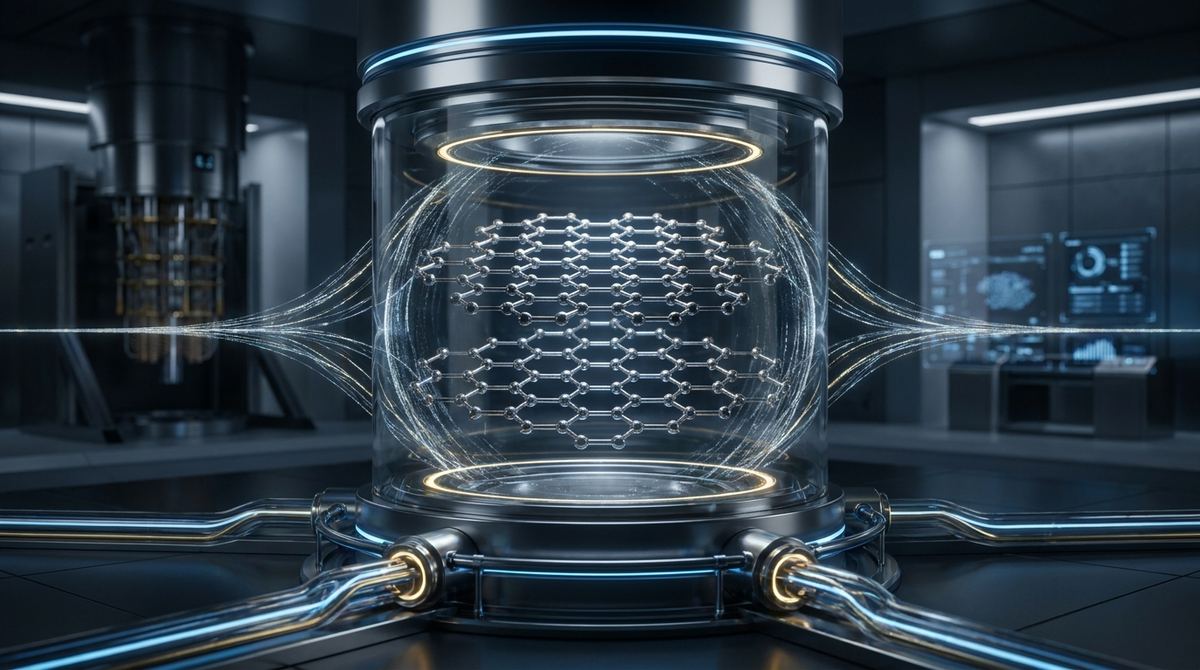
Quantum couplers are mesoscopic devices designed to transfer quasiparticles between propagating modes while controlling internal degrees of freedom such as pseudospin, valley, layer, or real spin. In Dirac materials, where low-energy carriers obey a linear dispersion and are described by spinor wavefunctions, couplers can exploit symmetry and chiral transport to achieve nearly reflectionless propagation together with programmable state conversion. The central challenge is to engineer a local perturbation that changes the polarization content of the transmitted state without introducing strong backscattering. This requirement is particularly natural in systems exhibiting Klein tunneling, where Dirac quasiparticles can transmit perfectly through certain barriers at special incidence conditions.
Graphene and related two-dimensional Dirac materials provide an ideal platform for such functionality. Their low-energy excitations are governed by effective Hamiltonians that encode sublattice pseudospin and, in multilayer structures, additional layer degrees of freedom. By tailoring stacking order, edge termination, and localized interlayer coupling, one can realize devices that act as quantum couplers: they connect input and output channels while reshaping the internal spinor composition. In this article we develop a symmetry-guided framework for such couplers and focus on an explicit implementation based on AA-stacked bilayer graphene nanoribbons with armchair edges and a localized interlayer interaction.
The AA-bilayer geometry is especially attractive because the two layers are directly aligned, producing two Dirac cones shifted in energy by the interlayer hopping. This structure supports rich interference between layer-symmetric and layer-antisymmetric components. When a local interlayer perturbation is introduced in a finite region, the device can selectively rotate the layer polarization of transmitted quasiparticles. Importantly, for suitable symmetry conditions, transmission remains perfect in the desired channels, enabling coherent conversion rather than dissipative scattering. We analyze the theoretical conditions for perfect transmission and show how external fields can be used to tune the coupler response.
The low-energy physics of graphene near the K and K' valleys is described by a massless Dirac Hamiltonian. In a monolayer, the pseudospin corresponds to the A/B sublattice degree of freedom, and the eigenstates are chiral spinors whose orientation is locked to momentum. This chirality underlies Klein tunneling: an electrostatic barrier cannot fully confine normally incident Dirac fermions because the pseudospin structure forbids backscattering under certain symmetry conditions.
In multilayers, additional internal labels appear. For AA-stacked bilayer graphene, the two layers are aligned so that each sublattice site in one layer lies directly above the corresponding site in the other. At low energy the bilayer Hamiltonian can be written as a direct sum of two monolayer-like Dirac sectors shifted by the interlayer hopping amplitude. The layer degree of freedom becomes a natural polarization variable. Symmetric and antisymmetric combinations of layer amplitudes diagonalize the interlayer coupling in the absence of spatial inhomogeneity.
Symmetry plays a decisive role in transport. Time-reversal symmetry relates valleys, while sublattice and layer symmetries constrain allowed scattering channels. If a localized perturbation preserves certain mirror or exchange symmetries, the scattering matrix decomposes into independent blocks labeled by the corresponding parity or polarization quantum numbers. A symmetry-guided coupler therefore aims to engineer a perturbation that couples only specific sectors, ensuring that incident quasiparticles are not reflected into forbidden channels. In practical terms, the device should preserve the phase coherence and chirality of the propagating Dirac states while rotating their layer composition.
We consider an AA-stacked bilayer graphene nanoribbon with armchair edges. The ribbon geometry quantizes transverse momentum and can open a finite-size gap depending on width and boundary conditions. Armchair termination is particularly useful because it mixes valleys and yields a well-defined set of transverse subbands. The transport direction is along the ribbon axis, and the coupler region is defined by a finite segment where an interlayer interaction is applied locally.
A minimal continuum model near the Dirac points can be expressed in a basis combining sublattice and layer degrees of freedom. The Hamiltonian is
H = v_F (tau_0 ⊗ sigma_x p_x + tau_0 ⊗ sigma_y p_y) + gamma tau_x ⊗ sigma_0 + U(x) tau_0 ⊗ sigma_0 + V(x) tau_z ⊗ sigma_0,
where v_F is the Fermi velocity, sigma_i act on the sublattice pseudospin, tau_i act on the layer pseudospin, gamma is the intrinsic AA interlayer hopping, U(x) is an electrostatic potential, and V(x) represents a layer-asymmetric bias. The localized coupler interaction can be modeled by a position-dependent interlayer term delta_gamma(x) tau_x, confined to a finite interval. In the simplest case, the coupler region has gamma -> gamma + delta_gamma, while the leads retain the bare AA coupling.
In the ribbon geometry, the wavefunction must satisfy armchair boundary conditions at the edges, which quantize the transverse wavevector ky into discrete values. This quantization converts the two-dimensional Dirac problem into a set of one-dimensional channels indexed by subband number. The propagating modes in the leads can be classified by their layer polarization, and the coupler acts as a mode converter between these channels. Because the model is linear in momentum, matching wavefunctions at interfaces yields analytic transmission amplitudes for each subband.
Perfect transmission through a localized perturbation requires that the incoming and outgoing states be matched by conserved quantum numbers and that the perturbation not induce destructive pseudospin mismatch. In Dirac systems, normal incidence often provides a protected channel because the pseudospin aligns with the transport direction, suppressing backscattering. In the AA-bilayer case, the situation is richer because each propagating mode carries a layer polarization determined by the superposition of symmetric and antisymmetric layer states.
For a finite coupler region, perfect transmission occurs when the transfer matrix across the active region maps an incoming eigenstate onto an outgoing eigenstate with the same longitudinal momentum magnitude and compatible polarization. This happens when the accumulated phase differences between the coupled sectors satisfy resonance conditions. In practice, these conditions depend on the coupler length L, the local interlayer coupling delta_gamma, the Fermi energy E, and any applied electrostatic or bias fields.
A useful way to express the transmission problem is to diagonalize the layer sector into bonding and antibonding combinations. In the leads, the eigenenergies are shifted by ±gamma, producing two Dirac cones. Inside the coupler, the shift becomes ±(gamma + delta_gamma). If the incident energy lies in a propagating window for both sectors, then the coupler can exchange amplitude between them. Perfect transmission into a chosen polarization channel requires that the phase accumulated by the two eigencomponents leads to constructive interference at the exit. This is analogous to a Mach-Zehnder interferometer, but realized in a compact Dirac nanoribbon with symmetry-protected mode matching.
The key point is that the coupler need not perturb the propagation strongly in the sense of reflection. Instead, it acts as a unitary polarization transformer. Reflection is minimized when the interface preserves the relevant chirality and when the potential profile is smooth enough to avoid intervalley scattering. In the armchair ribbon, valley mixing is intrinsic to the boundary, but the discrete subband structure allows one to work in a reduced set of channels where the dominant effect is interlayer conversion rather than backscattering.
The layer degree of freedom in AA bilayer graphene can be treated as a two-level system. An incoming quasiparticle prepared in a definite layer polarization can be represented by a spinor on the Bloch sphere. The localized interlayer coupling then acts as an effective rotation axis, generating a unitary transformation on the layer pseudospin. The coupler therefore performs a controlled SU(2) rotation, provided that reflection is negligible.
The rotation angle is determined by the integrated coupling strength and the dwell time of the quasiparticle in the active region. For a coupler of length L, the relevant phase is approximately proportional to delta_gamma L / (hbar v_x), where v_x is the longitudinal group velocity. By tuning L or delta_gamma, one can realize partial or complete conversion between layer-symmetric and layer-antisymmetric states. In the ideal case, a state entering in one polarization exits in the orthogonal polarization with unit probability, while the total transmission remains unity.
This picture is especially transparent when the electrostatic profile is uniform within the coupler and the interfaces are abrupt but symmetry compatible. The transfer matrix then factorizes into propagation and mixing parts. If the mixing angle equals pi/2 modulo pi, the device acts as a full converter. For intermediate angles, it functions as a tunable beam splitter for layer polarization. Because the process is coherent, the relative phase between output channels is also controllable, enabling more general quantum-state engineering.
The behavior of the device depends strongly on the coupler width, meaning the transverse ribbon width and the longitudinal extent of the active region. Narrow couplers support only a small number of transverse channels and therefore exhibit strong mode quantization. In this regime, resonance conditions are sharp and transmission can oscillate strongly with energy. The advantage is high selectivity: only a few channels participate, and the polarization transformation can be nearly ideal if the incident energy is tuned to a propagating subband. However, narrow couplers are more sensitive to edge effects and to small deviations in the potential profile.
Wide couplers contain many transverse modes and approach a quasi-continuum. The effective response becomes smoother, and the transmission resonances broaden. In this regime, the coupler can operate over a larger energy window, making it more robust to disorder and fabrication imperfections. Yet the coexistence of many channels can dilute the polarization selectivity unless the incident beam is collimated near normal incidence or filtered by energy. The symmetry-guided design principle remains crucial: by preserving the relevant exchange and chirality symmetries, one can suppress unwanted mode mixing even in a multimode ribbon.
Comparing the two regimes reveals an important tradeoff. Narrow couplers provide precise polarization control but require fine tuning. Wide couplers offer robustness and broader bandwidth but may need additional external control to maintain high-fidelity conversion. In both cases, perfect transmission through the desired channel is achievable when the resonance condition aligns the phase evolution of the coupled layer sectors.
External fields provide a versatile means to tune the coupler response. A gate voltage can shift the local electrostatic potential U(x), changing the longitudinal wavevector and therefore the phase accumulated in the active region. A layer bias V(x) breaks layer symmetry and modifies the effective pseudospin axis, allowing the output polarization to be steered away from the symmetric/antisymmetric basis. Because the AA bilayer has two shifted Dirac cones, even modest gating can move the Fermi level between different transmission windows.
Magnetic fields can also be used, though in nanoribbons their primary role is to adjust phase and subband alignment rather than to induce Landau quantization. By introducing a vector potential, one can alter the matching conditions at the interfaces and shift the resonance peaks. More generally, local strain or proximity-induced interactions can be incorporated into the same framework as symmetry-breaking perturbations that modify the effective Dirac Hamiltonian. The design strategy is to use fields not to block transport, but to select the internal channel through which transport occurs.
This tunability is central to the concept of a quantum coupler. The device is not merely a barrier or waveguide; it is a coherent transformer whose action can be programmed in situ. In the AA-bilayer implementation, the interlayer coupling itself can be gated indirectly by electrostatic control of interlayer spacing, substrate interaction, or local dielectric environment, offering additional flexibility. The result is a platform where polarization conversion, resonance position, and transmission phase can all be controlled electrically.
A compact theoretical description uses the scattering matrix S relating incoming and outgoing amplitudes in the lead channels. For a two-polarization problem, S can be decomposed into reflection and transmission blocks. Perfect coupler operation corresponds to vanishing reflection and a transmission block equal to a unitary rotation in polarization space. Symmetry imposes constraints on S: if the coupler preserves a layer-parity symmetry, then the scattering matrix is block diagonal in the corresponding basis. If the perturbation is engineered to couple only the two desired channels, then leakage into orthogonal channels is suppressed.
From this viewpoint, the design principles are clear. First, choose a Dirac material with a controllable internal pseudospin, such as AA bilayer graphene. Second, use boundary conditions that discretize the transverse spectrum without destroying the relevant symmetry, here armchair edges. Third, introduce a localized perturbation that acts primarily in the internal space, here an interlayer coupling region. Fourth, tune the length and strength of the perturbation to satisfy phase-matching conditions for perfect transmission. Finally, use external fields to compensate for residual mismatch and to select the output polarization.
These principles extend beyond graphene. They apply to any Dirac material where internal degrees of freedom can be coherently rotated by local symmetry-preserving perturbations. The AA-bilayer coupler is therefore a representative example of a broader class of symmetry-guided quantum devices.
Symmetry-guided design offers a powerful route to quantum couplers in Dirac materials. The essential idea is to exploit chiral transport and internal pseudospin structure so that a localized perturbation can transform the polarization of transmitted quasiparticles without inducing significant reflection. In AA-stacked bilayer graphene nanoribbons with armchair edges, a localized interlayer interaction provides a concrete realization of this concept. The bilayer’s layer pseudospin serves as the polarization variable, and the coupler region acts as a coherent rotation element.
Perfect transmission, or Klein-tunneling-like behavior, arises when the transfer matrix across the active region matches the incident and outgoing spinor structure. This condition depends on the coupler length, interlayer coupling, energy, and external fields. Narrow couplers exhibit sharp resonances and high selectivity, while wide couplers offer broader and more robust operation. In both cases, the transmission of polarized states can be finely tuned by gates and biases, enabling programmable quantum-state conversion.
The AA-bilayer graphene coupler thus provides a compelling platform for coherent control in Dirac materials. It combines the protection of symmetry with the flexibility of electrostatic tuning, opening a route toward nanoscale devices that manipulate quasiparticle polarization while preserving ballistic transport. Such couplers may become important building blocks for valleytronic, pseudospintronic, and layer-based quantum technologies.
Serious about B2B integration? Test our premium Pulsed Electrical Resistive Carbon Heating turbostratic graphene in your lab. 100g sample packs available now.
Explore More
Discover how rippled graphene pores act as fluidic memristors, enabling advanced synaptic functionalities for the next generation of neuromorphic computing.

Learn how to use electromechanical responses in gapped graphene to measure electronic temperature and band gaps using traveling flexural waves.

Explore how researchers have discovered viscous electron fluid behavior in cadmium, a breakthrough that could revolutionize the future of nanoelectronics.