
Rippled Graphene Pores for Neuromorphic Fluidic Memristive Devices
Discover how rippled graphene pores act as fluidic memristors, enabling advanced synaptic functionalities for the next generation of neuromorphic computing.
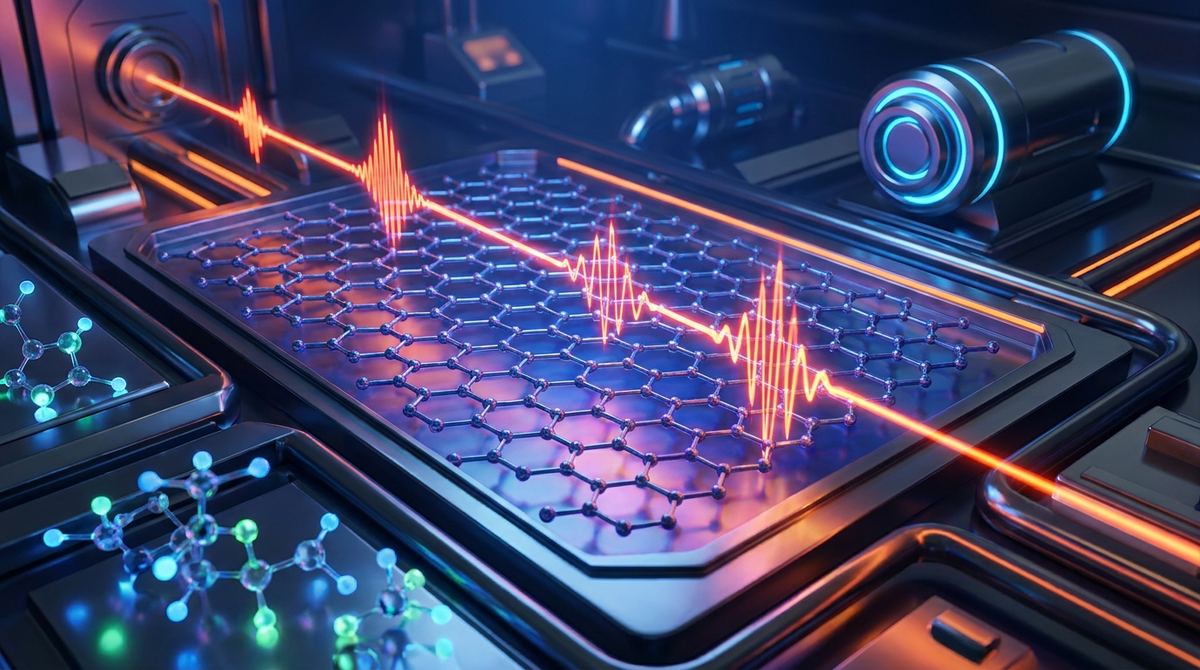
Graphene has emerged as a uniquely powerful platform for nonlinear optoelectronics because its massless Dirac fermions, ultrahigh carrier mobility, and gapless band structure enable strong field-driven responses at frequencies extending into the terahertz (THz) regime. Among all known materials, graphene exhibits exceptionally large nonlinear optical coefficients at THz frequencies, often exceeding those of conventional semiconductors, metals, and nonlinear crystals by orders of magnitude. This extraordinary behavior is particularly important for the development of compact, room-temperature sources and processors for ultrahigh-frequency electronic and photonic systems.
A central challenge in practical THz technology is the efficient conversion of low-frequency electronic signals into higher-frequency radiation. In conventional materials, nonlinear conversion efficiency is typically limited by weak coupling between the incident field and the charge carriers, carrier heating losses, or the need for cryogenic conditions and strong optical pumping. Graphene offers a different paradigm. Its electrons respond directly and strongly to electric fields, and because the material is atomically thin, it can be integrated with electronic circuits and resonant structures without severe parasitic loading. These properties make graphene especially attractive for frequency multiplication, harmonic generation, mixing, and ultrafast signal processing.
What makes graphene even more compelling is that its nonlinear response is not fixed. It can be tuned electrically through gating, allowing the carrier density and chemical potential to be adjusted in situ. This tunability provides a route to optimize nonlinear conversion efficiency for a given input field strength and frequency. In particular, experiments have shown that gating voltages of only a few volts can dramatically enhance THz third-harmonic generation, increasing power conversion efficiency by nearly two orders of magnitude under optimal conditions. Such control transforms graphene from a nearly linear conductor into a strongly nonlinear THz medium whose response can be engineered by external bias.
This article discusses the physical origin of graphene’s THz nonlinearity, the mechanisms by which electrical gating controls it, and the thermodynamic framework used to model its ultrafast response. The focus is on third-harmonic generation under both single-cycle and multi-cycle THz excitation, because these cases illustrate how graphene behaves under impulsive and quasi-continuous driving. The results are not only of fundamental interest but also provide practical guidance for designing graphene-based frequency multipliers and THz signal-processing devices.
The exceptional nonlinearity of graphene stems from its band structure. Near the Dirac points, the dispersion relation is linear, meaning that the carrier velocity is nearly independent of energy and is set by the Fermi velocity rather than an effective mass. Under an applied electric field, carriers in graphene are accelerated in momentum space in a highly nonparabolic environment. This leads to a strongly nonlinear current-field relation even at moderate field strengths.
In a conventional semiconductor with parabolic bands, the current response can often be expanded perturbatively, and nonlinearities are relatively weak unless the field is very large. By contrast, graphene’s linear dispersion and symmetric electron-hole structure produce a pronounced anharmonic response at much lower fields. The current does not simply scale linearly with the applied electric field; instead, the electronic distribution is distorted, heated, and periodically driven in a way that produces higher harmonics of the input frequency.
At THz frequencies, this response is especially strong because the driving period is comparable to the carrier scattering and energy relaxation times. The field can therefore reshape the carrier distribution before equilibrium is restored. This nonequilibrium dynamics is essential to understanding harmonic generation in graphene. The third harmonic, in particular, arises from the cubic component of the nonlinear current and serves as a sensitive probe of the material’s nonlinear susceptibility.
Another reason for graphene’s strong THz nonlinearity is its ultrathin geometry. Because all carriers are confined to a single atomic layer, the induced current density is effectively a sheet current. This enhances the interaction with incident fields and simplifies device integration with antennas, waveguides, and resonant cavities. The strong confinement of the electromagnetic field near the graphene layer can further increase the effective nonlinear interaction.
Electrical gating changes the carrier density in graphene, thereby shifting the chemical potential and modifying the occupation of electronic states near the Dirac point. This directly affects the strength of nonlinear THz processes. By tuning the gate voltage, one can move graphene from a regime of low carrier density, where the response may be limited by strong absorption and rapid heating, to a regime where the carrier population is optimized for harmonic generation.
The key point is that the nonlinear response depends not only on the intrinsic band structure but also on the thermodynamic state of the electron system. Gating alters the balance between absorption, carrier heating, and energy relaxation. Since the THz field drives the electrons out of equilibrium, the efficiency of harmonic generation depends on how readily the electronic temperature rises and how the distribution evolves during the pulse.
At low gate voltages near charge neutrality, graphene may absorb strongly but can also exhibit relatively inefficient harmonic conversion because the carrier population is small and the electronic system can become highly disordered under strong driving. As the carrier density increases, the conductivity and nonlinear current can increase, but only up to an optimum point. Beyond this point, additional doping can reduce the field-induced modulation of the carrier distribution and weaken the nonlinear response. Hence, the dependence of THz nonlinearity on gate voltage is nonmonotonic.
This nonmonotonicity is crucial experimentally. It means that a modest gate bias can dramatically improve conversion efficiency without requiring structural modification or high optical power. In practice, a few volts applied across a suitable gate dielectric can be enough to shift graphene into its optimal nonlinear operating regime. This makes electrical control a highly attractive strategy for active THz devices.
Third-harmonic generation is one of the clearest manifestations of graphene’s nonlinear THz response. When graphene is driven by an oscillating electric field at frequency f, the nonlinear current contains components at 3f, 5f, and higher odd harmonics. The third harmonic is typically the strongest and easiest to measure. Its intensity depends sensitively on the amplitude, frequency, pulse duration, carrier density, and relaxation dynamics.
For single-cycle THz pulses, the field is broadband and transient. In this regime, graphene responds to a rapidly varying waveform rather than a steady sinusoid. The nonlinear current is generated during the short pulse duration, and the emitted third-harmonic signal reflects the instantaneous distortion of the carrier distribution. Because the pulse is brief, electron heating and cooling occur on comparable timescales, making the response strongly time dependent.
For multi-cycle quasi-monochromatic excitation, the field is more periodic, and the nonlinear response can build up over several cycles. This allows a clearer separation between the fundamental and harmonic components and often makes it easier to compare with theoretical models. In both cases, the third-harmonic signal is a direct signature of the cubic nonlinearity in graphene’s current-voltage relation.
Experiments have shown that the third-harmonic power can be tuned by changing the gate voltage. At the optimum bias, the efficiency can increase by approximately two orders of magnitude relative to the ungated or poorly tuned case. This dramatic enhancement demonstrates that the nonlinear response is not a fixed material constant but a controllable property of the graphene electronic system.
The observed gating dependence of graphene’s THz nonlinearity is well described by a physical model based on the time-dependent thermodynamic balance of the electronic population. In this picture, the THz field injects energy into the electron system through Joule heating and field-driven redistribution in momentum space. The electrons then exchange energy among themselves and with the lattice, tending toward a quasi-equilibrium state characterized by an elevated electronic temperature and a time-dependent chemical potential.
The model treats the electron gas as a nonequilibrium thermodynamic system that is driven by the external field and relaxed by scattering processes. Carrier-carrier scattering is typically fast enough to establish a hot Fermi-Dirac distribution on ultrafast timescales, while energy transfer to phonons occurs more slowly. This separation of timescales allows the electronic subsystem to be described by an effective temperature that evolves during the pulse.
The nonlinear current is then calculated from the instantaneous distribution function and the field-dependent conductivity. As the electronic temperature rises, the conductivity and the occupation of states near the Fermi level change, altering the magnitude and phase of the current. This produces harmonic generation and other nonlinear effects. Importantly, the model captures the fact that gating changes the equilibrium chemical potential and therefore changes how strongly the THz field perturbs the electron population.
The quantitative agreement between experiment and model indicates that the essential physics is thermodynamic rather than purely phenomenological. The response is governed by a balance between field-induced heating, carrier redistribution, and relaxation to the lattice. This framework provides predictive power for device design, because it links the gate voltage, field amplitude, and pulse shape to the expected nonlinear output.
The distinction between single-cycle and multi-cycle THz excitation is important because the temporal structure of the driving field strongly influences the nonlinear response. Single-cycle pulses have broad spectral content and high peak field strengths. They are ideal for probing ultrafast dynamics and transient nonlinearities. However, their short duration means that the carrier system may not reach a steady periodic state, making the response more dependent on the detailed time evolution of the electronic temperature.
Multi-cycle pulses, by contrast, are narrower in bandwidth and more nearly sinusoidal. They allow the nonlinear response to be analyzed in terms of harmonics of a well-defined fundamental frequency. This is particularly useful for frequency multiplication applications. In gated graphene, the third-harmonic output under multi-cycle excitation can be optimized by tuning the carrier density so that the nonlinear current is maximized while dissipative losses remain manageable.
The fact that gating control works in both regimes underscores the robustness of the mechanism. Whether the input is a broadband single-cycle pulse or a quasi-monochromatic waveform, the same underlying thermodynamic and band-structure effects govern the response. This is encouraging for applications because it means graphene-based nonlinear devices can be designed for a wide range of THz signal formats.
The ability to electrically tune graphene’s THz nonlinearity has direct implications for ultrahigh-frequency electronics. One of the long-standing goals in this field is to bridge the gap between conventional electronic signal generation and the THz domain. Graphene offers a route to compact frequency multipliers that operate at room temperature and under ambient conditions, without the need for bulky nonlinear crystals or cryogenic infrastructure.
A gated graphene layer could serve as the active element in a THz harmonic generator, frequency doubler, or mixer. Because the nonlinear response can be adjusted by a gate electrode, the same device could be reconfigured dynamically for different operating frequencies or input powers. This is particularly valuable for adaptive communication systems, spectroscopy, and sensing applications where tunability is essential.
The strong conversion efficiency also suggests the possibility of integrating graphene with antennas, plasmonic resonators, and waveguides to enhance field confinement and impedance matching. Such hybrid structures could further increase the effective nonlinear interaction and reduce the required drive power. Since the gating voltages are small, the control circuitry can remain simple and energy efficient.
In practical terms, electrically tunable graphene nonlinearity could enable on-chip THz processors that perform signal multiplication, modulation, and waveform shaping at speeds inaccessible to conventional silicon electronics. The room-temperature operation and compatibility with standard fabrication methods make this especially attractive for scalable technology.
Despite its promise, several challenges remain before graphene-based THz nonlinear devices become widespread. Achieving reproducible and uniform gating over large areas requires high-quality dielectric interfaces and careful control of disorder. Contact resistance, substrate effects, and environmental contamination can all influence the carrier density and relaxation dynamics. Since the nonlinear response depends sensitively on the electronic state, device variability can be significant.
Thermal management is another important issue. Although graphene can sustain high current densities, repeated strong-field excitation may lead to local heating, especially in integrated devices with limited heat dissipation. Understanding the interplay between electronic heating, phonon emission, and substrate coupling is therefore essential for reliable operation.
From a modeling perspective, more detailed treatments may be needed for extreme field strengths, ultrashort pulses, or strongly coupled plasmonic environments. Nevertheless, the thermodynamic balance model already captures the main features of the observed gating dependence and provides a solid foundation for design. Future work will likely combine this framework with electromagnetic simulations and circuit-level models to optimize complete devices.
The broader outlook is highly promising. Because graphene’s nonlinearity can be tuned electrically with small voltages, it offers a rare combination of strength, speed, and controllability. This makes it an exceptional candidate for active THz components, especially where compactness and room-temperature operation are required. The fact that the nonlinear response can be enhanced by nearly two orders of magnitude through gating is particularly significant, as it demonstrates that the material can be switched between weak and strong nonlinear regimes on demand.
Graphene stands out as one of the most nonlinear optoelectronic materials known, especially in the THz range where its nonlinear coefficients greatly exceed those of conventional media. Its nonlinearity arises from the linear Dirac dispersion, ultrafast carrier dynamics, and strong field-driven redistribution of the electronic population. Crucially, this response is electrically tunable: by applying modest gate voltages, one can control the carrier density and chemical potential, thereby optimizing the THz nonlinear output.
Experiments on third-harmonic generation show that gating can enhance power conversion efficiency by about two orders of magnitude, effectively transforming graphene from an almost linear electronic material into a highly efficient THz nonlinear medium. This control works for both single-cycle and multi-cycle excitation and is quantitatively explained by a thermodynamic model of the time-dependent electronic population under ultrafast driving.
These findings establish graphene as a practical platform for ultrahigh-frequency electronic technology. By combining strong intrinsic nonlinearity with electrical tunability, graphene enables efficient THz frequency conversion, signal processing, and adaptive device operation at room temperature. The result is a powerful new avenue toward compact, reconfigurable, and scalable THz systems based on a single atomic layer of carbon.
Serious about B2B integration? Test our premium Pulsed Electrical Resistive Carbon Heating turbostratic graphene in your lab. 100g sample packs available now.
Explore More
Discover how rippled graphene pores act as fluidic memristors, enabling advanced synaptic functionalities for the next generation of neuromorphic computing.

Learn how to use electromechanical responses in gapped graphene to measure electronic temperature and band gaps using traveling flexural waves.

Explore how researchers have discovered viscous electron fluid behavior in cadmium, a breakthrough that could revolutionize the future of nanoelectronics.