
Nature's Nanotech: Graphene and Blue Emission Found in Bee Hives
Researchers discover naturally formed graphene sheets and carbon ovals in stingless bee hives, creating a novel emergent material with powerful blue light...
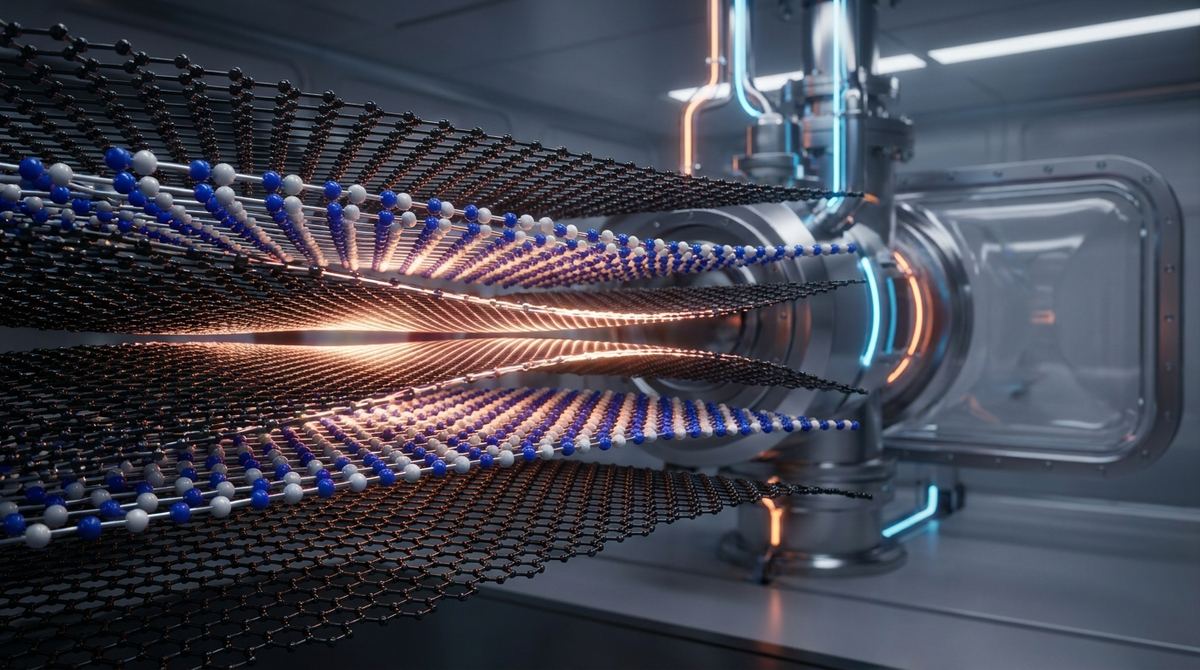
Interfacial thermal transport in layered two-dimensional (2D) materials is a central problem for nanoscale heat management. As device dimensions shrink and power densities rise, the ability of heat to cross atomically thin interfaces increasingly determines the thermal budget of heterostructures, transistors, sensors, and optoelectronic platforms. Among the most studied 2D materials, graphene and hexagonal boron nitride (h-BN) occupy a special position. Graphene offers exceptional in-plane thermal conductivity and mechanical strength, while h-BN is an electrically insulating, chemically stable, wide-bandgap material that is often used as a substrate, encapsulant, or dielectric. Their combination in van der Waals heterostructures has enabled a wide range of device architectures, but it has also raised a fundamental question: how do mechanical deformations such as strain and twist alter heat flow across their interfaces?
The answer is not universal. In layered systems, vertical heat transfer is governed by weak interlayer forces, phonon spectrum overlap, stacking registry, and the availability of out-of-plane vibrational modes. These factors can respond very differently to in-plane strain and relative rotation. Recent atomistic simulations reveal a striking contrast between homogeneous and heterogeneous interfaces. At graphene/graphene and h-BN/h-BN interfaces, both strain and twist strongly suppress vertical thermal conductance. In contrast, the graphene/h-BN heterointerface is largely insensitive to twist, but its thermal conductance changes markedly under biaxial or uniaxial strain: compression enhances heat transfer, whereas tension reduces it.
This behavior is surprising because twist is often expected to disrupt registry and reduce interfacial coupling in any layered material. The predictions indicate instead that the response depends critically on whether the two interfacing crystals are identical or dissimilar. The key microscopic ingredients are the vertical phonon modes that carry heat across the interface and the local stacking configurations that modulate interlayer force constants. Fermi’s golden rule provides a natural framework for understanding how phonon transmission depends on the density of states and coupling matrix elements, while a phenomenological model based on interlayer spacing and stacking reproduces the observed trends with minimal complexity.
In van der Waals solids, the interfacial thermal boundary conductance, often denoted G, quantifies the heat flux per unit temperature drop across an interface. Unlike bulk thermal conductivity, G is dominated by vibrational transmission across weakly bonded layers. In graphene and h-BN, in-plane phonons carry most of the heat within each sheet, but cross-plane transport depends on out-of-plane acoustic and low-frequency optical modes. Because the interlayer bonding is weak, small changes in geometry can produce disproportionately large changes in thermal conductance.
For homo-interfaces, the two layers are crystallographically identical. This creates strong phonon mode matching when the layers are aligned, especially for low-frequency flexural and shear-related vibrations. However, any perturbation that disturbs registry or changes the overlap of phonon states can reduce transmission. Both strain and twist can alter the phonon dispersion and the interlayer force landscape, decreasing the number of efficiently transmitting modes.
For hetero-interfaces such as graphene/h-BN, the situation is more subtle. Graphene and h-BN have similar lattice constants but different atomic masses and force constants, leading to partially mismatched phonon spectra. This mismatch can reduce the sensitivity of transmission to twist, because the dominant limitation is not registry alone but the intrinsic spectral overlap between the two materials. Strain, on the other hand, directly modifies the interlayer spacing and the phonon frequencies, thereby changing the coupling strength and the density of available interfacial states.
The predicted trends arise from atomistic calculations that combine molecular dynamics or lattice-dynamical methods with direct evaluation of heat flux across interfaces. In such simulations, two atomically thin layers are stacked with a chosen relative twist angle and subjected to controlled in-plane strain. The interlayer thermal conductance is then extracted from either nonequilibrium steady-state temperature gradients or equilibrium fluctuation correlations.
The essential outcome is robust across computational approaches: homogeneous interfaces show a monotonic reduction of G as strain increases in magnitude or as twist angle departs from commensurate alignment. Heterogeneous graphene/h-BN interfaces, however, display a nearly flat dependence on twist over a broad angular range, while strain produces a clear asymmetry between compression and tension. Compressive strain increases G, and tensile strain decreases it.
This difference cannot be explained solely by geometric registry. Instead, the simulations indicate that the vertical component of phonon motion and the local stacking-dependent interlayer potential govern the transport. Because the interfacial force constants are short-ranged and sensitive to atomic separation, even modest changes in the mean interlayer distance can alter the transmission probability of low-frequency modes. In a heterointerface, the absence of identical periodicity and the reduced coherence of interlayer vibrational modes make twist less influential than strain.
A useful theoretical description of interfacial heat transport is provided by Fermi’s golden rule. In this context, the rate of phonon transmission from one layer to the other is proportional to the square of the interlayer coupling matrix element and to the joint density of initial and final phonon states. Symbolically, the conductance can be understood as an integral over frequency of the product of the mode-resolved transmission, the phonon density of states, and the thermal occupation derivative.
This framework clarifies why homogeneous and heterogeneous interfaces behave differently. For a homo-interface, twist breaks the perfect momentum matching between the two layers. Since the phonon dispersions are identical, aligned structures can support coherent interlayer coupling between matching modes. Rotation disrupts this matching and reduces the overlap of states contributing to transmission. Strain additionally shifts phonon frequencies and modifies the interlayer force constants, further lowering the transmission.
For graphene/h-BN, the phonon spectra are already distinct. The transmission is therefore limited more by intrinsic spectral overlap than by exact lattice alignment. As a result, twist introduces only a weak additional penalty. The dominant effect comes from strain-induced changes in the local interlayer distance and the associated modulation of coupling matrix elements. Compression strengthens the interlayer interaction, increasing the probability of phonon transfer, whereas tension weakens it.
The golden-rule viewpoint also highlights the special role of vertical phonons. Only modes with significant out-of-plane displacement can couple efficiently across the van der Waals gap. In-plane modes contribute indirectly through anharmonicity or mode mixing, but their direct interfacial transmission is weaker. Thus, the interfacial conductance is particularly sensitive to any perturbation that modifies the population, frequency, or coupling of flexural and out-of-plane acoustic branches.
The density of phonon modes provides a complementary explanation. Interfacial thermal transport requires that phonons in one layer find compatible states in the other. The greater the overlap between the vibrational densities of states, the larger the interfacial conductance.
In graphene/graphene and h-BN/h-BN interfaces, the vibrational spectra are nearly identical when the layers are aligned. This maximizes overlap and permits efficient phonon transfer. Twist reduces the effective overlap by altering the selection rules and reducing coherent coupling between equivalent modes. Strain shifts the dispersion relations, especially at low frequencies, and thereby degrades the spectral matching that supports heat flow.
In graphene/h-BN heterostructures, the two materials exhibit different atomic masses and slightly different force constants. This already broadens the spectral matching problem. Because the overlap is determined mainly by the low-frequency portions of the phonon spectrum, twist-induced changes in registry do not strongly modify the available phase space for transmission. Strain has a larger effect because it can move the low-frequency branches into or out of better overlap and change the population of vertically polarized modes.
This mode-overlap perspective explains the observed asymmetry between compression and tension. Compression tends to stiffen the interlayer potential and enhance the frequencies of coupled vertical modes, increasing the number of transmitting channels. Tension increases the layer separation and softens the coupling, reducing the overlap and suppressing heat flow. The effect is stronger in heterointerfaces because the baseline coupling is already weaker and more sensitive to distance.
A simple phenomenological model can reproduce the simulated dependence of interfacial thermal conductance on strain and twist. The model assumes that G is primarily controlled by two local variables: the interlayer distance d and the stacking configuration s. Both variables affect the interlayer force constants and therefore the phonon transmission probability.
At the simplest level, one may write G as a function that decays with increasing d and varies periodically or quasi-periodically with stacking registry. In a homogeneous interface, twist changes the spatial distribution of local stackings and can average the system over less favorable configurations, reducing the net conductance. Strain modifies d directly and also changes the equilibrium stacking landscape through Poisson effects and in-plane lattice distortion.
For a heterointerface, the local stacking dependence is less pronounced because the two lattices are not equivalent. The conductance becomes dominated by the average interlayer spacing and the distribution of local atomic environments. Twist therefore has little effect on the spatially averaged coupling, while strain shifts the entire distribution of interlayer distances and produces a substantial change in G.
This model has practical value because it reduces a complex atomistic problem to a small number of physically transparent parameters. It suggests that interfacial thermal conductance can be engineered by controlling average spacing, local commensurability, and the fraction of favorable stacking motifs. It also provides a route to predicting thermal behavior in large-area moiré structures where direct atomistic simulation may be computationally expensive.
The dramatic difference between homo- and hetero-interfaces stems from symmetry and spectral matching. In a homo-interface, the two layers support identical phonon branches. Heat transfer can therefore occur through resonant coupling between matching modes. Such coupling is highly sensitive to registry, relative rotation, and strain-induced shifts in the dispersion. Any perturbation that destroys commensurability reduces the number of resonant channels and suppresses G.
In a graphene/h-BN heterointerface, symmetry is already broken by the chemical and mass contrast between carbon and the boron-nitrogen sublattice. This reduces the importance of exact twist alignment because the interfacial transmission is not governed by perfect mode matching in the first place. Instead, the relevant physics is controlled by the availability of low-frequency cross-plane modes and the strength of the van der Waals coupling. Strain affects these quantities strongly through changes in distance and local force constants, whereas twist only weakly perturbs them.
This distinction is important for applications. It means that thermal transport in homo-interfaces can be tuned by rotational alignment, but heterointerfaces require strain engineering to achieve meaningful modulation. Such selectivity is advantageous for designing thermal switches, heat spreaders, and interface-specific thermal barriers.
The ability to tune interfacial thermal conductance through strain and twist opens several technological opportunities. In all-graphene stacks, twist can be used to suppress heat flow without changing chemical composition, offering a purely geometric route to thermal isolation. In graphene/h-BN stacks, strain offers a more effective control knob, enabling reversible enhancement or suppression of heat transfer depending on whether compressive or tensile deformation is applied.
These effects are especially relevant in flexible electronics and nanoelectromechanical systems, where mechanical deformation is unavoidable or can be deliberately applied. A strain-sensitive graphene/h-BN interface could serve as a mechanically controlled thermal valve. Conversely, a twist-insensitive heterointerface may provide stable thermal performance even under rotational misalignment, which is useful for heterogeneous integration where perfect alignment is difficult to maintain.
The results also matter for interpreting thermal measurements in 2D materials. Experimental conductance values can vary widely due to sample preparation, residual strain, wrinkles, and twist heterogeneity. The present picture implies that in heterostructures, strain history may be a more important determinant of interfacial heat flow than twist angle. This should guide both device design and thermal metrology.
The study of strain and twist engineering in graphene and h-BN interfaces reveals that interfacial heat transport is governed by a delicate interplay between phonon spectra, vertical vibrational modes, and local stacking geometry. Homogeneous interfaces respond strongly to both strain and twist because their thermal conductance depends on precise mode matching and registry. Heterogeneous graphene/h-BN interfaces behave differently: twist has little effect, while strain can significantly enhance or suppress heat flow by changing interlayer distance and coupling strength.
The physical interpretation offered by Fermi’s golden rule and phonon density-of-states analysis provides a unified understanding of these trends. The key message is that vertical phonons are the primary carriers of interfacial heat, and their transmission is controlled by how mechanical perturbations reshape the local interlayer landscape. A simple phenomenological model based on stacking and spacing captures these dependencies and may be generalized to other van der Waals heterostructures.
More broadly, these findings show that interfacial thermal transport in 2D materials is not a passive property but an engineerable degree of freedom. By selecting material pairs and applying strain or twist, one can tailor heat flow at the atomic scale. This opens a path toward programmable thermal interfaces in next-generation nanoelectronics, phononic devices, and multifunctional layered materials.
Strain and twist provide distinct and powerful routes to control vertical thermal conductance in graphene and h-BN interfaces. In homo-interfaces, both perturbations reduce conductance by disrupting coherent phonon matching and registry-dependent coupling. In graphene/h-BN heterointerfaces, twist is largely ineffective, but compression and tension strongly increase and decrease conductance, respectively, through their impact on interlayer spacing and vertical phonon transmission. The combination of atomistic simulations, Fermi’s golden rule, and phonon density-of-states analysis reveals that local stacking and out-of-plane vibrational modes are the central determinants of interfacial heat flow. A compact phenomenological model based on these ingredients successfully reproduces the observed behavior and offers a practical framework for designing thermal interfaces in 2D van der Waals materials.
Serious about B2B integration? Test our premium Pulsed Electrical Resistive Carbon Heating turbostratic graphene in your lab. 100g sample packs available now.
Explore More
Researchers discover naturally formed graphene sheets and carbon ovals in stingless bee hives, creating a novel emergent material with powerful blue light...

Discover how rippled graphene pores act as fluidic memristors, enabling advanced synaptic functionalities for the next generation of neuromorphic computing.

Learn how to use electromechanical responses in gapped graphene to measure electronic temperature and band gaps using traveling flexural waves.