
Nature's Nanotech: Graphene and Blue Emission Found in Bee Hives
Researchers discover naturally formed graphene sheets and carbon ovals in stingless bee hives, creating a novel emergent material with powerful blue light...
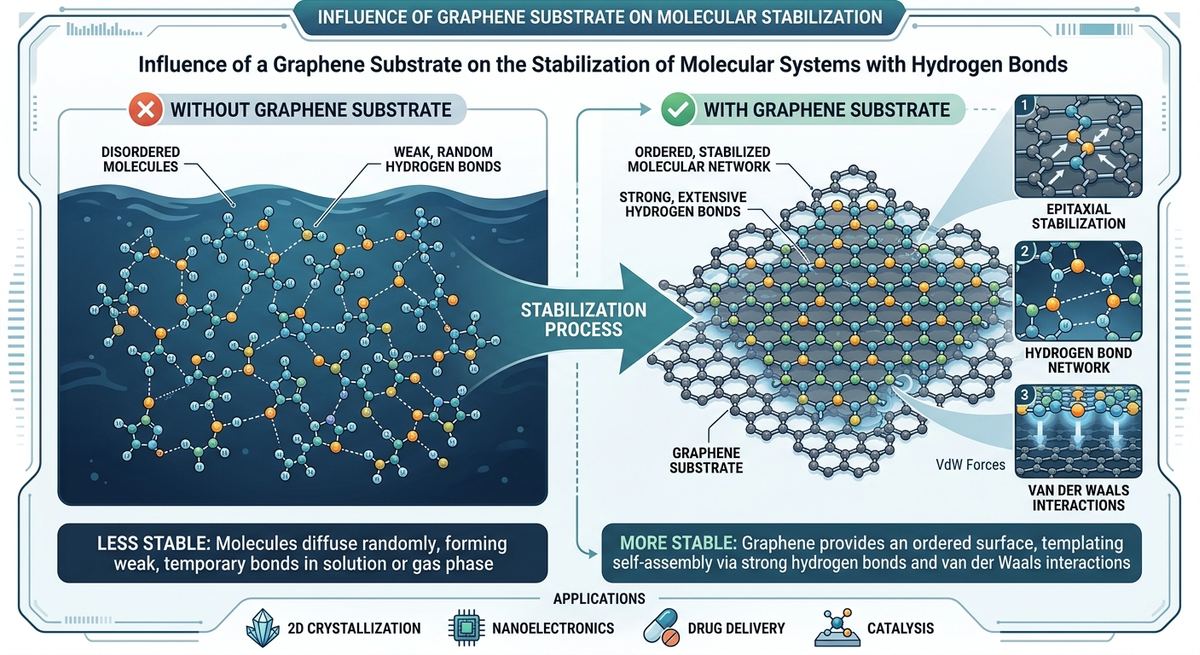
Graphene has emerged as a mechanically robust, thermally conductive, and chemically versatile substrate capable of modifying the stability of adsorbed molecular assemblies. This article discusses the influence of graphene on the stabilization of hydrogen-bonded molecular systems through the example of numerical simulations of planar two- and three-layer structures composed of β-sheets of polyglycine peptide chains and systems of parallel Kevlar (para-aramid) molecules adsorbed on a graphene sheet. The simulations show that graphene substantially enhances structural integrity by constraining out-of-plane fluctuations and supporting the organization of intermolecular hydrogen-bond networks. In β-sheet assemblies, the characteristic geometry is preserved up to approximately 800 K, indicating a strong resistance to thermal disruption. The Kevlar system demonstrates even higher stability, with parallel chains of hydrogen bonds between peptide groups persisting at still higher temperatures. These results support the conclusion that graphene can serve as an effective stabilizing platform for hydrogen-bonded molecular architectures and suggest a route toward improving the thermal durability of Kevlar-based composites.
Hydrogen bonding is one of the primary interactions responsible for the structure and stability of biological macromolecules and many synthetic polymers. In peptides and proteins, hydrogen bonds determine secondary structure motifs such as α-helices and β-sheets. In aromatic polyamides, including Kevlar, hydrogen bonding between amide groups contributes to the exceptional tensile strength and thermal resistance of the material. However, despite the intrinsic strength of hydrogen-bonded networks, thermal fluctuations can disrupt local order, especially in low-dimensional or surface-supported systems.
Graphene offers a unique environment for studying and controlling such molecular assemblies. As a single atomic layer of sp2-bonded carbon, graphene combines high in-plane stiffness with a smooth, chemically inert surface and strong van der Waals interaction with adsorbates. These properties make it a promising substrate for stabilizing ordered molecular layers. In addition, graphene can act as a heat spreader, redistributing thermal energy and reducing local overheating that may trigger bond rearrangements or structural collapse.
The present discussion focuses on numerical simulations of molecular systems placed on graphene: planar two- and three-layer β-sheets formed by polyglycine chains, and parallel Kevlar molecules arranged on a graphene sheet. The central question is how the graphene substrate affects the dynamics of hydrogen-bonded structures under thermal excitation. The results reveal that graphene significantly improves structural stability, maintaining β-sheet architecture up to high temperatures and preserving even more robust hydrogen-bond networks in Kevlar assemblies. These findings are relevant both to fundamental molecular physics and to the design of advanced composite materials.
Two classes of hydrogen-bonded systems were investigated. The first consists of planar two- and three-layer β-sheet structures constructed from polyglycine peptide chains. Polyglycine is a useful model system because its simplicity removes complications associated with bulky side chains while preserving the essential peptide backbone chemistry responsible for β-sheet formation. In such sheets, neighboring chains are linked by nearly linear hydrogen bonds between carbonyl oxygen and amide hydrogen atoms. The two-layer and three-layer configurations allow one to examine how interlayer coupling and dimensionality affect stability when the assembly is supported by graphene.
The second system consists of parallel Kevlar molecules, also placed on a graphene sheet. Kevlar, or poly(p-phenylene terephthalamide), is a para-aramid polymer known for its high crystallinity, strong intermolecular interactions, and exceptional thermal and mechanical performance. Its chains are rigid and highly extended, and adjacent molecules can form parallel hydrogen-bond chains between amide groups. Because Kevlar is already a highly stable material, it provides a stringent test of whether graphene can further increase the thermal resilience of hydrogen-bonded arrangements.
In both systems, the molecules are arranged in ordered planar geometries. This is important because hydrogen-bonded order in such assemblies depends not only on bond energies but also on collective geometric constraints. A substrate that suppresses large-amplitude distortions may therefore stabilize the entire network even if it does not directly strengthen each hydrogen bond individually.
The reported results are based on numerical simulation of molecular dynamics, a method that tracks the time evolution of all atoms under the influence of interatomic forces. In such simulations, intramolecular covalent bonds, bond angles, torsions, hydrogen bonds, and nonbonded interactions are represented by an interaction potential or force field. The graphene substrate is modeled as a rigid or flexible carbon lattice, depending on the level of approximation, and the adsorbed molecular system evolves on its surface under thermal conditions.
Temperature is introduced through an appropriate thermostat or by initializing atomic velocities according to a thermal distribution. By running trajectories at increasing temperatures, one can identify the onset of structural instability, bond rearrangement, or loss of long-range order. Key observables include the persistence of hydrogen bonds, the preservation of molecular alignment, fluctuations in interchain spacing, and the degree of out-of-plane deformation.
The central advantage of molecular dynamics for this problem is that it captures cooperative effects. Hydrogen bonds do not act independently; rather, their stability depends on the collective arrangement of neighboring chains and on the mechanical coupling to the substrate. Graphene can influence both aspects simultaneously. It provides a flat support that limits bending and twisting of molecular layers, and it also affects the balance of interactions through adsorption energy and surface-induced confinement.
Several mechanisms explain why graphene enhances the stability of hydrogen-bonded molecular systems.
First, graphene imposes geometric confinement. Molecules adsorbed on a flat, atomically uniform surface are less free to undergo out-of-plane motions than in bulk or in a suspended state. This suppression of transverse fluctuations is particularly important for β-sheets, which rely on precise alignment of backbone donors and acceptors. Even modest distortions can weaken hydrogen bonds by changing bond angles and distances. By reducing such distortions, graphene helps maintain the native geometry.
Second, graphene contributes via dispersive interactions. Although graphene is chemically inert, its π-electron system interacts with adsorbed molecules through van der Waals forces and, in some cases, weak π-related stacking effects. These interactions create an adsorption potential that favors close contact between the molecular layer and the substrate. The result is an energetic penalty for detachment or strong corrugation of the adsorbed structure.
Third, graphene acts as a thermal buffer. Its high thermal conductivity allows it to spread energy rapidly across the surface, reducing local hot spots where bond breaking might begin. In a hydrogen-bonded network, thermal disruption is often initiated locally and then propagates. Efficient heat redistribution therefore delays the onset of structural failure.
Fourth, the substrate may enhance cooperative ordering. In ordered planar systems, the presence of a rigid support can promote parallel alignment of chains and reduce configurational entropy. This effect is especially relevant for Kevlar, where parallel chain packing and hydrogen-bond chain formation are central to material performance. Graphene can help maintain registry between neighboring molecules, indirectly reinforcing the hydrogen-bond network.
The simulations show that planar β-sheet structures of polyglycine retain their overall shape on graphene up to temperatures of approximately 800 K. This is a remarkably high temperature for a hydrogen-bonded molecular assembly and indicates strong substrate-assisted stabilization.
In the two-layer β-sheet system, the hydrogen bonds between neighboring chains remain ordered over a broad temperature range. As temperature rises, fluctuations increase, but the chains remain aligned and the sheet does not undergo catastrophic unfolding. The graphene substrate suppresses large-amplitude bending and prevents the sheet from losing planarity. Because β-sheets depend on extended backbone conformations and regular interchain hydrogen bonding, the maintenance of planar geometry is essential to stability.
The three-layer structure shows similar behavior, though the additional layer introduces more complex interlayer interactions. The presence of multiple hydrogen-bonded planes increases the number of constraints and can improve resistance to thermal disorder. At the same time, the internal layers may experience reduced direct contact with graphene, making the stabilizing effect more dependent on the integrity of the entire stack. The simulations indicate that this multilayer arrangement still preserves the β-sheet architecture up to about 800 K, demonstrating that graphene support is sufficient to sustain the ordered state even in a thicker assembly.
The importance of this result lies in the fact that β-sheet stability is not determined solely by hydrogen bond energies. Thermal disruption often involves collective distortions, solvent effects in real systems, and loss of registry between chains. The graphene substrate minimizes these destabilizing pathways. Thus, the observed thermal resilience is a consequence of both the intrinsic hydrogen-bond network and the extrinsic stabilizing influence of the surface.
The Kevlar system exhibits even greater stability than the polyglycine β-sheets. The simulations show that parallel chains of hydrogen bonds between peptide groups of neighboring Kevlar molecules remain preserved at temperatures higher than those at which the β-sheet systems still retain shape. This behavior is consistent with the known rigidity and thermal robustness of Kevlar, but it also demonstrates that graphene can further reinforce an already strong molecular architecture.
Kevlar chains are highly extended and possess a stiff aromatic backbone. Their alignment on graphene is favorable because the flat substrate supports parallel packing and reduces torsional freedom. The amide groups form interchain hydrogen bonds in a regular pattern, creating chain-to-chain cohesion that is difficult to disrupt once established. When adsorbed on graphene, the molecules are constrained to remain close to the surface, which helps preserve the registry of hydrogen-bond donors and acceptors.
A key difference from the polyglycine case is that Kevlar’s backbone rigidity reduces susceptibility to thermal bending. As a result, the hydrogen-bond network is less sensitive to moderate fluctuations. Graphene then acts as an additional stabilizing factor, not by changing the chemistry of the hydrogen bonds, but by maintaining the planar alignment necessary for their persistence. The simulations therefore suggest that graphene-supported Kevlar assemblies can withstand substantially elevated temperatures without losing their ordered hydrogen-bond chains.
The results have direct implications for the design of graphene-based composites. Kevlar is widely used in applications requiring high mechanical strength and thermal resistance, but its performance can still be limited by interfacial degradation, microstructural disorder, and thermal softening under extreme conditions. Incorporating graphene into Kevlar fibers or laminates may improve thermal stability by stabilizing the molecular arrangement at the interface and within the fiber microstructure.
The conclusion that graphene can significantly increase the thermal stability of Kevlar fibers is especially important for high-performance materials used in aerospace, protective equipment, and electrical insulation. Graphene may serve not only as a reinforcement phase but also as a molecular scaffold that preserves chain alignment and hydrogen-bond connectivity during heating. This could delay the onset of structural relaxation, reduce creep, and improve resistance to thermal aging.
For peptide-based or bioinspired materials, the findings are equally significant. β-sheet assemblies are common in natural and synthetic fibrous systems, including amyloid-like structures and peptide nanofibers. Graphene could be used to stabilize such structures in nanoelectronic, sensing, or biomaterial applications where thermal robustness is required. The ability to preserve ordered hydrogen-bond networks at high temperature may enable new hybrid architectures with controlled mechanical and functional properties.
From a physical standpoint, these simulations demonstrate a general principle: a two-dimensional substrate can stabilize a hydrogen-bonded molecular system by reducing entropy-driven structural fluctuations. Hydrogen bonds are directional and moderately strong, but their effectiveness depends on precise molecular geometry. A substrate that enforces planarity and provides a uniform adsorption landscape can therefore amplify the apparent stability of the network.
This effect is not limited to one specific chemistry. The same reasoning applies to other ordered molecular layers, supramolecular assemblies, and polymer films in which hydrogen bonding is central. Graphene’s role is analogous to that of a mechanical template and thermal sink. It does not replace hydrogen bonding; rather, it helps the hydrogen-bond network realize its full stabilizing potential by preventing geometric degradation.
The simulations also highlight the importance of collective behavior. A single hydrogen bond may break and reform transiently without destroying the structure, but once enough bonds are lost, the entire assembly can collapse. Graphene shifts this balance by reducing the frequency and amplitude of disruptive motions. As a result, the threshold temperature for structural failure is increased.
Numerical simulation of planar hydrogen-bonded molecular structures on graphene shows that the substrate has a pronounced stabilizing effect. Two- and three-layer β-sheets of polyglycine preserve their geometry up to about 800 K, demonstrating that graphene can maintain ordered peptide secondary structure under strong thermal excitation. Parallel Kevlar molecules exhibit even higher stability, with hydrogen-bond chains between neighboring molecules remaining intact at still higher temperatures. These findings indicate that graphene enhances the thermal robustness of hydrogen-bonded assemblies primarily by suppressing out-of-plane fluctuations, supporting chain alignment, and redistributing thermal energy.
The practical implication is clear: graphene can significantly improve the thermal stability of Kevlar fibers and related polymer composites. More broadly, graphene is a powerful substrate for stabilizing molecular systems in which hydrogen bonds govern structure and function. The combination of atomically flat geometry, mechanical strength, and high thermal conductivity makes graphene an exceptional platform for engineering robust nanoscale and mesoscale materials.
It should be noted that numerical simulations provide a controlled representation of molecular behavior, and real materials may also be influenced by defects, surface roughness, chemical functionalization, environmental moisture, and long-term aging. Nevertheless, the simulated trends are physically compelling and align with the expectation that graphene can act as a stabilizing support for ordered hydrogen-bonded systems. Future work may extend these studies to more realistic composite geometries, multilayer graphene supports, and experimentally relevant loading conditions. Such efforts will further clarify how graphene can be integrated into high-temperature molecular and polymeric materials to achieve improved performance.
Serious about B2B integration? Test our premium Pulsed Electrical Resistive Carbon Heating turbostratic graphene in your lab. 100g sample packs available now.
Explore More
Researchers discover naturally formed graphene sheets and carbon ovals in stingless bee hives, creating a novel emergent material with powerful blue light...

Discover how rippled graphene pores act as fluidic memristors, enabling advanced synaptic functionalities for the next generation of neuromorphic computing.

Learn how to use electromechanical responses in gapped graphene to measure electronic temperature and band gaps using traveling flexural waves.