
Understanding Electron Hydrodynamics in Cadmium
Explore how researchers have discovered viscous electron fluid behavior in cadmium, a breakthrough that could revolutionize the future of nanoelectronics.
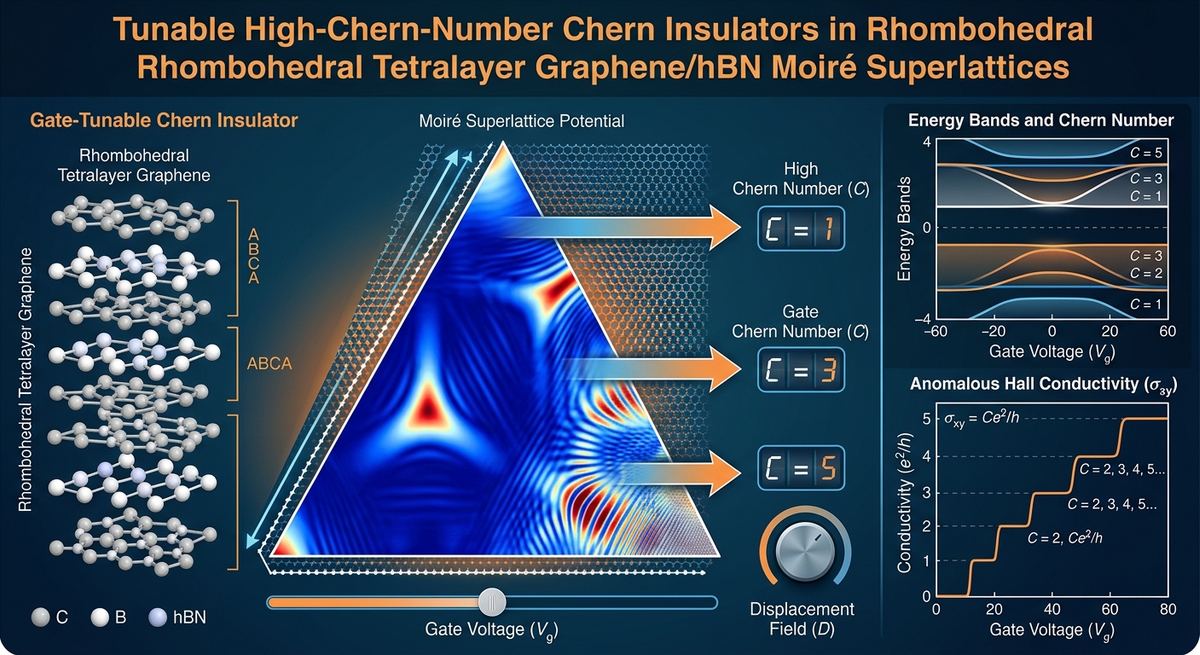
Moiré superlattices formed by aligning rhombohedral tetralayer graphene (RTG) with hexagonal boron nitride (hBN) provide an unusually flexible platform for realizing interaction-driven topological phases. In these systems, the combination of a narrow-band moiré miniband structure, strong Coulomb interactions, valley-contrasting Berry curvature, and externally tunable displacement fields enables the stabilization of Chern insulating states with large and variable topological indices. Here we discuss the hole-doped side of RTG/hBN moiré superlattices across a range of twist angles and crystallographic alignments, emphasizing the emergence of multiple high-Chern-number Chern insulators. In addition to the previously reported integer Chern insulator with C = -4 at moiré filling factor v = -1, recent transport measurements reveal symmetry-broken Chern insulating states with C = +3 and C = ±2, ±1 near fractional fillings v = -2.5 and -2.6. These phases are observed in both hBN alignment configurations, but their stability depends sensitively on moiré wavelength, displacement electric field, and external magnetic field. The resulting phase diagram highlights an exceptionally rich topological landscape in hole-doped RTG/hBN, where topology is not fixed by a single band structure but is instead reshaped by interaction, symmetry breaking, and moiré engineering.
The discovery of moiré materials has transformed condensed matter physics by showing that small-angle lattice mismatch can generate flat or narrow electronic bands with enhanced interaction effects. In graphene-based moiré systems, the interplay between band topology and strong correlations has produced superconductivity, correlated insulators, orbital magnetism, and quantum anomalous Hall states. A particularly powerful route to large-topology phases is provided by rhombohedral multilayer graphene, whose low-energy electronic structure becomes progressively flatter with increasing layer number and is highly sensitive to electrostatic gating.
Rhombohedral tetralayer graphene is especially attractive because its low-energy bands inherit a large Berry curvature from the chiral multilayer stacking, while remaining highly tunable by displacement electric field. When RTG is aligned with hBN, the resulting moiré potential breaks inversion and modifies the valley-resolved band topology, enabling insulating phases with nonzero Chern number. Unlike ordinary band insulators, Chern insulators host quantized Hall conductance in zero or small magnetic field due to spontaneous or moiré-induced time-reversal symmetry breaking. In RTG/hBN, the topological character is further enriched by the multivalley and multiband nature of the system, which can support high-Chern-number states beyond the canonical C = ±1 quantum anomalous Hall phase.
The hole-doped regime is particularly fertile. Here, the valence-side minibands can become narrow and isolated over a broad range of displacement fields, and the interaction scale can exceed the single-particle bandwidth. As a result, the system may spontaneously break spin, valley, or lattice symmetries, thereby reconstructing the band topology and producing correlated Chern insulators at integer or fractional moiré fillings. The observation of C = -4 at v = -1 established RTG/hBN as a platform for unusually large Chern numbers. More recently, the emergence of C = +3 and lower-magnitude Chern states at v ≈ -2.5 to -2.6 has revealed that the topological hierarchy in this system is not limited to a single dominant phase.
The electronic structure of RTG near charge neutrality is governed by chiral hopping between the four graphene layers, leading to a low-energy dispersion that is much flatter than monolayer or bilayer graphene. In the presence of an interlayer displacement field, the layer polarization of the states changes substantially, opening gaps and reshaping the band edges. When RTG is placed on hBN with a small twist angle or near-commensurate alignment, the moiré potential imposes a long-wavelength periodic modulation that folds the Brillouin zone and hybridizes states near the valley-specific band extrema.
Several ingredients conspire to produce Chern insulating behavior. First, the hBN substrate breaks sublattice symmetry and induces a valley-dependent mass term. Second, the rhombohedral stacking gives rise to large Berry curvature hotspots near avoided crossings in momentum space. Third, the moiré potential can isolate minibands with nontrivial valley Chern numbers. Finally, electron-electron interactions can drive symmetry breaking, including spin polarization and valley polarization, which convert a partially filled narrow band into an integer-filled topological insulator.
The Chern number of an insulating phase is determined by the total Berry curvature of the occupied bands. In a multivalley system, the observed quantized Hall response can arise from the occupation of one valley over the other, or from more complex combinations of spin and valley order. In RTG/hBN, the large observed Chern numbers suggest that multiple minibands or multiple symmetry-related sectors participate in the topological reconstruction. This makes the system qualitatively different from single-band moiré insulators with only C = ±1.
The key experimental observable is the longitudinal and Hall resistance measured as a function of carrier density, displacement field, and perpendicular magnetic field. Moiré filling factor v counts the number of carriers per moiré unit cell relative to charge neutrality. Integer and fractional values of v correspond to commensurate fillings of the moiré minibands. Insulating phases appear as peaks in longitudinal resistance, while quantized Hall plateaus signal topological order characterized by an integer Chern number.
In RTG/hBN devices, the twist angle and alignment determine the moiré wavelength, which directly sets the moiré unit-cell area and therefore the characteristic carrier density scale. Devices with slightly different moiré wavelengths can exhibit markedly different phase diagrams even when fabricated from the same materials. This sensitivity is a hallmark of the competition between moiré band formation and interaction-driven reconstruction. The displacement electric field, applied via dual gates, tunes the layer asymmetry and can move the system between topological and trivial insulating regimes. Meanwhile, an external magnetic field can stabilize or reveal Chern phases by polarizing domains, suppressing competing orders, or providing a diagnostic of the underlying Berry curvature through Landau fan evolution.
The hallmark of a Chern insulator is a resistance state with a quantized anomalous Hall response at zero or low magnetic field. In practice, the Chern number is extracted from the Hall conductance plateau or inferred from the slope of Landau fans emanating from the insulating state under magnetic field. In the RTG/hBN system, the previously reported C = -4 phase at v = -1 provides a benchmark: it demonstrates that the occupied manifold carries a large integrated Berry curvature and that the topological state is robust enough to survive disorder and thermal fluctuations over a measurable range.
The most striking development in hole-doped RTG/hBN is the appearance of multiple high-Chern-number states at fractional moiré fillings near v = -2.5 and -2.6. These fillings lie away from the simplest integer commensurate points, suggesting that the insulating phases are not merely due to band filling but instead emerge from symmetry breaking within a partially occupied manifold. The observed Chern numbers include C = +3 and C = ±2, ±1, indicating a sequence of competing topological orders.
The existence of C = +3 is especially notable because it implies a large net Berry curvature with a sign opposite to that of the previously established C = -4 state at v = -1. Such a sign reversal points to a different valley or spin polarization pattern, or to a distinct reconstruction of the moiré minibands under displacement field. The presence of C = ±2 and C = ±1 nearby in filling suggests a hierarchy of states connected by changes in symmetry breaking, domain structure, or partial filling of topological subbands. Rather than a single isolated phase, the hole-doped side of RTG/hBN appears to host a cascade of Chern insulators with nearby filling factors and closely spaced energetic competition.
These fractional filling Chern insulators are symmetry broken in the sense that they arise not from a fully filled noninteracting miniband but from interaction-driven selection among nearly degenerate internal degrees of freedom. Possible broken symmetries include spin polarization, valley polarization, translation symmetry associated with charge order, or combinations thereof. The resulting insulating states can inherit different Chern numbers depending on which subset of flavor and valley degrees of freedom is occupied.
A central finding is that these Chern states are sensitive to the moiré wavelength. Devices with different twist angles or alignment orientations show different stability ranges for the same nominal filling factor. This dependence likely reflects the fact that the moiré wavelength controls several competing energy scales simultaneously: the miniband bandwidth, the strength of interband hybridization, the density of Berry curvature hot spots, and the ratio of interaction energy to kinetic energy.
For shorter moiré wavelengths, the moiré potential varies more rapidly and can strengthen band folding and hybridization, potentially favoring certain topological gaps. For longer wavelengths, the bands may become flatter and more interaction dominated, enhancing symmetry breaking but also increasing susceptibility to disorder or competing phases. The fact that the high-Chern-number states appear in both hBN alignment configurations indicates that exact crystallographic registry is not the sole determinant; instead, the overall moiré scale and electrostatic environment govern whether the system selects a particular topological order.
This wavelength dependence provides an important design principle. By adjusting twist angle and alignment, one can move between regimes where the same filling factor hosts either a robust Chern insulator, a weakly gapped correlated phase, or a metallic state. In other words, moiré engineering does not merely create a topological band structure; it controls the balance between band topology and interaction-driven reconstruction.
The displacement electric field is a key tuning knob in RTG/hBN because it changes the layer polarization and modifies the effective mass of the low-energy bands. In rhombohedral multilayers, the low-energy states are distributed unevenly across layers, so an out-of-plane field can strongly reshape the band topology. Experimentally, the Chern insulating states often occupy narrow windows of displacement field, indicating that the topological gap is optimized only when the band inversion and moiré hybridization are appropriately balanced.
External magnetic field plays a dual role. At small fields, it can help identify the Chern number through the evolution of Hall plateaus and insulating gaps. At larger fields, it may stabilize a particular valley polarization or align domains, sharpening quantization. In some cases, the field dependence of the insulating gap can distinguish between a purely interaction-induced Chern state and a state that already possesses a nontrivial single-particle Chern band. The sensitivity of the observed phases to magnetic field suggests that they are not simple rigid band insulators, but rather emergent states at the boundary between topology and correlation.
The combined control of displacement field and magnetic field allows one to map a multidimensional phase diagram. Within this phase diagram, the same filling factor can host different Chern numbers depending on the electrostatic environment. This tunability is one of the defining features of RTG/hBN and is not commonly found in more rigid topological materials.
The observed high-Chern-number phases can be understood as interaction-stabilized topological states in a multicomponent moiré miniband system. Theoretical descriptions typically begin with a continuum model for RTG coupled to a periodic hBN potential, then incorporate Coulomb interactions at mean-field or beyond-mean-field level. The resulting bands may carry valley Chern numbers that are redistributed when spin and valley symmetries are broken. A partially filled manifold can then spontaneously choose an occupation pattern that maximizes exchange energy while preserving or enhancing the net Chern number.
In this framework, C = -4 at v = -1 may correspond to a fully polarized occupation of a set of topological subbands whose combined Chern number is large and negative. The fractional-filling states near v = -2.5 and -2.6 may arise from additional symmetry breaking within a higher-lying miniband manifold, generating C = +3 or lower-magnitude Chern states. The coexistence of several nearby Chern numbers implies that the energy landscape is shallow, with small changes in displacement field or density selecting different minima. Such near-degeneracy is consistent with strong correlations and multiband topology.
An important implication is that the observed phases may not all be adiabatically connected to a single noninteracting band topology. Some may be interaction-generated topological insulators whose Chern number emerges only after spontaneous order sets in. Others may be descendants of preexisting valley Chern bands. Distinguishing these possibilities will require a combination of transport, spectroscopy, and microscopic theory.
The discovery of tunable high-Chern-number Chern insulators in hole-doped RTG/hBN moiré superlattices significantly expands the landscape of quantum anomalous Hall physics. The ability to realize C = -4, +3, ±2, and ±1 states in a single materials platform demonstrates that moiré systems can support a broad spectrum of topological orders, not just the simplest integer phases. Equally important, these states are controllable by twist angle, alignment, displacement field, and magnetic field, offering multiple experimental handles for engineering desired topological responses.
Future work will likely focus on several directions. First, direct imaging of domains and edge states could clarify whether the observed quantized transport arises from homogeneous bulk order or from percolating Chern domains. Second, spectroscopic measurements could resolve the miniband reconstruction and identify the symmetry-breaking channels responsible for each Chern number. Third, theoretical studies that include realistic screening, disorder, and lattice relaxation will be needed to explain why particular Chern states are favored at specific moiré wavelengths. Finally, extending these ideas to other rhombohedral multilayers or heterostructures may reveal even larger Chern numbers and new forms of fractional and non-Abelian topological order.
Rhombohedral tetralayer graphene aligned with hBN has emerged as a remarkably tunable setting for correlated topology. On the hole-doped side, the system hosts a sequence of high-Chern-number Chern insulators whose appearance depends sensitively on moiré wavelength and electrostatic control. The established C = -4 state at v = -1 and the newly discovered C = +3, ±2, and ±1 states near v = -2.5 to -2.6 demonstrate that the topological response of RTG/hBN is both rich and highly programmable. These results underscore a broader principle in moiré quantum matter: topology, when combined with strong correlations in a multiband platform, can be engineered into a wide family of emergent states whose Chern number is not fixed but tunable. RTG/hBN therefore represents an exceptional laboratory for studying and controlling high-Chern-number quantum phases.
Serious about B2B integration? Test our premium Pulsed Electrical Resistive Carbon Heating turbostratic graphene in your lab. 100g sample packs available now.
Explore More
Explore how researchers have discovered viscous electron fluid behavior in cadmium, a breakthrough that could revolutionize the future of nanoelectronics.

Discover how helical multilayer graphene creates supermoiré patterns that allow researchers to control electron valley topology for future nanoelectronics.

Learn how to engineer graphene single vacancies to drive water dissociation for advanced nanofluidic filtration and desalination applications.