
Nature's Nanotech: Graphene and Blue Emission Found in Bee Hives
Researchers discover naturally formed graphene sheets and carbon ovals in stingless bee hives, creating a novel emergent material with powerful blue light...
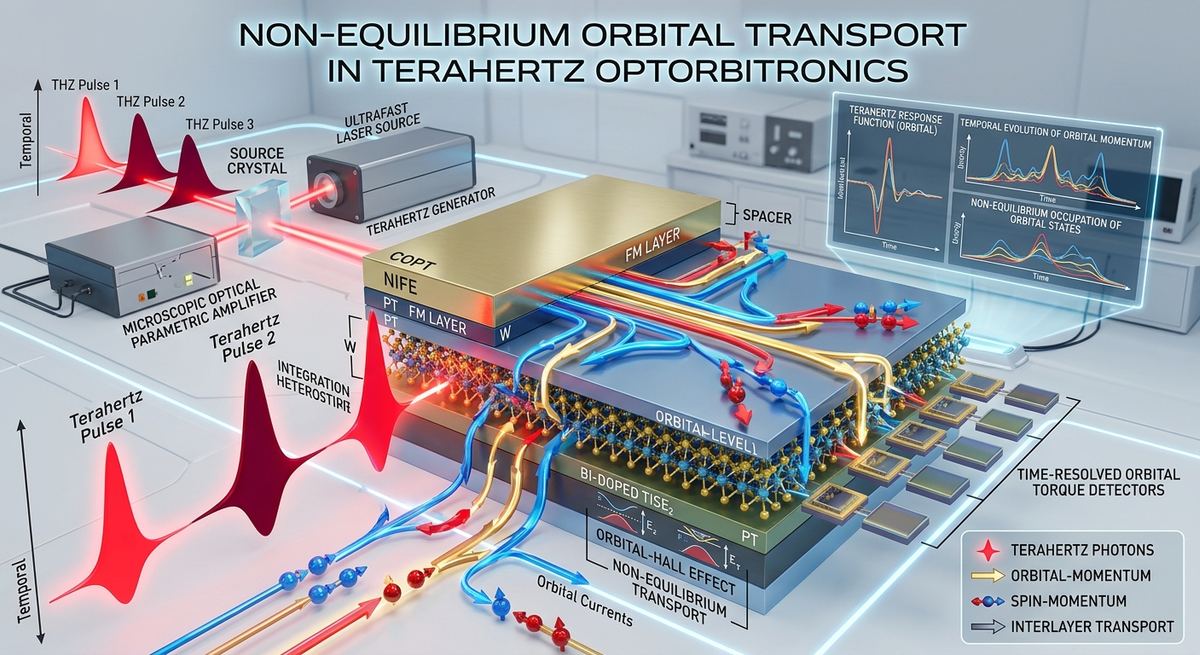
Modern electronics is built on the control of charge flow, while spintronics adds the electron spin as a second degree of freedom for storing and processing information. A third channel, the orbital motion of electrons around atomic centers, is now emerging as a distinct and potentially transformative carrier of information. Orbital angular momentum (OAM) is not merely a static atomic property; in solids it can be organized into orbital textures, carried by currents, and converted into measurable voltages. Because orbital degrees of freedom are often less tied to strong relativistic effects than spin, orbital-based devices may ultimately operate with lower power and fewer heavy-element requirements than conventional spintronic platforms.
The central challenge is that orbital transport is intrinsically non-equilibrium. Orbital polarization is not a conserved scalar in most solids, and its dynamics are shaped by crystal symmetry, band hybridization, scattering, and coupling to spin and lattice degrees of freedom. This makes orbital currents difficult to generate, detect, and interpret using steady-state electrical probes alone. Terahertz optorbitronics has therefore emerged as a powerful ultrafast approach. By combining femtosecond laser excitation with terahertz (THz) emission and detection, it can follow orbital currents on sub-picosecond timescales, when they are launched, propagate across interfaces, and convert into charge or electromagnetic radiation.
This review examines the physics of non-equilibrium orbital transport in the THz regime. We focus on how ultrafast optical excitation can create orbital currents, how these currents evolve in nanoscale films, why recent experiments have produced apparently contradictory propagation lengths, and how materials engineering can improve orbital generation and detection. The field is still young, but it already reveals orbital transport as a dynamic process rather than a static material property.
In atoms, OAM labels the circulation of electronic wavefunctions around the nucleus. In solids, the situation is more complex: crystal fields split orbital manifolds, hybridization mixes orbital character, and the Bloch states of a band structure can carry momentum-dependent orbital textures. Orbital transport therefore refers not to the literal motion of isolated atomic orbitals, but to the flow of orbital polarization or orbital angular momentum density through a material.
A useful distinction is between local orbital moments and orbital currents. Local orbital moments describe the imbalance in orbital occupation at a site or within a unit cell. Orbital currents describe the spatial transport of this orbital polarization. In analogy with spin currents, orbital currents can be pure, meaning they carry orbital angular momentum without net charge flow, or mixed, meaning they accompany charge motion. However, unlike spin, orbital angular momentum is strongly influenced by the lattice because orbitals are spatially anisotropic and directly coupled to crystal symmetry. As a result, orbital transport can be highly sensitive to interface termination, strain, and band topology.
Another important feature is the orbital-to-spin conversion channel. In many materials, particularly those with spin-orbit coupling, orbital polarization can be transferred into spin accumulation or vice versa. This makes the experimental separation of orbital and spin transport essential. Terahertz optorbitronics addresses this problem by exploiting ultrafast timescales, where distinct relaxation pathways can be temporally resolved.
The THz window spans frequencies from roughly 0.1 to 10 THz, corresponding to timescales of picoseconds to sub-picoseconds. Ultrafast optical pump pulses, typically tens of femtoseconds long, can impulsively excite electrons far from equilibrium. The excited carriers then relax through a hierarchy of processes: coherent wavepacket motion, intraband scattering, interband redistribution, orbital depolarization, spin-orbit conversion, and heat flow into the lattice. THz emission from the sample provides a direct probe of transient currents and polarization dynamics during this cascade.
This temporal resolution is crucial. Orbital currents can be launched and quenched before steady-state transport regimes are established. In that brief interval, the current may be governed by coherent band dynamics rather than diffusive motion. THz optorbitronics therefore probes the “birth” of orbital transport, not just its long-time fate. This is especially important in thin films and heterostructures, where interfaces can absorb, reflect, or convert orbital angular momentum on ultrafast timescales.
The THz approach also offers a practical advantage: the emitted radiation encodes the time derivative of the transient current. By measuring the waveform, one can infer the sign, duration, and spectral content of the underlying transport process. Combined with polarization-resolved pump-probe geometries, this allows researchers to identify whether the source is likely orbital, spin, or charge driven.
Ultrafast optical excitation can generate orbital currents through several mechanisms. In materials with orbital-selective band structure, circularly polarized light can preferentially excite carriers into states with finite orbital texture, creating an imbalance in orbital occupation. Even linearly polarized light can produce orbital polarization when the crystal symmetry allows anisotropic optical matrix elements. In both cases, the key is that the pump pulse drives the system into a non-equilibrium distribution that is not described by a thermal Fermi-Dirac function.
A second mechanism is the optical rectification of orbital textures in non-centrosymmetric materials. Here, the light field couples to the orbital character of Bloch states and induces a second-order response, producing a transient orbital current. This is closely related to nonlinear optical effects but is distinguished by its sensitivity to orbital rather than purely charge degrees of freedom.
A third route involves ultrafast demagnetization or interfacial transfer in magnetic heterostructures. In some systems, a laser pulse excites spin-polarized carriers that quickly convert into orbital polarization through spin-orbit coupling and band mixing. This conversion can occur on tens of femtoseconds, making it essential to use THz probes to distinguish the primary source from downstream relaxation channels.
Because these mechanisms depend on excitation geometry, photon energy, and crystal symmetry, terahertz optorbitronics is naturally a spectroscopy of orbital generation. It is not enough to ask whether a material supports orbital currents; one must ask under what non-equilibrium conditions those currents are launched and how they evolve.
Once generated, orbital currents must propagate through the material. Here the field faces one of its most fundamental unresolved questions: do orbital currents travel as coherent ballistic waves over tens of nanometres, or do they decay within a few atomic layers?
Evidence for long-range propagation comes from experiments in which THz signals are detected after orbital excitation in thin films or multilayers with thickness dependence suggesting transport over several nanometres to tens of nanometres. Such observations are consistent with a ballistic or quasi-ballistic picture, in which orbital polarization rides on coherent electronic wavepackets before strong scattering occurs. In this view, orbital currents can retain memory of the band structure and interface symmetry over relatively long distances.
However, other experiments indicate extremely short decay lengths, sometimes on the order of a few monolayers. This would imply that orbital angular momentum is rapidly quenched by local crystal fields, interfacial disorder, or strong coupling to phonons and spin degrees of freedom. In such a case, orbital transport would be highly localized and mainly useful as an interfacial phenomenon rather than a bulk carrier.
Why the contradiction? The answer likely lies in the fact that “orbital current” is not a uniquely conserved quantity in most materials. Different experiments may probe different components: propagating orbital polarization in the bulk, interfacial orbital accumulation, or orbital-to-charge conversion at a boundary. Additionally, the measured THz signal may integrate multiple processes, including charge motion, spin currents, and lattice-driven polarization. A short apparent decay length may therefore reflect rapid conversion rather than true disappearance of orbital angular momentum.
Theoretical models suggest that transport regimes depend on the hierarchy of timescales. If the orbital precession time is shorter than the momentum-scattering time, coherent propagation is possible. If scattering or orbital dephasing dominates, transport becomes diffusive and short-ranged. The experimental challenge is to identify which regime applies in a given material and geometry.
A major strength of THz optorbitronics is its ability to separate orbital effects from conventional spin transport. This is essential because spin and orbital dynamics are often entangled through spin-orbit coupling, especially in heavy-element systems. Several strategies are used.
First, symmetry analysis helps identify the allowed response channels. Orbital currents can be generated in geometries where spin-based mechanisms are symmetry-forbidden, or vice versa. By rotating the sample, changing the pump polarization, or reversing the magnetization, one can isolate response components with distinct transformation properties.
Second, temporal resolution distinguishes prompt electronic responses from slower spin-lattice relaxation. Orbital excitation often occurs on the earliest timescales after photoexcitation, before significant heating or spin diffusion develops. If the THz emission appears within the first few hundred femtoseconds, it may reflect coherent orbital dynamics rather than secondary spin transport.
Third, material selection is critical. Systems with weak spin-orbit coupling but strong orbital textures can suppress spin-based contamination. Conversely, comparing materials with identical charge transport but different orbital character can reveal orbital-specific contributions. This comparative method is especially useful in engineered graphene systems and in layered oxides or transition-metal compounds with active d orbitals.
Finally, detection schemes based on polarization, frequency, and phase can distinguish orbital-generated THz emission from other sources. Because orbital dynamics may have unique spectral fingerprints, broadband THz spectroscopy provides a richer diagnostic than dc transport measurements.
Several material classes are now being explored as sources and conduits of orbital currents. Engineered graphene is especially attractive because its low intrinsic spin-orbit coupling allows orbital effects to be studied without overwhelming relativistic mixing. By introducing sublattice asymmetry, twist, proximity coupling, or patterned strain, graphene can acquire orbital textures and valley-orbital responses that are tunable by design. Such systems offer a clean platform for exploring coherent orbital transport.
Transition-metal oxides and intermetallic compounds provide a different route. Their d-orbital manifolds are naturally active, and strong crystal-field effects can produce robust orbital polarization. In layered heterostructures, interfaces can enhance orbital reconstruction, creating localized orbital currents that are highly sensitive to termination and stacking order.
A particularly exciting development is the emergence of altermagnets. These are magnetic materials with alternating spin-split band structures but zero net magnetization. Their symmetry can support unconventional transport responses that are promising for orbital generation. Because their electronic structure combines magnetic order with nontrivial momentum-space anisotropy, altermagnets may act as efficient orbital current sources without the stray fields associated with ferromagnets.
Topological materials, moiré systems, and low-dimensional semiconductors are also promising. In each case, the band geometry can create strong orbital textures and nonlinear responses that are favorable for THz optorbitronic functionality.
To make orbital transport useful for devices, it must be controllable. Light is the most direct control knob. By tuning pump polarization, fluence, duration, and photon energy, one can selectively excite orbital channels and modulate the emitted THz response. Pulse shaping may eventually allow coherent steering of orbital wavepackets.
Electrical gating offers a slower but technologically important handle. By shifting the Fermi level, gating changes which bands are occupied and therefore alters orbital texture, scattering rates, and orbital-to-charge conversion efficiency. In two-dimensional materials, gating can even switch the dominant transport regime.
Strain is another powerful control parameter. Because orbital states are tied to lattice symmetry, mechanical deformation can reshape orbital hybridization and anisotropy. Tensile or compressive strain can enhance or suppress orbital currents, and strain gradients may generate orbital analogues of piezoelectric effects.
Interface engineering may be the most important route of all. Orbital currents are often created or detected at boundaries, where symmetry is broken and orbital reconstruction is strongest. By selecting materials with matched lattice constants, controlled roughness, or tailored interlayers, one can optimize the transfer of orbital angular momentum into measurable charge signals. In this sense, the interface is not a passive boundary but an active orbital converter.
Terahertz optorbitronics is still defining its basic rules. The field needs a clearer microscopic theory of orbital current, including how to define it in multiband systems, how to separate bulk from interfacial contributions, and how to quantify orbital relaxation in the presence of disorder and strong correlations. Equally important is the development of benchmark experiments that can compare different materials under identical conditions.
Several open questions stand out. What sets the true orbital coherence length in real solids? Under what conditions can orbital currents remain ballistic? How efficiently can orbital polarization be converted into electrical signals without parasitic spin effects? Can orbital transport be made robust at room temperature and integrated into nanoscale architectures? And can altermagnets, engineered graphene, or oxide heterostructures provide practical sources and detectors for orbital information processing?
Answering these questions will require a close partnership between ultrafast spectroscopy, first-principles theory, and materials synthesis. The prize is substantial: a new electronics paradigm in which information is carried not only by charge and spin, but by the orbital motion of electrons themselves.
Non-equilibrium orbital transport is emerging as a central problem in ultrafast condensed matter physics. Terahertz optorbitronics provides the experimental means to observe orbital dynamics in real time, revealing how femtosecond light pulses can launch orbital currents, how those currents propagate across nanostructures, and how they are converted into detectable signals. The striking disagreement between long-range ballistic transport and ultrashort decay underscores that orbital motion is not yet understood as a conventional transport variable. Instead, it appears to be a symmetry-sensitive, interface-dependent, and strongly non-equilibrium phenomenon.
By disentangling orbital dynamics from spin and charge, THz methods are uncovering a new layer of electronic behavior. Materials such as engineered graphene and altermagnets, together with control by gating, strain, and interface design, suggest that orbital currents may eventually be manipulated with precision. If so, terahertz optorbitronics could become the foundation for a new class of ultrafast, low-power devices that exploit the full internal structure of the electron. In that sense, the field is not merely extending spintronics; it is expanding the language of information transport itself.
Serious about B2B integration? Test our premium Pulsed Electrical Resistive Carbon Heating turbostratic graphene in your lab. 100g sample packs available now.
Explore More
Researchers discover naturally formed graphene sheets and carbon ovals in stingless bee hives, creating a novel emergent material with powerful blue light...

Discover how rippled graphene pores act as fluidic memristors, enabling advanced synaptic functionalities for the next generation of neuromorphic computing.

Learn how to use electromechanical responses in gapped graphene to measure electronic temperature and band gaps using traveling flexural waves.